Documenting Daily Care for VA Aid and Attendance Claims
A practical guide to care logs and supporting evidence

Illustration of a fictional veteran and caregiver.
Abstract
Caregivers offer daily help that often goes unrecognized in tests or brief independence descriptions. This article explains how to document this support for a veteran's SMC-L Aid and Attendance claim. Eight Board decisions illustrate how caregiver reports, medical findings, and completed forms were assessed. Some records had conflicts or required more details. A dated care log helps organize your observations. A clinician can clarify how service-connected disabilities create the need for assistance. A signed caregiver statement records the daily routine. There’s no set 14- or 30-day log period, and no log or case guarantees an award.
Highlights
Make the daily help visible. Record tasks, assistance given, and frequency. Note what the veteran can and cannot do alone.
Include reminders and supervision. Describe the prompting or protection needed, along with any physical help.
Connect the observations with the examination. Bring the log to the clinician filling out Form 21-2680. This lets the clinician assess your observations alongside the examination findings.
Show the real pattern over time. Include better days, worse days, and when needs began or changed. Don’t delay a claim or evidence deadline to finish the log.
The help a checklist can miss
You help your spouse into the shower. You button their clothes since they can't. You remind them they took their medication. At an appointment, they say, “I can take care of myself.” This response ignores your role in the day.
That gap appeared in a real Board of Veterans' Appeals decision. An examiner called a veteran independent in daily activities but noted he received extensive help from his significant other. The Board reviewed her detailed account, family testimony, and medical evidence, then granted Aid and Attendance. The key lesson is to describe the help that makes a task possible. Read decision 21009199.
This guide follows our SMC Aid and Attendance article with a practical way to document that help: keep dated observations, bring them to the examining clinician and explain your experience in a signed caregiver statement.
The focus is Special Monthly Compensation at the L level, or SMC-L, for a veteran who regularly needs another person's assistance because of service-connected disabilities. Pension Aid and Attendance and the VA's family-caregiver stipend program have different rules. SMC-L is a benefit for the veteran; it does not automatically pay the caregiver. See the RateMyVSO SMC-L guide for the broader benefit overview.
Describe what happens during personal care
The Aid and Attendance regulation looks at actual assistance and protection the veteran needs. The need can be regular without being constant. The veteran does not have to need help with every listed function or be bedridden. A relative can provide the care.
Use the tasks below to organize your observations. They are not a five-box eligibility score. The VA must assess the veteran’s overall condition and whether a service-connected disability drives the need.
Bathing and keeping clean. Describe how the veteran gets in and out of the shower. Include reaching, washing, drying, and any reminders needed. For example, “I hold her arm while she steps over the tub edge and wash the lower legs she cannot safely reach” is more informative than “needs help bathing.” Note what the veteran can do independently.
Dressing and undressing. Record assistance with buttons, zippers, socks, shoes, or choosing clothing. Explain any difficulties observed: fingers slipping, pain from bending, or needing prompts to finish. Distinguish help that is necessary from help that is just for convenience.
Eating and feeding oneself. Describe how the veteran holds utensils and brings food to the mouth. Include any needed help due to weakness or poor coordination. Preparing a meal is different from self-feeding. Record cooking help, but clarify the limitations instead of labeling all meal prep as inability to self-feed.
Adjusting a prosthetic or orthopedic appliance. Name the device, the adjustment needed, how often it occurs, and why the veteran cannot do it alone. The regulation has a specific limit: it excludes adjustments that anyone without that impairment would also need help with.
Toileting and continence care. Describe getting on and off the toilet, managing clothing, wiping, and cleaning after an accident or changing continence supplies. “Attending to the wants of nature” is the regulation's term. A diagnosis of incontinence does not explain what assistance is required.
Include reminders and protection from danger
A veteran may have the strength to perform a task and still need another person to prompt it or keep it safe. Describe the supervision as carefully as physical assistance.
For example, explain that you remained nearby during a shower because of observed losses of balance, or that you intervened after the veteran tried to take an already-taken dose. Record what happened, what you did and how often it happens. “Fall risk” or “memory problems” by itself leaves those questions unanswered.
In decision A26059478, the record included reminders about bathing, clothing, eating and medication, along with household safety concerns. A private psychologist explained the psychiatric limitations, and the Board granted A&A. The case shows why cueing and protection belong in the account. It does not mean every reminder qualifies.
For SMC-L, the medical evidence must establish the relevant connection to service-connected disability. Describe the behavior you observed; leave diagnosis and medical attribution to the clinician. Do not assume age, dementia or a history of falls automatically establishes that connection.
Keep a care log you can actually maintain
A notebook or a simple document is enough. Write an entry after a care task or near the end of the day while the details are fresh. Give each caregiver's name and relationship at the beginning, then use initials to identify individual entries.
Fourteen to thirty days is an optional starting point, useful for capturing a routine and its variations. It is not a VA requirement or a proven way to obtain a higher approval rate. Do not delay a claim or an evidence deadline while trying to complete a particular number of days.
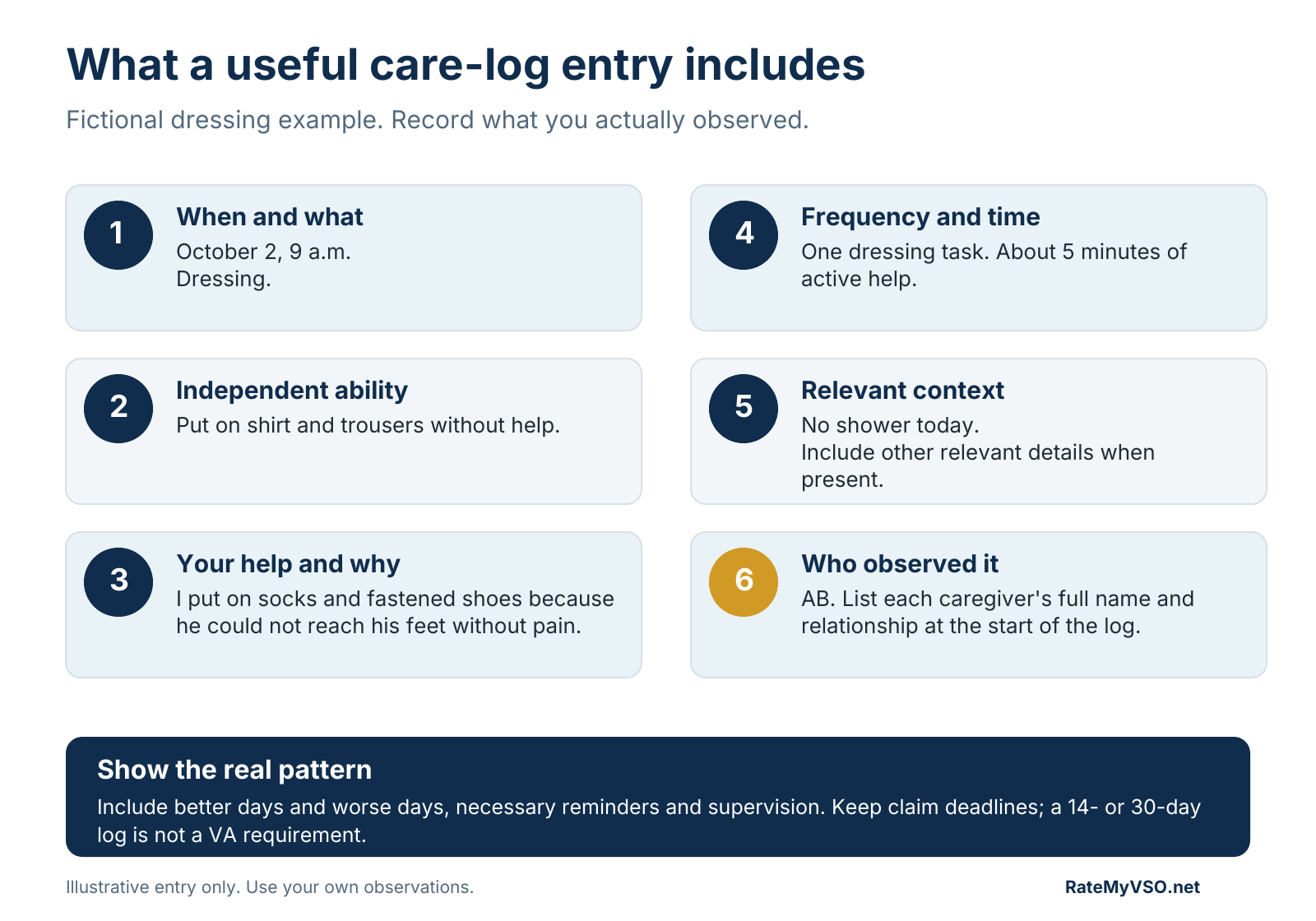
For each entry, record:
- When and what: the date, approximate time and task.
- What the veteran did: include the parts completed independently and any equipment used.
- Your help and why: setup, reminders, nearby supervision, physical help or doing the task for them, with the difficulty you actually observed.
- Frequency and time: how often the help was needed and an honest estimate of active assistance. Identify standby supervision separately; avoid counting the same minutes twice.
- Safety and context: an actual incident or intervention, who observed it and any related appointment or record.
Those help descriptions are ordinary words, not a VA points system. There is no minimum number of caregiver minutes in the regular A&A criteria. Never withhold needed care to create an incident for the log.
A sample daily care log
Fictional teaching example. These entries are not facts about a real veteran and should not be copied into a claim. This example caregiver is “AB.”
Date and task |
What happened and the help provided |
Frequency and time |
|---|---|---|
October 1, 7:40 a.m. Shower |
Washed face and upper body while seated. I steadied the transfer into the shower and washed and dried the lower legs because reaching them caused a loss of balance. Used the shower chair. AB |
One shower. About 18 minutes of active help. |
October 1, 8:15 a.m. Medication routine |
Picked up the medication container again after taking the scheduled dose. I reminded him it had already been taken and followed the existing medication plan. No extra dose was taken. AB |
One observed episode. About 3 minutes. |
October 2, 9 a.m. Dressing |
Put on shirt and trousers without help. I put on socks and fastened shoes because he could not reach his feet without pain. No shower today. AB |
About 5 minutes of active help. |
Download a blank daily care log (PDF) Edit the blank log (Word)
Optional RateMyVSO worksheet, not a VA form.
A useful entry records what happened without guessing. If you didn't see an event, state who reported it. If you write an entry later, label it as reconstructed and note the source, like a calendar entry or message.
Record both good and bad days. In decision A25051178, a clinician reviewed the veteran's and spouse's accounts of changing pain levels, assistance with bathing and dressing, medication issues, and stove hazards. The Board granted SMC-L, also based on a favorable finding from an earlier rating decision. The account of changing needs was part of the evidence, not the only reason for the outcome.
At the end of your log, add a brief summary based on the entries. Note which tasks needed help, how needs changed, and which dates highlight key examples. You don’t need to turn every ordinary day into a long story.
Bring the log to the clinician completing Form 21-2680
The current VA Form 21-2680, Examination for Housebound Status or Permanent Need for Regular Aid and Attendance, is dated June 2026. Older Board decisions discuss older versions, so their item numbers may differ.
Bring the log, a brief summary of regular help, relevant treatment or therapy records and an accurate list of service-connected disabilities. Ask the clinician to review how the veteran functions during a typical day, including help that may be easy to overlook during a short appointment.
On this version, item 27 lists activities requiring assistance. Items 17 and 25 address diagnoses, symptoms and the disabilities restricting activities. The later questions cover upper and lower limbs, other impairments, mobility and leaving home. These answers should explain how the medical findings relate to the assistance described.
The form permits an MD, DO, physician assistant or advanced practice registered nurse to serve as examiner. Section VI onward must be completed by the examiner. Give your observations separately; do not fill in the medical findings or alter a signed examination.
If the veteran says “I dress myself,” clarify the actual sequence: “He puts on the shirt, and I fasten the buttons each morning.” If a record describes independence, ask the clinician to explain any apparent difference between the examination and the help needed at home. It may reflect a better day, an assistive device, another person's setup or a change in condition. Ask for accuracy, including abilities the veteran retains.
In decision A25000101, a form checked bathing assistance without explaining why, and the record did not adequately identify which service-connected disabilities caused the restrictions. The Board remanded for further development. A checked box still needs enough explanation to be understood.
Write the caregiver statement in your own words
Firsthand caregiver observations can be competent lay evidence. You do not need medical credentials to explain that you help with clothing, provide repeated reminders or steady a transfer you personally witnessed.
Use VA Form 21-10210, Lay/Witness Statement for your own account. The current PDF is dated July 2024. Identify the claim issue, write the statement in item 17, complete the witness information, then sign and date the certification. Each witness should use a separate form. The form does not require notarization.
Begin with your relationship, how often you are present and the period you personally observed. Describe the help regularly needed, give a few dated examples, explain any changes and identify the attached log. A simple structure is:
“I am [name], the veteran's [relationship]. I provide care [days or schedule] and have personally observed the assistance described here since [date or approximate period].
“The veteran can [abilities retained]. I regularly help with [tasks]. For example, on [date], I observed [specific difficulty] and provided [specific help]. This occurs [frequency based on your observations].
“The need has [remained about the same or changed, with details]. My attached log covers [dates]. Earlier records that may help explain the history include [identify records, if available].”
This is an outline, not suggested testimony. Replace every bracket with your own accurate information, and leave out anything you do not know.
VA Form 21-4138, Statement in Support of Claim, also dated July 2024, remains available for general supporting information. Its signature block is for the veteran or beneficiary. For a caregiver writing as a witness, Form 21-10210 provides the dedicated witness information and signature fields. These evidence forms do not replace the appropriate claim or review application.
Explain the history and any conflicting records
A current log shows current needs. If assistance began earlier, identify older records that help establish the timeline: treatment notes, therapy assessments, previous examinations or family-leave documents. Use approximate dates when that is all you can honestly recall. If the level of help has been stable, say so.
In decision 20057607, the evidence included examinations, treatment records, family-leave documentation and later testimony describing years of assistance. The Board awarded an earlier A&A effective date. That result depended on the claim's particular history; keeping a log does not automatically establish an earlier payment date.
Do not ignore a record that appears inconsistent with your account. In decision A26030692, the Board denied A&A after considering conflicting functional evidence and assistance attributed to nonservice-connected physical conditions rather than service-connected depression. Detail alone did not resolve those problems. Explain real changes and differences, and ask the treating clinician to address the medical cause where needed.
Check the packet before submitting it
Keep the packet easy to follow: the completed medical examination, the signed caregiver statement, the dated care log and the relevant supporting records you identified. Label attachments and retain a copy of what you submit, along with the submission confirmation.
Check the current form version, every page, readable text, applicable answers, the claimant's signature and date, and the examiner's signature, date and requested professional and facility details. On the June 2026 Form 21-2680, the claimant certification is in Section V and the examiner details are in items 38 through 45.
These checks address problems seen in actual cases. In decision 20019672, a missing form page, outdated examinations and evidence of worsening led to further development. In decision A25078208, missing provider information and a signature became part of an effective-date dispute. Neither case establishes that an incomplete form always has the same consequence.
How this affects you
If you are a spouse, adult child or other caregiver, the assistance you provide belongs in the claim record. A brief appointment may not reveal the setup, reminders or physical help that make the veteran's day possible.
Start with the next task you assist with. Write down what the veteran did, what you did, why the help was needed and approximately how long it took. Continue through ordinary days as well as difficult ones. Use the sample log as a guide to the level of detail, not as facts to copy.
Before the examination, choose a few entries that show the regular pattern and bring them with your summary. Ask the clinician to address the limitations and their connection to service-connected disabilities. Your signed statement should explain the same routine in your own words, including any changes over time.
For the veteran, describe what you can do and the help that makes it possible. If you dress yourself after someone lays out your clothes and fastens the buttons, explain both parts. That gives the VA a clearer account of your actual needs. Keep any claim or evidence deadline you already have; a complete month of logging is not a prerequisite.
Current forms and further reading
Forms checked October 12, 2026. Download a fresh copy when preparing a submission.
- Form 21-2680 information and current download: medical examination, June 2026 PDF.
- Form 21-10210 information and current download: lay or witness statement, July 2024 PDF.
- Form 21-4138 information and current download: general supporting statement, July 2024 PDF.
- RateMyVSO: Aid and Attendance examination guide and buddy and lay statement guide.
The linked Board decisions illustrate how evidence was evaluated in individual cases. They are nonprecedential and do not guarantee another veteran's outcome. This article provides general education, not an individual eligibility determination.