When VA’s Automated Summary Gets the Record Wrong
One veteran’s breathing claim and the records behind the summary

AI-generated editorial illustration of a fictional veteran. It is not a photograph or depiction of the claimant in the cited decision.
Summary
A veteran with years of breathing complaints was denied an asthma claim without the examination the Board later found necessary. His file also contained an automated summary that did not match the original medical records. The Board ordered more work on both claims and overturned an incorrect finding that sleep apnea was confirmed.
Highlights
- The original records mattered. The Board found significant discrepancies in the automated summary.
- The examination was missing. VA had denied the asthma claim without the exam needed to resolve the medical questions.
- An error had favored the veteran. The Board overturned VA’s mistaken finding of confirmed sleep apnea while ordering more work on both claims.
A breathing claim without the needed exam
He became winded with activity. He described coughing, wheezing and a tight throat. Sometimes, he said, getting air in was harder than getting it out.
VA prescribed albuterol. In May 2019, it gave him a home nebulizer. His breathing complaints appeared in treatment records over several years.
But when VA denied his asthma claim, it had not given him the asthma examination needed to help answer two basic questions: What respiratory condition did he have, and was it connected to his military service?
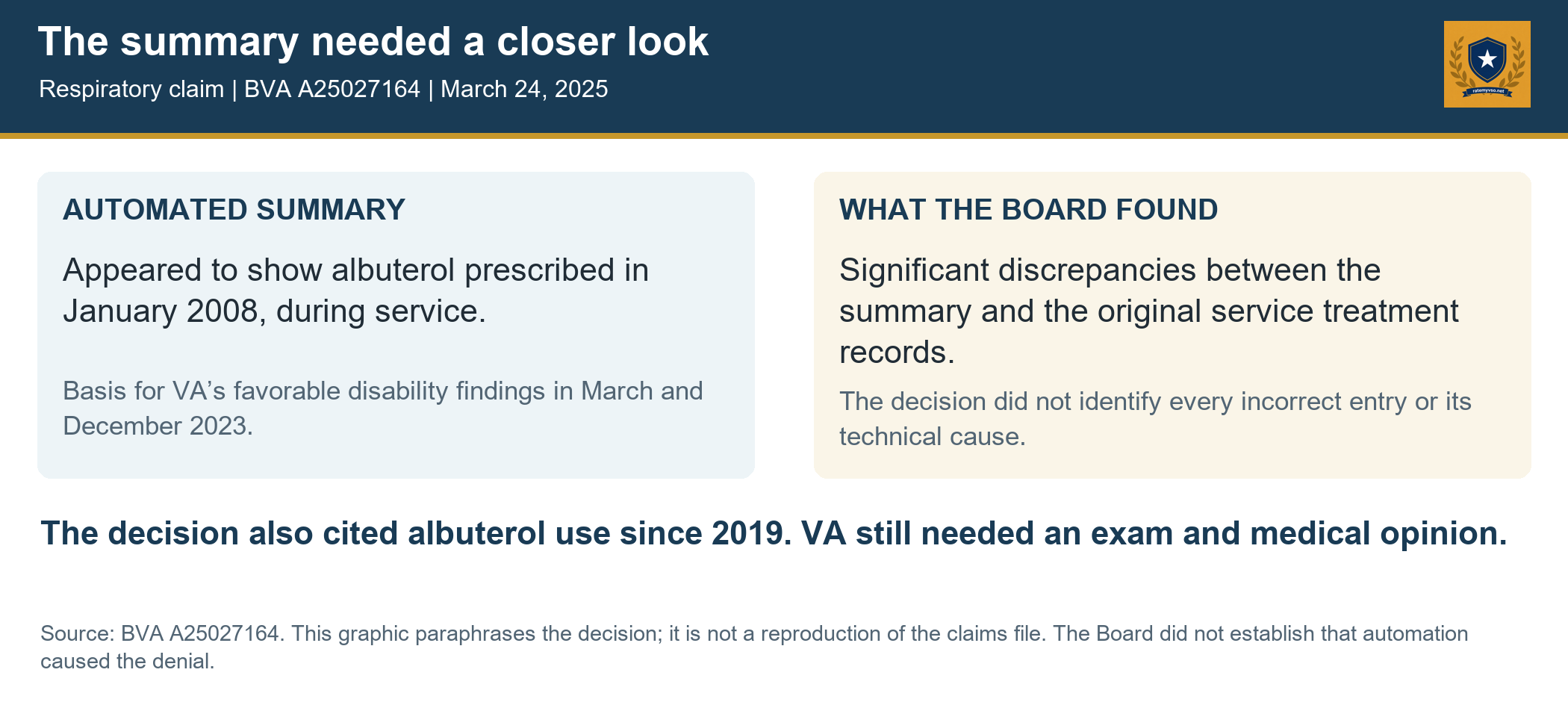
His file also contained an Automated Review Summary. When a judge at the Board of Veterans’ Appeals compared that summary with his original service treatment records, the judge found “significant discrepancies.”
On March 24, 2025, the Board sent the claim back for an examination and medical opinion. The veteran still had no final answer on that claim. He had an order requiring VA to do work it should have done before denying it. [1]
The breathing problems behind the paperwork
The public decision does not identify the veteran by name. It says he served on active duty from January 2008 through September 2009, entirely within the continental United States.
His military medical records showed upper respiratory infections and a dry cough. They did not contain an asthma diagnosis.
Years later, the picture was still complicated. A 2018 note mentioned asthma. A 2019 note recorded a history of it. Neither settled when the condition had been diagnosed. VA records showed albuterol prescriptions from 2019 onward, and breathing tests in April 2022 showed a significant response to the inhaled medication.
VA had already made a finding in his favor: its December 2023 decision accepted that he had a disability, pointing to his asthma medication. But questions about the precise diagnosis and its connection to service remained.
The veteran also offered another explanation. He said panic attacks associated with his already service-connected PTSD caused asthma attacks. That was a claim for a medical examiner to investigate; the Board did not declare the connection proven.
The judge found enough evidence to require an examination. VA needed a clinician to sort through the symptoms, treatment and possible causes before deciding the claim. [1]
The summary and the records did not agree
The automated summary appeared to list inhaler prescriptions and a report of bronchospasm, or tightening of the airways, around the veteran’s service years. One entry appeared to place an albuterol prescription in January 2008, while he was on active duty.
The entry had already mattered. The Board called the apparent in-service albuterol prescription “the stated basis” for VA’s March and December 2023 favorable findings that he had a diagnosed disability. VA had relied on it. Elsewhere, the decision also cited albuterol use since 2019 as the basis for the December finding. It gives both accounts without explaining how they fit together. [1]
But the Board found that the summary did not reliably match the underlying military records. The written decision does not identify every incorrect entry or explain what went wrong inside the software. It also does not establish that the summary caused the denial.
What it does establish is that an automated account of the evidence and the evidence itself were at odds. The Board also found that VA had denied the asthma claim without the examination needed to resolve the medical questions.
That matters because dates and context can change what a record means. A prescription during service raises different questions from a prescription years after discharge. A mention of asthma may need clarification before it can establish a diagnosis and when it began.
In this case, the summary could not resolve those questions. The Board ordered an examiner to investigate them and explain the answers. [1]
A missed appointment with no clear paper trail
The same appeal contained a second problem, this time involving the veteran’s claim for sleep apnea.
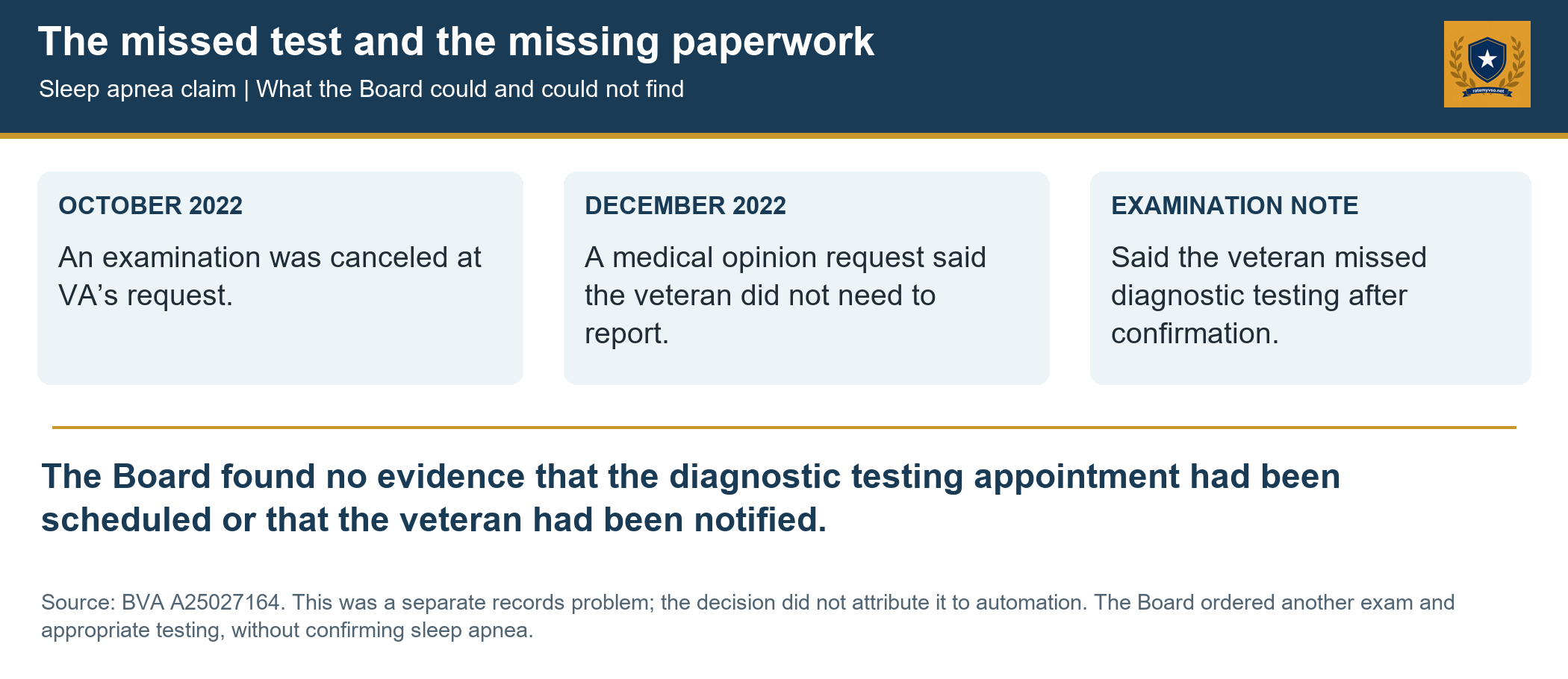
He reported loud snoring, feeling very tired after sleep and changes in his breathing. An examination report found no confirmed sleep apnea diagnosis and noted that no sleep study had been performed.
A note said the veteran had failed to report for diagnostic testing after the appointment was confirmed.
The Board checked the record. An October 2022 examination had been canceled at VA’s request. A December request for a medical opinion specifically said the veteran did not need to report for an examination. The judge could find no evidence that a diagnostic testing appointment had been scheduled or that he had been notified about it.
The file said he had missed testing. The Board could not find the paperwork showing he had been told to attend.
The decision does not connect that problem to the automated summary. It shows why checking the original record matters throughout a claim. The Board found the sleep apnea opinion inadequate and ordered another examination, with appropriate testing. It did not decide that he had sleep apnea. [1]
What automation is supposed to do
VA describes Automated Decision Support as a way to gather medical information and produce a summary for the employee reviewing a claim. Its stated purpose is to reduce time spent collecting and sorting records. VA says employees remain responsible for reviewing the evidence and making decisions. [2]
The appeal does not identify a particular AI model or explain how its summary was generated. Calling this an “AI denial” would go beyond what the decision tells us.
The wider concern has received fresh attention. A November 5, 2026, investigation by Phineas Hogan of The Beam, published by Military Times, reported that expanded automation coincided with a rise in evidence-gathering errors found during claim reviews. VA disputed a causal link and said the tool speeds processing. The investigation also acknowledged a key limit: VA’s published figures do not separate mistakes made by automation from those made by people. [3]
There is earlier evidence of problems with automated summaries. In September 2023, VA’s inspector general found incomplete blood-pressure information in summaries used in a hypertension claims project, along with inaccurate decisions and confusing staff guidance. That review concerned a specific project at that time. Its report page now lists a December 2025 closure date; it does not establish a current error rate for VA automation. [4]
What the Board decided
The Board sent both claims back. That is called a remand. It meant VA had more work to do before deciding whether these conditions were connected to service. The ruling did not award compensation or promise that the examinations would lead to an approval.
The Board also took away a favorable finding. In May 2024, VA had said a December 20, 2022 examination confirmed sleep apnea. The examination actually said the veteran did not have a sleep-apnea diagnosis. The Board found VA’s reading factually wrong and overturned that finding. [1]
The missing asthma examination and inadequate sleep-apnea opinion were failures in VA’s “duty to assist.” In everyday terms, VA had not done enough to obtain the medical evidence needed to decide these claims properly. VA’s own guidance explains that this duty can include obtaining an examination or medical opinion. [5]
For this veteran, the remand meant further examinations and review. The March 2025 decision does not tell us what happened afterward. It applies to his case and does not create a rule guaranteeing the same result for other veterans. [1]
How this affects you
If a decision seems to describe a different medical history from the one you remember, start with the reason VA gave. Then compare that statement with the original record.
- Check the dates. Identify when the visit, diagnosis or prescription actually occurred. Write down the record’s date and page so a reviewer can find it.
- Check what the clinician actually said. A reported symptom, a suspected condition and a confirmed diagnosis mean different things. Preserve the wording and its context.
- Check any claim that you missed an examination. Compare it with your appointment notices, messages and cancellation records. If it is wrong, describe the specific mismatch and provide the records you have.
- Use the review process that fits your evidence. A Higher-Level Review does not accept new evidence. A Supplemental Claim generally requires new and relevant evidence. An accredited representative can help you choose the appropriate route and check the deadline in your decision letter. [6]
The useful correction is specific: what the decision says, what the dated record says, and why the difference matters.
The veteran in this appeal had documented breathing complaints, treatment records and unanswered medical questions. The Board required VA to examine those questions more carefully. His case shows the value of going back to the records behind the summary, especially when the two tell different stories.
References
1. Board of Veterans’ Appeals. Decision A25027164, March 24, 2025.
2. Veterans Benefits Administration. Modernizing the disability claims process, August 23, 2023.
5. Department of Veterans Affairs. VA’s duty to assist.
6. Department of Veterans Affairs. Decision reviews FAQs.
Reporting note: This account is based on the published Board decision and the linked sources. We have not interviewed the veteran. His later claim outcome has not been established. The ruling applies to his case and is not precedent for other claims.