How to Ask Your Doctor for a Nexus Letter
A nexus opinion is the medical link between your disability and your service, and it usually has to come from a doctor, not from you. This guide covers the part veterans ask about most: how to prepare for that conversation, how to frame the request so a busy clinician will say yes, what the law actually requires, and what to do when a VA provider hesitates. It is educational only. The VA decides every claim; your doctor only supplies a medical opinion and the reasoning behind it.

What You Are Actually Asking For
To win direct service connection, a veteran generally has to prove three things: a current diagnosed disability, an in-service event, injury, disease, or exposure, and a causal relationship, the "nexus," between the two. The Federal Circuit set out this three-element test in Shedden v. Principi (2004), building on Caluza v. Brown (1995) and the principles in 38 CFR § 3.303.
The first two elements usually come from your medical and service records. The third is different. It is a medical judgment, and for most conditions the VA requires competent medical evidence to establish it. That is the nexus opinion (VA policy calls it a "medical opinion"), and it is why this conversation with a doctor matters so much.
One note before you start: a presumptive claim (PACT Act, Agent Orange, certain Gulf War conditions) generally does not need a nexus opinion, because the law presumes the connection. Check whether your condition is presumptive before you ask a doctor for an opinion you may not need.
The Language That Decides the Outcome
VA adjudicators weigh a medical opinion partly by the certainty language it uses. These are the phrases, ranked from strongest to weakest. The third rung is the one that wins.
- Strongest"Is due to" (states near-certainty).
- Wins"More likely than not" (greater than 50 percent).
- Threshold"At least as likely as not" (50 percent or greater). This is the standard that wins, and the benefit-of-the-doubt rule in 38 CFR § 3.102 means an even 50/50 goes to the veteran.
- Loses"Less likely than not" (below 50 percent).
- Little weight"May be," "could be," "possibly." Speculative language that adjudicators routinely give little or no weight.
Your doctor does not have to be certain. They only have to conclude the odds are even or better. Saying so in the recognized words is what lets the VA credit the opinion. The overview page explains this standard of proof in more depth.
What Makes an Opinion Persuasive: the Reasoning
Any licensed health care provider can author a nexus opinion. Providers report that the VA tends to give more weight to opinions from physicians (MD or DO), physician assistants, nurse practitioners, and doctoral-level psychologists, and that an opinion is stronger when the condition falls within the author's specialty. A board-certified neurologist opining on peripheral neuropathy carries more natural authority than a general practitioner doing the same.
But credentials are not the main event. In Nieves-Rodriguez v. Peake (2008), the Court of Appeals for Veterans Claims held that most of the probative value of a medical opinion comes from its reasoning. A report "must contain not only clear conclusions with supporting data, but also a reasoned medical explanation connecting the two." An opinion that states a conclusion with no rationale is entitled to essentially no weight, no matter who signed it.
Anatomy of a strong opinion
When you ask, it helps to know the shape of what you are asking for. A persuasive opinion has seven parts:
- Credentials. Specialty, board certifications, and the provider's relationship to you (treating physician or independent reviewer).
- Records reviewed. An explicit list, service treatment records, post-service records, diagnostic studies, lay statements, with specific records cited by date.
- Current diagnosis. Stated plainly, with supporting clinical findings.
- The in-service event or exposure. Identified specifically, not generically.
- The opinion. "It is at least as likely as not (a 50 percent or greater probability) that [condition] was caused or aggravated by [in-service event or service-connected condition]."
- The rationale. The medical mechanism, the timeline, citations to medical literature where available, and a discussion of other possible causes and why service remains at least as likely. This section does the winning.
- Signature block with license information and date.
The annotated sample structure shows what each part looks like on the page.
Asking a Private Doctor
Prepare before you ask
Veterans law practitioners describe preparation as the difference between a yes and a no. The conversation really starts before you walk in. Bring:
- Organized, labeled records. Your relevant service treatment records, post-service records, and diagnostic studies, with the key pages flagged. A doctor who has to dig through a 400-page file will decline. A doctor handed a 15-page tabbed packet often will not.
- A short written timeline or personal statement covering onset, symptoms, and continuity since service.
- Medical literature, if it exists. Peer-reviewed studies linking your exposure or injury type to your condition make the doctor's rationale section nearly write itself.
- A sample or template showing the structure the VA expects, including the "at least as likely as not" language, so the doctor is not guessing at an unfamiliar format.
How to frame the request
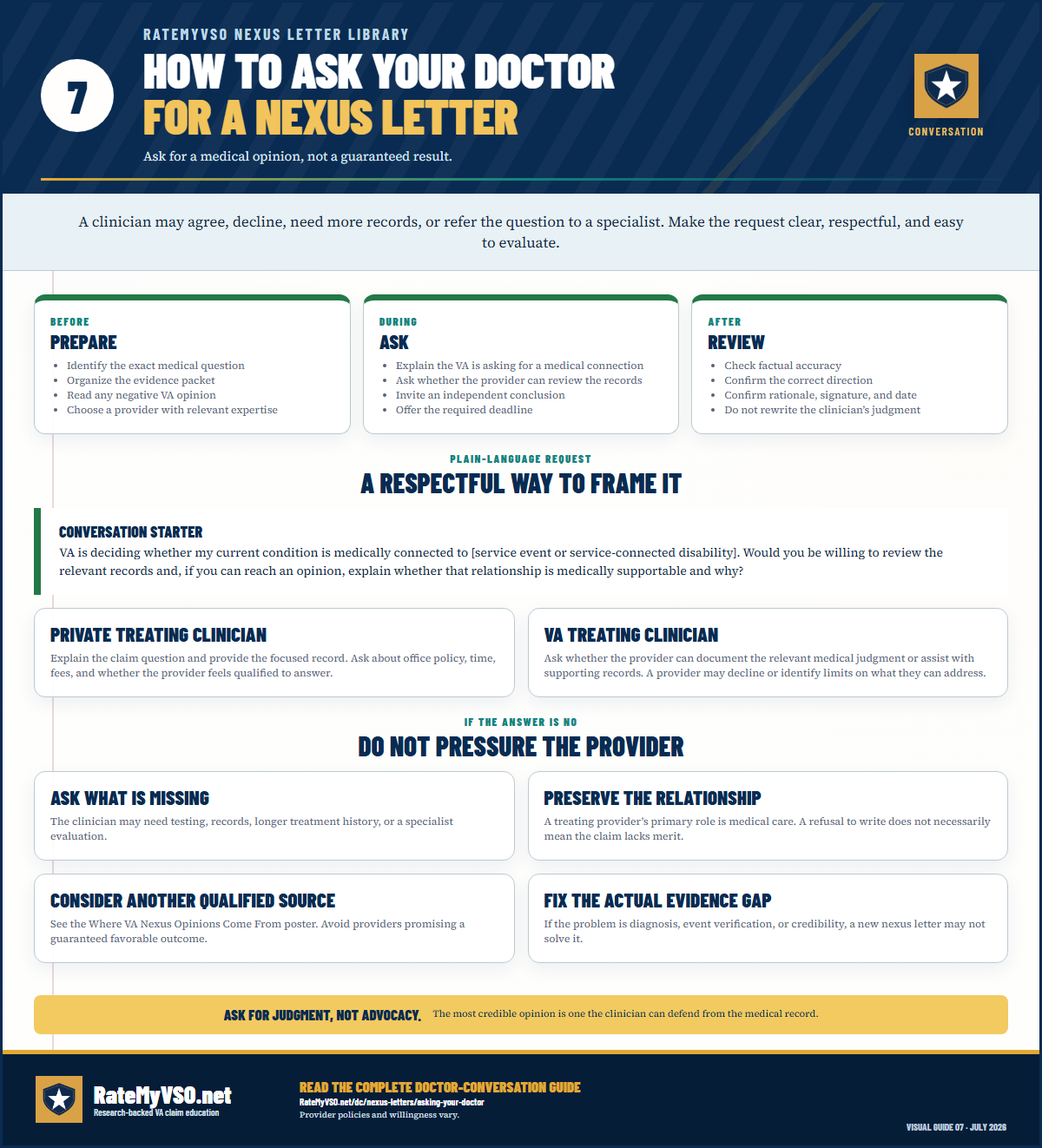
One practitioner-recommended approach: do not open with the phrase "nexus letter," which sounds legal and can make a clinician wary. Ask for a "medical opinion" on causation. Then make the doctor's job small and clear:
- Define the standard in one sentence. "Is it at least as likely as not, meaning 50/50 or better, that my service caused or aggravated this condition? You do not have to be certain. Fifty percent is the standard."
- Reassure them about scope. They are not testifying, not certifying a disability percentage, and not making the legal decision. They are stating a medical probability and their reasoning. The VA decides everything else.
- Ask for the reasoning on paper. Explain that a one-line conclusion gets thrown out, and that walking through what they reviewed, the mechanism, and why other causes do not change the answer is the part that counts.
- Schedule a dedicated appointment for the discussion rather than tacking it onto a routine visit. Some offices bill this as an extended consult.
- Be ready for an honest no. If the doctor reviews your records and does not believe the connection is at least as likely as not, you do not want that opinion on paper. Thank them, and reconsider whether the evidence supports your theory.
Costs and outside options
What a treating physician charges varies. Some write the letter as part of a normal visit, some bill a records-review fee for the time it takes, and some decline to write one at all. Independent medical opinion services and specialist reviewers charge a fee that varies by provider and by how complex the record is. We have no concrete range to give you, so ask for the price in writing and compare options before paying. VSOs cannot write nexus letters themselves, but local chapters of organizations like the DAV, VFW, and The American Legion sometimes keep lists of providers familiar with VA medical opinions. The where-to-get guide breaks the sources down by cost and weight.
Asking a VA Doctor: What Directive 1134 Actually Says
Veterans often hear "VA doctors are not allowed to write nexus letters." That is not what the policy says. VHA Directive 1134(3) governs medical statements and forms, and it is more helpful than its reputation.
First, completing medical forms is part of the VA medical benefits package under 38 CFR § 17.38. The directive states that providers, when requested, "must assist patients in completion of VA and non-VA medical forms," and it specifically lists Disability Benefits Questionnaires (DBQs), Aid and Attendance forms, and pension forms among the documents providers complete on request. It adopts a "no wrong door" approach for veterans bringing a DBQ to a VA facility.
Where causality opinions fit
The directive draws a careful line on nexus opinions. It cautions that service connection is a legal determination belonging to the Veterans Benefits Administration, that VHA providers often lack access to military medical records, and that they "are often not well suited to assess causality." It does not prohibit the opinion. Instead it sets the standard for providers who choose to give one: a VHA provider who writes a causality opinion "must include clear and specific rationale citing evidence to support the conclusion reached, and should employ standard language appropriate for medical opinions (such as 'at least as likely as not')."
A provider may also decline to write a statement if uncomfortable or if it would present a conflict of interest, and for mental health DBQs the directive recommends the treating provider not complete the form, to protect the therapeutic relationship.
Procedural rights most veterans never use
- Medical Statements and Forms point of contact (MS&F POC). Every VA medical facility and large outpatient clinic must designate at least one point of contact to help veterans and staff with form and statement requests. If a request stalls, ask for this person by title.
- The 20-workday timeframe. Facilities must have a process for acting on form and statement requests, generally within 20 working days. Knowing the window helps you follow up without guessing.
- Reconsideration when a provider refuses. The directive requires every facility to have a process for reconsideration when a provider refuses to issue a medical statement or complete a form, and also when you object to what a completed form says. VA's own Mail Call episode on nexus letters says the same. Ask the MS&F point of contact how that process works at your facility.
Two Conversations: How It Can Go
The following narratives are entirely fictional. The veterans, the doctors, and every detail are invented to illustrate technique. They are composites built from the preparation and framing strategies in the sources below, not transcripts, and not advice for any specific claim.
Fictional scenario 1 · Private physician
Ray, a fictional Army veteran, was a wheeled-vehicle mechanic from 1989 to 1993. He has lumbar degenerative disc disease diagnosed by Dr. Okafor, the orthopedist who has treated him for three years. Ray booked a 30-minute consult and arrives with a tabbed folder: four flagged pages of service treatment records, his MRI report, a one-page timeline, and a one-page sample opinion format.
Ray: Before we talk about the injections, I want to ask something different. I am filing a VA disability claim for my back. The VA needs a medical opinion on what caused it. Would you be willing to write an opinion on whether my time in the Army caused or contributed to my disc disease?
Dr. Okafor: Patients have asked about VA letters before. I will be honest, I have avoided them. I do not know the VA's rules and I am not going to swear in court about something from thirty years ago.
Ray: That is fair, and it is simpler than that. You are not certifying anything legally and there is no testimony. The VA makes the legal decision. They need your medical judgment, in writing, on one question: is it at least as likely as not, meaning 50/50 or better, that my service caused or aggravated my back condition? You do not have to be certain. Fifty percent is the standard.
Dr. Okafor: At least as likely as not. So I am not saying it definitely came from the Army. I am saying the probability is at least even.
Ray: Exactly. And I did the legwork so you are not digging. This tab is my service records: two documented sick-call visits for low back pain in 1991 and 1992 after lifting transmission assemblies, and my separation exam noting recurrent back pain. This tab is your own MRI and notes. This page is my timeline since discharge. This last page is the format the VA recognizes, so you do not have to guess at the wording.
Dr. Okafor flips through the flagged pages for a minute.
Dr. Okafor: Documented in-service injuries, symptoms at separation, a continuous pattern after. Mechanically, repetitive axial loading in your twenties accelerating disc degeneration is a story I can defend. Here is my condition: I review everything in this folder first, and I write what I actually conclude. If I think your landscaping business in the 2000s is the bigger driver, I will tell you that instead of writing the letter.
Ray: That is exactly what I want, an honest opinion with your reasoning in it. One thing that matters to the VA: the why. A one-line conclusion gets thrown out. If you write it, walk through what you reviewed, the mechanism, and why other causes do not change your answer.
Dr. Okafor: Leave the folder. Have the front desk schedule a records-review slot, there is a fee for my time. I will have an answer in two weeks either way.
Why this worked: Ray asked for a "medical opinion," not a "nexus letter." He defined the legal standard in one sentence, shrank the doctor's workload with a flagged packet, explained that the rationale is the part that counts, and accepted that an honest review might go against him.
Fictional scenario 2 · VA provider
Maria, a fictional Navy veteran, asks her VA primary care provider, Dr. Chen, during a scheduled appointment about a knee disability already diagnosed in her VA record.
Maria: I have a claim pending and I would like to ask about two things while I am here. First, would you complete the knee DBQ for me? It is a condition you already treat and it is documented in my chart.
Dr. Chen: A DBQ for an existing diagnosis I manage, yes, that is routine. We can do part of it now and I will finish it from your chart. It may take a couple of weeks to come back through release of information.
Maria: Understood, I know the facility has 20 working days. Second question, and I know this one is different. Would you be willing to write an opinion connecting the knee arthritis to the injury in my service records?
Dr. Chen: That one I am more careful with. I do not have your full service file, and opinions about causation from decades ago are usually outside what I can support. Our guidance says service connection is the benefits side's call, not ours.
Maria: That is fair, and the same guidance, Directive 1134, says it is your choice. It does not prohibit it. It says if a provider does write a causation opinion, it needs a clear rationale and the "at least as likely as not" wording. I can give you the service treatment record pages so you have the documentation. But if you are not comfortable, I will not push. Could you instead put a descriptive statement in my record on the current diagnosis, prognosis, and how the knee limits my function? The directive covers that too.
Dr. Chen: A current-status statement with functional limits, absolutely. Bring me those service record pages anyway. If the documentation is as clear as you say, I will consider the causation question, and if I stay uncomfortable with it, the status statement and the DBQ go in regardless.
Maria: Thank you. And if anything stalls, who is the Medical Statements and Forms point of contact here? I understand the facility also has a reconsideration process if a request is refused.
Dr. Chen: The front office can give you that name, and the same office handles reconsideration requests. You have clearly read the policy.
Why this worked: Maria led with the easy, clearly-covered request (a DBQ for a treated, documented condition), stayed respectful when the provider hedged on causation, knew the directive well enough to correct the record without confrontation, and had a fallback ask (the descriptive status statement) the provider could say yes to.
Quick Reference
Do
- Ask for a "medical opinion" on causation.
- Bring a short, tabbed packet with key records flagged.
- Explain the "at least as likely as not" 50 percent standard.
- Ask the doctor to explain their reasoning in writing.
- Provide peer-reviewed literature supporting the link.
- Accept an honest "no" and reassess your evidence.
- At the VA: ask during a scheduled appointment; know the MS&F point of contact and the 20-workday window.
Don't
- Open with jargon like "nexus letter" or wave printed regulations at your doctor.
- Hand over hundreds of unorganized pages.
- Ask the doctor to say your condition is "definitely" service-caused.
- Accept a one-sentence conclusion with no rationale.
- Script the doctor's conclusion or pressure an unwilling provider.
- Pay a letter mill for a template opinion with no record review.
- At the VA: assume a refusal ends the matter, or that only a VA opinion counts.
The one sentence the letter needs
Everything after "for the following reasons" determines how much the letter is worth.
Your appointment
Prepare for my appointment
Bring the questions, history and record details you want to discuss. Choose your conditions, review your notes, and print only what you want to share.
Working from your records: ICD-10 Diagnosis Extractor reads a folder of records on your own computer. ICD-10 Lookup explains a code you found. Record findings keep the exact wording, the document and the page you found it on.
Claim Quest: Quick Check
Five questions based only on this guide.
This checks what you understood from this guide. It is not a claim-readiness score, a prediction, an official test, or a record on your account.
Sources
This guide draws on federal case law, VA regulation, VHA policy, and published practitioner guidance. Verify the current text of any directive, regulation, or decision before relying on it; VA policy and case law change.
- Shedden v. Principi, 381 F.3d 1163 (Fed. Cir. 2004), the three-element test for direct service connection; Caluza v. Brown, 7 Vet. App. 498 (1995).
- Nieves-Rodriguez v. Peake, 22 Vet. App. 295 (2008), probative value of a medical opinion comes from its reasoning, not the author's access to the claims file.
- VHA Directive 1134(3), Provision of Medical Statements and Completion of Forms by VA Health Care Providers (amended July 8, 2025), including the facility reconsideration process and the Medical Statements and Forms point of contact.
- VA Mail Call: "Can Your VA Doctor Write a Nexus Letter? What VA Policy Says", VA's The SITREP channel, October 2, 2026. VA's own summary of Directive 1134: a VA provider can give a causation opinion, it must carry clear reasoning and "at least as likely as not" language, and each facility has a Medical Statements and Forms point of contact and a reconsideration process when a provider refuses.
- 38 CFR § 3.303 (principles of service connection), 38 CFR § 3.102 (benefit of the doubt), 38 CFR § 3.310 (secondary service connection), and 38 CFR § 17.38 (medical benefits package).
- Practitioner guidance on preparation, framing, costs, and letter mills from veterans-law firms and independent medical opinion services (Chisholm Chisholm & Kilpatrick, Berry Law, Spearman Appeals, Valor 4 Vet, Telemedica, and others).
- VA: Get help from an accredited representative or VSO.
Common Questions
Should I ask my doctor for a nexus letter or a medical opinion?
Can a VA doctor write a nexus letter?
What is the single most important part of a nexus letter?
Should I pay a company for a nexus letter?
Related Tools and Guides
This guide is general educational information about the VA benefits system, current as of June 2026, and is not legal, medical, or claims-preparation advice for your individual situation. Only VA-accredited representatives, agents, and attorneys may assist in the preparation, presentation, or prosecution of a VA claim (38 USC § 5901). RateMyVSO does not prepare, present, or prosecute claims. For help with your claim, find a VA-accredited representative. The conversations above are fictional composites created for instruction; any resemblance to real people is coincidental.