Camp Lejeune Contaminated Water Presumption
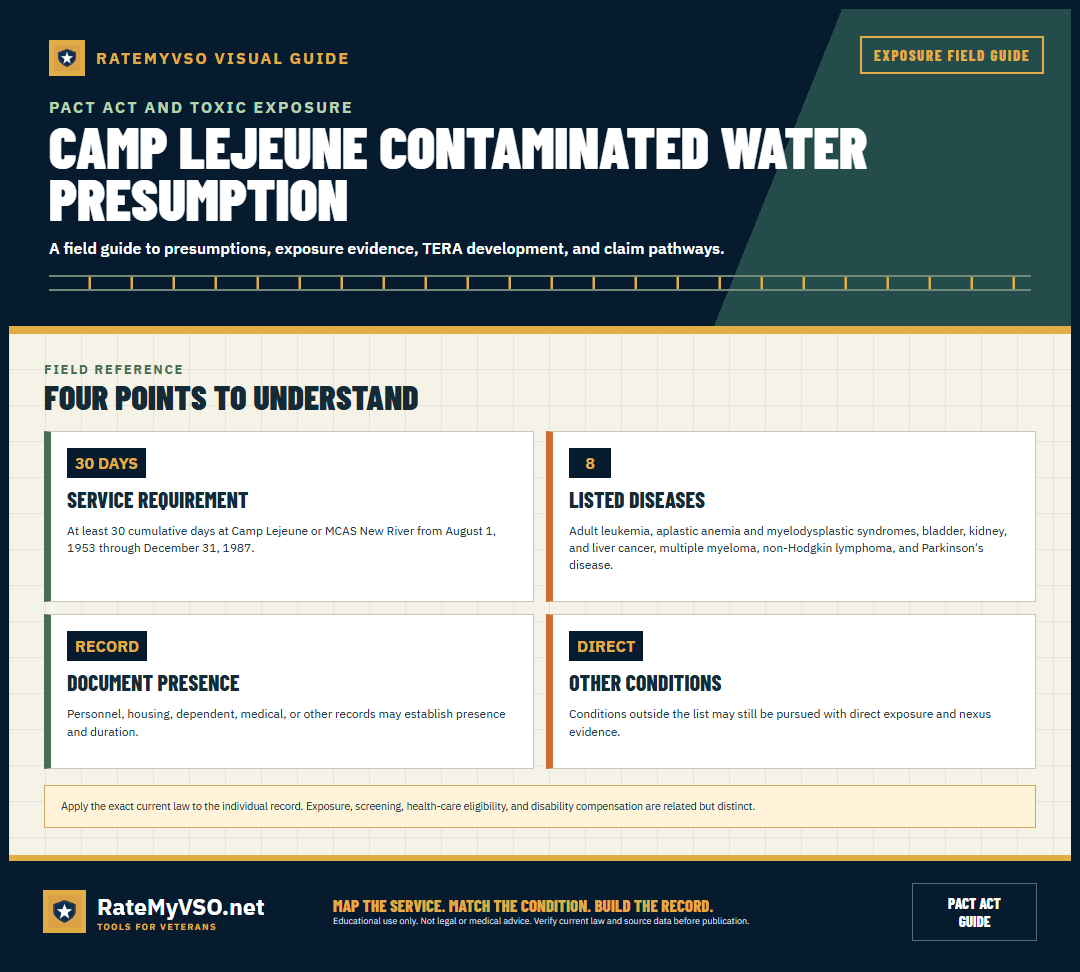
From 1953 through 1987, drinking water at Marine Corps Base Camp Lejeune, North Carolina, was contaminated with industrial solvents, including trichloroethylene (TCE), perchloroethylene (PCE), benzene, and vinyl chloride. 38 CFR 3.307(a)(7) and 3.309(f) establish a presumption of service connection for eight diseases in veterans (and Reservists / Guard members on active duty) who served at Camp Lejeune or MCAS New River for at least 30 days during the contamination period.

How the presumption works
The Camp Lejeune presumption operates on the same two-part structure as other VA presumptions:
- Exposure presumption (3.307(a)(7)). A veteran or covered Reservist / Guard member who served at Camp Lejeune or MCAS New River for at least 30 days (consecutive or non-consecutive) between August 1, 1953 and December 31, 1987 is presumed to have been exposed to the contaminants in the camp's drinking water.
- Disease presumption (3.309(f)). If the veteran later develops one of eight specifically listed diseases, that disease is presumed to be service-connected, even without proof of a direct nexus to a specific exposure event.
Qualifying service (3.307(a)(7))
Who is covered
- Veterans (active-duty service members)
- Former members of the Reserve who served on active duty for training or inactive duty training at Camp Lejeune during the period
- Former members of the National Guard who served on active duty for training or inactive duty training at Camp Lejeune during the period
Where
Service must have been at Marine Corps Base Camp Lejeune or Marine Corps Air Station (MCAS) New River, both in North Carolina. The contaminated water systems served both locations.
When
Between August 1, 1953 and December 31, 1987.
How long
At least 30 days, consecutive or non-consecutive. Brief temporary-duty (TDY) trips that total 30 days across multiple assignments qualify, provided the days fall within the contamination period.
The eight presumptive conditions (38 CFR 3.309(f))
The following diseases are presumptively service-connected for veterans (and covered Reservists / Guard members) with qualifying service:
- Adult leukemia
- Aplastic anemia and other myelodysplastic syndromes
- Bladder cancer
- Kidney cancer
- Liver cancer
- Multiple myeloma
- Non-Hodgkin's lymphoma
- Parkinson's disease
Manifestation rules
No time limit
The Camp Lejeune presumption imposes no manifestation deadline. The presumptive disease may become manifest at any time after the qualifying service. Many of the eight presumptive conditions (multiple myeloma, kidney cancer, leukemia) are typically diagnosed decades after exposure.
Survivors and dependents
Surviving spouses and dependents of veterans who died from a Camp Lejeune presumptive disease may be eligible for DIC under 38 USC 1310 if the cause of death was a presumptive disease and qualifying service is established. Family members who lived at Camp Lejeune during the period are not covered by the VA presumption (which is veteran-specific) but may have separate remedies under the Camp Lejeune Justice Act discussed below.
Camp Lejeune Justice Act of 2022 (separate tort pathway)
The Camp Lejeune Justice Act of 2022 (CLJA), enacted as part of the PACT Act, is a separate remedy from the VA disability presumption. It allows veterans, family members, and others who were exposed to Camp Lejeune water for at least 30 days between August 1, 1953 and December 31, 1987 to file a federal lawsuit in the U.S. District Court for the Eastern District of North Carolina seeking damages.
- Different forum: A tort suit in federal court, not a VA claim.
- Different evidence standard: Plaintiffs must show that exposure was at least as likely as not to have caused the alleged harm.
- Different conditions: CLJA is not limited to the eight VA-presumptive conditions; the broader list of conditions associated with the contamination can be litigated.
- Coordination with VA benefits: Any award is reduced by the amount of disability compensation, medical care, or survivor benefits the plaintiff received from VA for the same harm. CLJA awards do not bar simultaneous VA presumptive claims.
The CLJA is a litigation pathway requiring legal representation. This site does not provide CLJA legal services; consult an attorney about whether to file.
Limitations
The VA presumption can be rebutted by:
- Affirmative evidence that the individual was not exposed to contaminants in the water supply during the qualifying service.
- Affirmative evidence that the disease did not result from exposure to the contaminated water.
- Evidence that the disease is the result of the veteran's own willful misconduct or the abuse of alcohol or drugs.
If the veteran's diagnosis is not on the eight-condition presumptive list, direct service connection may still be established by proving exposure and a medical nexus on the facts of the individual case.
Source and currency
Authority: 38 U.S.C. 1710(e), 1787; Pub. L. 112-154 (Honoring America's Veterans and Caring for Camp Lejeune Families Act of 2012); Pub. L. 117-168 section 804 (Camp Lejeune Justice Act of 2022).
Regulation text: 38 CFR 3.307 on eCFR.gov and 38 CFR 3.309 on eCFR.gov. The eCFR text is authoritative.
VA reference: VA.gov / Camp Lejeune contaminated water.
Scope and limitations
Two pathways, very different. This page describes the VA disability presumption (a benefits claim filed with VA). The Camp Lejeune Justice Act tort pathway is a separate federal lawsuit with different rules, deadlines, and remedies. They are not interchangeable; many veterans pursue both.
Not legal advice, not a claim filing. This page provides factual reference only. It is not legal advice, does not establish representation, and does not constitute the filing of any claim or lawsuit. For VA-claim guidance, find an accredited VSO representative; for CLJA litigation, consult an attorney admitted to the U.S. District Court for the Eastern District of North Carolina.
Data vintage. Statutory and regulatory text reproduced from authoritative sources. Always verify against the eCFR link above; both the regulatory presumption and CLJA litigation procedures continue to evolve.
Current diagnosis and qualifying service still required. The presumption relieves the burden of proving the exposure-to-disease link. It does not eliminate the need for a current medical diagnosis and proof of qualifying service.