How to Get Your Private Medical Records for a VA Disability Claim
Your private treatment records are often the strongest evidence in a VA claim file: the current diagnosis, the treatment history, and the raw material your doctor uses for a nexus opinion. Federal law gives you the right to copies of nearly all of them. This guide covers that right, who to ask at each kind of provider, exactly what to request, the timelines and fees providers may use, and what to do when a provider drags its feet.
Your Legal Right to Your Records
The HIPAA Privacy Rule (45 CFR 164.524) gives you an enforceable right to see and receive copies of the health information your providers and health plans keep about you. That covers doctors, hospitals, clinics, imaging centers, therapists, labs, pharmacies, and insurers.
- What you can get: medical records, billing records, lab and test results, imaging reports, consent forms, and clinical notes in the record.
- How you can ask: in writing, on the provider's form, through a patient portal, or however the provider accepts requests. A provider may require the request in writing but cannot make the process unreasonably hard.
- Format: you can ask for electronic copies, and if the records are kept electronically the provider must give you an electronic copy if you want one.
- Deadline: generally 30 days from your request, with one 30-day extension allowed if the provider tells you in writing why.
- Cost: only a reasonable, cost-based fee for copying and postage. Many states cap per-page fees. Electronic copies are often free or nearly free.
- One exception worth knowing: psychotherapy notes a mental-health professional keeps separately from the chart are not covered by the access right. The rest of the mental-health record is.
Who to Ask, by Provider Type
The law is the same everywhere; the desk you ask at is not. This is where requests actually get processed.
| Where you got care | Best way to get the records |
|---|---|
| Primary care | Patient portal (MyChart, Athena, and similar) first; otherwise the office's medical records or Health Information Management (HIM) staff |
| Specialist | Patient portal or the practice's medical records department |
| Hospital | Health Information Management (HIM) or Release of Information (ROI) office; most large systems post a request form online |
| Urgent care | Medical records department, or the chain's corporate portal (many national chains centralize requests) |
| Imaging center | The imaging center itself; ask for the radiologist's REPORT and, if needed, the images on disc or via link. The report and the images are separate requests at many centers |
| Physical therapy | Clinic records request; ask for evaluations AND progress notes |
| Mental health | The provider or the practice's records department; the treatment record is yours, separately-kept psychotherapy notes are the one exception |
| Sleep center | The sleep lab's records office; request the FULL diagnostic report (the AHI and study data, not just the one-line result) |
| Chiropractor | Office records request |
| Pharmacy | Prescription history from the chain (in-store or online account); one request per chain covers all its stores |
Step by Step
- List every provider who treated the condition. Work backward through the years: primary care, specialists, hospitals, imaging, therapy, pharmacies. Your insurance claims history and old calendars help jog memory.
- Check the portal first. Many records (visit notes, labs, imaging reports) are already downloadable free. Grab what is there before requesting anything.
- Find the records desk for the rest. Use the table above. For hospitals, search the hospital name plus "medical records request" for the ROI form.
- Complete the authorization form. Expect to provide your name, date of birth, the date range, what you want released, and a signature, plus a photo ID. Sending records to yourself keeps you in control of what goes to the VA later.
- Ask for electronic delivery. Faster, usually cheaper, and easier to upload to VA.gov later.
- Calendar the 30-day mark. If nothing has arrived, call the records office and reference your request date.
- Review everything before you file. Confirm the diagnosis, the ICD code, and the treatment history actually say what you expect. Errors in the record are best caught now, not after a decision.
What to Request: the Checklist
"All records" sometimes gets you a visit summary. Naming the document types gets you the file. Ask for each of these that applies:
- Office visit notes (the clinician's actual notes, not just after-visit summaries)
- Consultation reports from specialists
- Operative reports for any surgery
- Imaging reports (X-ray, MRI, CT), plus the images themselves if a reviewer may need them
- Lab results
- Pathology reports
- Physical therapy evaluations and progress notes
- Mental health treatment notes, if applicable (the chart record; separately-kept psychotherapy notes are excluded by law)
- Medication history (from each pharmacy chain and from the prescriber)
- Hospital discharge summaries
- Sleep study full diagnostic reports, if applicable
Patient Portals
Most health systems run a portal (MyChart is the most common) where visit notes, labs, and imaging reports can be downloaded immediately and free. Two practical notes:
- Portals rarely hold everything. Older records, scanned documents, and records from before the system adopted the portal usually require a records-office request.
- Download, do not screenshot. Use the portal's document download (usually PDF) so dates, provider names, and page headers stay intact for the file you build.
Timelines and Fees
- 30 days: the general federal deadline for providing access, with one 30-day extension if the provider notifies you in writing.
- Reasonable, cost-based fees only: copying labor, supplies, and postage. Providers cannot charge for searching or retrieving your records.
- Electronic copies: often free through a portal; if you request electronic delivery of electronic records, fees are typically minimal.
- State law: many states cap fees below what HIPAA allows. When state law is more protective of you, it wins.
If the Provider Will Not Comply
- Call the records office and reference your request date and the 30-day rule.
- Escalate in writing to the practice manager or the hospital's HIM director. A short letter citing your HIPAA right of access (45 CFR 164.524) usually moves things.
- File a complaint with HHS Office for Civil Rights if the provider still refuses or blows the deadline: hhs.gov/hipaa/filing-a-complaint. Complaints must generally be filed within 180 days of the violation.
Using Private Records in Your VA Claim
- They carry the current diagnosis: the first element every claim needs. A private diagnosis is fully acceptable evidence.
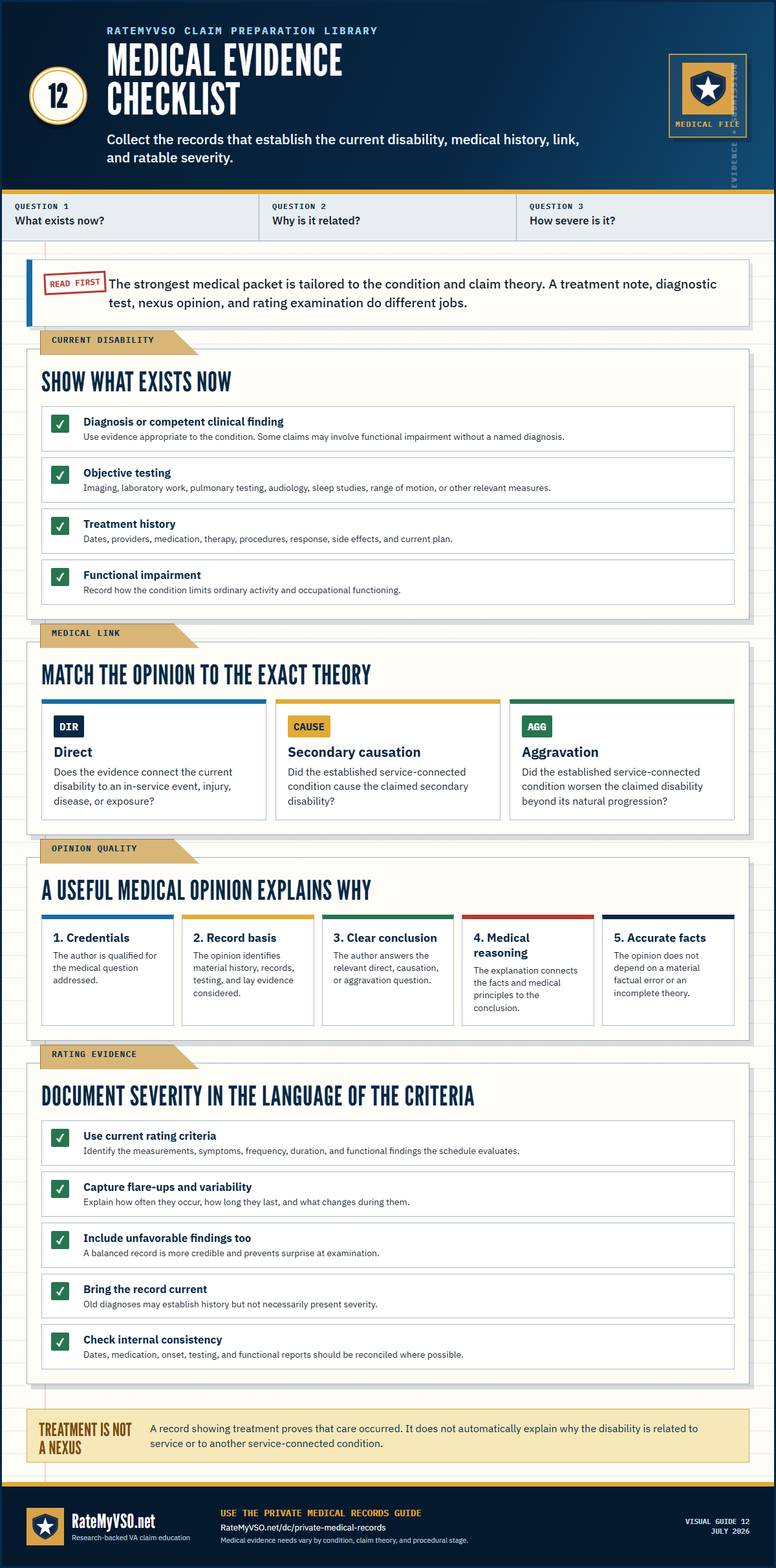
- They feed the nexus opinion: a doctor writing a nexus letter needs the treatment history in front of them. Bringing your own records makes that opinion better-reasoned, and reasoning is what gets weighed.
- They document severity over time: the treatment trail is often the best evidence of frequency, severity, and functional impact, the things the rating schedule actually measures.
- Submit copies, keep originals: upload to VA.gov attached to your claim, and keep your own set organized per the Claim File Guide.
- You can authorize the VA to fetch them (VA Form 21-4142), but requesting them yourself first means you know exactly what the file says before a rater does.
Frequently Asked Questions
Can a provider refuse because I owe them money?
No. Unpaid bills are not a lawful basis for denying access to your records.
Do I have to say the records are for a VA claim?
No. You never have to give a reason. If a form asks for a purpose, "personal use" is enough.
The provider says only a doctor can receive them. True?
No. The right of access belongs to you. A provider may release records directly to another provider at your direction, but they must also release them to you when you ask.
How far back do providers keep records?
Retention varies by state and provider type, commonly 6 to 10 years for adults and longer for hospitals. Ask even if the care was long ago; older records are often archived, not destroyed.
What about records from a military or VA facility?
Different system, different request path. Service treatment records and VA medical records go through the VA and the National Personnel Records Center; see the FOIA Guide and the Service Records guide.
Sources
- HHS, Your Medical Records and HHS, Get It. Check It. Use It. (the individual right of access)
- HHS OCR, Individuals' Right under HIPAA to Access their Health Information, 45 CFR 164.524 (scope, timeliness, fees, exceptions)
- HHS OCR, Filing a HIPAA Complaint
- AHIMA Journal, How to Request Your Medical Records (HIM and Release of Information practice)
- CMS, Medical Record Maintenance and Access Requirements
- ONC HealthIT.gov, How to Get Your Health Record
This guide is educational and is not legal or medical advice. For help with a specific claim, work with a VA-accredited representative. All RateMyVSO tools are free.