New Gavels, Same Pen: What 2027 May Hold for Veterans
A RateMyVSO take. Where we report facts, we cite them and rate our confidence. Where we speculate, we say so.

RateMyVSO | Editorial illustration
Summary
The people leading the committees look set to change. But the person who signs does not. The big veterans story of 2027 is not likely to be a new benefit. It is likely to be a fight over who pays for the benefits already promised.
Highlights
- The divided veterans lobby. The big veterans groups did not agree.
- Our forecast on ratings. The sleep apnea and tinnitus fight moves from Congress to VA's rule desk.
- Our forecast on oversight. 2027 is an oversight year. Expect many hearings on staffing, community care, and the health record system.
A promise made on cable news
Richard Ojeda has not taken the oath of office yet, and he is already picking a fight.
On Monday afternoon, the congressman-elect appeared on CNN. He said he opposes the planned changes to how the VA rates sleep apnea and tinnitus. Ojeda is a Democrat from North Carolina's 9th District. He is also a veteran. He enlisted in the Army in 1989 and retired in 2013 as a major after 24 years [1].
So why should one freshman's TV appearance matter to a veteran with a CPAP machine on the nightstand? Because it previews the whole year. The big veterans story of 2027 is not likely to be a new benefit. It is likely to be a fight over who pays for the benefits already promised.
Our one-line read: the people leading the committees look set to change. But the person who signs does not. Everything below follows from that.
The scoreboard
Start with the numbers, stated carefully, because the counting is not all done.
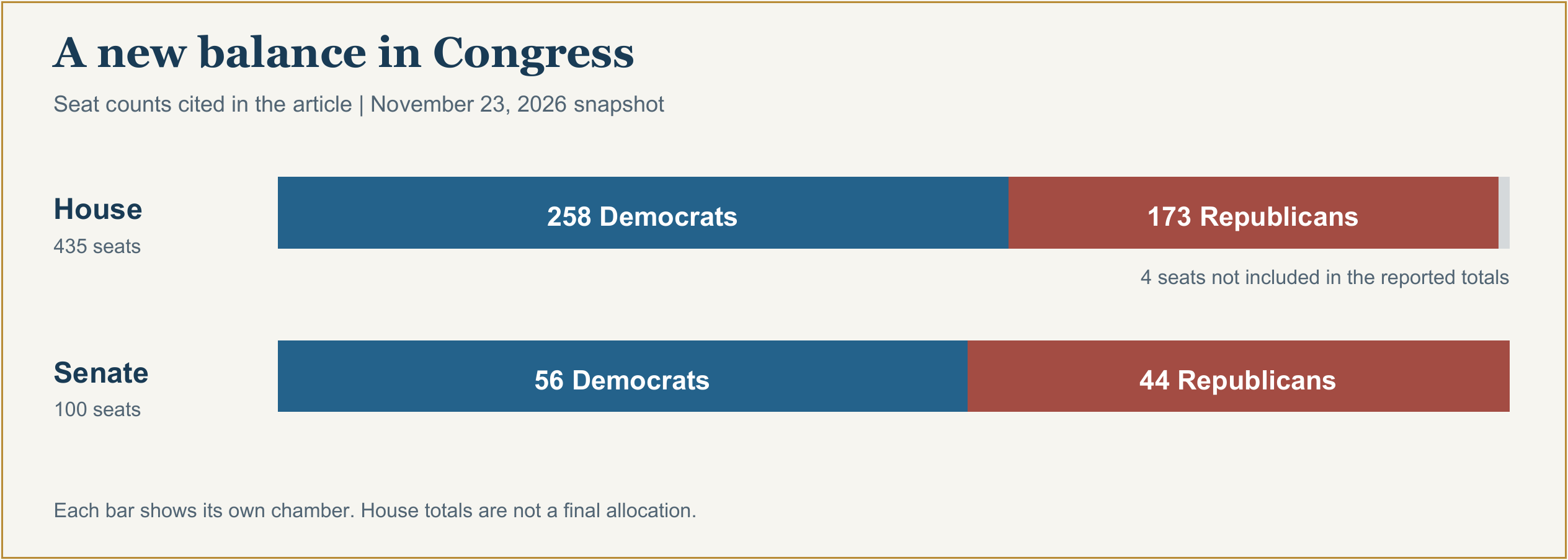
As of Nov 23, AP reports that Democrats have won 258 House seats. Republicans have won 173 (AP, 2026). In the Senate, AP reports 56 seats for Democrats and 44 for Republicans (AP, 2026). From here on, this piece goes by AP's count of those seats.
Now a second scoreboard, the one that counts uniforms. In its preliminary count published November 4, With Honor projected that at least 79 veterans would serve in the next Congress. They would make up about 15% of its members, down from 19% [9]. At least 11 of them are women veterans, which the group calls the most ever to serve at one time [9].
So there are fewer veterans in the building. But veterans punch above their weight at the ballot box. In 2022, 62.7% of veterans voted, compared with 51.3% of nonveterans [10]. More than half of veterans say they identify with neither major party [11].
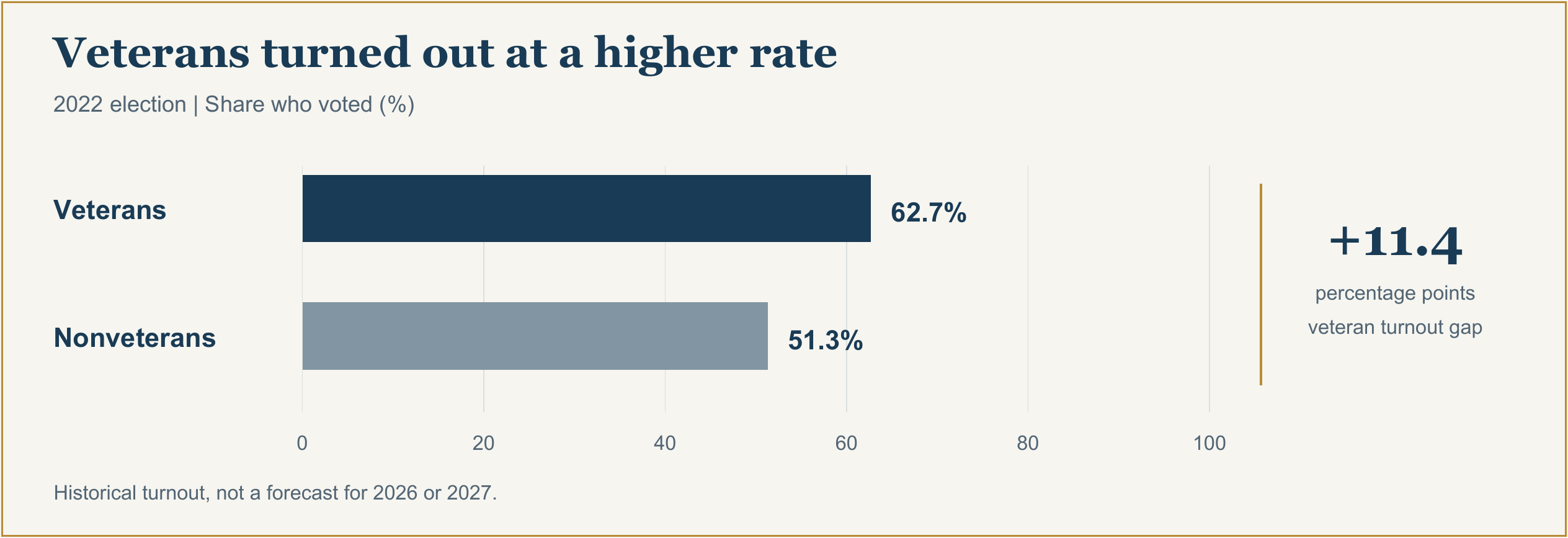
In simple terms, a voting bloc turned out on Election Day, November 3. It belongs to no one and watched a fight over benefits play out. Politicians notice that.
The bill that split the veterans' lobby
To understand 2027, first understand a bill from 2026. It’s called the Take Care of America's Veterans Act, or TCAVA.
Think of it as a full grocery cart. It bundles more than 60 veterans bills into one package [2]. Most groups want the Major Richard Star Act. Today, veterans who medically retired because of combat injuries have their retirement pay reduced by the amount they receive in VA disability pay. The Star Act would end this reduction [4].
The trouble is at the checkout. Section 108 helps fund the cart. It changes how VA rates two common conditions in future claims [2].
| Condition | Today | Under Section 108, for future claims |
|---|---|---|
| Sleep apnea | Generally 50% when a CPAP or similar device is required | 0% if treatment controls symptoms, 10% if relief is incomplete, 50% if treatment fails or cannot be used, 100% with organ damage |
| Tinnitus | 10% as its own condition | No separate rating, with one narrow exception tied to service-connected hearing loss |
Sources for the table: current rules from [26]; proposed rules from [2].
DAV says the change could reach up to 1.5 million veterans and reduce future compensation by as much as $57 billion over ten years, citing a VA analysis [3].
Then came Veterans Day. The House passed TCAVA by voice vote, which produces no individual roll-call record on final passage [2]. Democratic leaders were not in the room at that time. Mark Takano, the top Democrat on the veterans committee, said, "The intention was to sneak this through" [2]. Republican leaders responded that no member requested a recorded vote [2].
Here is the part RateMyVSO readers should sit with. The big veterans groups did not agree.
- For moving the bill: The American Legion calls TCAVA its top priority [18]. The Wounded Warrior Project urges Congress to keep pushing it forward [19].
- Against the bill as written: DAV wants Section 108 removed. The VFW opposes the bill but supports many benefits. Iraq and Afghanistan Veterans of America also opposes the package [2].
Both camps have a real argument. The Star Act would reach more than 60,000 combat-wounded retirees, supporters say. They also say more than 30 veterans organizations support the package [5]. Opponents say you should not fund one veteran's benefit by shrinking another's. In the VFW commander's words, a grateful nation "does not send them the invoice" [20].
One fact that complicates the party story: the rating changes did not start with this Congress. VA itself first proposed them in February 2022 [24]. VA's reasoning was that the current rules measure how intense the treatment is, not how disabled the veteran remains [27]. Section 108 would write that older VA idea into law.
Six weeks on the clock
Before 2027 arrives, the old Congress still has about six weeks to act. This stretch is called the lame duck: the people who lost are still voting, and the people who won are still waiting.
The current terms end on January 3, 2027 [32]. A bill that has not cleared both chambers by then has to start over in the new Congress [33].
Here is where things stand as we publish:
- The Senate received the House bill on November 18 [15].
- Senate veterans committee chairman Jerry Moran has pushed to remove the VA home loan fee increases. He also wants to change the tinnitus language [8].
- The VFW states that even with these changes, Section 108 would still cut compensation for some future veterans [8].
- Senator Richard Blumenthal, the leading Democrat on the committee, promises that the House version will be defeated in the Senate [6].
- The Senate has not yet acted on the package or on a standalone Star Act [8].
The two sides have been stuck on the same question since summer. Blumenthal proposed using unspent Defense Department money to pay for the package. Moran objected. Congressional budget scorekeepers had found the approach would not work [16].
A cost-of-living increase for veterans' benefits was approved. It has now reached the President's desk [17].
Our speculation: the most likely ending is that the clock runs out on TCAVA and the whole argument rolls into 2027. A softened deal in December is possible, but each fix that pleases one group seems to lose another.
What probably changes in January: the referees
Going by AP's count of the seats above, the names on the committee doors look set to change.
Mark Takano, now the senior Democrat on the House Veterans’ Affairs Committee, is expected to become its chair. He has pledged to act as a check on VA Secretary Doug Collins [7]. In the Senate, the committee’s own release already identifies Blumenthal as the incoming chairman [6].
What does a committee chair actually do? Picture a referee. A referee cannot call the plays or swap out the coach. But a referee can stop the game, review the tape, and throw a flag. In Congress, that means hearings, document demands, and subpoenas.
Here is the tape we expect them to review.
Staffing. VA lost nearly 30,000 employees in 2025 due to buyouts and attrition. This followed a decision to avoid mass firings [28]. They also plan to cut about 25,000 vacant positions. However, Collins states the reorganization won’t affect jobs at hospitals and clinics [29]. Takano plans to investigate if these cuts lead more veterans to seek care from outside providers [7].
Community care. The debate continues about how much VA care should involve private doctors. Common Defense runs a campaign called "VA Not For Sale." They cite a November 2026 poll showing that 85% of veterans want new officials to improve and expand VA health care [12]. In contrast, House Republicans focus on putting physicians, not bureaucrats, at the center of care [5]. The VFW's 2026 goals included passing the Veterans' ACCESS Act on community care [21]. So this fight does not split neatly by party or by VSO.
The health record system. The VFW states that all 13 planned medical center rollouts of the new electronic health record finished in 2026. They plan to add 26 more rollouts in 2027 [8]. Critics say the project's cost has far exceeded the original estimate. They want to pause the rollout [7].
The 2025 file. Democrats have been building their case since last year. At a June 2025 hearing in Norfolk, members alleged that more than 6,000 veterans had been fired from federal jobs and that contracts for suicide prevention and homelessness had been canceled [14]. The Center for American Progress made a similar argument at a June 2025 event [13]. Expect those talking points to become hearing titles.
VA disputes much of this picture. Collins has said the reorganization removes overhead and sends more resources to the field [30]. He will get to say so under oath, often.
What probably does not change: the pen and the rulebook
Now the cold water. A new set of referees does not mean a new game.
The pen stays where it is. A bill can become law with the President's signature, through a two-thirds veto override in both chambers, or without a signature if the President does not return it within ten days, excluding Sundays, unless Congress adjourns in a way that prevents its return (U.S. Constitution, Article I, Section 7). The White House does not change hands in 2027. So any veterans bill still has to get past the same President's veto power.
The VA Secretary stays too. As one pre-election analysis put it in its headline, control of Congress may shift, but Doug Collins will still be VA chief [31].
VA can rewrite the rating schedule without Congress. This is the piece most headlines miss, and it bears directly on Ojeda's promise. There are two separate roads to the same sleep apnea and tinnitus changes:
- The law road. Congress passes Section 108. A House majority can simply decline to bring that up. This is the road a new congressman can help block.
- The rule road. VA finishes the regulation it proposed in 2022. As of October 2026, no final rule had been published [25]. But the proposal is still sitting on the shelf.
The rule road can move fast. In February 2026, VA issued a rule changing how medication is considered in ratings, then pulled it back ten days later [25]. That episode cuts both ways. It shows VA can act quickly, and it shows loud pushback can reverse VA quickly.
Blocking a rule is much harder for Congress than blocking a bill. The usual tools are hearings, public pressure, and spending restrictions attached to must-pass bills. That last tool still needs Senate approval and must get past the President's veto power.
The math does not change. The Star Act costs money, and somebody has to decide where it comes from. DAV argues Congress routinely waives its own pay-as-you-go rules for other priorities and should do the same for veterans [3]. Winning an election does not make that bill smaller.
Your current rating does not change either. A rating already in effect cannot be reduced just because the schedule changes [25]. Sources do differ on the edges. One law firm reads Section 108 as covering only claims filed after enactment [26], while DAV warns it would also reach reevaluations of existing claims [3].
The RateMyVSO take: seven calls for 2027
Everything in this section is speculation. We are reading the evidence above and placing bets. Hold us to them next November.
| # | Our call | Confidence | Why we think so |
|---|---|---|---|
| 1 | Section 108, as the House passed it, does not become law. | Medium | The Senate's own chairman is already rewriting it, the opposing senator has vowed to stop it, and the calendar is short. |
| 2 | The Star Act returns early in 2027 as its own bill, and the real fight is how to pay for it. | High that it returns, Medium that it is signed in 2027 | It is the one item nearly every group wants. The pay-for question is the same one that stalled it this year. |
| 3 | The sleep apnea and tinnitus fight moves from Congress to VA's rule desk. | Medium | If the law road closes, the rule road is the only one left, and the 2022 proposal is still pending. |
| 4 | 2027 is an oversight year. Expect many hearings on staffing, community care, and the health record system. | High | The incoming chairs have said so, and hearings need no signature. |
| 5 | Few large new veterans laws pass. Small, popular ones like the annual cost-of-living increase still do. | Medium | Split power between Congress and the White House tends to shrink what can pass. The cost-of-living bill moved even in this year's fight. |
| 6 | Veterans start grading their VSOs on where they stood on Section 108. | Medium | The split was public and named. Members noticed. |
| 7 | Veteran freshmen like Ojeda get far more airtime than their seniority would suggest. | Medium | Fewer veterans in Congress makes each one a more valuable messenger, for either party. |
A few words on the two calls that matter most to a claimant.
On call 3. This is our least comfortable prediction, and the one we most want readers to hear. A promise to "block the changes" in Congress only covers half the field. If VA finalizes its own rule in 2027, the argument will not be on the House floor. It will be in the Federal Register, in hearing rooms, and possibly in court. A new public-comment period is not guaranteed.
On call 6. This is the RateMyVSO angle. Two respected groups looked at the same bill and reached opposite answers. One side said: take the 60 good things now. The other said: never pay for benefits with benefits. Neither position is foolish. But you deserve to know which choice your VSO made in your name, and whether it asked you first.
Where we could be wrong
- A December deal. Moran's changes could be enough to pass a slimmer package before January 3. That would make call 1 wrong in the best way for Star Act families.
- Compromise under split power. Divided government sometimes forces deals, because neither side can act alone. A president who wants a veterans win and a Congress that wants one too can meet in the middle.
- Oversight as theater. Hearings can produce headlines without producing a single extra nurse or claims processor. Critics of the incoming chairs will say exactly that, and they may have a point.
- The cost of waiting. Supporters of TCAVA argue that every month of delay is a month combat-wounded retirees and surviving spouses go without help. If the package dies and nothing replaces it, that cost is real.
What a veteran can do right now
None of this requires panic. It does reward paying attention. This is general information, not legal advice.
- Know that nothing has changed yet. As of this writing, tinnitus and sleep apnea are still rated under the current schedule, and TCAVA is a bill, not a law [26].
- Stop sitting on a claim you already meant to file. An intent to file sets a potential start date for benefits and gives you one year to finish the claim [34]. Whether an intent to file would also lock in today's rating rules if the law changed is a question we cannot answer. We could not find a verifiable source for this specific claim, so ask an accredited representative.
- Be wary of anyone selling urgency. Since 2022, some paid claim consultants have repeatedly told veterans the new criteria were about to hit [25]. Accredited VSO representatives generally do not charge for claims help.
- Ask your VSO one question. "Where did we stand on Section 108, and why?" Then decide whether the answer earns your membership. You can look up and rate accredited organizations in the RateMyVSO directory.
- Call your senators before January 3. Whatever your view, this is the window. The VFW is asking members to urge a no vote on the bill as written [22]. MOAA is asking members to urge senators to support it [23]. Read both and make your own call.
- Watch the Federal Register in 2027, not just C-SPAN. If our call 3 is right, the next move on your rating may be a proposed rule or a final rule. Check the publication and any effective date. If VA opens a public-comment period, use that window to make your voice part of the record.
Ojeda made his promise on television. The veterans who voted, in every district and for either party, are owed something sturdier than a sound bite. Our job in 2027 is to keep score of who delivers it.
Sources and how we rated confidence
How to read the ratings. High means an official record or a primary source we opened and read. Medium means a credible secondary report, an organization's own numbers, or a page we could only see through a search summary. Low means a single source with a stake in the outcome, or a figure we could not check.
What we could not verify.
- The CNN segment with Richard Ojeda. We found no transcript or clip. The description rests on RateMyVSO's own viewing.
- Congress.gov blocked our direct read, so bill status comes from its search listing and from news coverage.
- The VA analysis behind the 1.5 million and $57 billion figures. We saw it only as relayed by DAV and by Senator Blumenthal's office.
- The RateMyVSO directory list did not load for our research pass, so this piece draws on the organizations' own sites instead.
Election results. The Associated Press, results as of Nov 23, 2:47pm ET (House and Senate counts) and Nov 13, 4:44pm ET (North Carolina's 9th District).
Pages we opened and read.
2. Military Times: House passes sweeping veterans benefits bill with polarizing tactic
3. DAV: DAV condemns congressional proposal to cut disability benefits
4. Wounded Warrior Project: Government Affairs
5. House Committee on Veterans' Affairs: Veterans Day release
6. Senate Committee on Veterans' Affairs: Blumenthal statement
7. The American Prospect: What the New Democrats Should Do About the VA
8. The Verardo Group: Daily Brief, 23 Nov 2026
9. With Honor: Veterans elected to Congress
10. Ripon Society: Beyond the Uniform
12. Common Defense
13. Center for American Progress: Uniformed Disservice event
14. Office of Rep. Robin Kelly: June 2025 hearing release
Pages seen only through search summaries.
16. Senate Committee on Veterans' Affairs: Moran unanimous consent request, July 2026
17. Senate Committee on Veterans' Affairs: cost-of-living bill passes
18. American Legion: House approves TCAVA
19. Wounded Warrior Project: statement on TCAVA
20. VFW: opposition statement, June 2026
24. Martin Disability Law: rating changes still not final
25. Advocates for Benefits: October 2026 status
26. Vetus Legal: tinnitus and sleep apnea changes
27. Military.com: VA is rewriting the disability rating playbook
28. Philadelphia Inquirer: VA health care staff cuts
29. WUSF: VA reorganization plan
30. Collins testimony, February 11, 2026
31. PM Press: Doug Collins will still be VA chief
32. Congress Countdown: House Veterans' Affairs Committee