Why Does a VA Page Still Show a 2026 Gulf War Cutoff?
Congress removed the old limit in 2022. VA’s manual says that law governs, but its regulation and a health page still display the cutoff.
Summary
Congress removed the December 2026 onset cutoff and the old 10% threshold for qualifying Gulf War chronic disabilities in 2022. VA’s manual says the amended statute governs while the regulation awaits an update. The old wording remains in the regulation and on a VA health page. It is not a claim-filing deadline. Other eligibility requirements still apply. [1] [2] [9] [10]
Highlights
- Congress removed the December 2026 onset cutoff for this presumption in 2022. [2]
- VA’s main Gulf War benefits page describes conditions diagnosed during active duty or at any time after separation. [3]
- VA’s manual says the statute governs until the regulation is updated. [10]
- Qualifying service, a qualifying chronic disability and evidence still matter. The change does not promise a payment or erase other deadlines.
The date on the screen
December 31, 2026. For a Gulf War veteran looking up chronic fatigue syndrome, that date is sitting near the top of an official VA page. With the year nearly over, it can look like time is running out.
The page says the illness must have emerged during qualifying service or by that date, and be at least 10% disabling. A reader could reasonably wonder whether getting sick later would mean losing a chance at benefits. [1]
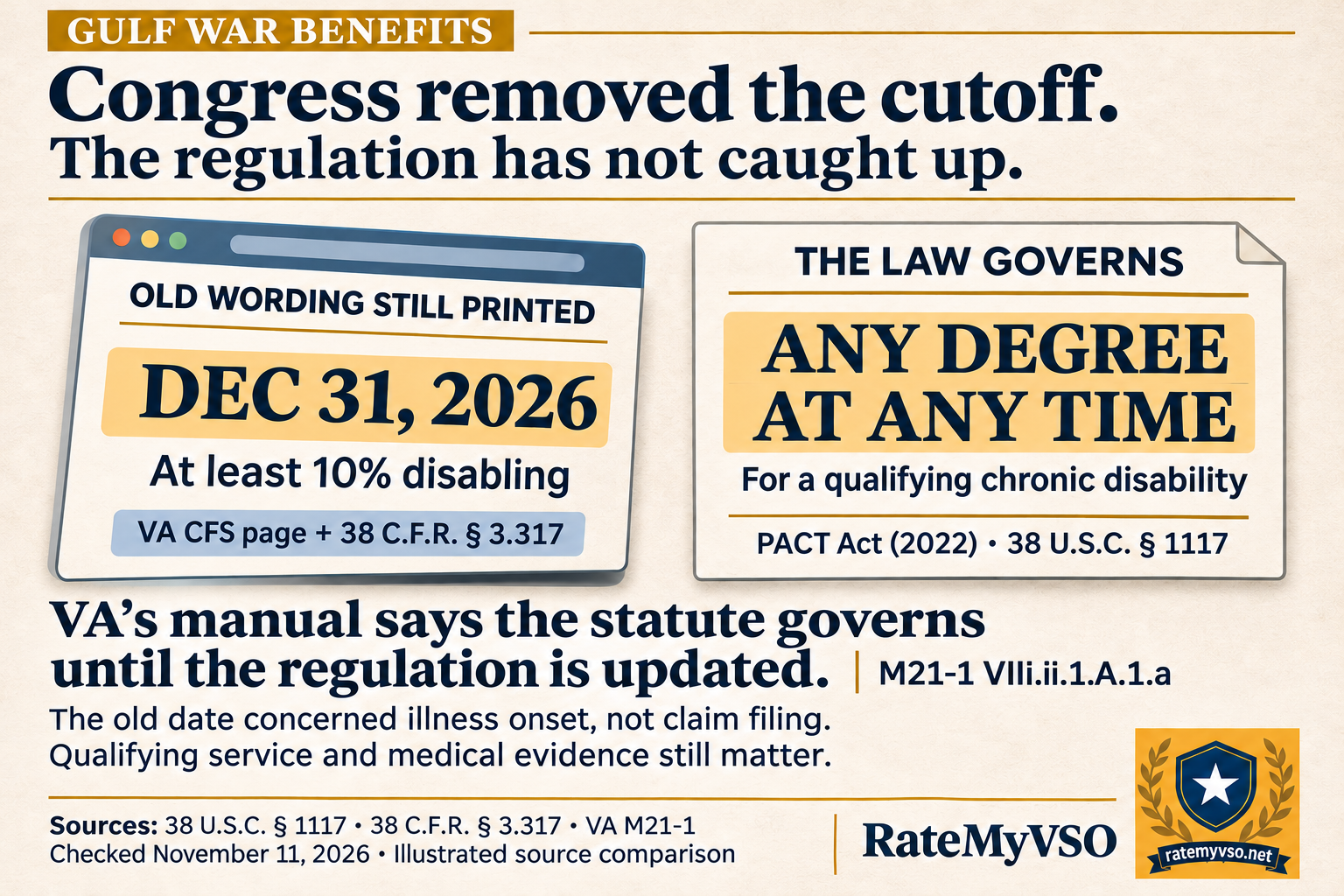
Congress already changed that rule. Section 405 of the PACT Act, enacted in August 2022, replaced the old timing and minimum-severity language. The law now says a qualifying chronic disability may become apparent “to any degree at any time.” [2]
VA’s claims manual addresses the mismatch: the amended statute governs until VA updates the regulation. Veterans do not have to wait for that rewrite for the removed cutoff to stop applying. [2] [10]
More than four years later, the public-facing messages still disagree.
Two VA pages, two different messages
RateMyVSO checked VA’s “Chronic Fatigue Syndrome in Gulf War Veterans” page on November 11, 2026. It still carried the December 31 date and the 10% requirement. The page displays a “Last updated April 27, 2026” date, but that label does not say what was changed. [1]
VA’s main Gulf War disability-benefits page tells a different story. It lists chronic fatigue syndrome among conditions that may be diagnosed during active duty or at any time after separation, provided the veteran meets the other requirements. [3]
| Source | What it says |
|---|---|
| VA chronic-fatigue page | Illness during qualifying service or by December 31, 2026; at least 10% disabling. [1] |
| VA regulation | Still prints the December 31, 2026 onset limit and 10% threshold. [9] |
| Amended federal law | A qualifying chronic disability may appear to any degree at any time. [2] |
| VA claims manual | Says the statute governs until the regulation is updated. [10] |
| VA main benefits page | Lists CFS among conditions diagnosed during service or at any time after separation, with other requirements. [3] |
Paraphrases of the sources, not screenshots. This comparison concerns the Gulf War chronic-disability presumption.
A veteran should not have to compare two government pages and then look up a federal statute to find out which date to believe. Here, the amended law supplies the answer: December 31, 2026 is not the cutoff under this provision. [2]
Where the date came from
The date was real under the earlier rules. In October 2021, VA announced that it had extended the presumptive period through December 31, 2026. The concern was that veterans whose illnesses appeared later could otherwise be excluded. [4]
Then Congress changed the law in 2022. Instead of setting another expiration date, it removed the old manifestation limit and the 10% threshold for this presumption. [2]
“Manifestation” simply means the illness becomes apparent. It describes the illness’s timing. Filing a claim is a separate event. Even the old December date was not a general deadline to get a claim into VA.
VA acknowledged the change in an October 2024 proposed regulation. The agency explained that the PACT Act had removed those requirements and proposed updating its regulatory wording to match. That proposal documented a change Congress had already made; it was not a reason for veterans to wait for another extension. [5]
As of November 11, 2026, that proposed amendment had not been finalized. VA’s regulation, 38 C.F.R. § 3.317(a)(1), still printed the December 31, 2026 date and 10% threshold in the eCFR text checked for November 9. The CFS health page repeats that old wording. [1] [5] [9]
VA tells claims staff to follow the statute
VA’s adjudication manual, called M21-1, expressly says that the statutory authority in section 1117 governs until VA updates section 3.317. It also describes the presumption as applying to a qualifying chronic disability that appears to any degree at any time. [10]
The unfinished task is updating the regulatory wording. Congress’s removal of the cutoff is already in the law. [2] [10]
What the change does and what a claim still needs
This concerns a particular Gulf War presumption: the rule allowing certain chronic disabilities to be connected to qualifying service without the veteran proving the usual medical link. It includes undiagnosed illness and medically unexplained chronic multisymptom illness. The law specifically names chronic fatigue syndrome, fibromyalgia and irritable bowel syndrome as examples. [2]
It does not mean every illness in every Gulf War veteran qualifies. VA still needs evidence of qualifying service and the qualifying condition. Its benefits guidance also requires the illness to have lasted at least six months. The recognized service locations extend beyond the 1991 Desert Storm campaign; readers should check the location and service dates that apply to them. [3]
And chronic fatigue syndrome is a specific medical diagnosis. Feeling exhausted does not, by itself, establish it. VA’s diagnostic criteria require an evaluation that considers other possible causes, along with the required pattern and duration of symptoms. [6]
Removing the old 10% eligibility threshold also does not guarantee a monthly check. Establishing service connection and deciding a disability rating are separate questions. VA bases the rating on the severity of the service-connected disability. [7]
Other Gulf War presumptions have their own rules. For example, VA lists separate timing requirements for certain infectious diseases. The change discussed here is not a blanket removal of every benefits deadline. [3]
If that date made you hesitate
Do not use the December 2026 wording on the CFS page to rule yourself out. Start with the current Gulf War benefits guidance and the amended law, then check your service and medical records against the actual requirements. [2] [3]
If VA previously denied your claim, look at the reason in the decision letter. VA says veterans whose previously denied conditions are now presumptive can submit a Supplemental Claim. An accredited representative can help review which route fits the decision and evidence. Other review deadlines and rules affecting when benefits can begin still matter; this article does not establish anyone’s back-pay date. [3] [8]
This review did not identify a veteran whose claim was denied because of this webpage. The health page repeats the old limit still printed in VA’s regulation, but no VA statement reviewed here explains why the page has not been corrected. The statute and VA’s manual make clear that the removed cutoff does not govern these qualifying claims. [1] [2] [9] [10]
Updating that sentence would save veterans from having to untangle the contradiction themselves.
Reporting note: Public documents checked November 11, 2026. The eCFR text is dated November 9; the 2024 proposed amendment had not been finalized as of November 11. The manual establishes VA’s written guidance, not how every individual claim was decided. This article reports no interview or VA response. Eligibility, review deadlines and effective dates depend on the claim. [5] [9] [10]
Sources
1. VA Public Health: Chronic Fatigue Syndrome in Gulf War Veterans. Current page text checked November 11, 2026.
2. 38 U.S.C. § 1117: Compensation for disabilities occurring in Persian Gulf War veterans. Subsections (a) and (f), plus the 2022 amendment notes. Page states laws in effect through October 7, 2026.
3. VA: Gulf War illnesses linked to Southwest Asia service. Current page checked November 11, 2026; displayed update date May 15, 2024.
4. VA News: VA extends presumptive period for Persian Gulf War Veterans. October 28, 2021. Historical announcement preceding the PACT Act.
5. VA proposed rule: VA Adjudication Regulations for Disability or Death Benefit Claims Based on Toxic Exposure. October 1, 2024; 89 FR 79815, discussion at 79821. Proposed rule, not a final rule.
6. 38 C.F.R. § 4.88a: Chronic fatigue syndrome. Official 2025 annual CFR edition, pp. 461–462. Cited only for diagnostic requirements.
7. VA: About disability ratings. Explains how the severity of a service-connected disability affects its rating.
8. VA: Decision reviews FAQs. Review options, timing and effective-date considerations.
9. 38 C.F.R. § 3.317: Compensation for certain disabilities occurring in Persian Gulf veterans. Section (a)(1)(i), eCFR text as of November 9, 2026. Version history lists September 14, 2021 as the latest substantive amendment.
10. VA M21-1, Part VIII, Subpart ii, Chapter 1, Section A: General Information on Presumptive Service Connection for Persian Gulf Veterans. Sections VIII.ii.1.A.1.a and 1.c. Published manual text updated June 6, 2025; statutory authority governs until the regulation is updated.