Rating reference network
Cancer Residuals Network
When the VA's 100% rating for active cancer ends, ratings move to the lasting effects of the cancer and its treatment. This page maps the residual conditions most commonly rated after service-connected cancer, drawn from 38 CFR Part 4 and the VA M21-1 Adjudication Manual.
Encyclopedic reference, not medical advice and not a prediction of any individual claim outcome. Consult an accredited representative before filing.

Loading cancer residuals data...
Each cancer type below lists the residual conditions most commonly rated after active treatment ends. Click any condition to open its diagnostic code page.
How Residuals Are Rated After Active Cancer Ends
When the VA's 100% rating for active cancer ends, each lasting disability is rated under its own diagnostic code. There is no single "cancer in remission" rating. The sections below cover the two highest-volume cancers in the veteran population in detail.
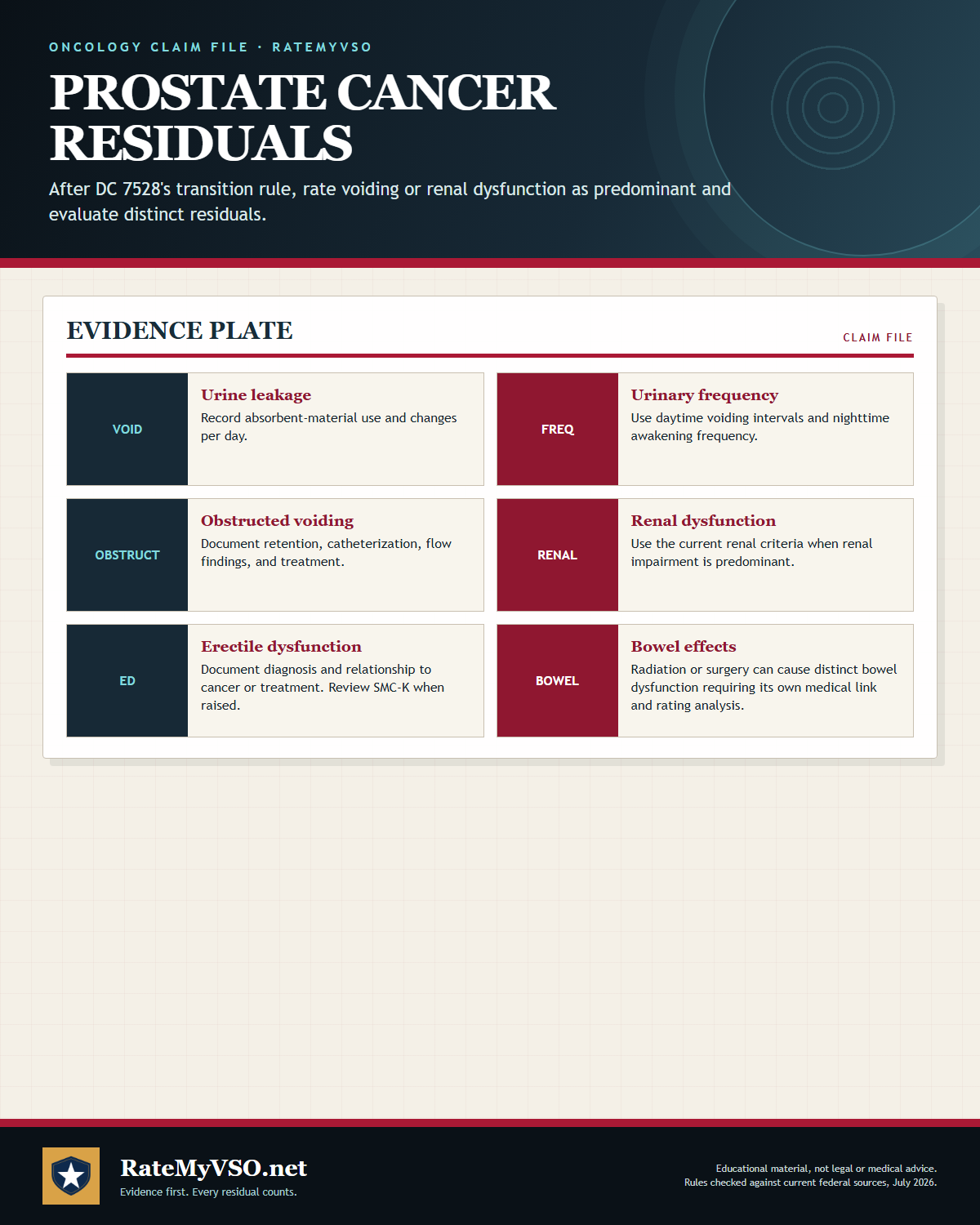
Prostate Cancer Residuals (38 CFR § 4.115b, DC 7528)
After the mandatory six-month post-treatment exam shows no local recurrence or metastasis, DC 7528 requires rating on residuals as voiding dysfunction or renal dysfunction, whichever is predominant. The voiding dysfunction criteria are in 38 CFR § 4.115a.
Urinary frequency: Daytime voiding interval of two to four hours or waking at least twice at night rates 10%. Daytime interval under one hour or waking five or more times at night rates 40%.
Urinary incontinence requiring absorbent materials: Changing less than twice daily rates 20%. Two to four changes daily rates 40%. More than four changes daily or requiring a urinary appliance rates 60%. This is the highest schedular rating commonly reached through voiding dysfunction alone.
Renal dysfunction: If prostate cancer or its treatment impaired kidney function, this is rated separately under the renal dysfunction criteria of 38 CFR § 4.115a.
Bowel dysfunction from radiation: Pelvic radiation for prostate cancer can cause bowel incontinence or urgency rated under DC 7332.
SMC-K for erectile dysfunction: Erectile dysfunction after prostate cancer (from the cancer itself, prostatectomy, radiation, or cryotherapy) qualifies for Special Monthly Compensation at the K rate under 38 CFR § 3.350(a) for loss of use of a creative organ. DC 7522 (erectile dysfunction) is typically rated 0% with retained anatomy, but SMC-K adds a separate monthly payment (approximately $139.87 per month as of 2026) on top of the combined rating. This requires a separate claim and is the most commonly missed benefit in prostate cancer cases. The rating system does not automatically flag it; the veteran or representative must raise it explicitly. See the SMC Guide.
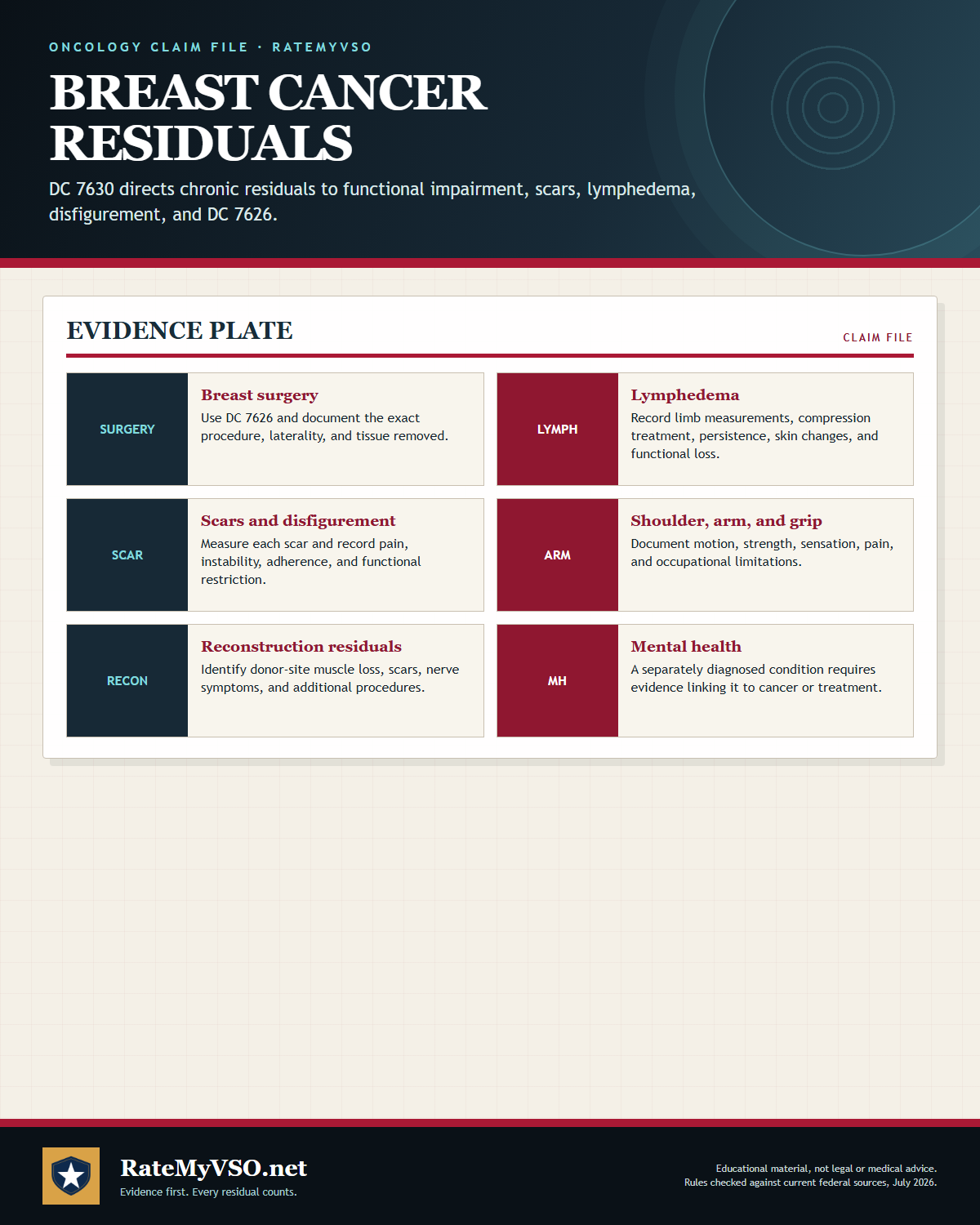
Breast Cancer Residuals (38 CFR § 4.116, DC 7630 active / DC 7626 surgery)
After the mandatory six-month post-treatment exam, residuals of breast cancer are rated based on impairment of function due to scars, lymphedema, disfigurement, and surgical outcomes. The relevant diagnostic codes are DC 7630 (active malignant neoplasm of the breast, rated 100% while active) and DC 7626 (surgery of the breast, covering mastectomy residuals).
Mastectomy ratings under DC 7626:
- Radical mastectomy (both breasts): 80%
- Radical mastectomy (one breast): 50%
- Modified radical mastectomy (both): 60%
- Modified radical mastectomy (one): 40%
- Simple mastectomy or wide excision with significant alteration in appearance (both): 50%
- Simple mastectomy or wide excision with significant alteration in appearance (one): 30%
- Wide excision without significant alteration: 0%
Lymphedema (DC 7121): Lymph node dissection or axillary radiation frequently causes arm or hand lymphedema on the treated side. This is rated from 0% for asymptomatic cases through increasing percentages tied to functional impairment. Lymphedema is among the most consistently underclaimed residuals in breast cancer cases.
Scarring (DC 7800 through DC 7805): Surgical scars rated by surface area, pain, and whether they limit motion near joints.
Limited shoulder and arm motion: Post-surgical or post-radiation restriction of the shoulder rated under musculoskeletal codes (DC 5201 through DC 5203).
Ongoing hormone therapy: Under DC 7630, the 100% rating continues while qualifying breast-cancer treatment remains ongoing and through the required six-month post-treatment examination period. Hormone therapy may qualify when the oncology record shows that it is being used as antineoplastic treatment for the cancer. Long-term hormone therapy does not automatically make the 100% rating permanent; the purpose of the medication and the documented treatment status matter. (38 CFR § 4.116)
PACT Act note: Breast cancer falls within "reproductive cancer of any type," which is a presumptive condition under the Sergeant First Class Heath Robinson PACT Act of 2022 for veterans who served in qualifying Southwest Asia locations on or after August 2, 1990, or in Afghanistan, Djibouti, Syria, or Uzbekistan on or after September 19, 2001. Veterans denied before August 10, 2022 may file a Supplemental Claim citing the PACT Act. (Pub. L. 117-168)