How the VA Fully Developed Claim (FDC) Program Works
The Fully Developed Claim program is an optional way to file. You gather all your available evidence, submit it with your application, and certify there is no more evidence to come. This page explains what that involves, what the VA still gathers on its own, and what happens if your claim later reverts to a Standard claim.

What a Fully Developed Claim Is
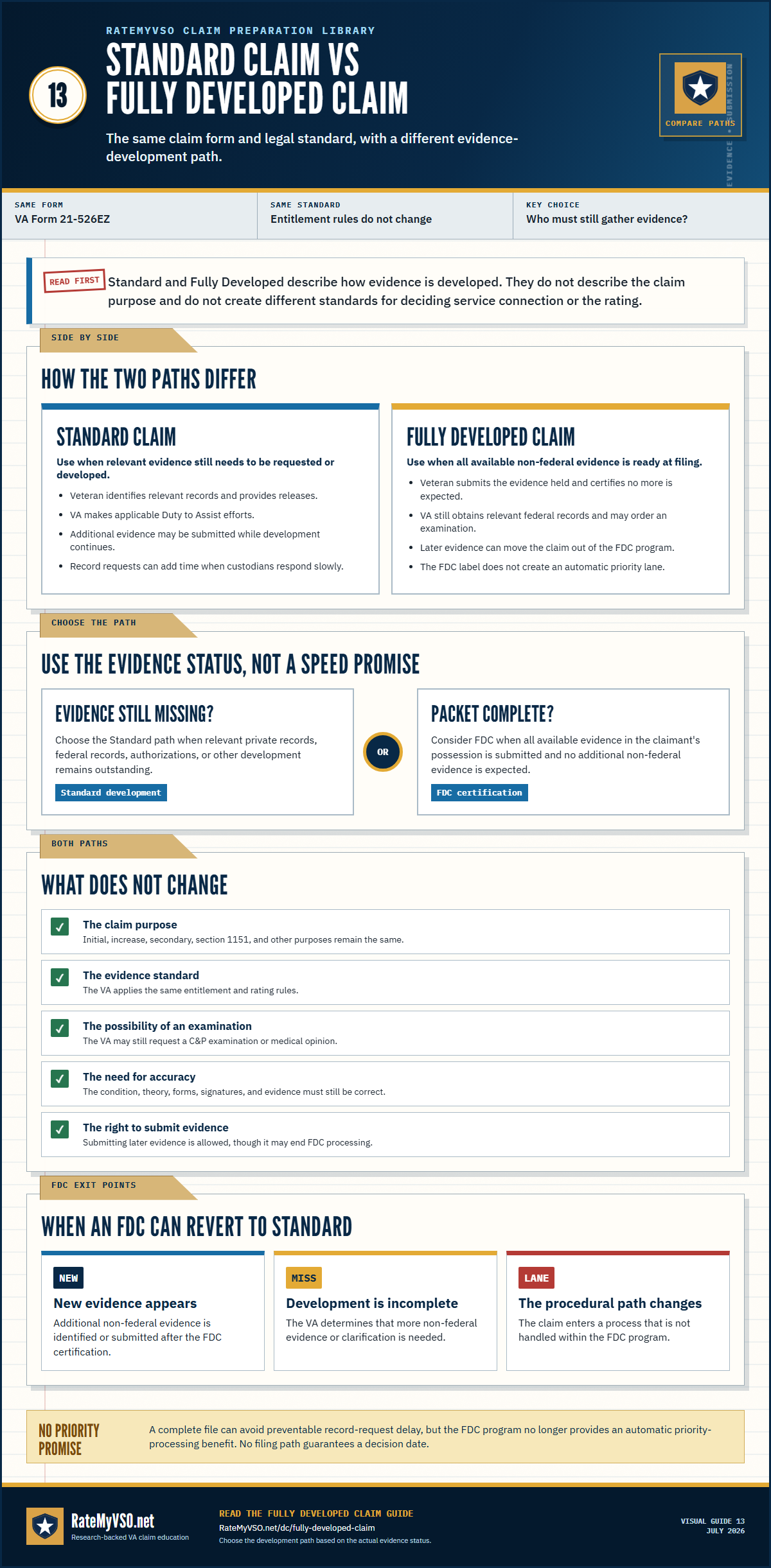
The Fully Developed Claim (FDC) program is an optional way to file a VA disability claim. It uses the same application as a standard claim, VA Form 21-526EZ. The difference is how the evidence reaches the VA.
Under the FDC program, you gather all your available evidence and submit it with your application. You then certify there is no more evidence to submit. Your file is already complete, so the VA can reach a decision sooner than when it waits for evidence to arrive piece by piece.
Source: VA, Fully Developed Claims, va.gov/disability/how-to-file-claim/evidence-needed/fully-developed-claims.
What the Veteran Submits
To file under the FDC program, you submit everything you reasonably have in hand when you file. That includes:
- All relevant evidence you already have: documents, statements, and records that support your claim.
- Private records you can get easily: for example, private treatment records from a non-VA doctor or hospital. These are records you can gather without much delay.
This evidence goes in with your application, not after it. The point of the program is that your file is as complete as you can make it on the day you submit it.
What the VA Still Obtains
Filing under the FDC program does not mean you gather every record alone. The VA still gathers certain federal records on its own. These include:
- Service treatment records: your military medical records.
- VA medical records: treatment records from VA facilities.
- Social Security Administration (SSA) records: when they are relevant to your claim.
The VA still schedules a Compensation and Pension (C&P) exam if your claim needs one. The exam is part of the regular process. It does not move your claim off the FDC path.
Processing Speed
An FDC can reach a decision sooner because the file is complete. When your evidence is already in, the VA skips the slow back-and-forth of requesting records from third parties and waiting for them to come back. That third-party record gathering is often the longest part of a standard claim.
The FDC program once carried a separate priority-processing benefit. The VA discontinued that benefit after 2022. The program still exists, and a complete file still avoids the third-party wait. There is no longer a special priority lane tied to it.
When an FDC Reverts to a Standard Claim
A claim filed under the FDC program can move back to the Standard path. The VA calls this a revert. It can happen when:
- You add new evidence later: if more evidence comes in after you file, your certification that the file was complete no longer holds.
- The VA must request a record from a third party: if the VA needs a non-federal record outside the file you submitted, your claim moves to the Standard path so the VA can request it.
- An appeal opens: if your claim enters an appeal, the VA handles it as a Standard claim.
FDC vs Standard at a Glance
This table sets the two paths side by side. Both use VA Form 21-526EZ and follow the same rules for deciding your claim.
| Fully Developed Claim | Standard Claim | |
|---|---|---|
| Who gathers private records | You gather and submit private records up front. | The VA helps request the private records you identify. |
| Your certification | You certify there is no more evidence to submit. | You do not certify this. |
| Federal records | The VA still gathers service, VA medical, and SSA records. | The VA gathers service, VA medical, and SSA records. |
| Reverts when | You add new evidence, the VA must request a third-party record, or an appeal opens. | This does not apply. Your claim is already on the Standard path. |
How the VA claim types compare
This chart shows what each VA claim type is for and how it differs from the others. It does not tell you which one to file. For help with your own claim, work with a free VA-accredited representative.
| Claim type | Use it when | Form | What makes it different |
|---|---|---|---|
| What you are claiming (the purpose) | |||
| Initial | You claim a condition the VA has not decided before. | VA Form 21-526EZ | You prove three elements: a current diagnosis, an in-service event, and a nexus that links them. |
| Increase | A condition the VA already granted has gotten worse. | VA Form 21-526EZ | You ask for a higher rating on a condition you already won. |
| Secondary | A service-connected condition caused or worsened a new one. | VA Form 21-526EZ | You need a medical nexus that links the new condition to the service-connected one (38 CFR 3.310). |
| 1151 | VA medical care caused an added disability. | VA Form 21-526EZ | You show VA fault or an event that was not reasonably foreseeable. If granted, the VA pays it as if it were service-connected. |
| How the VA develops your claim (the path) | |||
| Standard | You want the VA to gather your records for you. | Same 526EZ claim, no separate form | The VA gathers evidence under its Duty to Assist. This is the default path and it takes longer. |
| Fully Developed You are here | You already hold all of your evidence. | Same 526EZ claim, no separate form | You submit everything up front and certify there is no more. The VA still pulls federal records. It moves faster. |
The top group is what you claim. The bottom group is how the VA develops it. All four claim purposes use the same form, VA Form 21-526EZ. Every claim has one purpose and one development path. An initial claim, for example, is filed as either a Standard or a Fully Developed claim.
Frequently Asked Questions
Did I lose anything if my FDC reverts to Standard?
No. The evidence you already submitted stays in the file and still counts. A revert changes the processing path, not the record. The VA uses the same rules to decide your claim on either path, so the outcome rules do not change.
Is an FDC still faster than a Standard claim?
A complete file avoids the slow back-and-forth of the VA requesting records from third parties. That wait is often the longest part of a Standard claim. The separate priority-processing benefit ended after 2022, so there is no special priority lane anymore. No path promises a specific timeline. How long your claim takes depends on its own facts.
Does the FDC program skip the C&P exam?
No. The VA still schedules a Compensation and Pension (C&P) exam if your claim needs one. The exam is part of the regular process. It does not move your claim off the FDC path.
RateMyVSO. Educational resource. Not affiliated with the U.S. Department of Veterans Affairs. Not legal advice. All RateMyVSO tools are free. Find a VSO representative for personalized guidance.