How a VA Initial Claim Works
An initial claim is the first complete claim the VA receives for a benefit. Every new condition you bring to the VA starts as an initial claim. It does not matter how many claims you have filed before. This page explains what that means, the three elements a direct service-connection claim must show, and how the VA sets the effective date.

What an Initial Claim Is
An initial claim is the first complete claim the VA receives for a benefit. The VA's regulations use the formal term original claim for the same thing. Under 38 CFR § 3.160(b), an original claim is "the initial complete claim for one or more benefits on an application form prescribed by the Secretary." On VA.gov and in the VA's systems, this same first-time claim is called an initial claim. Both terms mean the same filing. This guide uses initial claim.
The VA treats every new condition you bring to it as an initial claim. It does not matter how many claims you filed before. Say you have a service-connected back condition and you later bring a brand-new knee condition to the VA. That knee condition is its own initial claim.
You file an initial claim for disability compensation on VA Form 21-526EZ (Application for Disability Compensation and Related Compensation Benefits).
The Three Elements of Direct Service Connection
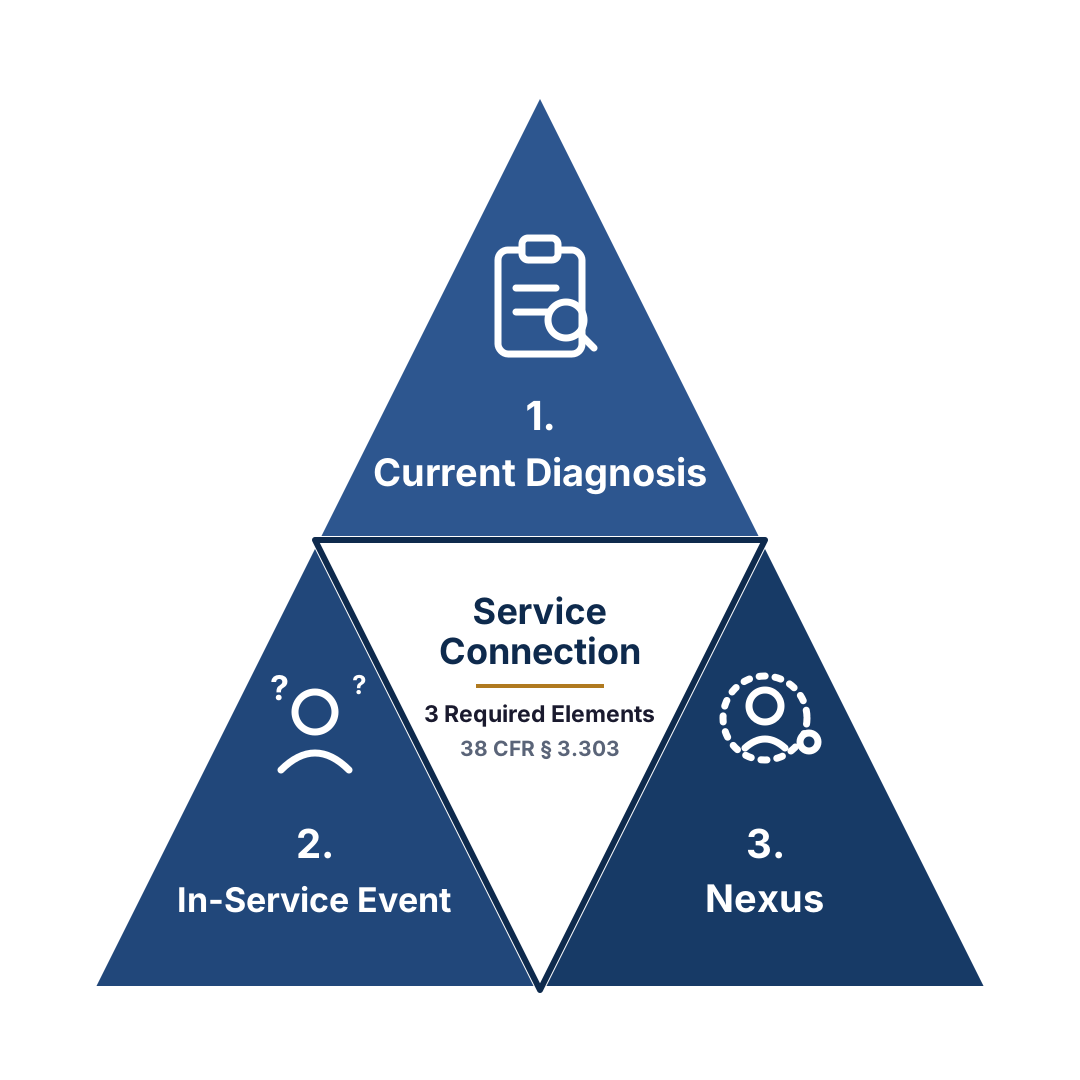
Most original compensation claims ask the VA to grant direct service connection. Under 38 CFR § 3.303, your record must show three elements before the VA grants direct service connection.
Current Diagnosis
A current diagnosed disability. The condition has to be present now, not only in the past.
In-Service Event
An event, injury, or illness that happened during military service.
Nexus
A medical link, called a nexus, connecting the current diagnosis to the in-service event.
Evidence an Initial Claim Relies On
The VA decides an initial claim on the evidence in your file. The kinds of evidence that commonly appear in a direct service-connection record include:
- Service treatment records: the medical records created during your military service. They can show the in-service event or injury.
- Current medical records: recent records from a VA or private provider that show your current diagnosis.
- Nexus letter or independent medical opinion (IMO): a written medical opinion that links your current condition to service. See the Nexus Letter Guide.
- Buddy or lay statements: written statements from people who witnessed an event or your symptoms. See the Buddy Statement Guide.
- Disability Benefits Questionnaire (DBQ): a structured medical form that records your condition in the format the VA uses to rate it. See the DBQ Guide.
- Compensation and pension (C&P) exam: an exam the VA schedules when it needs a medical opinion or current findings to decide your claim.
How the Effective Date Works
The effective date is the date the VA figures benefits from if it grants your claim. For an initial claim, an Intent to File (ITF) can hold that date in place.
An Intent to File tells the VA that a claim is coming. Once an ITF is on record, it holds the effective date for up to one year while you gather evidence. File a complete claim within that year and the effective date is the ITF date or the claim date, whichever is earlier.
Effective-date rules: 38 CFR § 3.400 and 38 CFR § 3.155.
The Effective Dates Guide explains how the VA sets these dates in more detail.
How the VA Develops an Initial Claim
After you file an initial claim, it follows one of two routes. The route depends on how you submit the evidence.
| Route | How evidence is handled |
|---|---|
| Standard Claim | The default route. The VA gathers evidence for you under its Duty to Assist, such as service records and private records you identify. See the Standard Claim Guide. |
| Fully Developed Claim | An optional program. You submit all the evidence you hold up front and certify there is nothing more to send. See the Fully Developed Claim Guide. |
Both routes use the same form, VA Form 21-526EZ. The difference is who gathers the evidence and when.
How the VA claim types compare
This chart shows what each VA claim type is for and how it differs from the others. It does not tell you which one to file. For help with your own claim, work with a free VA-accredited representative.
| Claim type | Use it when | Form | What makes it different |
|---|---|---|---|
| What you are claiming (the purpose) | |||
| Initial You are here | You claim a condition the VA has not decided before. | VA Form 21-526EZ | You prove three elements: a current diagnosis, an in-service event, and a nexus that links them. |
| Increase | A condition the VA already granted has gotten worse. | VA Form 21-526EZ | You ask for a higher rating on a condition you already won. |
| Secondary | A service-connected condition caused or worsened a new one. | VA Form 21-526EZ | You need a medical nexus that links the new condition to the service-connected one (38 CFR 3.310). |
| 1151 | VA medical care caused an added disability. | VA Form 21-526EZ | You show VA fault or an event that was not reasonably foreseeable. If granted, the VA pays it as if it were service-connected. |
| How the VA develops your claim (the path) | |||
| Standard | You want the VA to gather your records for you. | Same 526EZ claim, no separate form | The VA gathers evidence under its Duty to Assist. This is the default path and it takes longer. |
| Fully Developed | You already hold all of your evidence. | Same 526EZ claim, no separate form | You submit everything up front and certify there is no more. The VA still pulls federal records. It moves faster. |
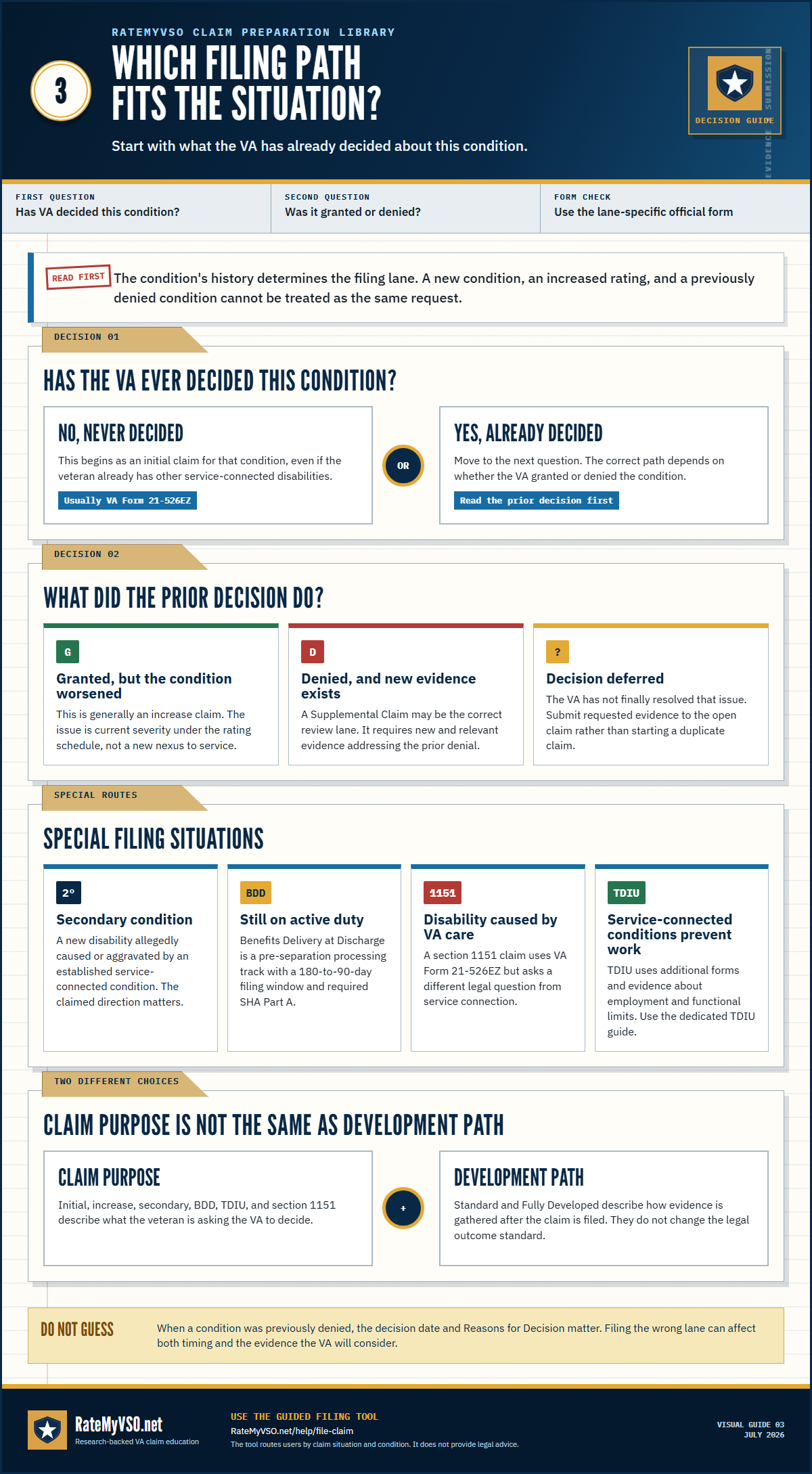
The top group is what you claim. The bottom group is how the VA develops it. All four claim purposes use the same form, VA Form 21-526EZ. Every claim has one purpose and one development path. An initial claim, for example, is filed as either a Standard or a Fully Developed claim.
Frequently Asked Questions
What is the difference between an initial claim and an original claim?
They are the same filing. "Original claim" is the formal term in 38 CFR § 3.160(b). "Initial claim" is the plain-English label VA.gov and the VA's systems use for a first-time claim. The label does not change the evidence rules or the outcome.
Is every new condition an initial claim?
Yes. A condition the VA has not decided before is an initial claim. It does not matter how many other claims you filed in the past.
What form is an initial claim filed on?
You file an initial claim for disability compensation on VA Form 21-526EZ, the Application for Disability Compensation and Related Compensation Benefits.
I was denied before. Do I file a new initial claim?
No. A condition the VA already decided or denied is not a new initial claim. You handle that situation through a different lane, such as a Supplemental Claim or another appeal route.
What is an Intent to File?
An Intent to File (ITF) tells the VA that a claim is coming. It holds the effective date for up to one year while you gather evidence. File a complete claim within that year and the effective date is the ITF date or the claim date, whichever is earlier.
RateMyVSO. Educational resource. Not affiliated with the U.S. Department of Veterans Affairs. Not legal advice. All RateMyVSO tools are free. Find a VSO representative for personalized guidance.