Filing a VA Rating Increase: Before You File, Read This
If a service-connected condition has gotten worse, you can file an increased-rating claim. The form is simple. The strategy is not. A blind filing, without the right evidence, without checking the next-tier criteria, can confirm the rating you already have, or in some cases lower it. This guide walks the full decision before you submit VA Form 21-526EZ: how to find your diagnostic code, how to read the rating schedule, why pain alone almost never raises a rating, when the 5-year stabilization protection in 38 CFR 3.344 actually applies, what evidence wins, and the right time to file versus wait.

Section 1: What an Increase Claim Actually Is
An increased-rating claim is filed when a condition that is already service-connected has gotten worse, and the veteran believes the current symptoms now meet a higher rating tier in 38 CFR Part 4. There is no minimum waiting period between increase claims, but filing one is not free of risk. The rater opens the file, orders a fresh C&P exam (or completes an ACE review), and re-evaluates the condition against the entire rating schedule. The outcome is one of four things: increase, confirmed and continued, reduction (rare, but possible), or proposed reduction with notice under 38 CFR 3.105(e).
The strategy question is not "is my condition worse." It is "can I prove my current symptoms now meet the criteria written in the rating schedule for the next higher tier." Those are different questions. The rest of this guide is about closing the gap between them.
Section 2: Find Your Diagnostic Code First
Every service-connected condition is rated under a four-digit diagnostic code (DC) in 38 CFR Part 4. The same body region can be rated under several different codes. A knee can be rated under 5256 (ankylosis), 5257 (recurrent subluxation or lateral instability), 5258 (dislocated semilunar cartilage), 5259 (removal of semilunar cartilage), 5260 (limitation of flexion), 5261 (limitation of extension), or 5262 (impairment of tibia and fibula). The criteria are completely different. You cannot plan an increase strategy without knowing which one VA used.
Where to look
- Top of your most recent rating decision narrative. VA sometimes prints the DC next to the condition. Sometimes not.
- Codesheet via FOIA. Submit a FOIA request to the regional office or BVA for your "rating codesheet." It lists every diagnostic code, percentage, and effective date.
- VA.gov claim status. The "Status Details" view of a recent rating sometimes lists the diagnostic code.
- Reverse-engineer it from the narrative. Every rating decision lists the criteria for the next higher level at the bottom of the disability discussion. Copy that exact wording, then search our diagnostic code lookup or the 38 CFR Part 4 schedule to find the code those criteria come from.
Section 3: Map the Next-Tier Criteria
Once you have the DC, look at the exact wording for the percentage above your current one. The rating schedule is symptom-based. Not pain-based. Not how-disabling-it-feels based. The rater is matching the documented symptoms in your record against the words in the schedule.
Example: DC 5237 (lumbosacral or cervical strain) under the General Rating Formula for Diseases and Injuries of the Spine in 38 CFR 4.71a. The ladder for the cervical spine reads:
20%: forward flexion of the cervical spine greater than 15 degrees but not greater than 30 degrees; combined range of motion of the cervical spine not greater than 170 degrees; muscle spasm or guarding severe enough to result in an abnormal gait or abnormal spinal contour such as scoliosis, reversed lordosis, or abnormal kyphosis.
30%: forward flexion of the cervical spine 15 degrees or less; or, favorable ankylosis of the entire cervical spine.
If a veteran is currently rated 20% and wants 30%, the conversation at the C&P exam needs to be about forward flexion measured at 15 degrees or less, or favorable ankylosis. Spending the appointment talking about kyphosis is not wrong, it is just not the symptom that moves the rating from 20 to 30. Kyphosis is already in the 20% box.
This is the single most important moment in the strategy: write down the exact wording of the next-tier criteria, and ask honestly whether your most recent objective measurements (most recent range-of-motion in your VA notes, most recent imaging, most recent diagnostic tests) support it. If they do not, that is the answer. Get the objective evidence first, then file.
Section 4: The Pain Myth
Pain is real. Pain is debilitating. Pain counts for something in the rating schedule. But for most musculoskeletal conditions, the only thing pain alone earns you is the minimum compensable rating: 10% for most joints, 20% for the shoulder. That is the rule from 38 CFR 4.59, as confirmed by the Federal Circuit in Mitchell v. Shinseki, 25 Vet. App. 32 (2011) and Burton v. Shinseki, 25 Vet. App. 1 (2011): painful motion of a joint is entitled to the minimum compensable evaluation. Not more.
Pain at 2-out-of-10 versus pain at 9-out-of-10 does not change the rating. Increasing pain over time is a medical treatment concern, raise it with your VA primary care, ask for a referral to pain management, fill out a new DBQ. It is not what gets you from 10% to 20%, or from 20% to 30%.
What changes the rating in musculoskeletal conditions:
- Measured range of motion at the next-tier threshold.
- Objective findings: ankylosis, muscle spasm with abnormal gait or spinal contour, recurrent subluxation, instability.
- Functional loss under 38 CFR 4.40 and 4.45 (weakness, fatigability, incoordination), measured during a flare-up if possible.
- DeLuca factors from DeLuca v. Brown, 8 Vet. App. 202 (1995), how much additional limitation a flare-up causes.
Section 5: The Reduction Risk Is Real but Bounded
The number-one fear of filing an increase is being reduced instead. The risk exists, but the protections are specific. Know which ones cover you.
Stabilized rating: 38 CFR 3.344
Special protections apply to "ratings which have continued for long periods at the same level (5 years or more)" (see 38 CFR 3.344(a) and (c)). For these stabilized ratings, VA generally cannot reduce based on a single examination, unless all the evidence of record clearly warrants the conclusion that sustained improvement has been demonstrated (38 CFR 3.344(b)). Outside that narrow exception, the reduction has to be based on the entire record, an examination as full and complete as the one that originally established the rating, and material improvement that is reasonably certain to be maintained under the ordinary conditions of life. That is a high bar, and a reduction built on a thin record is vulnerable on appeal.
Protected ratings: 38 CFR 3.951(b) and 3.952
A rating in effect for 20 years or more becomes a "continuous rating" under 38 CFR 3.951(b) and cannot be reduced below the level held for 20 years, except on a showing of fraud. A 100% rating in effect for 20 years is locked at 100%. Service connection itself is protected from severance after 10 years under 38 CFR 3.957, except for fraud or a showing that the veteran did not have the requisite service or a qualifying discharge. See the Rating Protections guide for the full ladder.
The danger zone: under 5 years
If the rating you want to increase has been in effect less than 5 years, 38 CFR 3.344(c) says reduction can be based on a single examination showing improvement. There is no "material improvement reasonably certain to continue" requirement. This is where the reduction-on-increase horror stories come from. The veteran files for more, the exam documents improvement (even if just on that one day), the rater proposes a reduction under 38 CFR 3.105(e), and the rating drops.
The whole file gets reviewed
Filing any claim opens the file. If the rater notices a Clear and Unmistakable Error (CUE) on an existing grant, even one unrelated to the condition you are asking about, they can act on it. See the CUE guide. Stabilized ratings still get protection, but it pays to know what is in your file before you ask VA to look at it again.
Section 6: Evidence That Wins an Increase
The C&P examiner does not start from zero. They review what is in the file, plus what you submit with the claim. What gets seen is what the Veterans Service Representative (VSR) chooses to forward in the examination request. If the records that matter live deep in your CAPRI file, the examiner may never read them.
We analyzed the Board's published decisions and found a private medical opinion is the highest-yield evidence for these claims:
The submission packet
- Most recent objective measurements from VA or private records that match the next-tier criteria (range of motion, sleep study AHI, MRI, PFT, audiogram, MOCA, GAF replacement scales).
- A current DBQ if you can get one. A treating physician (VA or private) can fill out the appropriate Disability Benefits Questionnaire. A complete DBQ from a treating physician can substitute for or supplement the C&P exam.
- VA Form 21-4142 and 21-4142a authorizing VA to retrieve specific private treatment records. Forms at va.gov/find-forms/about-form-21-4142.
- A My HealtheVet "Blue Button" report of the relevant VA primary-care, specialty, or pain-clinic notes from the last 12 months. Highlight the entries that demonstrate next-tier symptoms.
- Lay statements from spouse, coworkers, friends, or yourself describing observable symptoms and frequency of flare-ups. Lay testimony is competent evidence for observable symptoms under Buchanan v. Nicholson, 451 F.3d 1331 (Fed. Cir. 2006).
Submit the packet on the same day as the claim. Trickling evidence in afterward risks it not reaching the examiner before the exam is scheduled. The current claim-processing speed is much faster than veterans expect.
See the Medical Opinion Weighing guide for what makes a medical opinion probative under Nieves-Rodriguez v. Peake, 22 Vet. App. 295 (2008), and the Negative Evidence guide for what to avoid handing VA.
Section 7: Flare-Ups, Sharp v. Shulkin, and Why the C&P Snapshot Lies
Many service-connected conditions are episodic. The C&P examination captures one moment. If that moment is a good day, the exam under-states the disability. The Court of Veterans Appeals addressed this directly in Sharp v. Shulkin, 29 Vet. App. 26 (2017): the examiner is required to ask about flare-ups, document the additional functional loss during flares, and explain why an opinion on flare severity cannot be given if one is declined. A C&P report that records normal range of motion at the exam and says nothing about flares is inadequate and grounds for a remand.
How to use this:
- Walk in prepared with a clear description of your flare frequency, duration, triggers, and functional loss during a flare. Example: "Two to three times a month, lasting 24 to 48 hours, triggered by lifting more than 20 pounds. During a flare, I cannot put weight on the leg without help."
- The examiner must address it. If the report does not, the rating decision based on that report is challengeable under Sharp.
- See the Painful Motion guide and C&P Exam Preparation guide.
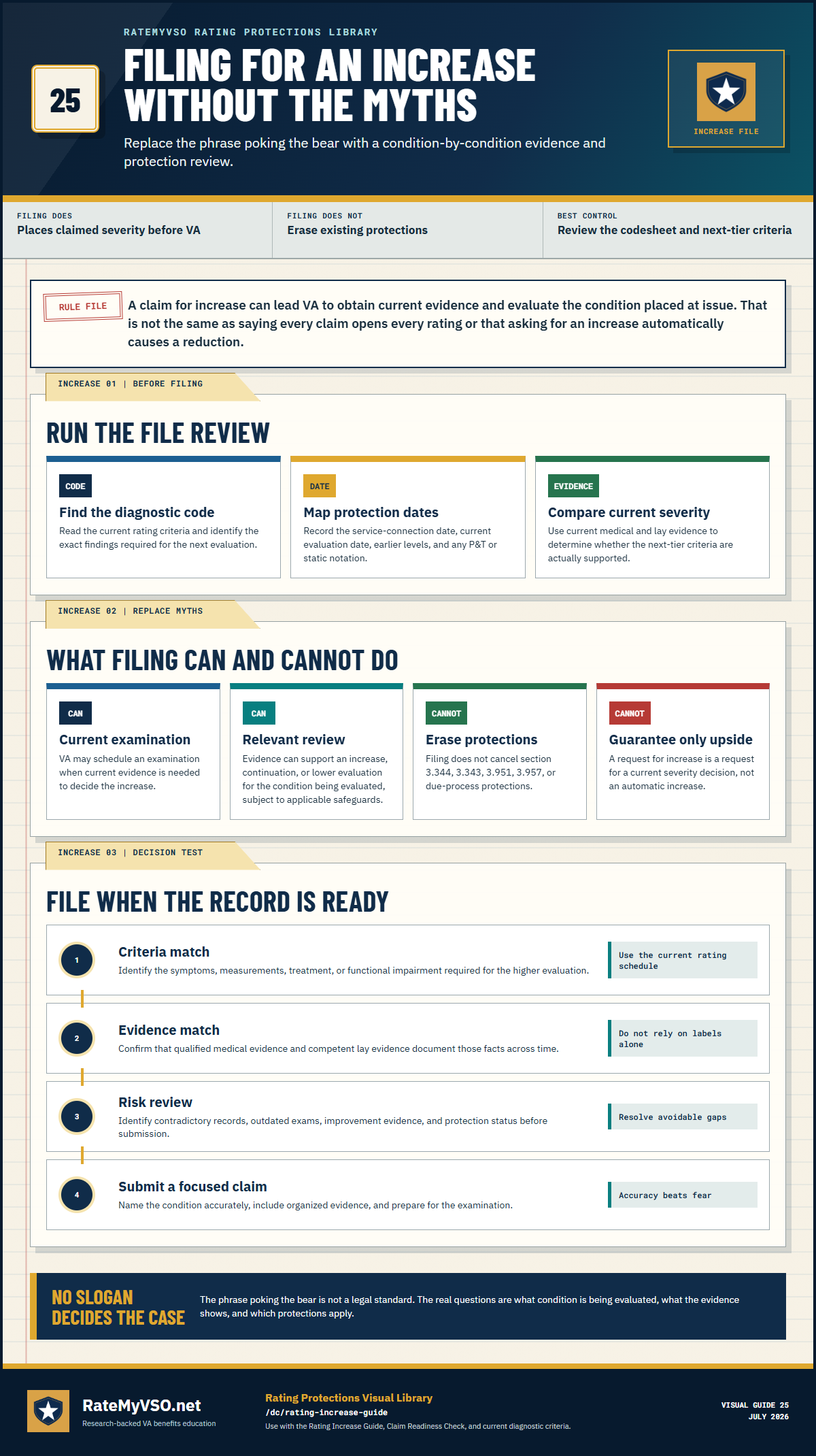
Section 8: Filing the Claim Itself
Step 1: Intent to File (ITF)
Submit a VA Form 21-0966 (or call 1-800-827-1000, or start a claim online at va.gov/disability/how-to-file-claim) to lock in today's date as a potential effective date. The ITF gives you one year to file the formal claim. If the increase is granted, the effective date can reach back to the ITF date.
Step 2: VA Form 21-526EZ
The formal claim. On the application, select the existing service-connected condition and indicate you are claiming an increased rating. va.gov/find-forms/about-form-21-526ez.
Step 3: Fully Developed Claim (FDC) or Standard
The Fully Developed Claim program is faster but requires the veteran to submit all evidence with the claim and certify there is no further evidence to obtain. If your packet is complete, FDC. If VA needs to chase private records via 21-4142, Standard. See the Claim Types catalog.
Step 4: Wait for the C&P (or ACE) decision
VA either schedules an in-person or telehealth C&P exam, or completes an ACE review from records. The ACE pathway is faster but does not capture any in-person finding such as painful motion under 38 CFR 4.59. If the records strongly support the next tier on objective measurements, ACE is fine. If the case depends on a current physical exam finding, advocate (politely) for in-person.
Section 9: At the C&P Exam Itself
- Bring a one-page summary of next-tier criteria and the objective findings you want documented.
- Answer what is asked. Do not lead with pain on musculoskeletal exams.
- For range-of-motion exams, follow the examiner's instructions exactly. Do not artificially limit. Do not push past the point of pain just to "look strong." Move until pain stops the motion. That is the measurement.
- Describe flares in concrete numbers: frequency, duration, functional loss.
- If the examiner is rushed, dismissive, or skips required sections, see the Bad C&P Examiner guide.
- Full preparation walkthrough at C&P Exam Prep.
Section 10: Effective Date Math
For increase claims, the effective date can reach back up to one year before the date of claim, if the evidence shows the condition met the higher level during that window. 38 CFR 3.400(o)(2): the effective date is the earliest date as of which it is factually ascertainable that an increase in disability occurred, if the claim is received within one year from that date. Otherwise, the effective date is the date of receipt of the claim.
This is why documenting a clear timeline of when the condition got worse, in your VA notes and private records, before you file the claim, matters financially. Each month of retroactive payment can be hundreds or thousands of dollars depending on the rating jump.
Full walkthrough at the Effective Dates guide and Earlier Effective Date guide.
Section 11: After the Decision
One of four outcomes:
- Increase granted. Check the effective date. If it should reach back further under 38 CFR 3.400(o)(2), file a Supplemental Claim or HLR within one year for the earlier effective date. See EED guide.
- Confirmed and continued. Same rating. Within one year, you can file a Supplemental Claim with new and relevant evidence (a fresh DBQ, new MRI, new sleep study), or file a Higher-Level Review if the rater misapplied the schedule to the existing evidence.
- Proposed reduction. 60-day notice period under 38 CFR 3.105(e) to submit evidence against the reduction. Right to a predetermination hearing. Read the Rating Reductions guide immediately.
- Reduction effected. Appeal lane choice (Supplemental, HLR, or Board) under AMA. See Supplemental Claim and HLR guide.
Section 12: When Waiting Is the Right Move
- You have a diagnostic test scheduled. MRI, sleep study, neuropsych evaluation, pulmonary function test. Wait for the result. Filing first, then trying to slide the evidence in mid-claim, risks it not reaching the examiner.
- Your symptoms are episodic and you are in a calm period. A C&P exam scheduled during a calm month captures a snapshot that hurts you. Wait for an active flare, document it with your treating provider, then file.
- The rating is < 5 years old and the objective evidence is borderline. Per Section 5, the reduction protection of 38 CFR 3.344(a) does not apply yet. Build the file first.
- You are inside 90 days of the 5-year stabilization mark. Wait for it.
Do not get paralyzed. If the objective evidence is clearly there, file. Just be deliberate about the moment.
Section 13: Three Worked Examples
Example 1: Cervical Strain, 20% rated 6 years
Veteran rated 20% under DC 5237 since 2020. Six years on record. Recent VA primary-care notes show forward flexion of the cervical spine repeatedly measured at 12 to 14 degrees, with persistent muscle spasm. Veteran submits a current DBQ from VA neurosurgery noting flexion at 13 degrees. Files 21-526EZ as an increase. Stabilization protection of 38 CFR 3.344(a) applies (5+ years). Objective measurements directly meet the 30% criterion ("forward flexion of the cervical spine 15 degrees or less"). Strong filing.
Example 2: Knee Limitation of Flexion, 10% rated 2 years
Veteran rated 10% under DC 5260 since 2024. Has more pain than before, no recent measurements of flexion, no MRI, no PT records since 2024. Wants to file an increase. Risk: less than 5 years, no objective evidence supporting the 20% tier ("limitation of flexion to 30 degrees"). A C&P examiner who measures normal flexion will confirm 10%, and may consider reduction. Better path: request a VA orthopedic consult, get a current range-of-motion measurement and PT evaluation, document a flare-up with the treating provider, then file.
Example 3: Sleep Apnea, 50% rated 8 years, weight gain, more severe AHI
Veteran rated 50% under DC 6847 for OSA requiring CPAP. New sleep study from VA pulmonology shows AHI of 62 with documented chronic respiratory failure and reliance on supplemental oxygen overnight, criteria for the 100% tier. Stabilization protection applies (8 years). Veteran submits the new sleep study, a current DBQ from VA pulmonology, and a 21-4142 for the home-health agency that delivers the oxygen equipment. Files 21-526EZ as an increase. Strong filing. ACE review is appropriate, the records support 100% on their face.
How the VA claim types compare
This chart shows what each VA claim type is for and how it differs from the others. It does not tell you which one to file. For help with your own claim, work with a free VA-accredited representative.
| Claim type | Use it when | Form | What makes it different |
|---|---|---|---|
| What you are claiming (the purpose) | |||
| Initial | You claim a condition the VA has not decided before. | VA Form 21-526EZ | You prove three elements: a current diagnosis, an in-service event, and a nexus that links them. |
| Increase You are here | A condition the VA already granted has gotten worse. | VA Form 21-526EZ | You ask for a higher rating on a condition you already won. |
| Secondary | A service-connected condition caused or worsened a new one. | VA Form 21-526EZ | You need a medical nexus that links the new condition to the service-connected one (38 CFR 3.310). |
| 1151 | VA medical care caused an added disability. | VA Form 21-526EZ | You show VA fault or an event that was not reasonably foreseeable. If granted, the VA pays it as if it were service-connected. |
| How the VA develops your claim (the path) | |||
| Standard | You want the VA to gather your records for you. | Same 526EZ claim, no separate form | The VA gathers evidence under its Duty to Assist. This is the default path and it takes longer. |
| Fully Developed | You already hold all of your evidence. | Same 526EZ claim, no separate form | You submit everything up front and certify there is no more. The VA still pulls federal records. It moves faster. |
The top group is what you claim. The bottom group is how the VA develops it. All four claim purposes use the same form, VA Form 21-526EZ. Every claim has one purpose and one development path. An initial claim, for example, is filed as either a Standard or a Fully Developed claim.
Sources
- 38 CFR Part 4, Schedule for Rating Disabilities.
- 38 CFR 4.40, Functional loss.
- 38 CFR 4.45, The joints.
- 38 CFR 4.59, Painful motion.
- 38 CFR 4.71a, Schedule of ratings, musculoskeletal system.
- 38 CFR 3.105(e), Reductions in evaluation, compensation.
- 38 CFR 3.344, Stabilization of disability evaluations.
- 38 CFR 3.400(o)(2), Effective dates, increases.
- 38 CFR 3.951(b), Preservation of disability ratings.
- M21-1 Part V, Subpart iii, Chapter 1, Section A, claims for increase.
- M21-1 Part IV, Subpart i, Chapter 2, Section A, examination requests and ACE.
- DeLuca v. Brown, 8 Vet. App. 202 (1995), functional loss during flare-ups.
- Mitchell v. Shinseki, 25 Vet. App. 32 (2011), painful motion does not by itself constitute a separate rating.
- Burton v. Shinseki, 25 Vet. App. 1 (2011), 38 CFR 4.59 applies to all painful joints.
- Sharp v. Shulkin, 29 Vet. App. 26 (2017), flare-up analysis required.
- Nieves-Rodriguez v. Peake, 22 Vet. App. 295 (2008), five-factor probative-value test.
- Reonal v. Brown, 5 Vet. App. 458 (1993), opinion based on inaccurate factual premise has no probative value.
- Buchanan v. Nicholson, 451 F.3d 1331 (Fed. Cir. 2006), lay evidence of observable symptoms.
- VA.gov: How to file a VA disability claim.
- VA Disability Benefits Questionnaires (DBQ list).
- VA Form 21-4142 (Authorization to Disclose Information).
- Acknowledgement: framing influenced by Raider HQ After Dark, "Filing an Increase, a Candid Conversation," public YouTube discussion.