VA Form 21-526EZ: Section-by-Section Guide
VA Form 21-526EZ, "Application for Disability Compensation and Related Compensation Benefits," is the form behind most VA disability claims. It covers four claim purposes, an initial claim for a condition never decided before, a request to increase a rating that already exists, a secondary claim linking a new condition to one already service-connected, and a claim for added disability caused by VA medical care under 38 U.S.C. 1151, and it supports two development paths, the Standard Claim Process and the Fully Developed Claim (FDC) Program. See Standard vs. Fully Developed Claims for the full comparison of every VA claim type. This guide walks through the current January 2026 revision of the form, section by section, with an image of each fillable page.

When to Use This Form
VA Form 21-526EZ is the form for filing or developing a disability compensation claim itself. It is not the form for appealing a decision you already received; the three post-decision review lanes each use a different form (Higher-Level Review uses VA Form 20-0996, a Supplemental Claim uses VA Form 20-0995, and a Board Appeal uses VA Form 10182). Use 21-526EZ when you are:
- Filing an initial claim: a condition VA has never decided. See the Initial Claim guide.
- Requesting an increase: a condition VA already service-connected has gotten worse.
- Filing a secondary claim: a new condition caused or worsened by one already service-connected. See the Secondary Claim guide.
- Filing a claim for added disability under 38 U.S.C. 1151: VA medical care, not military service, caused the disability. See the 1151 Claim guide.
Every 526EZ claim also follows one of two development paths, chosen right on page 9 of the form itself: the Standard Claim Process (VA gathers your records under its duty to assist, generally the slower path) or the Fully Developed Claim (FDC) Program (you submit everything up front and certify there is nothing more, generally the faster path). See the Fully Developed Claim guide for how to qualify. A full comparison of all four claim purposes against both development paths is on the Standard vs. Fully Developed Claims page.
Download the Form
VA Form 21-526EZ (January 2026 revision) is a 15-page PDF. Pages 1 through 8 are instructions and evidence tables; the fillable form itself starts on page 9. It can also be filed online at VA.gov, which walks through the same sections in a web form.
Download VA Form 21-526EZ (PDF) →
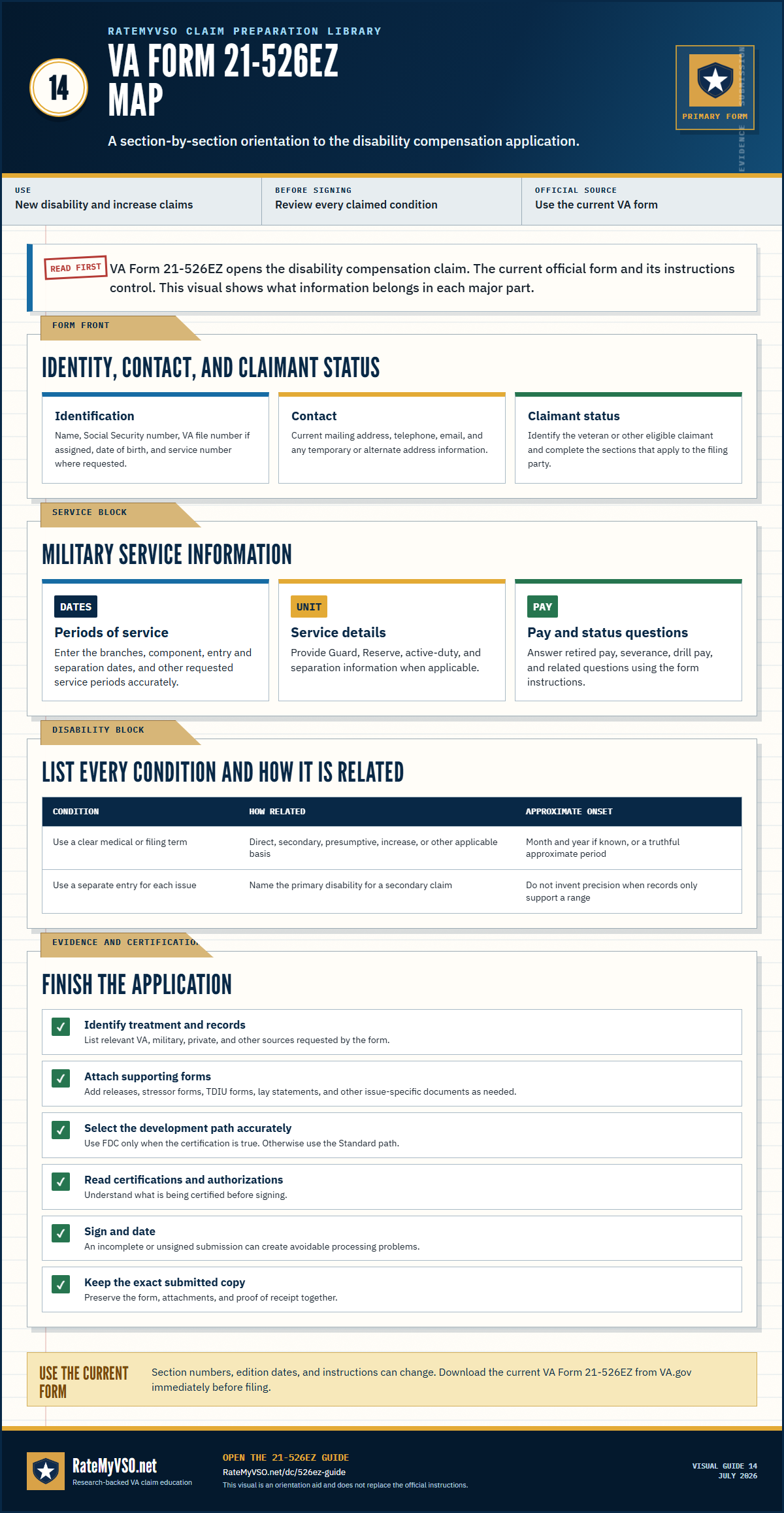
Section-by-Section Walkthrough
The form has 13 numbered sections (I through XIII) spread across pages 9 through 15. Every claim requires Section I, Section V, and a signature in Section IX; the rest apply depending on the claim.
-
Claim Type, Veteran Identification, and Change of Address (Item 1, Sections I to II)
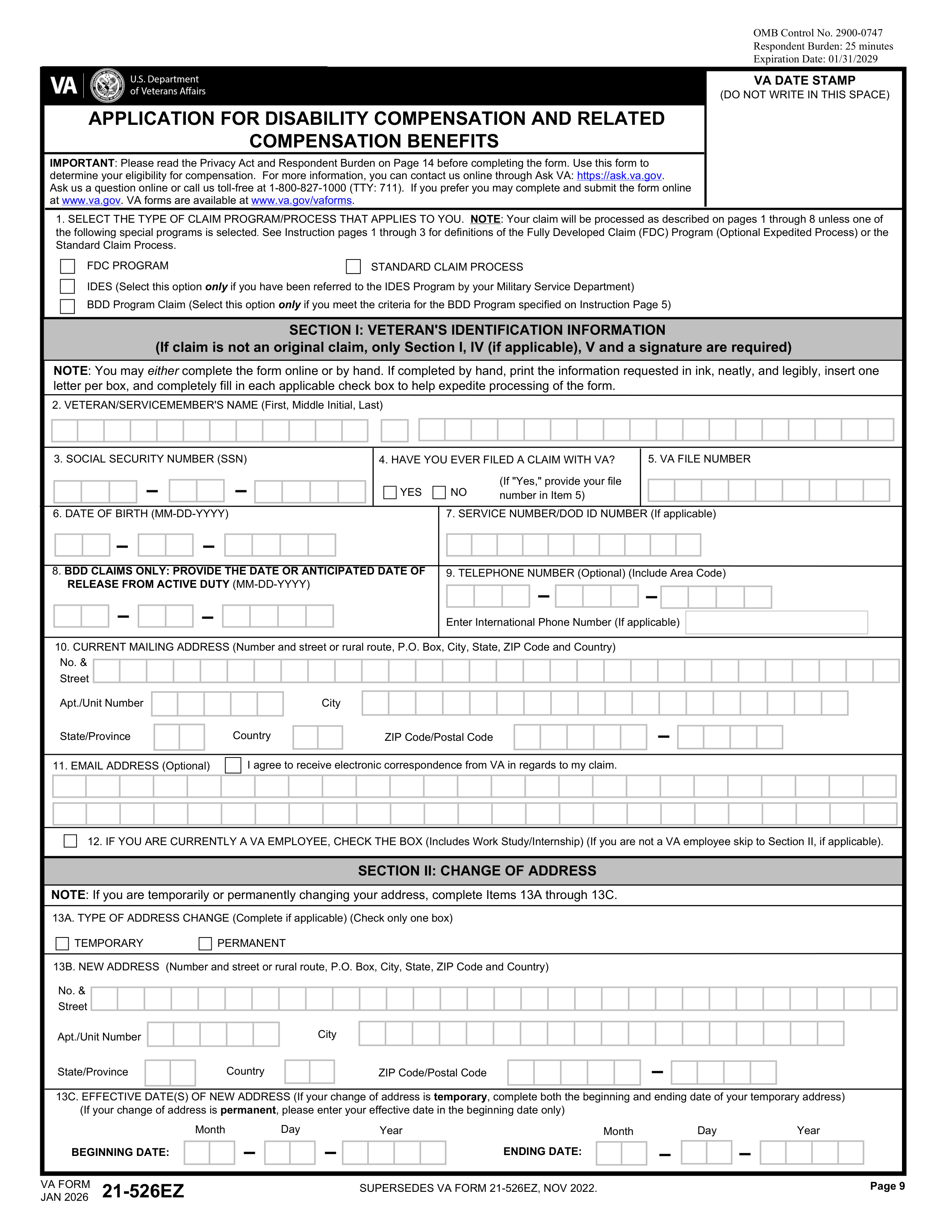
Item 1 is where the Standard Claim Process or FDC Program checkbox lives, along with two narrower checkboxes for the IDES and BDD pre-discharge programs. Section I collects name, Social Security number, VA file number (if one exists), date of birth, contact information, and mailing address. Section II is only needed if the address on file is changing.
-
Homeless Information and Toxic Exposure Information (Sections III to IV)
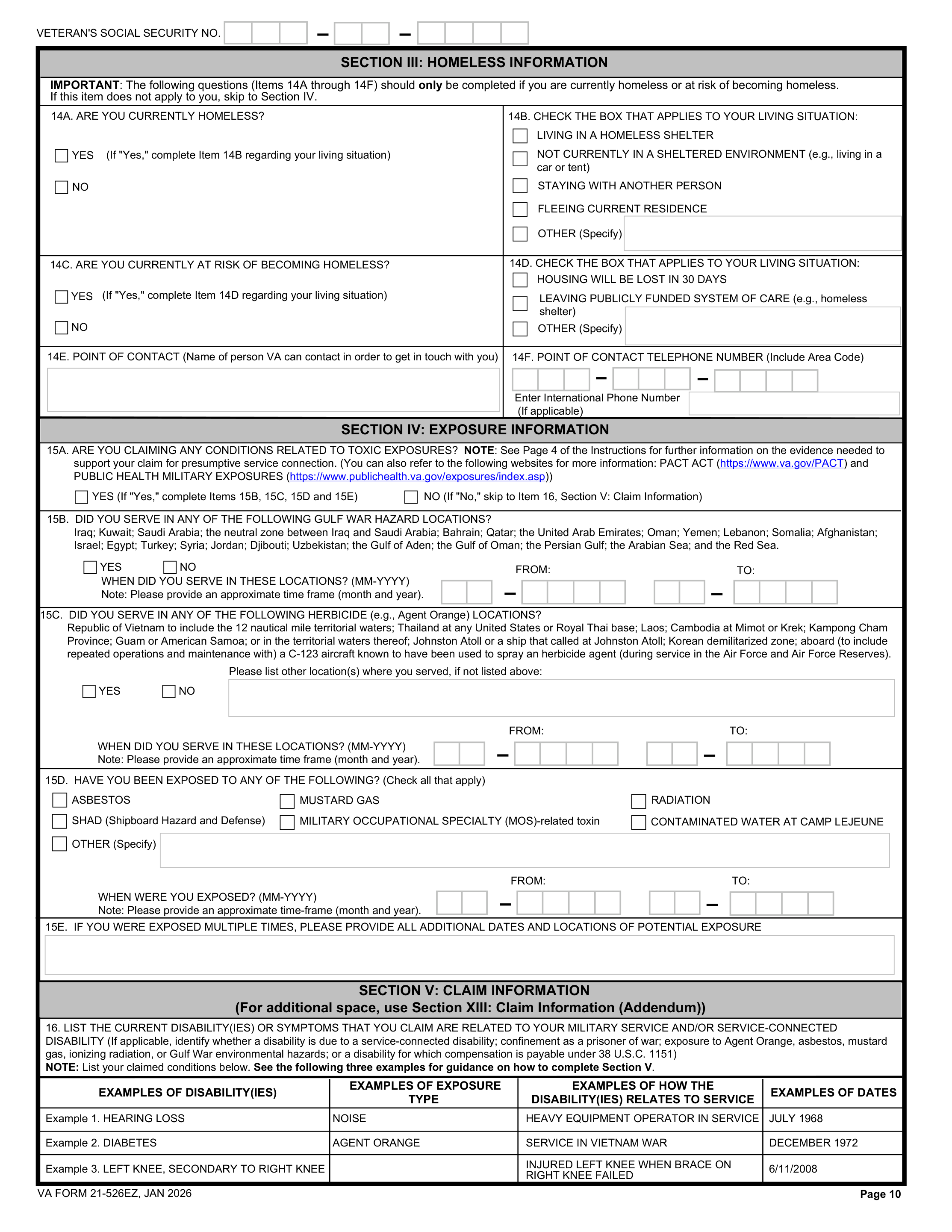
Section III applies only if currently homeless or at risk of becoming homeless; otherwise it is skipped. Section IV asks whether any claimed condition relates to a toxic exposure and, if so, which locations, hazards (Agent Orange, asbestos, mustard gas, radiation, contaminated water, and others), and approximate dates apply. This is the section that flags a claim for PACT Act presumptive review.
-
Claimed Conditions and Treatment Facilities (Item 16 to 17, Section V)
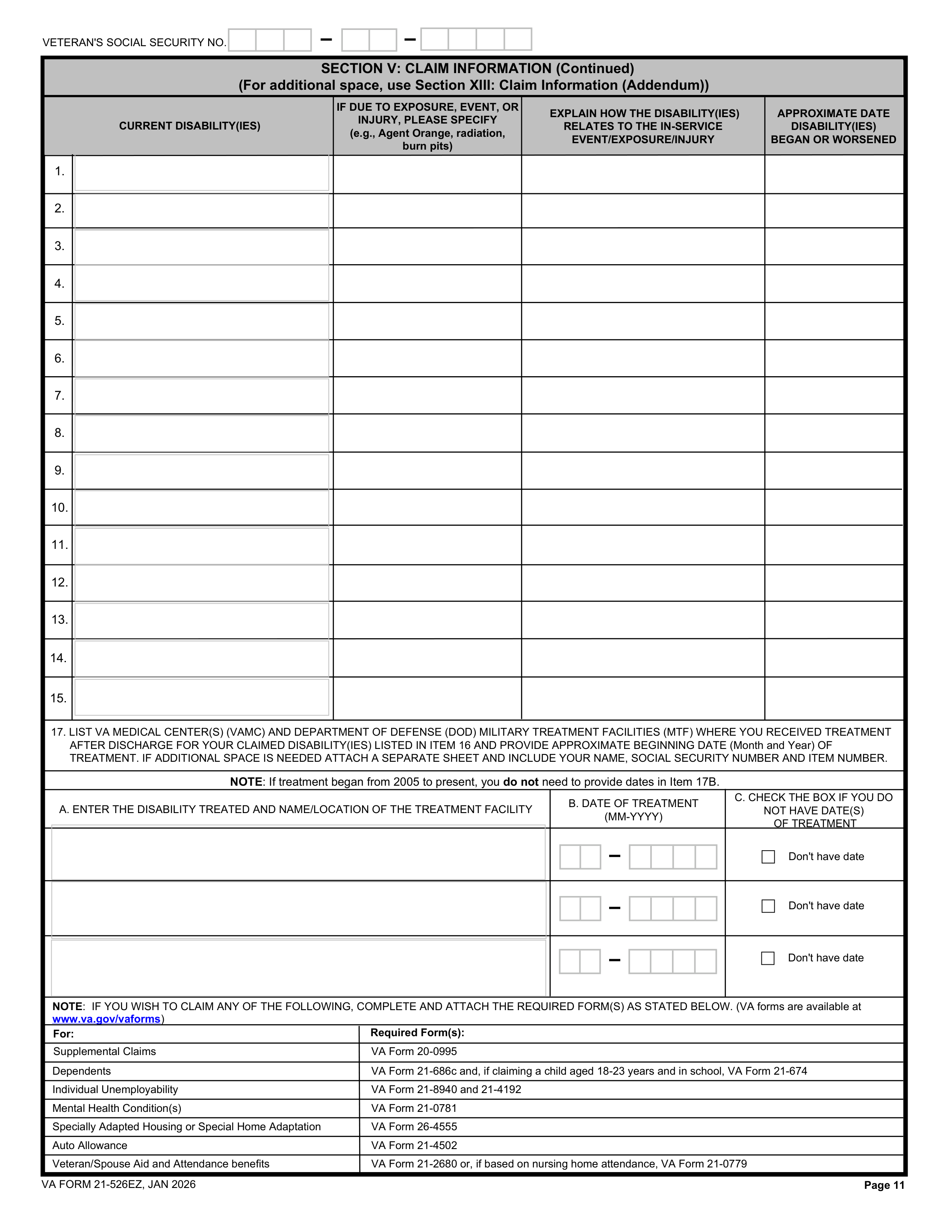
This is the core of the claim. Section V starts on the previous page with a table of 3 filled-in examples, "Hearing loss, noise, heavy equipment operator in service" is the level of detail expected; a one-word condition name with no context is not. Item 16, pictured above, is where the blank table continues: a numbered list (15 rows) for each claimed condition, what event or exposure it relates to, how it relates to service, and roughly when it began or worsened. Item 17 lists VA and DoD facilities where treatment was received for those conditions after discharge.
More than 15 conditions? Section XIII: Claim Information (Addendum), on page 15, is the same table with 20 additional rows. Attach as many copies as needed. -
Service Information and Service Pay (Sections VI to VII)
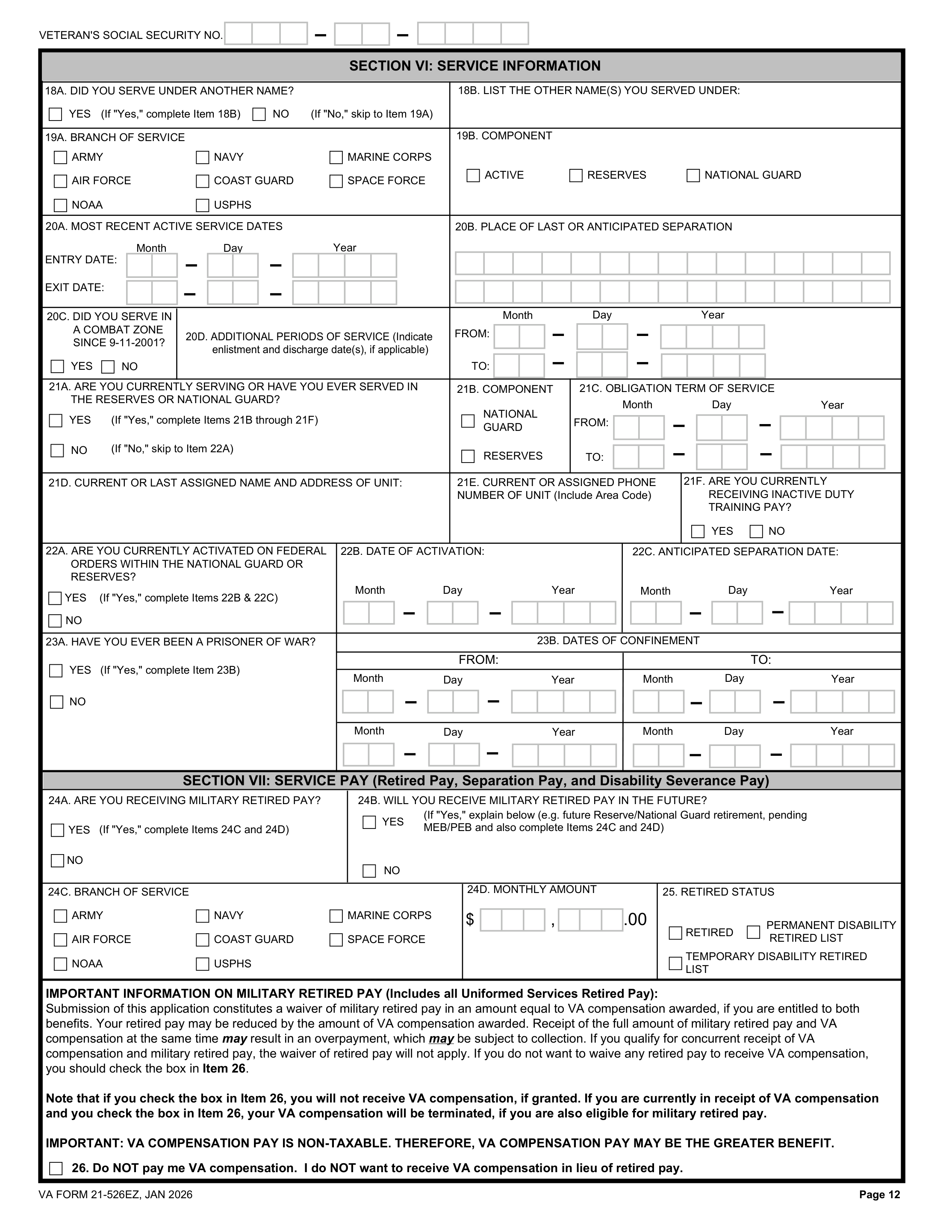
Section VI covers branch of service, service dates, combat zone service since September 11, 2001, Reserve or National Guard status, and prisoner of war history. Section VII discloses military retired pay, separation or severance pay, and inactive duty training pay, because VA compensation can offset those payments unless a waiver is elected.
-
Direct Deposit Information (Section VIII)
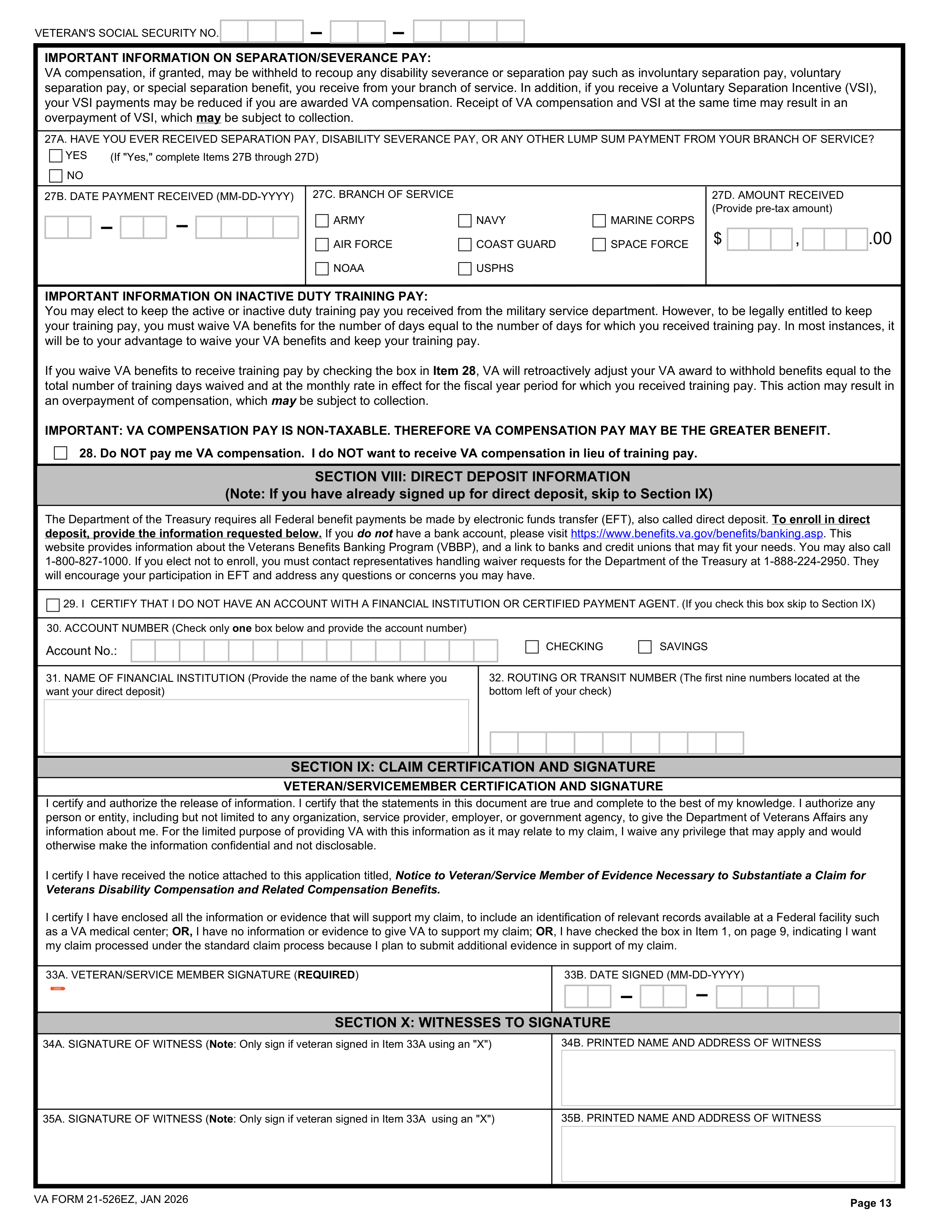
Federal benefit payments are required to go out by direct deposit. This section asks for account number, account type (checking or savings), the name of the financial institution, and the routing number. A veteran already enrolled in direct deposit can skip this section entirely and go to Section IX. A veteran with no bank account checks the box in Item 29 instead, which also skips ahead.
-
Claim Certification, Signature, and Witnesses (Sections IX to X)
Section IX is the certification: the veteran attests the statements are true, authorizes VA to gather outside records, and confirms whether all supporting evidence has been enclosed. The signature and date in Item 33 are required for the claim to be valid. Section X only applies if the veteran signed with an "X" instead of a full signature, in which case two witnesses sign as well.
-
Alternate Signer and Power of Attorney Signature (Sections XI to XII)
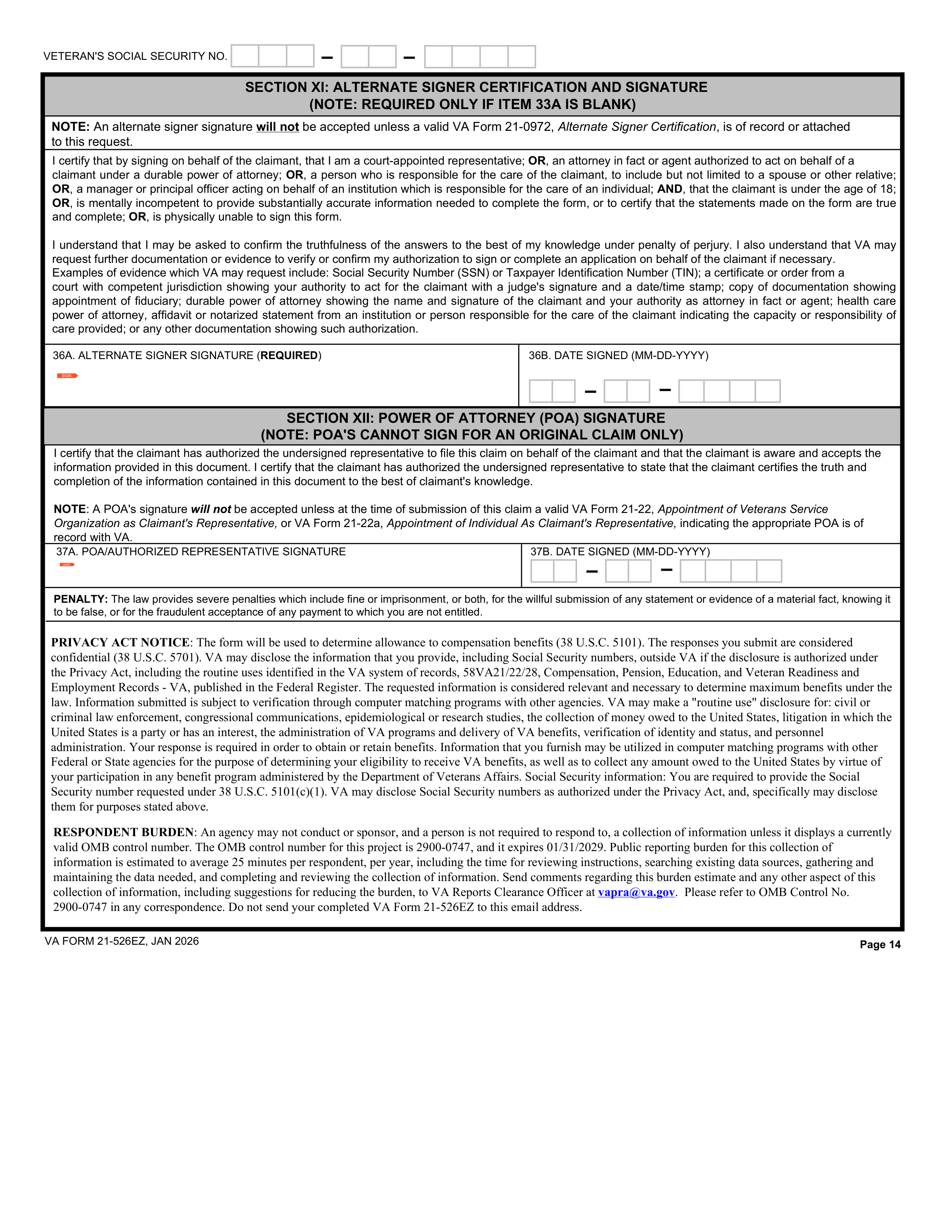
Section XI applies only when Item 33A is left blank, someone other than the veteran is certifying the claim on the veteran's behalf, such as a court-appointed representative or a caregiver for a claimant who cannot sign. It requires a separate VA Form 21-0972 on record. Section XII is for an accredited representative's Power of Attorney signature and requires a VA Form 21-22 or 21-22a already on file; a POA cannot sign for an original claim.
Common Mistakes Filing Form 21-526EZ
- Leaving the form unsigned: Item 33A is required. A claim without a valid signature is not a substantially complete application and will not move forward.
- Selecting the wrong claim program in Item 1: checking FDC without meeting the certification requirement, or leaving Item 1 blank, sends the claim down the default Standard path even when a faster option applied.
- Skipping direct deposit information: an incomplete or incorrect Section VIII delays the first payment after a claim is granted, even after the rating decision itself is final.
- Vague condition descriptions in Item 16: a one-word entry with no exposure, no in-service event, and no approximate date gives the rater nothing to develop. Follow the form's own examples for the level of detail expected.
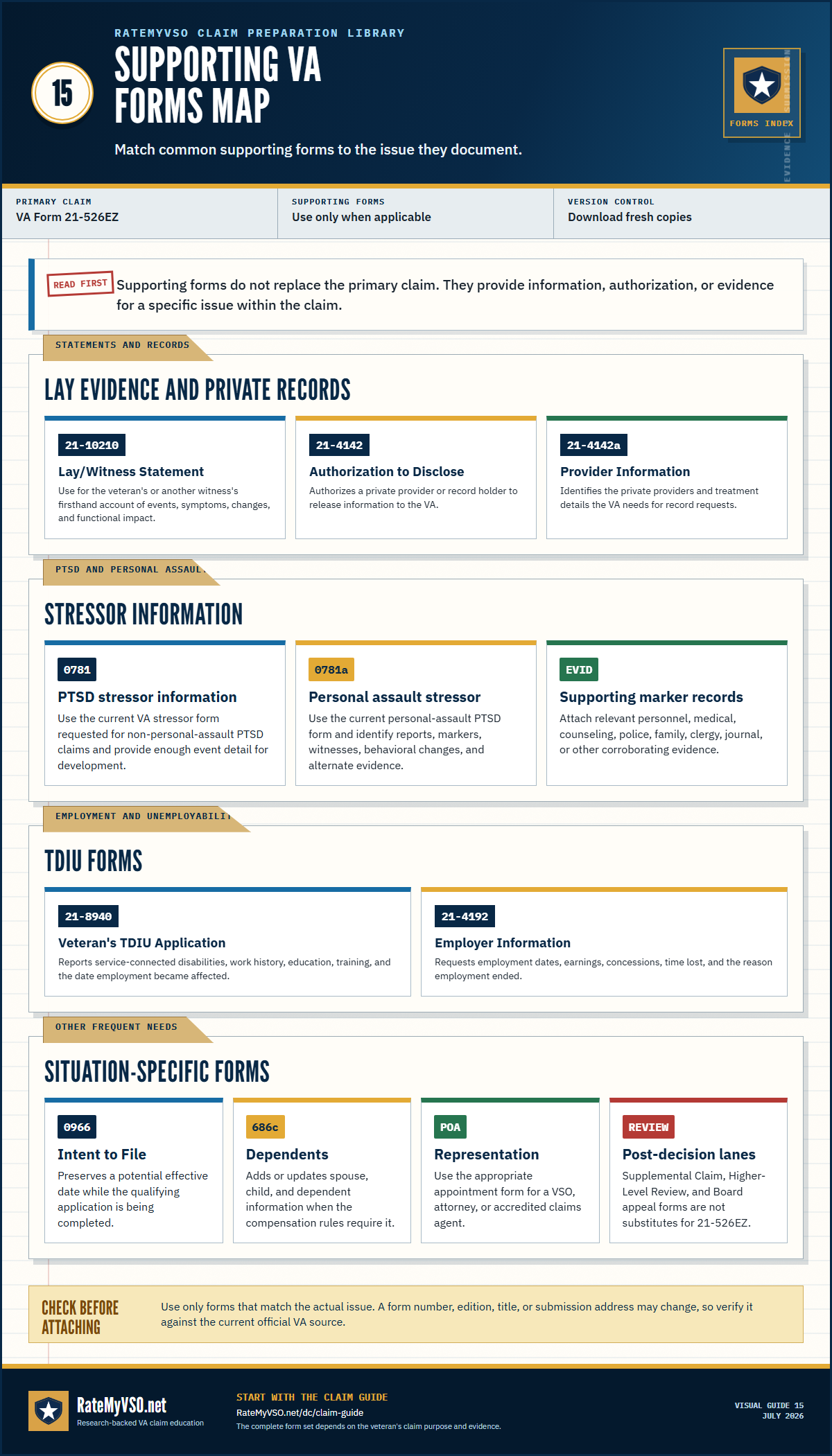
- Not attaching VA Form 21-4142 for private records: Section V, Item 17 identifies where treatment happened, but a private (non-federal) provider requires a signed VA Form 21-4142 authorization before VA can request those records. Federal records (VA and DoD facilities) do not need this authorization.
Sources and references:
- 38 C.F.R. § 3.155: How to file a claim (eCFR)
- VA Form 21-526EZ: Application for Disability Compensation and Related Compensation Benefits
This guide is for educational purposes only and is not legal advice. Regulations, forms, and case law change over time. Always verify at va.gov, ecfr.gov, or law.cornell.edu before relying on any rule. For individualized help with a VA claim, find an accredited VSO representative. All RateMyVSO tools are free. We never sell anything.