VA Insomnia Claims: Symptom of Another Condition vs Standalone Insomnia Disorder
The most-misunderstood part of insomnia claims is that filing one rarely produces a separate VA rating. M21-1, Part V, Subpart iii, Chapter 13 (updated 2026-05-27) confirms what raters have been doing for years: insomnia is almost always a symptom of an underlying service-connected disability, and its symptoms get folded into that disability's rating, not rated separately. A standalone insomnia rating is possible, but only when DSM-5 insomnia disorder is diagnosed and every other potential cause is ruled out. This guide walks the two pathways with the regulatory anchors.

Section 1: The Big Picture
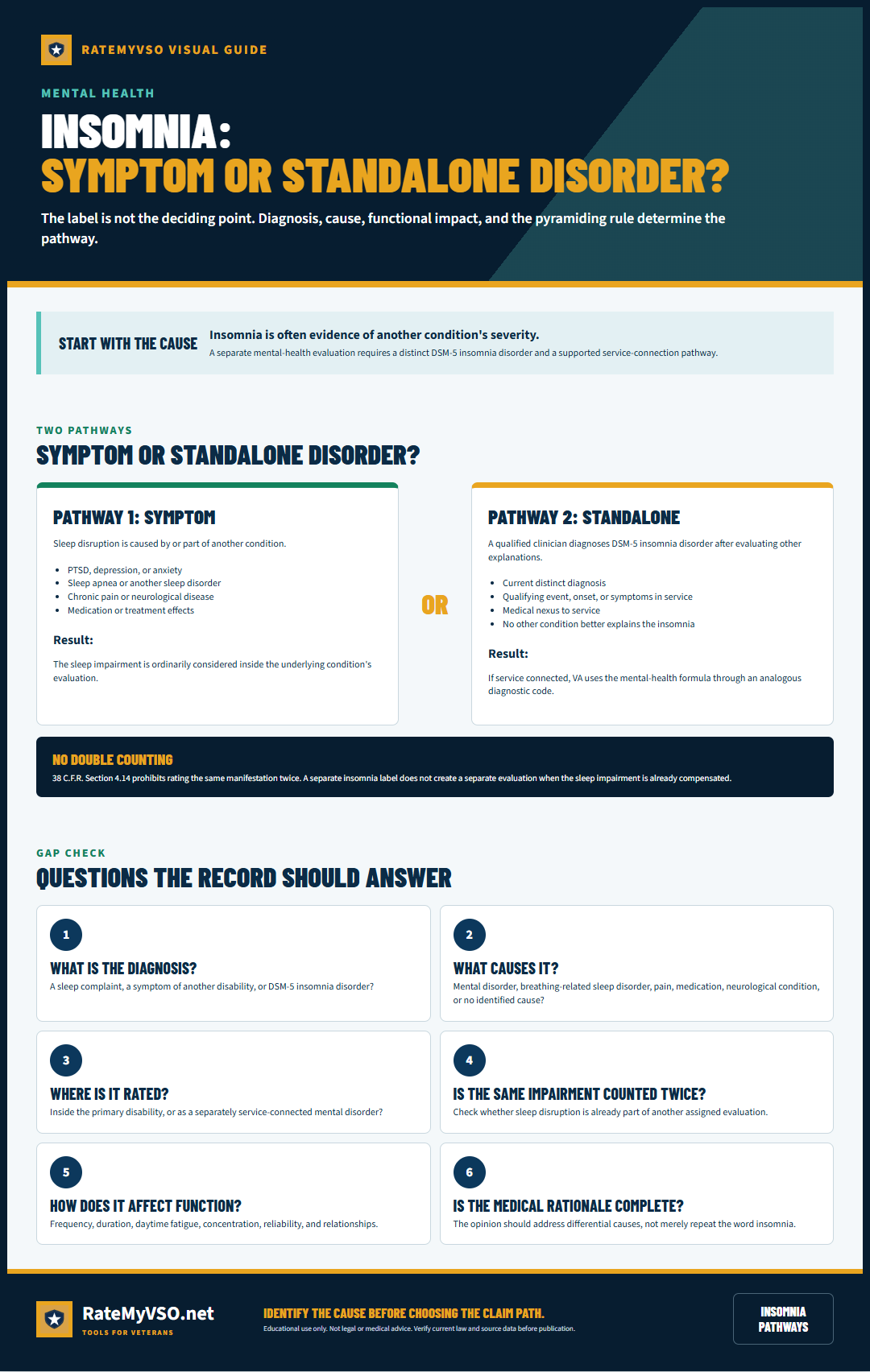
Insomnia is a sleep complaint, not by itself a disability the VA rating schedule calls out. It is rated when it represents a recognized DSM-5 mental disorder (insomnia disorder) or when its symptoms describe another condition's severity (e.g., PTSD with chronic sleep impairment, sleep apnea with daytime hypersomnolence, chronic pain with sleep disruption).
M21-1, Part V, Subpart iii, Chapter 13 was updated 2026-05-27 with reorganized guidance on this question. The principle quoted directly from the manual:
The rater applies a two-pathway test. Most cases land in Pathway 1 (symptom of an underlying SC condition). Pathway 2 (standalone insomnia disorder) is rare in practice because the DSM-5 diagnostic criteria themselves require ruling out other causes.
Section 2: Pathway 1, Insomnia as a Symptom of Another SC Disability
Per the updated M21-1 V.iii.13 table, when insomnia is shown to be secondary to or a symptom of another underlying service-connected disability, a separate SC evaluation on a secondary basis is not warranted for insomnia. Instead:
- Service connection should be established for the underlying primary disability, if it is not already.
- The insomnia symptoms are folded into the evaluation assigned under the diagnostic code for the primary SC disability.
- The rating decision narrative for the primary SC disability must explicitly discuss that the insomnia symptoms are included in the evaluation, because the primary disability was determined to be the cause of the insomnia.
Common scenarios where Pathway 1 applies:
- PTSD with chronic sleep impairment. Sleep disturbance is a DSM-5 Criterion B and Criterion E feature of PTSD. The 30 percent 38 CFR § 4.130 level explicitly lists "chronic sleep impairment." Insomnia symptoms drive the PTSD rating, no separate insomnia rating.
- Major depressive disorder (MDD) with insomnia or hypersomnia. Sleep disturbance is a DSM-5 Criterion A feature of MDD. Rated under DC 9434 using the General Rating Formula.
- Generalized anxiety disorder (GAD) with sleep disruption. Sleep disturbance is one of the six DSM-5 symptoms required for diagnosis. Rated under DC 9400.
- Obstructive sleep apnea (DC 6847). Sleep fragmentation, non-restorative sleep, and daytime hypersomnolence are core to the diagnosis. The OSA rating subsumes insomnia symptoms. See the Sleep Apnea Claims Guide.
- Chronic pain (orthopedic, neurologic, or other). Pain that wakes a veteran multiple times a night is part of the underlying condition's functional impact, not a separate rating.
- Medication side effects. A service-connected condition's medication regimen can produce insomnia. The functional impact is captured in the primary condition's rating.
Section 3: Pathway 2, Standalone DSM-5 Insomnia Disorder
A separate rating for insomnia is possible only when all three of the following are true:
- A current diagnosis of insomnia disorder meeting DSM-5 diagnostic criteria, meaning the insomnia is not associated with any other underlying disease or injury.
- An event in service, such as a documented diagnosis of primary insomnia or insomnia disorder during active duty, or a documented in-service incident known to cause insomnia.
- A medical nexus establishing that the current DSM-5 insomnia disorder is connected to the in-service event.
If all three elements are met, service connection is granted on a direct basis and the condition is rated analogously under an appropriate diagnostic code in 38 CFR § 4.130. See Analogous Ratings for the 38 CFR 4.20 mechanism.
Section 4: DSM-5 Terminology Note
DSM-5 revised the diagnostic terminology from "primary insomnia" (DSM-IV) to "insomnia disorder." The diagnostic criteria in both versions include ruling out all other potential causes. M21-1 V.iii.13 explicitly states:
The DSM-5 criteria for insomnia disorder require:
- Predominant complaint of dissatisfaction with sleep quantity or quality, with difficulty initiating sleep, maintaining sleep, or early-morning awakening with inability to return to sleep.
- Sleep disturbance causing clinically significant distress or impairment in social, occupational, educational, academic, behavioral, or other important areas of functioning.
- Sleep difficulty at least three nights per week, present for at least three months, despite adequate opportunity for sleep.
- The insomnia is not better explained by and does not occur exclusively during the course of another sleep-wake disorder, the physiological effects of a substance, or a coexisting mental disorder or medical condition.
That last criterion is the gatekeeper. A clinical record that calls something "insomnia" without applying the DSM-5 criteria does not meet the standard. Per 38 CFR § 4.125(a), mental disorder diagnoses must be in accordance with DSM-5.
Section 5: How Insomnia Disorder Is Rated When It Stands Alone
The General Rating Formula for Mental Disorders at 38 CFR § 4.130 applies. There is no insomnia-specific diagnostic code. The rater assigns an analogous DC under 38 CFR § 4.20 (analogous ratings), typically DC 9440 ("Chronic adjustment disorder" or another residual mental-disorder code) or a similar closest-fit code.
Sleep duration, awakenings, fatigue, and other sleep findings may help document the disability picture, but they do not mechanically determine the percentage. The VA evaluates the overall occupational and social impairment caused by all symptoms.
For deeper coverage of the rating formula, see Mental Health Rating Formula.
- The full 0 to 100 percent mental-health rating ladder
- The automatic 50 percent provision (38 CFR 4.129)
- How occupational and social impairment is judged
- What the C&P examiner documents
Section 6: Why You Cannot Stack Insomnia on Top of PTSD or Sleep Apnea
Under the pyramiding rule at 38 CFR § 4.14, the same disability or the same symptoms cannot be rated under two different diagnostic codes. Sleep disturbance is a recognized component of PTSD, MDD, GAD, sleep apnea, and chronic pain ratings. Adding a separate insomnia rating on top would double-count the same symptom.
VA's pyramiding analysis is the structural reason the new M21-1 V.iii.13 language exists: it tells raters explicitly that insomnia symptoms get folded into the primary diagnosis's evaluation, not double-counted. See Pyramiding for the broader rule and case-law anchors.
The Pathway 2 standalone path avoids pyramiding by definition: if no other condition is causing the insomnia (DSM-5 criterion), there is nothing to double-count.
Section 7: What a C&P Examiner Will Look For
If you file an insomnia claim, the examiner will work through the differential. Be prepared to address each branch:
- Sleep apnea screen. Have you had a sleep study? Symptoms of snoring, witnessed apnea, gasping awakenings, BMI? If sleep apnea is plausible, expect a referral for a sleep study (DC 6847 path, see Sleep Apnea Claims Guide).
- Mental-health symptom screen. Hypervigilance, intrusive thoughts, nightmares, anhedonia, panic, persistent worry, racing thoughts at bedtime? Any positive answer routes into a PTSD or other mental-disorder DBQ.
- Pain screen. Does pain wake you? If so, the insomnia is folded into the pain condition's rating.
- Substance and medication review. Caffeine, alcohol, stimulants, prescription medications known to disrupt sleep (steroids, beta-blockers, certain antidepressants).
- DSM-5 criterion check. If the differential rules everything else out, the examiner can validly diagnose DSM-5 insomnia disorder.
For broader C&P preparation, see C&P Exam Preparation. If your file is dense enough, the exam may be completed through the ACE process (records review without an in-person visit).
Section 8: What This Means for Your Claim
- If you already have an SC mental-health condition, do not file a separate insomnia claim. Your sleep disturbance is already inside that rating. If your sleep symptoms have worsened, file for an increase on the underlying condition, not a separate insomnia rating. See Proposed and Grant for the increase mechanics.
- If sleep apnea may explain the sleep problem, a sleep study and medical evaluation can help distinguish the conditions. A service-connected sleep-apnea condition that meets the current criteria under DC 6847 is evaluated under that code. A CPAP prescription does not by itself establish service connection, and the order in which conditions are claimed does not determine the percentage.
- If you have chronic pain that wakes you, document it inside the pain-condition claim. Range-of-motion DBQs and pain-questionnaire responses can include "pain disrupts sleep" findings that support a higher functional-impact rating.
- If you genuinely have isolated insomnia with no other cause, get a clinician to apply DSM-5 criteria explicitly, document the in-service onset, and obtain a nexus letter. Pathway 2 is the right route. See Nexus Letters Guide.
- If VA denied a separate insomnia rating in a case where another SC condition was found, that may be the correct outcome under M21-1 V.iii.13, but verify the rater explicitly addressed insomnia symptoms inside the primary condition's evaluation. If the decision does not explain where the insomnia symptoms were considered, that may be an error. Use Higher-Level Review when the supporting evidence is already in the file. Use a Supplemental Claim when you need to add new and relevant evidence.
Sources
- M21-1, Part V, Subpart iii, Chapter 13 (Mental Disorders), updated 2026-05-27, including the insomnia symptom-vs-standalone guidance table.
- 38 CFR § 4.130: General Rating Formula for Mental Disorders.
- 38 CFR § 4.125(a): DSM-5 diagnostic requirement for mental disorders.
- 38 CFR § 4.20: Analogous ratings.
- 38 CFR § 4.14: Pyramiding.
- M21-1, Part V, Subpart iv, Chapter 1, Section C.2.a (analogous-rating procedure).
- M21-1, Part V, Subpart ii, Chapter 3, Section D.1.c (analogous-rating procedure).
- American Psychiatric Association, Diagnostic and Statistical Manual of Mental Disorders, Fifth Edition (DSM-5), Insomnia Disorder criteria.