Protect Your VA Disability Rating
Once a rating is granted, the VA can only reduce it under specific legal rules. Several protections lock a rating in over time based on how long it has been held. This guide explains those protections, when the VA can and cannot reduce a rating, what to do if you get a proposed reduction, and the common myths about what puts a rating at risk.

The Time-Based Protections
Four legal protections apply once a rating reaches certain age thresholds. Each one operates at a different level, protecting the percentage, the service connection itself, or the floor of the rating.
5-year rule (stabilized rating), 38 CFR 3.344
If a rating has been in place at the same level for 5 or more years and the condition is one subject to temporary or episodic improvement, the VA generally cannot base a reduction on a single reexamination. A reduction can rest on one exam only if all the evidence clearly warrants that the improvement is sustained.
10-year rule, 38 CFR 3.957
After a condition has been service-connected for 10 years, the VA cannot sever that service connection except on a finding of fraud or if you did not have the required service or character of discharge. It protects the connection itself, not the percentage assigned.
20-year rule, 38 CFR 3.951(b)
A disability rated continuously at or above a certain level for 20 years cannot be reduced below that level except on a showing of fraud. The protected floor is the lowest level continuously held during those 20 years.
100 percent and Permanent and Total (P&T), 38 CFR 3.343 and 3.344(c)
A total rating is not reduced without an examination showing material improvement. P&T status means no future reexaminations are scheduled, so the condition is not routinely reviewed for reduction.
The 10-year rule protects service connection, which is different from a severance. A reduction lowers the percentage while service connection stays in place. A severance ends service connection entirely, and the Government carries a heavier burden to do it. The comparison below breaks down how the two differ.
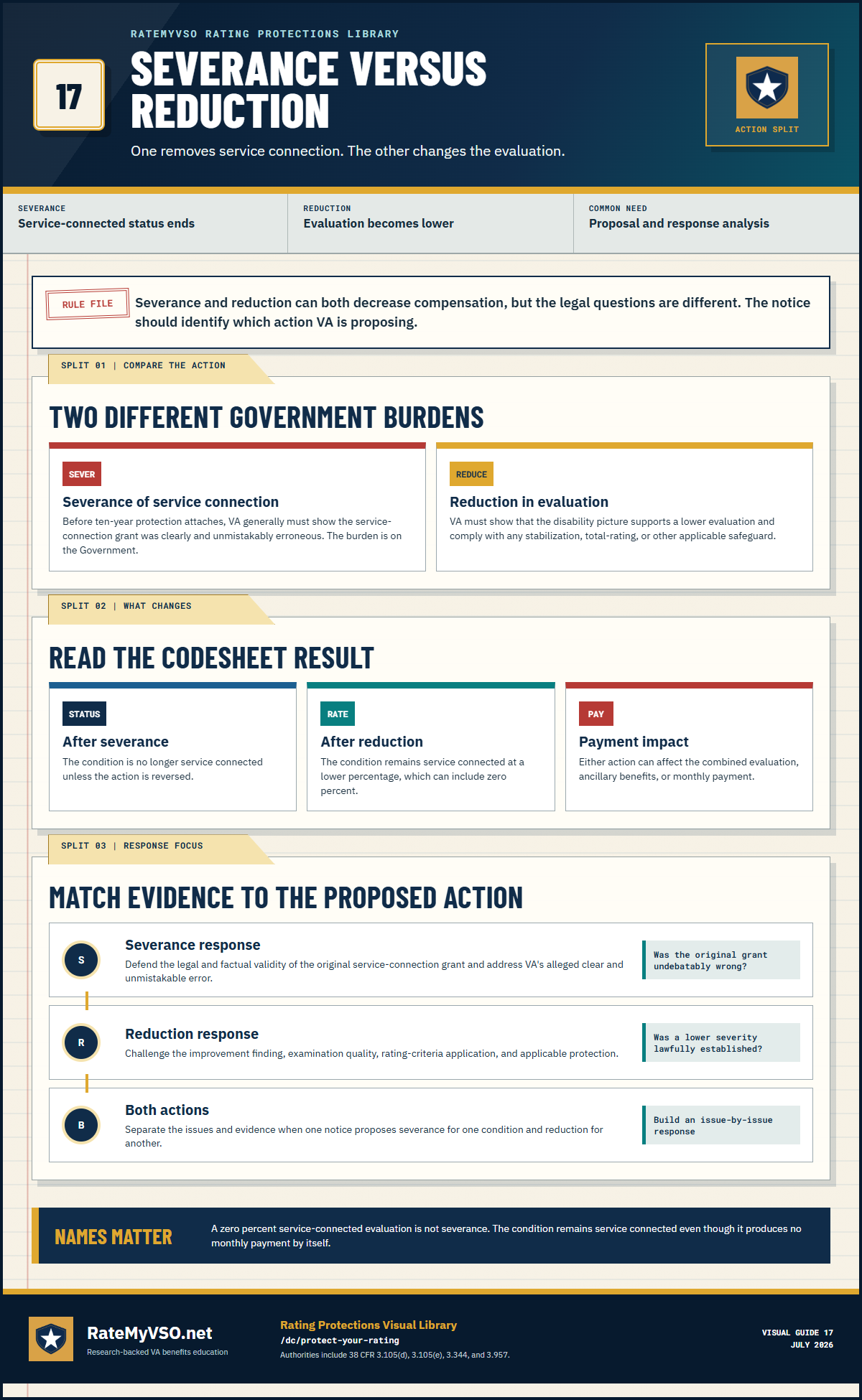 One-page guide: VA Severance Versus Rating Reduction
Comparison of severance and reduction, including the different Government burdens, codesheet results, payment effects, and response focus. Opens the full-size chart, free to save or print.
One-page guide: VA Severance Versus Rating Reduction
Comparison of severance and reduction, including the different Government burdens, codesheet results, payment effects, and response focus. Opens the full-size chart, free to save or print.
The chart below lines up all four protections side by side, showing what each one actually locks in: service connection, evaluation level, exam scheduling, or payment procedure.
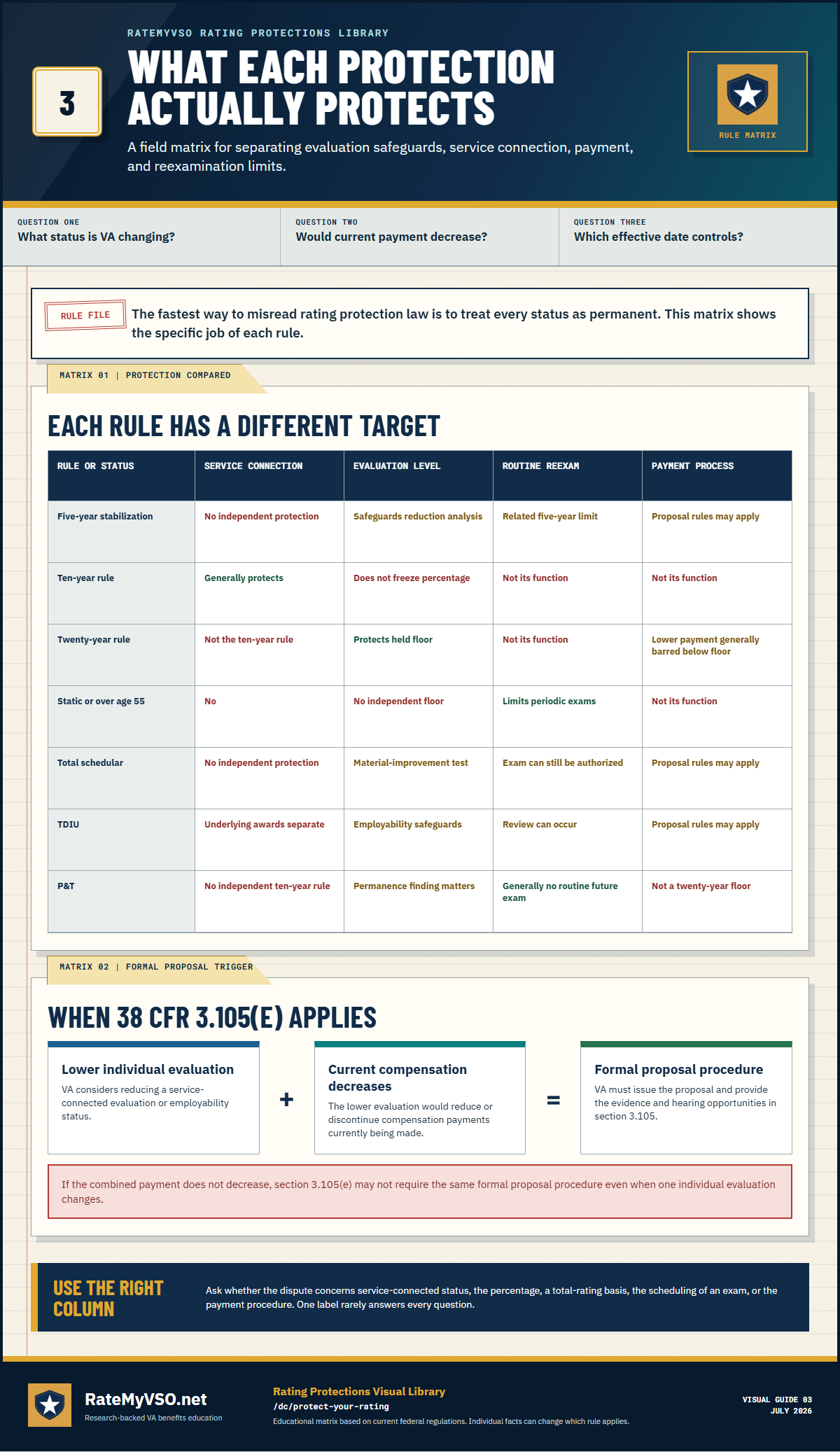 One-page guide: What Each VA Rating Protection Actually Protects
Comparison matrix showing how five-year, ten-year, twenty-year, static, total schedular, TDIU, and P&T rules affect service connection, evaluation level, periodic examinations, and payment procedure. Opens the full-size chart, free to save or print.
One-page guide: What Each VA Rating Protection Actually Protects
Comparison matrix showing how five-year, ten-year, twenty-year, static, total schedular, TDIU, and P&T rules affect service connection, evaluation level, periodic examinations, and payment procedure. Opens the full-size chart, free to save or print.
When the VA Can Actually Reduce a Rating
To reduce a rating, the VA must show two things. First, the disability actually improved. Second, that improvement reflects a better ability to function under the ordinary conditions of life and work. A better or more thorough examination is not enough. Different wording in a new report is not enough.
Courts have established these requirements across a series of decisions including Brown v. Brown, Faust v. West, Kitchens v. Brown, and Sorakubo v. Principi. The VA must review the entire medical history, not a single snapshot from one exam visit. The burden falls on the VA, not the veteran, to show that the reduction is warranted.
Reexaminations and Who Is Exempt
The VA may schedule a routine future examination to verify the current degree of a disability. However, a reexamination is not appropriate when any of the following applies (see 38 CFR 3.327):
- The disability is static (no likelihood of material change).
- Symptoms have persisted without material improvement for 5 or more years.
- The disability is permanent with no likelihood of improvement.
- The veteran is over age 55 (except in unusual circumstances).
- The rating is already at the minimum level on the rating schedule.
If a reexamination is scheduled and none of the exemptions apply, attend it. Document your worst days. The exam captures a point in time, so a symptom diary covering the weeks before the exam gives the examiner a fuller picture of your typical functional level.
Extra Protection for TDIU
Total Disability based on Individual Unemployability (TDIU) carries its own protection under 38 CFR 3.343(c). The VA can terminate TDIU only if it shows by clear and convincing evidence that you are actually capable of substantially gainful employment. A single instance of work does not establish that capacity. Marginal employment, defined as earnings below the federal poverty threshold, does not establish substantially gainful employment either.
The clear-and-convincing standard is a higher burden than the standard used for other reductions, which reflects how much TDIU means to the veteran who depends on it for income.
What Does NOT Put Your Rating at Risk
Several common misconceptions cause veterans to avoid actions that would actually help them. The following things do not put existing ratings at risk:
- Using VA healthcare or seeing VA doctors: Routine VA medical care does not trigger a rating review or reduction. See Will VA Healthcare Lower My Rating for the full explanation.
- Filing for an increase on an existing condition: Filing an increased rating claim puts only the claimed condition at issue. Your other conditions are not opened for review as a result. The condition you claimed may be reexamined as part of the increase process, but protected ratings stay protected by the rules in this guide.
- Filing for a new secondary condition: Adding a secondary condition claim does not open your existing ratings to review.
- Talking to a VSO or representative about your claim: Consulting a representative carries no risk to existing ratings.
The "poking the bear" concern is common but often misapplied. Filing an increase or a new condition puts only the claimed condition at issue. If a 5-year, 10-year, or 20-year protection applies to another rating, that protection does not disappear because you filed a new claim. See Rating Reductions for the specific triggers that do put a rating at risk.
If You Get a Proposed Reduction: Your 60 Days
The VA must follow a specific process before any rating is reduced. A proposed reduction is not a final decision. You have time and rights. (see 38 CFR 3.105(e))
- Read the proposal carefully. The VA must send a rating decision proposing the reduction, with all facts and the reasons behind it. The proposal is not final. Your current rating stays in place while you respond.
- Gather current medical evidence. You have 60 days to submit evidence showing that your condition has not materially improved. Current treatment records, a Disability Benefits Questionnaire completed by your treating provider, and lay statements from people who observe your daily functioning all count.
- Request a predetermination hearing. If you request a predetermination hearing within 30 days of the proposal, your payments continue at the current rate until a final decision is made. Missing that 30-day window means payment may adjust before you get a final answer.
- Point to any protection or exemption that applies. If the 5-year, 10-year, or 20-year rule applies, put that argument in writing with the supporting dates. Age over 55 and a static condition are not rating protections themselves, they are limits on when a routine reexamination is appropriate under 38 CFR 3.327, but if VA relied on an exam it should not have scheduled, raise that too. The VA must address it.
- Appeal if the reduction is finalized. If the reduction goes through, you can appeal through a Higher-Level Review, a Supplemental Claim with new evidence, or the Board of Veterans Appeals. See Proposed and Grant Decisions and the HLR guide for the mechanics of each lane.
Making a Rating Permanent
Permanent and Total (P&T) status means the VA has determined that your disability is permanent and that you are totally disabled. The practical effect is that no future reexaminations are scheduled. Your rating is not periodically reviewed for reduction. P&T also unlocks benefits for dependents, including DEA (Chapter 35) education benefits and CHAMPVA healthcare for eligible family members.
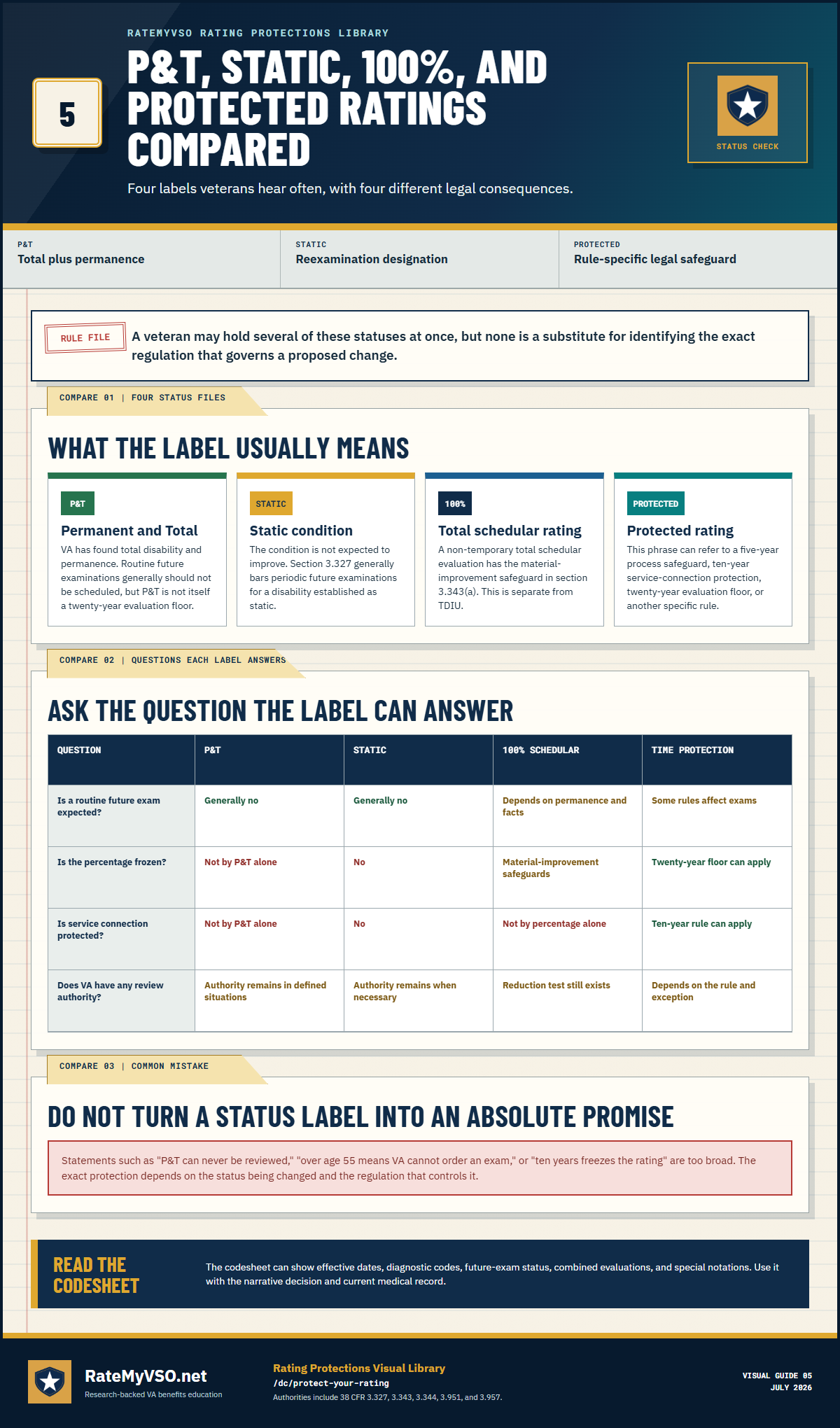
P&T, a static rating, a 100 percent schedular rating, and a time-protected rating (the 5, 10, and 20-year rules) are four different labels. Each one establishes something specific and none of them substitutes for another. The chart above sorts out what each label does and does not lock in.
Look at your rating decision for language such as "no future examinations are scheduled" or "the disability is considered permanent and total." If you believe the medical evidence supports a P&T finding and your decision does not reflect it, you can ask the VA to make that determination, either in a new claim or through a supplemental claim with supporting medical documentation.
P&T does not mean the rating can never be changed by any mechanism; a clear and unmistakable error (CUE) motion or certain administrative corrections can still affect the record. P&T also does not replace the 10-year or 20-year protection, it is a separate exam-scheduling status, not a service-connection or evaluation-floor guarantee. But it eliminates the routine reexam cycle that is the most common path to a reduction notice.
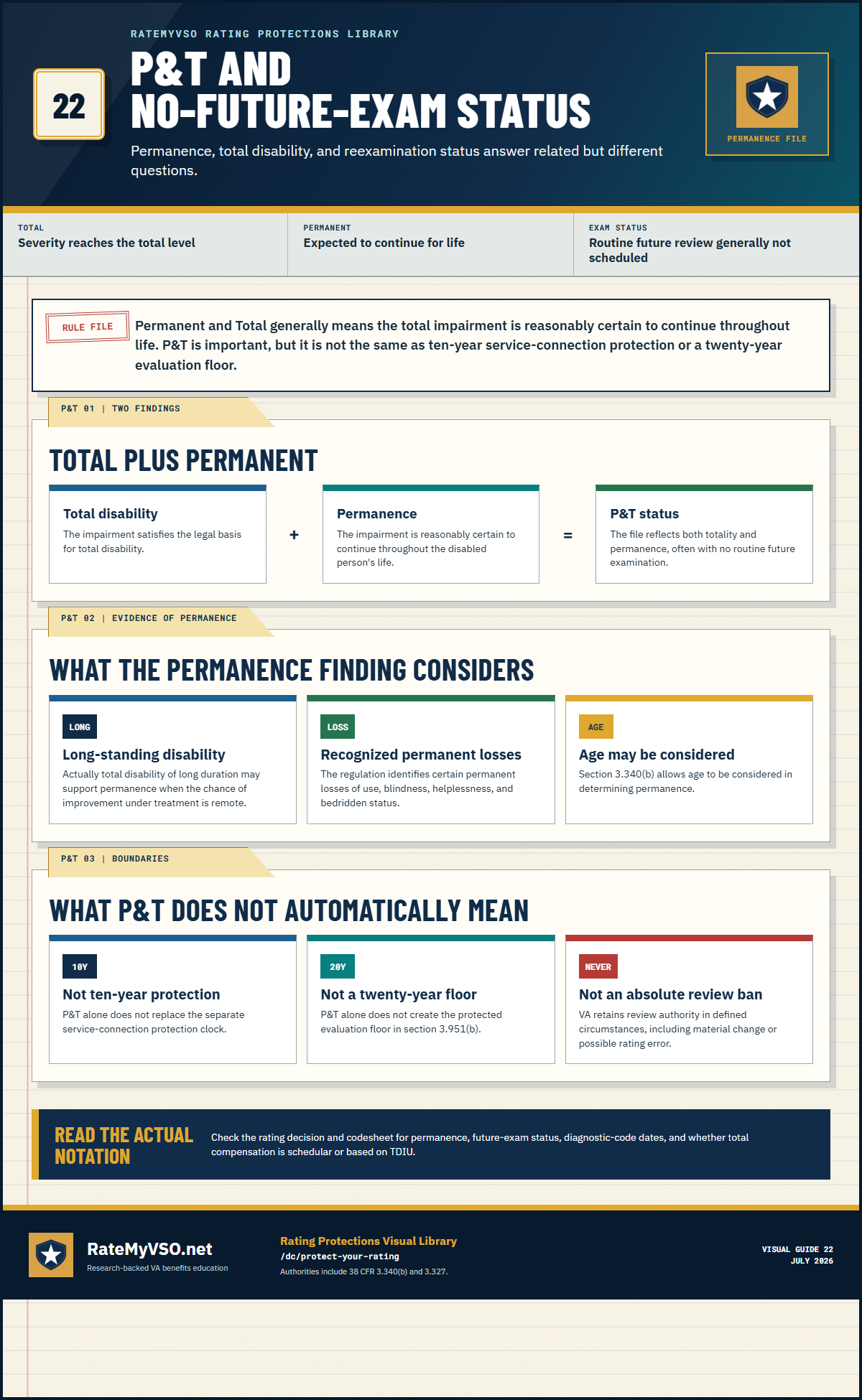 One-page guide: P&T and No-Future-Exam Status
P&T guide explaining totality, permanence, future-exam status, and why P&T does not replace ten-year or twenty-year protection. Opens the full-size chart, free to save or print.
One-page guide: P&T and No-Future-Exam Status
P&T guide explaining totality, permanence, future-exam status, and why P&T does not replace ten-year or twenty-year protection. Opens the full-size chart, free to save or print.
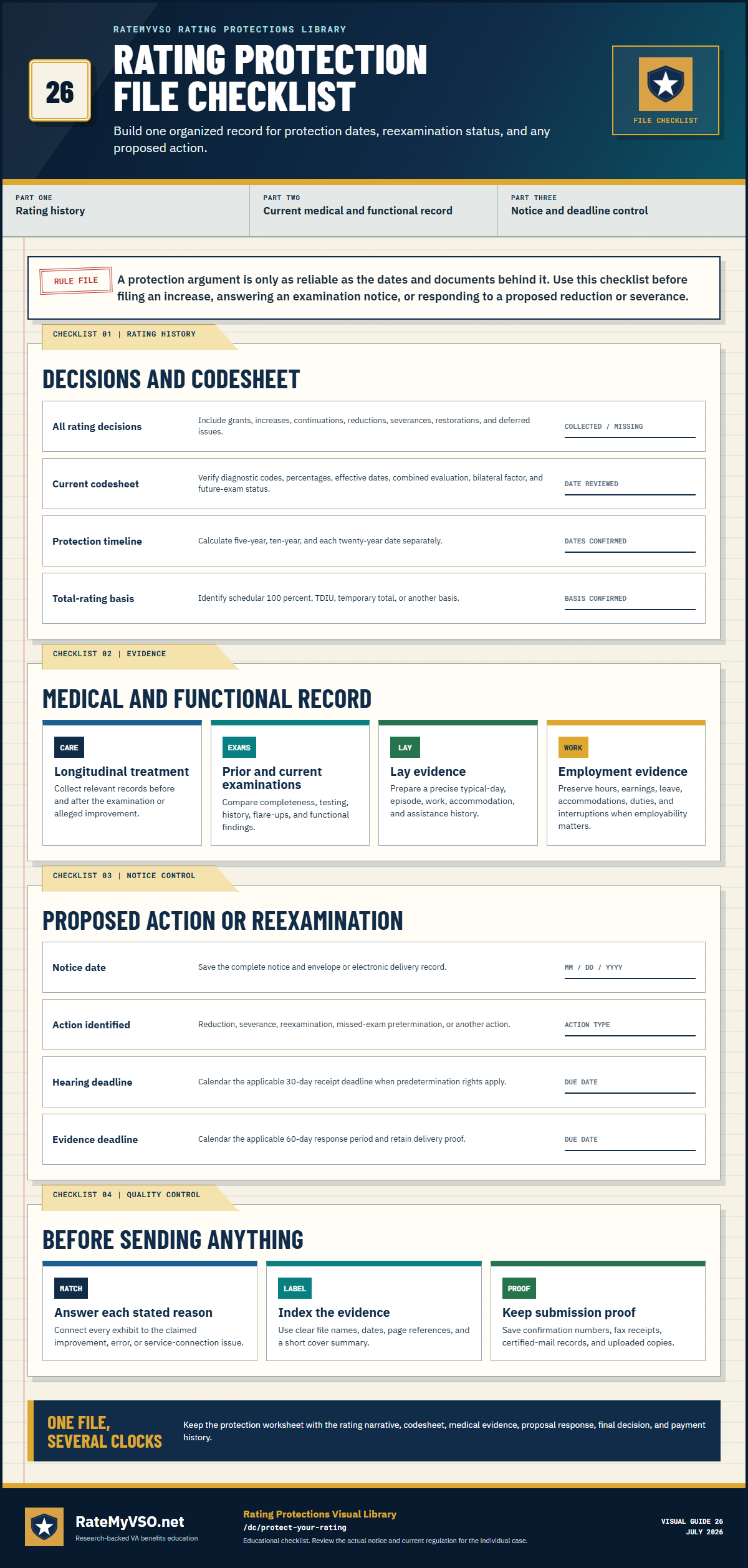
Before you close this guide, use the checklist below to gather what you would need if a reduction is ever proposed: your decisions, codesheet, protection dates, and the medical evidence tied to each.
Frequently Asked Questions
Can the VA take away my rating after 20 years?
Does filing for a rating increase risk my current rating?
Does using VA healthcare lower my rating?
I am over 55. Will I still get reexams?
What do I do the day I get a proposed reduction notice?
Related Tools and Guides
Sources: 38 CFR 3.344 (stabilized ratings) · 38 CFR 3.957 (10-year rule) · 38 CFR 3.951 (20-year rule) · 38 CFR 3.105(e) (proposed reduction process) · 38 CFR 3.327 (reexaminations) · 38 CFR 3.343 (total ratings) · CCK Law, VA rating reduction protections. Current as of June 2026. Verify in 38 CFR before relying on it. Educational, not legal advice. For your own claim, talk to a VA-accredited representative.