After the Dust and Smoke
Particulate exposure and the lasting burden of sinusitis, rhinitis and asthma

AI-generated editorial illustration, not an archival photograph or a depiction of a veteran in the cited decisions.
Summary
For some veterans, the dust and smoke of deployment became part of a much longer medical history: a nose that stayed blocked, recurring sinus infections, coughing or asthma that needed continuing treatment. Fine particulate matter is one component of the airborne hazards encountered around oil fires, burn pits, dusty roads and military work. Three Board decisions show how veterans described those exposures, what happened to their breathing afterward and which records helped explain the connection. Their stories also show why persistent symptoms deserve a clear diagnosis and a documented history. Current VA presumptions cover asthma, rhinitis and sinusitis for qualifying service, but an exposure history alone does not identify the illness.
Highlights
- Start with what you breathed. Describe the location, duties, smoke, dust and frequency you actually remember.
- Follow what happened afterward. Recurring infections, nasal obstruction and worsening lung function can leave different records.
- Use the current rules. The former ten-year manifestation limit in the particulate-matter regulation has been removed.

The sinus problems that outlasted two surgeries
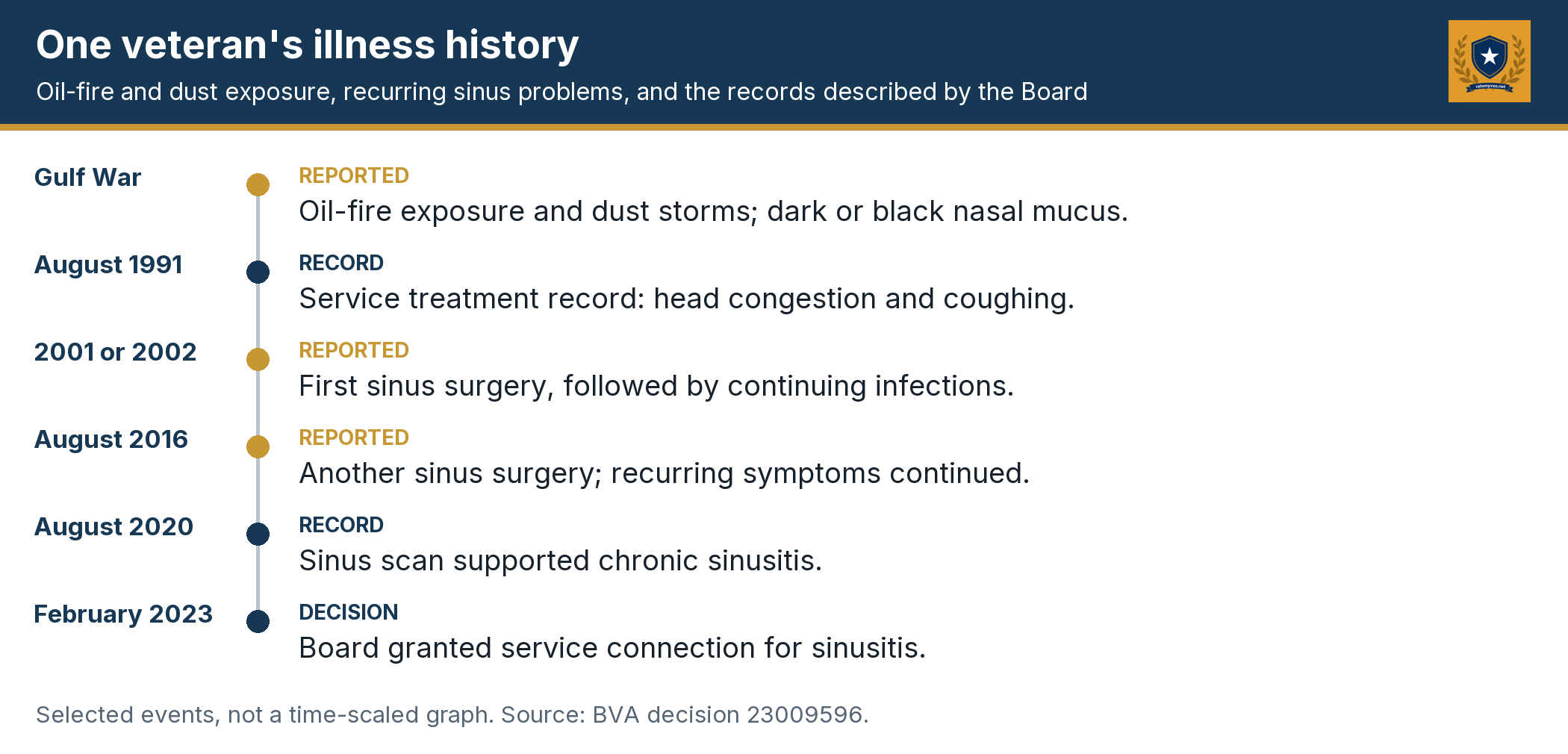
A Gulf War veteran remembered oil fires, dust storms and mucus that came out dark or black. In his account to VA, he described daily exposure to oil fires for about a month while serving in Kuwait, along with other environmental hazards during service in Kuwait and Saudi Arabia.
After returning, he sought care for what seemed at first like an ordinary illness. An August 20, 1991 service treatment record documented a week of head congestion and coughing. He recalled being told he had a cold, then going to a civilian doctor who treated a sinus infection with antibiotics.
His account continued well beyond that first visit. He described about six sinus infections a year, courses of antibiotics and surgery around 2001 or 2002. The infections continued. He reported another surgery in August 2016. Day-to-day life involved nasal sprays, twice-daily sinus flushing, congestion and a nagging cough.
A former coworker remembered the infections, his absence from work for surgery and the problems that persisted afterward. The Board also reviewed later medical treatment and a 2020 sinus scan supporting chronic sinusitis. In February 2023, it granted service connection under the fine-particulate-matter presumption.
Read the veteran's decision on RateMyVSO, 23009596.
What makes this story useful is its detail. It connects a particular environment with symptoms, treatment and effects another person could observe. It does not measure the particles he inhaled or establish what every exposed veteran will experience.
What fine particulate matter means
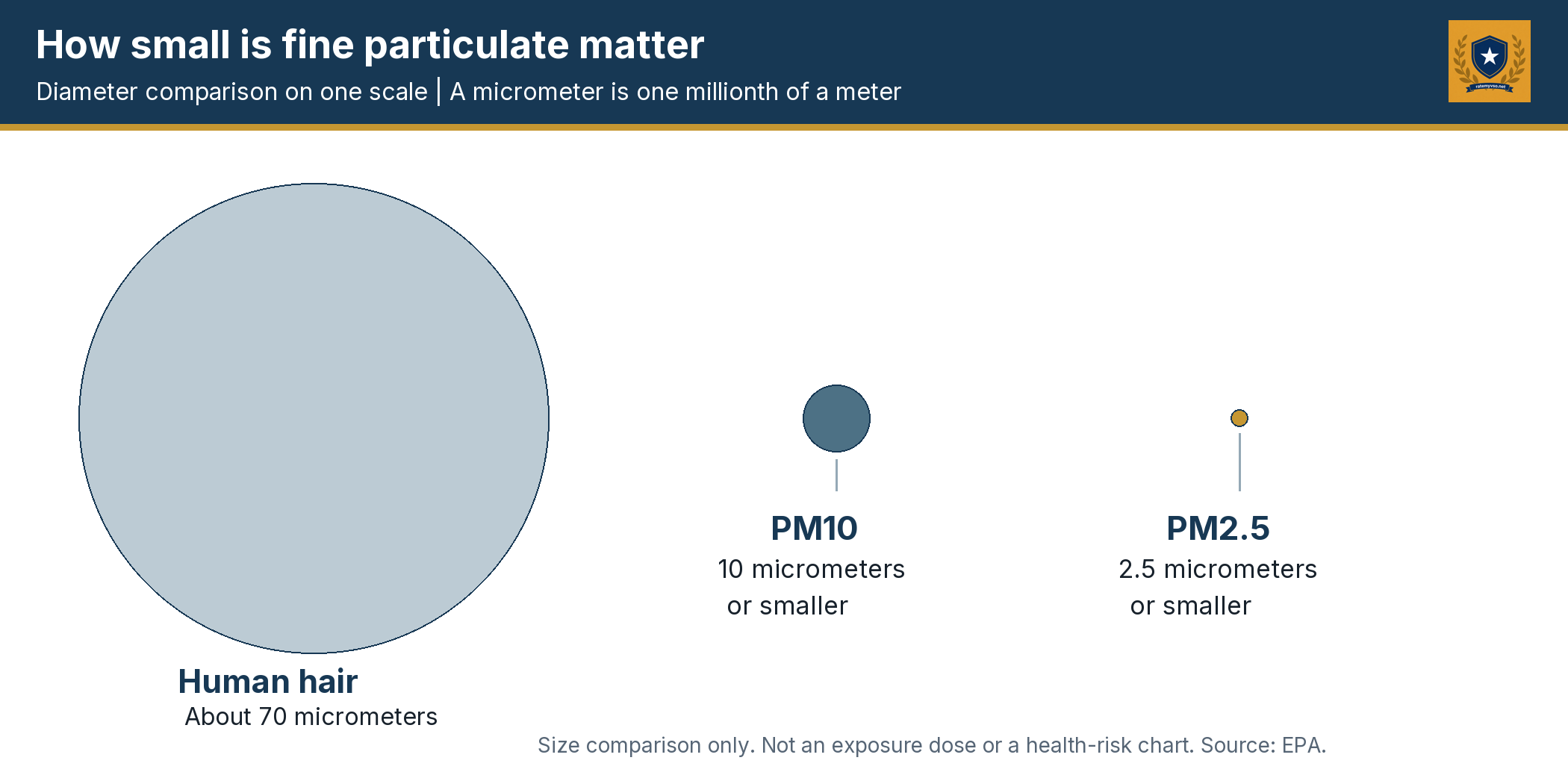
Particulate matter is a mixture of solid particles and liquid droplets suspended in the air. Some dust and smoke are visible. Other particles are too small to see. The term PM2.5 refers to fine particles generally 2.5 micrometers in diameter or smaller. For comparison, EPA uses a human hair about 70 micrometers across.
Small particles can be inhaled deep into the lungs. The composition and size of airborne material vary, and a haze can contain particles alongside gases and other pollutants. Seeing smoke or recalling dark mucus cannot tell you the exact chemical mixture, particle size or dose. EPA's explanation of particle pollution describes these differences.
A burn pit is only one possible source of hazardous air. VA also identifies sand and dust, general air pollution, fuel and engine exhaust, and smoke from oil-well fires. A veteran might encounter a mixture while working a flight line, driving a convoy, standing guard or simply living and exercising on a base. VA's airborne-hazards overview covers this broader environment.
Breathing the air was part of the job
In another appeal, a veteran described outdoor work and physical training in Iraq during a 2004-2005 deployment. Dust clouds and burn-pit smoke were part of that environment. He recalled shortness of breath and dark or black mucus, and said he was not issued a mask for those air conditions.
The decision recounts sinus infections during deployment and continuing treatment after he returned. By his 2023 hearing, he described recurring infections requiring antibiotics. His nasal symptoms also continued, with a polyp reducing his ability to breathe through one nostril.
His history included allergy symptoms before deployment. That detail belongs in the story. A credible exposure history does not require erasing earlier health problems. The Board considered that history, the medical evidence and the applicable presumptions, and granted both sinusitis and allergic rhinitis.
Read the Iraq veteran's decision on RateMyVSO, 23050331.
When the problem reaches the lungs
An aircraft loadmaster described his first memorable asthma attack in Kuwait after a flight out of Balad Air Base. He had already been using an over-the-counter inhaler for symptoms. At his hearing, he described burn-pit exposure at Balad. Personnel records documented missions over Iraq and service at the base.
The medical history added something his recollection alone could not: testing. In March 2009, pulmonary function tests showed obstruction before a bronchodilator and normal results afterward, supporting an asthma diagnosis. Later testing showed significantly worse lung function. By 2019, his records described severe persistent asthma treated with several medications.
A January 2021 pulmonology note judged the persistent asthma most likely related to his military burn-pit exposure. The Board granted service connection in March 2022. This was an individual medical assessment alongside the exposure presumption, not proof that one particular flight caused his asthma.
Read the loadmaster's decision on RateMyVSO, A22005829.
These three appeals describe different respiratory illnesses. They do not establish a sequence in which rhinitis must become sinusitis and then asthma. A veteran can have more than one condition, and similar complaints can have different explanations.
A familiar symptom still deserves an explanation
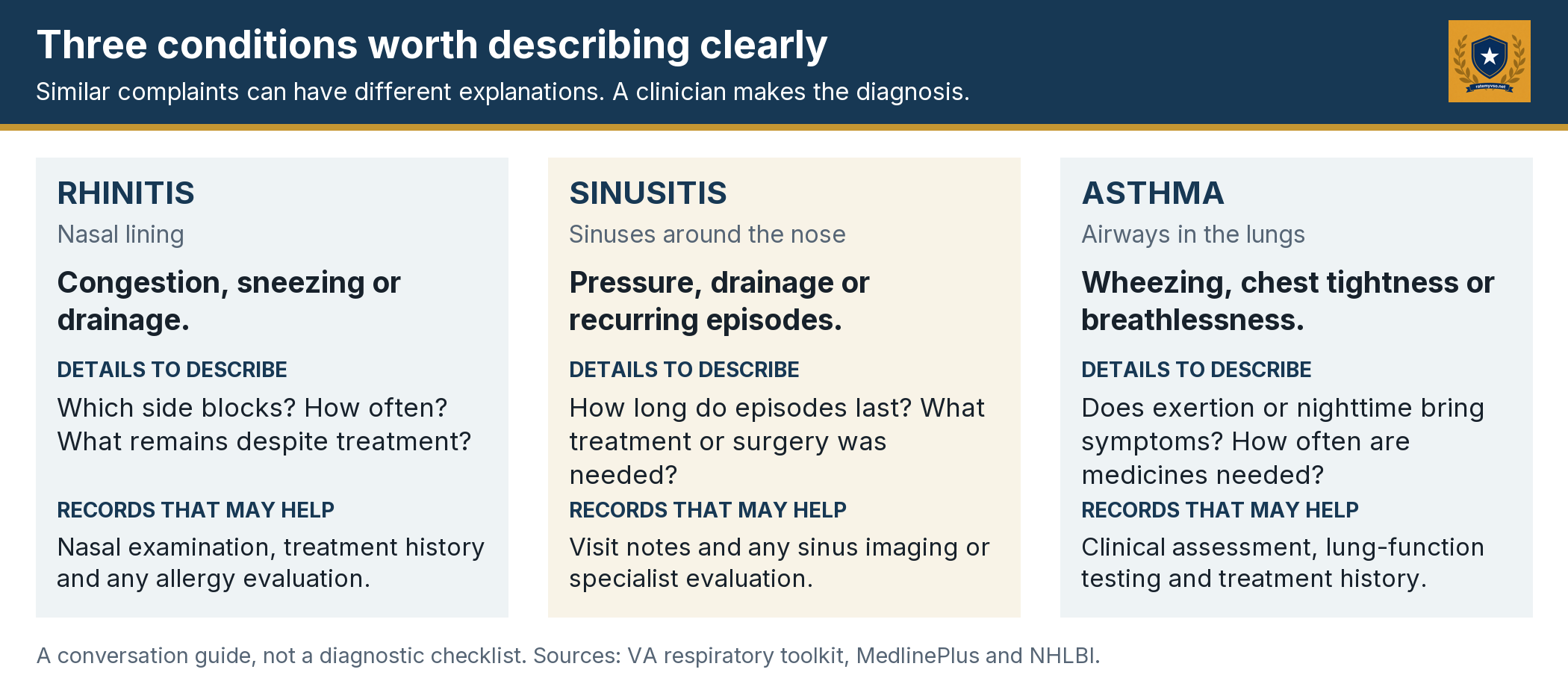
Congestion can become so routine that it stops sounding important when someone asks how you are doing. The useful details often come next: how often one side is blocked, whether drainage causes coughing, whether infections keep returning, or whether exertion leaves you wheezing or short of breath.
Rhinitis involves inflammation in the nose. Sinusitis involves inflammation of the sinuses, the air spaces around the nose. Asthma affects the airways in the lungs. Symptoms overlap, and the name a veteran uses for the problem may not be the final diagnosis.
VA's Deployment-Related Respiratory Disease Toolkit explains that there is no single test for deployment-related respiratory disease. Clinicians consider symptoms, exposure history, medical history and other risk factors, then decide which conditions to evaluate. The toolkit includes a respiratory questionnaire to help organize that conversation.

A record of prescriptions, visits, sinus imaging or lung testing can help show what clinicians found and how the illness changed. Explain what treatment helps and what remains despite it. Describe earlier allergies, smoking, civilian workplace exposures and other relevant history accurately so the clinician can assess the whole picture.
What the research adds
A 2024 study in JAMA Network Open examined deployment and VA health records for 459,381 Army and Air Force veterans. Longer deployment to bases with open burn pits was associated with modestly higher adjusted odds of asthma. That provides useful population-level evidence alongside the individual stories.
The study measured time assigned to bases with burn pits, not the amount each person inhaled. It was observational, so it could not prove an individual cause. It also did not study sinusitis or rhinitis as outcomes. VA's explanation of its particulate-matter rule describes the broader evidence and the scientific uncertainties behind its presumptions.
Keep related problems connected to actual evidence
The oil-fire veteran's decision also granted sleep apnea secondary to sinusitis after the Board weighed conflicting medical opinions. That is a supported connection in his case, not a finding that everyone with particulate exposure or sinusitis develops sleep apnea.
He also described intense headaches during sinus episodes. Those headaches help explain the burden of his illness. The decision does not establish a separate migraine award or show that particulate exposure caused a distinct headache disorder. Keeping those distinctions clear preserves the strength of the respiratory story.
How this affects you
If these experiences sound familiar, start with a clear account of your own exposure and health history. You do not need to copy another veteran's story. The useful details are the ones you can describe accurately.
- Put yourself back at the assignment. Record where and when you served, your duties and what you encountered. Describe proximity, frequency, duration and protective equipment if you remember them. Do not guess at chemicals or exposure measurements.
- Build the illness history. Note the first symptoms you remember, the earliest treatment you can identify, recurring episodes, tests and changes over time. Separate remembered events from dates documented in records.
- Bring the continuing problem to a clinician. Explain what affects sleep, breathing, exercise or daily activities and what remains despite treatment. Ask for an evaluation of the symptoms, rather than assuming every problem is the same condition.
- Check the condition and service requirements together. Current 38 CFR 3.320 covers asthma, rhinitis and sinusitis, including rhinosinusitis, after qualifying service, subject to its requirements and exceptions. It no longer requires manifestation within ten years of separation. A diagnosis and qualifying service still matter; a precise measured dose is not required to establish exposure under that presumption.
RateMyVSO's Presumptive Checker helps review service and condition requirements. Its MOS exposure guide can help you research duties, while our PACT Act and TERA article explains where presumptions and individual exposure evidence fit.
The Board stories here concern individual appeals and are not precedents or predictions. Their practical value is the record they reveal: what a veteran breathed, what changed afterward, and how symptoms, treatment, testing and observations made that history understandable. The deployment may be years behind you. Persistent sinus and breathing problems still deserve attention now.
References
Web sources accessed October 26, 2026. Board decisions are individual case examples, not binding precedents.
Board decisions on RateMyVSO
1. Board of Veterans' Appeals. Decision 23009596. February 15, 2023. Gulf War oil-fire and dust exposure, chronic sinusitis, and sleep apnea secondary to sinusitis.
2. Board of Veterans' Appeals. Decision 23050331. September 11, 2023. Iraq dust and burn-pit exposure, sinusitis and allergic rhinitis.
3. Board of Veterans' Appeals. Decision A22005829. March 31, 2022. Aircrew service, Balad exposure, pulmonary testing and an asthma grant.
VA regulation and rulemaking
4. 38 CFR 3.320: Claims based on exposure to fine particulate matter. Current regulatory requirements, qualifying service and exceptions.
5. Department of Veterans Affairs. Presumptive Service Connection for Respiratory Conditions Due to Exposure to Fine Particulate Matter. Final rule. Federal Register. September 1, 2023;88:60336-60342. Explains the evidence review and removal of the ten-year manifestation limit.
Exposure science and clinical information
6. U.S. Environmental Protection Agency. Particulate Matter (PM) Basics. Particle definitions, size comparison and inhalation concerns.
7. Department of Veterans Affairs, Public Health. Airborne Hazards and Burn Pit Exposures. Sources of airborne hazards during military service.
8. VA War Related Illness and Injury Study Center. Deployment-Related Respiratory Disease Toolkit for Veterans. Respiratory symptoms, evaluation and a questionnaire for discussing concerns with clinicians.
9. Savitz DA, Woskie SR, Bello A, et al. Deployment to Military Bases With Open Burn Pits and Respiratory and Cardiovascular Disease. JAMA Network Open. 2024;7(4):e247629. doi:10.1001/jamanetworkopen.2024.7629. Observational cohort of 459,381 veterans.
10. National Library of Medicine, MedlinePlus. Sinusitis. Overview of sinus inflammation, symptoms and evaluation.
11. National Heart, Lung, and Blood Institute. Asthma. Overview of asthma and the airways it affects.