Causation Chains: Secondary Service Connection Through an Intermediate Step
One injury rarely stays one injury. A bad knee changes how you walk. The limp wears down your back. The back pain keeps you up at night, and the lost sleep feeds depression.
That is a chain. The VA has a rule for it. A condition the VA already covers can connect you to a second condition you never expected, even when the link in the middle is something the VA does not cover on its own. The rule is 38 CFR 3.310.
This page keeps it plain, then goes deep. It explains how the rule works. It is not advice about your own claim.
The Two Rules Inside 38 CFR 3.310
Every chain runs on two rules inside 38 CFR 3.310. The two are simple once you split them apart.
- Cause, 3.310(a): a covered condition caused a new one. The new condition gets covered too.
- Made worse, 3.310(b): a covered condition made a separate, non-covered condition worse than it would have been. The VA covers the extra worsening, not the whole condition.
Either way, the proof bar is the same. You do not need to prove it beyond doubt. You need it to be "at least as likely as not," which means a 50-50 call goes to you (38 CFR 3.102). For the full side-by-side, see secondary vs aggravation.
How a Chain Works
Think of a chain as three links. Start at the condition you are claiming and work backward to the injury the VA already covers.
Take the knee. The VA covers your knee. The bad knee changed your walk. The new walk wore down your back. You are claiming the back. So the back traces to the walk, and the walk traces to the covered knee. Three links.
The rest of this page uses a shorthand for that shape.
X is what you claim. Y is the link in the middle. Z is the condition the VA already covers.
The link in the middle comes in two kinds, and the kind decides which rule you use:
- The middle link is already covered. Then your claim is an ordinary secondary claim, because the link is already a service-connected disability. Example: nerve damage in the legs from a covered diabetes condition.
- The middle link is not covered. Then it is an intermediate step, and the chain only works if a service-connected condition caused that middle link in the first place. This is the harder case, it is the more common one, and it has its own rule.
The Intermediate Step: When the Middle Link Is Not Service-Connected
Obesity is the clearest case. The VA does not treat obesity as a disease for the direct path, so a claim for obesity by itself as a service-connected condition does not go through that way. For years that ended a lot of claims. Then the VA General Counsel ruled that obesity can still act as a step in the middle between a covered condition and the condition you are claiming (VAOPGCPREC 1-2017).
To win through a middle step like that, you show three things:
- the covered condition made you gain the weight,
- that weight was a real driver of the condition you are claiming, and
- you would not have the claimed condition if not for that weight.
The Board granted this in decision 23047545 (2023), where obesity was the middle step between the veteran's covered joint conditions and sleep apnea.
Worked Example: Sleep Apnea Through Obesity From PTSD Medication
Walk a real one through, link by link. A veteran has covered PTSD (DC 9411). The medicine for the PTSD packed on weight. The weight became obesity. The obesity brought on obstructive sleep apnea (DC 6847). The veteran is claiming the sleep apnea.
Obesity is the step in the middle. What drove it was the medicine for the covered PTSD. The Board granted exactly this in decision A25036568 (2025), where the covered PTSD caused the obesity that caused the apnea.
Here are the same three requirements, in plain terms:
- The covered condition caused the weight: the PTSD medicine drove the weight gain. The prescription record, the dates, and the weight trend prove it.
- The weight drove the new condition: a doctor explains how the obesity brought on the sleep apnea.
- No weight, no condition: the doctor says the sleep apnea would not have shown up without the weight.
Every arrow is its own question for a doctor to answer, and each one can turn on cause, on worsening, or both. See nexus letters for what those opinions say, and the sleep apnea guide for the secondary paths into DC 6847.
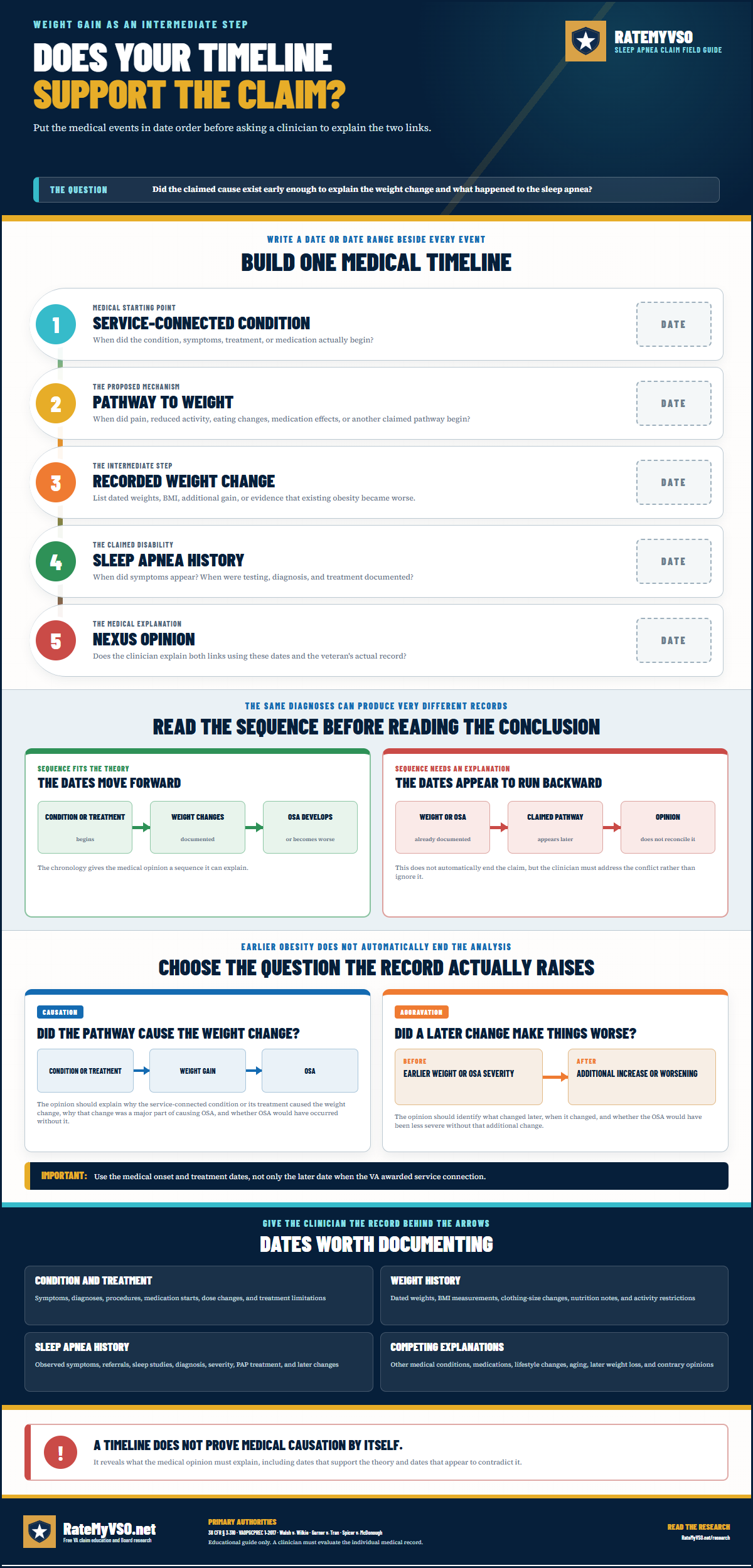 One-page guide: Does Your Timeline Support the Claim?
Put the service-connected condition, why the weight changed, weight gain or worsened obesity, sleep-apnea history, and the medical opinion explaining both links in date order.
One-page guide: Does Your Timeline Support the Claim?
Put the service-connected condition, why the weight changed, weight gain or worsened obesity, sleep-apnea history, and the medical opinion explaining both links in date order.
More Chain Examples
A covered knee brings constant pain and a smaller life, and a doctor ties that to depression. The middle link, the chronic pain, comes straight from the covered knee, so this is a plain secondary mental-health claim. See the depression guide. The Board granted this in decision A23027200 (2023), a depression claim tied to chronic pain.
The pills for a covered back condition can chew up the stomach over time and bring on a digestive problem. The medicine is the middle link. See the GERD guide. The Board granted this in decision A24074530 (2024), GERD on a secondary theory.
A worsening chain. The claim is not that PTSD started the high blood pressure. It is that covered PTSD pushed an existing high blood pressure past where it would have gone on its own. Under 3.310(b), the VA covers only that extra worsening. The Board granted this in decision 1305292 (2013), hypertension covered by worsening under 3.310.
Same shape as the PTSD example, but here the covered condition that drove the weight is a bad back or knee that cut down how much the veteran could move. The three requirements are the same. The Board granted this in decision A25096858 (2025), sleep apnea tied to a back strain and flat feet, with obesity as the deciding middle step.
Unexpected Multifactor Causation Chains Found in BVA Data
Some chains sound far-fetched at first. How would post-traumatic stress cause hepatitis, or hearing loss cause depression? Each one hides a middle link, and once you read the actual cases the path makes sense. Every pairing below is one the Board has really granted on a secondary theory in a published decision. The counts are a floor from the decisions we have on file. They are not a total and not a success rate, and they do not predict your claim.
One covered condition, many body systems: PTSD as a root
Covered PTSD (DC 9411) reaches into seven body systems, through a different middle link each time. The link, not the diagnosis, is the part a doctor has to explain.
| Claimed condition | Hidden middle link | Granted Board example |
|---|---|---|
| Hepatitis C (7354) | self-medication leading to IV or polysubstance drug use | A25101865 (2025) |
| Erectile dysfunction (7522) | psychiatric medications (SSRIs) plus a psychogenic component | A25004046 (2025) |
| Hypertension (7101) | weight gain from medication and reduced activity, plus chronic arousal | A25004759 (2025) |
| Diabetes (7913) | obesity as an intermediate step | A25005350 (2025) |
| GERD (7206) | medications taken for PTSD, obesity, anxiety | A26000602 (2026) |
| IBS (7319) | the gut-brain axis: stress-altered gut reactivity | A25001427 (2025) |
| Coronary artery disease (7005) | chronic stress, and in some cases an alcohol-use pathway | A25045381 (2025) |
The chains read closer
On its face, PTSD causing hepatitis makes no sense. The path runs through behavior. The PTSD drives a veteran to self-medicate. The drug use becomes how hepatitis C gets in. That drug use is the middle step, and it is not covered on its own. The Board still grants it. In decision A25101865 (2025) it found the hepatitis C "due to his service-connected PTSD and resultant self-medication." In decision 22029381 (2022) it tied the hepatitis C to PTSD "with depression and polysubstance abuse." We count at least 10 grants on this pairing.
The middle link here is the treatment, not the diagnosis. In decision A25004046 (2025) the examiner wrote that "PTSD and medications used to treat PTSD commonly cause erectile dysfunction," and the Board granted. See the erectile dysfunction (DC 7522) page. We count at least 155 grants on this pairing, one of the more common PTSD chains.
A chain with a behavior link in the middle. In decision A25004759 (2025) the veteran's high blood pressure was tied to "the considerable weight he gained due to his service-connected PTSD and PTSD medications, which caused a loss of motivation for exercise" and comfort eating. The weight is the middle step, the same shape as the sleep apnea example above. We count at least 222 grants.
Not every root is PTSD. Losing your hearing can cut you off from the people around you, and that isolation can bring on depression. In decision 19190581 (2019) a clinician opined that the covered hearing loss "has at least as likely as not contributed to his depression due to enforced isolation." Tinnitus does the same thing through lost sleep (decision 20046859 (2020)). We count at least 16 hearing-loss-to-depression grants.
These are real examples of how the Board has reasoned. They are not a menu and not advice. The middle link in each is a medical question a doctor has to answer with a reason. See nexus letters for what that opinion contains.
Every Chain the Board Has Named, Counted
We analyzed the findings of published Board decisions for the two-hop pattern itself: a decision that names the claimed condition, the middle step, and the root in its own reasoning. The table lists every chain our index has seen at least 3 times. The count is how many affirmative Board findings name that exact chain. It is a floor from the decisions we have on file, not a total and not a success rate, and it does not predict any claim.
The chain table needs JavaScript to load. The worked examples above cover the most common chains: sleep apnea through obesity, hypertension through weight gain, and hepatitis C through self-medication.
Where the root reads "service-connected disabilities," the Board named the veteran's covered conditions collectively rather than one condition. Middle steps like obesity or medication side effects are usually not ratable on their own; that is exactly why the chain matters under the intermediate-step rule explained above.
How the Issue Is Framed So Every Theory Is Considered
The VA answers the exact question you put in front of it. Name only one theory, and the decision can rule on that one theory and skip the rest. So a chain claim is usually written broad, so the record asks the VA to weigh direct cause, the middle step, and worsening all at once instead of one at a time. The lines below show how that language tends to read. They are examples, not a form to copy.
service connection for X secondary to Y by service-connected Z X as secondary to Y caused by service-connected Z X to include as secondary to Y and/or as intermediately caused by Z X to include as due to Y as an intermediate step caused by Z X is proximately aggravated, that is, worsened beyond its natural progression, by service-connected Y Y is caused by, due to, or otherwise aggravated by service-connected ZWhat a Complete Medical Opinion Covers in a Chain
A link can lose on cause and still win on worsening. So a good opinion answers both questions at every link, and gives a reason for each answer. An answer with no reason behind it is one of the top reasons a rater, a DRO, or the Board sends an exam back. Take a chain that runs from a covered condition, through a middle condition, to the condition you claim. A full opinion works through these in order:
- Did the covered condition cause the middle condition?
- Or did the covered condition make the middle condition worse than it would have been on its own?
- If either is yes, did the middle condition then cause the condition you are claiming?
- Or did the middle condition make worse the condition you are claiming?
For every answer, the doctor explains the why, not just the yes or no. The same two questions, cause and worsening, repeat at every arrow in the chain. See nexus letters and the DBQ guide for how these opinions get written down, and bad C&P examiner for what to do when the answer has no reason behind it.
When the Intermediate Step Is Aggravated, Not Caused: the Two-Baseline Problem
The obesity example above assumed the covered condition caused the obesity. Here is the harder version, and raters, DROs, and the Board hit it all the time. The covered conditions did not cause the obesity. They only made an obesity the veteran already had worse. The moment the middle link is worsened instead of caused, a second baseline appears, and the opinion the office orders gets longer. We have more than 1,200 decisions on file with this worsened-obesity-with-baseline pattern, and dozens land in 2026 alone (for example A26000052 and A26001028). The wording repeats because it follows the rater's playbook in the VA manual, which we cover next.
The covered conditions did not start the obesity. They pushed an obesity that was already there higher than it would have gone, and that increase is the part that has to drive the new condition.
In plain terms, the doctor walks a ladder, and each rung only opens if the one before it does:
- Did the covered conditions make the obesity worse than it would have been alone? If no, the chain stops right here.
- If yes, without that extra weight, would the new condition even exist? That is the cause question.
- And without that extra weight, would the new condition be milder, with less impact on daily life? That is the worsening question.
- If it would be milder, the doctor has to set a baseline, the level the new condition sat at before the extra weight made it worse.
The "I can't say without guessing" trap. If the doctor cannot answer one of these, it is not enough to write that an opinion would take guesswork. The doctor has to say why, and whether more records would settle it or whether medicine simply does not know yet. The Court of Appeals for Veterans Claims requires that explanation (Jones v. Shinseki, 23 Vet. App. 382 (2010)). A bare "would require speculation," with no reason, is a common reason the Board sends an exam back. See bad C&P examiner for how to push back on it.
How the rater measures it: the M21-1 instructions
The doctor's answers land on the rater's desk next. The manual section raters and DROs follow for these claims is M21-1, Part V, Subpart ii, Chapter 2, Section D, "Secondary Service Connection and Aggravation of Non-Service-Connected Disabilities." It spells out how the worsening gets measured:
- Set the baseline first. The rater pins the baseline, the level the condition sat at before the worsening, using medical records from before the worsening started, or the earliest records after it started. The manual says lay statements alone usually will not set that baseline.
- Pay the difference, not the whole. Setting the baseline is what lets the rater split off the part "resulting from" the covered condition (38 U.S.C. 1110) from the part that was already there. The rating is the current level minus the baseline (38 CFR 3.310(b); Allen v. Brown, 7 Vet. App. 439 (1995)).
- When no baseline can be set. If the records still cannot fix a baseline after the VA finishes gathering evidence, the manual tells the rater to write in the decision why the worsening cannot be measured, and to deny the worsening claim on that ground. This is why a fuzzy exam that never nails down a baseline can sink a chain that would otherwise win. That deny rule is the secondary lane, 3.310(b). The in-service lane, 3.306, runs the other way, and we explain that contrast just below.
So the chain crosses two desks. The doctor answers the ladder above. The rater turns those answers into a baseline and a rating under the manual. The Board only steps in if you appeal, and when it sends the case back, the same Regional Office redoes the exam and the baseline.
Two kinds of baseline: in-service (3.306) versus secondary (3.310(b))
The word "baseline" means two different things in VA law, and people mix them up all the time. They live under different rules and need different proof.
- In-service worsening, 38 CFR 3.306: the baseline is the condition the day you entered service. The question is whether service permanently worsened something you already had on day one. The VA compares where it started to how bad it got in service. See 38 CFR 3.306 and the rater section M21-1, Part V, Subpart ii, Chapter 2, Section C.
- Secondary worsening, 38 CFR 3.310(b): the baseline is the level of a separate condition the VA does not cover, taken before a covered condition made it worse. Service entry has nothing to do with it. The rating is the current level minus that earlier baseline. This is the rule the rest of this section walks through, in Section D.
Asthma you had before you enlisted that got permanently worse during service is usually a 3.306 question. A covered knee that changes your walk and grinds down a separate back is usually a 3.310(b) question. Same word, "baseline," but two different starting points.
Limits to Know
- Worsening pays only for the increase. When a covered condition worsens one the VA does not cover, the VA sets a baseline and pays only for the part above it (3.310(b)).
- The tobacco limit. For secondary claims filed after June 9, 1998, you cannot chain off a condition that was itself covered because of tobacco use in service (3.310(a)). See 38 CFR 3.310.
- No double-paying a symptom. The same symptom cannot be paid twice under two codes. See pyramiding.
Frequently Asked Questions
Can a claim run through a condition the VA does not cover?
What is the difference between cause and worsening here?
Why word the claim with "and/or aggravated"?
Can one medical opinion settle a chain?
Should I write this claim myself?
Related Tools and Guides
Sources: 38 CFR 3.310, secondary service connection and aggravation · 38 CFR 3.102, reasonable doubt · VAOPGCPREC 1-2017, obesity as an intermediate step · VA Adjudication Procedures Manual (M21-1), Part V, Subpart ii, Chapter 2, Section D, secondary service connection and aggravation of non-service-connected disabilities · Allen v. Brown, 7 Vet. App. 439 (1995), aggravation baseline · Horn v. Shinseki, 25 Vet. App. 231 (2012), missing pre-service baseline not held against the veteran · Jones v. Shinseki, 23 Vet. App. 382 (2010), speculation must be explained. This guide is educational, not legal or medical advice, and not a prediction of any individual claim outcome. Rules change; confirm current details in 38 CFR 3.310. For help framing your own claim, talk to a VA-accredited representative.