Original research
The Appeal Gap: Initial Approval vs. Board Outcomes for the Top 10 Disabilities
The ten most common VA service-connected disabilities cover most of the 6,338,253 veterans currently receiving compensation. This report lines up how often each is approved on an INITIAL claim (GAO analysis of VBA data) against how often the SAME conditions are granted once a denial reaches the Board of Veterans' Appeals, a very different, much harder population.
Two different populations, read carefully: the initial-approval column describes every veteran who filed a first claim for that condition. The Board column describes only veterans who were DENIED and chose to appeal all the way to the Board, a smaller, self-selected, harder-fought group. A large gap does not mean "the Board reverses most claims", it means the easy grants never reach the Board at all; what's left to appeal is disproportionately the hard cases.
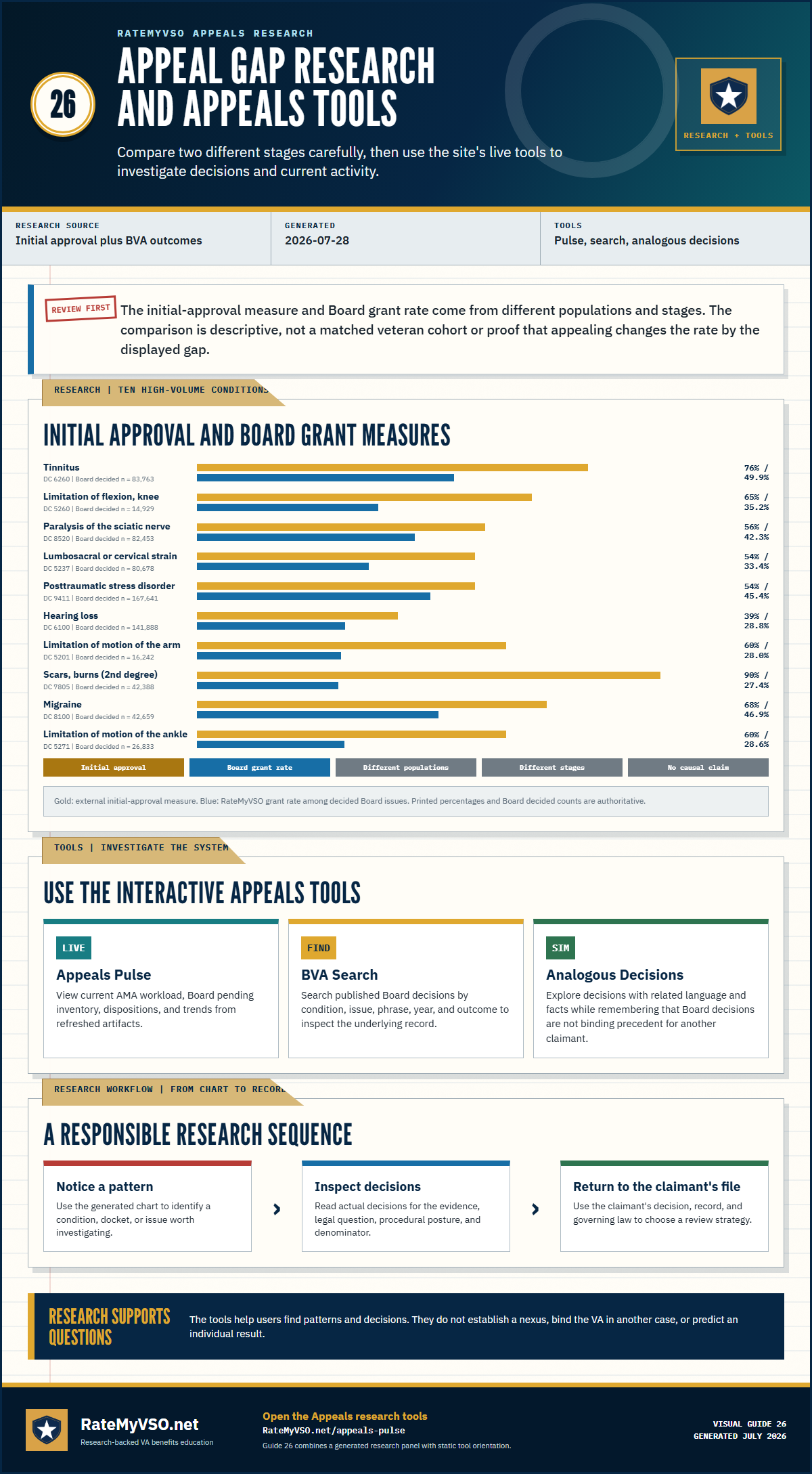 Visual guide: Appeal Gap Research and Appeals Tools
Generated appeal-gap comparison as of 2026-10-19 for ten high-volume conditions, plus orientation to Appeals Pulse, BVA Search, and Analogous Decisions. Opens the full-size chart, free to save or print.
Visual guide: Appeal Gap Research and Appeals Tools
Generated appeal-gap comparison as of 2026-10-19 for ten high-volume conditions, plus orientation to Appeals Pulse, BVA Search, and Analogous Decisions. Opens the full-size chart, free to save or print.
Initial claim vs. Board appeal, by condition
Initial approval rate is GAO's FY2010-2020 analysis of VBA's own data, covering all veterans who received a decision on an initial claim. GAO also found approval rates for Black male veterans ran 3 to 22 percentage points lower than for White male veterans on nine of these ten conditions, so this single rate does not describe every veteran's experience. Board grant rate is granted of decided (granted+denied) issues in our full published-decision corpus. The gap column is initial-approval minus Board grant rate, a positive number means the condition grants MORE often on an initial claim than on Board appeal:
| # | Condition | Veterans | Initial approval | Board grant rate | Gap | Top reason for Board denial |
|---|---|---|---|---|---|---|
| #1 | Tinnitus DC 6260 | 3.6M | 76% |
50.9% |
−25.1 pts | No medical nexus (41.4%) |
| #2 | Limitation of flexion, knee DC 5260 | 2.3M | 65% |
28.2% |
−36.8 pts | No in-service event (48.4%) |
| #3 | Paralysis of the sciatic nerve DC 8520 | 2M | 56% |
41% |
−15 pts | No in-service event (41.1%) |
| #4 | Lumbosacral or cervical strain DC 5237 | 1.8M | 54% |
32.9% |
−21.1 pts | No in-service event (59.3%) |
| #5 | Posttraumatic stress disorder DC 9411 | 1.8M | 54% |
45.9% |
−8.1 pts | No current diagnosis (48.8%) |
| #6 | Hearing loss DC 6100 | 1.7M | 39% |
28.8% |
−10.2 pts | No current diagnosis (47.3%) |
| #7 | Limitation of motion of the arm DC 5201 | 1.4M | 60% |
29.5% |
−30.5 pts | No in-service event (47.7%) |
| #8 | Scars, burns (2nd degree) DC 7805 | 1.3M | 90% |
26.5% |
−63.5 pts | No current diagnosis (45.1%) |
| #9 | Migraine DC 8100 | 1.3M | 68% |
49% |
−19 pts | No in-service event (44.8%) |
| #10 | Limitation of motion of the ankle DC 5271 | 1.3M | 60% |
40.1% |
−19.9 pts | No current diagnosis (52%) |
Methodology
Initial-approval percentages and veteran counts are GAO-23-106097 and the VA Annual Benefits Report FY2025, external federal sources, not derived from our corpus; they are curated and hand-updated when a newer report publishes. Board figures are issue-level aggregates over published Board of Veterans' Appeals decisions for the same 10 diagnostic codes: grant rate is granted divided by granted-plus-denied; the dispositive-element breakdown uses the same Caluza-element methodology (missing diagnosis, missing in-service event, or missing nexus) as the Missing Nexus report, requiring at least 20 classified denials per condition. Figures refresh weekly as new decisions publish.
Cite this research
RateMyVSO. (October 2026). The Appeal Gap: Initial Approval vs. Board of Veterans' Appeals Outcomes for the Ten Most Common Service-Connected Disabilities. https://ratemyvso.net/dc/appeal-gap-report
Free to cite and link with attribution. Board figures derived from published Board of Veterans' Appeals decisions; initial-approval figures from GAO-23-106097 and VA's Annual Benefits Report.
Educational and encyclopedic only, not legal advice, and not a prediction of any individual claim. Figures describe patterns across two different veteran populations, initial claims and Board appeals. For help with a claim, find a VA-accredited representative.