Sciatica and Radiculopathy Claims Guide
Sciatica, the shooting pain, numbness, or weakness that runs down the leg, is usually radiculopathy: a spinal nerve root being pinched, most often by a service-connected back. It is one of the most common VA disabilities, and for most veterans the smart move is to claim it as a secondary condition to the spine, to diabetes, or to another already service-connected disability. This guide explains how the sciatic nerve is rated (DC 8520), the service-connection paths that win most often, the rule that caps purely-sensory cases, the evidence the VA looks for, why these claims get denied, a checklist before you file, what the claims process looks like step by step, how to read your decision letter, and what to do whether you win or you're denied.
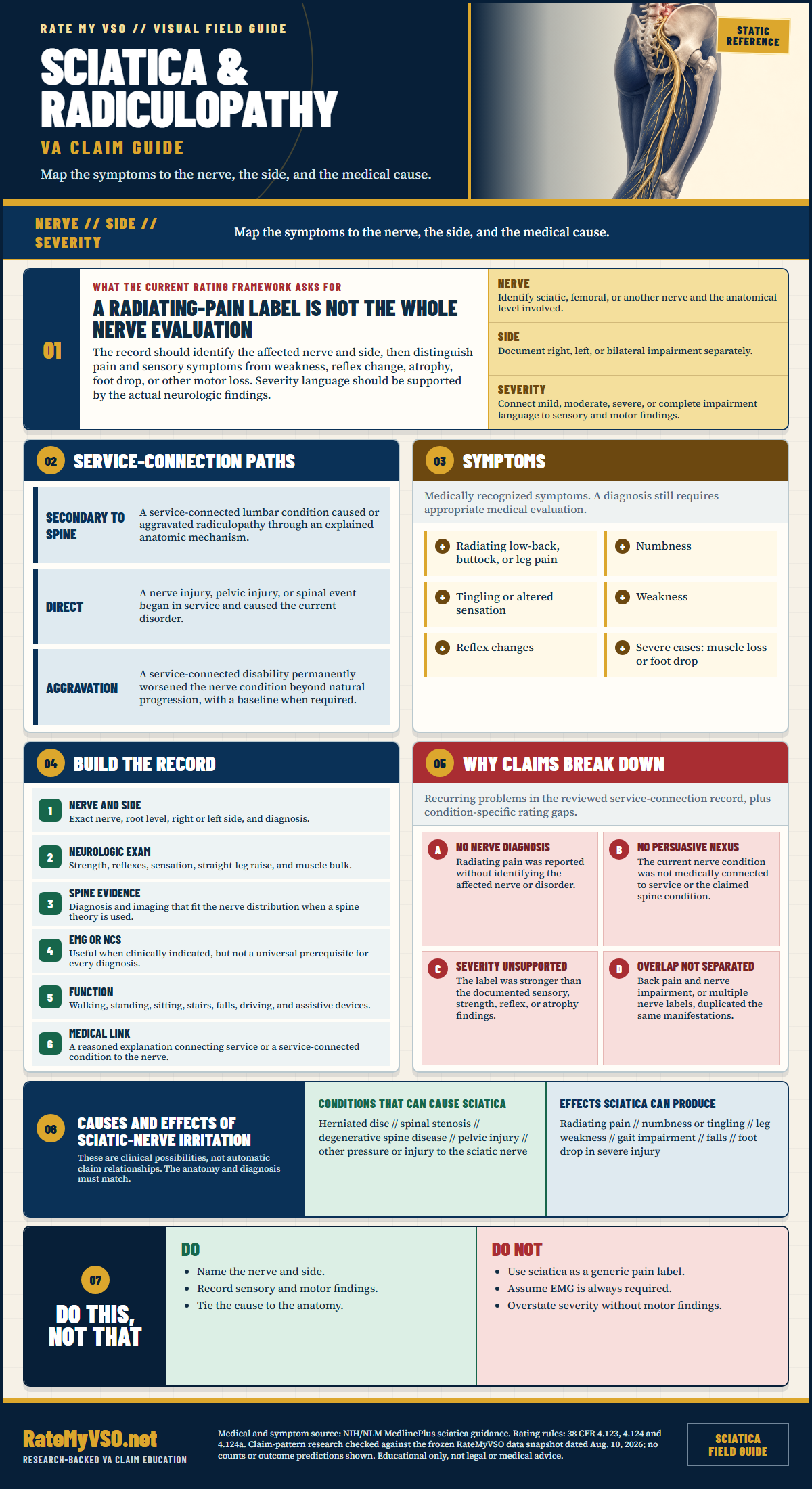 One-page guide: Sciatica and Radiculopathy Claims in One Page
Sciatica and radiculopathy guide covering the affected nerve and side, sensory and motor findings, spine relationships, service-connection paths, causes, effects, and common claim gaps. Opens the full-size chart, free to save or print.
One-page guide: Sciatica and Radiculopathy Claims in One Page
Sciatica and radiculopathy guide covering the affected nerve and side, sensory and motor findings, spine relationships, service-connection paths, causes, effects, and common claim gaps. Opens the full-size chart, free to save or print.
Start with the essentials
- 01Service Connection
The ways service connection can be established for this condition.
- 02Diagnosis and Evidence
Common symptoms and the evidence cited in published Board appeals.
- 03Your History
What you experienced, what others observed, and what treatment changed.
Understand the claim
Overview: What Sciatica and Radiculopathy Actually Are
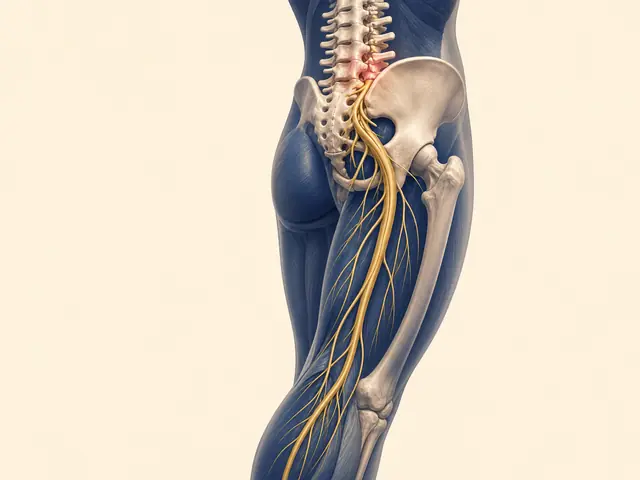
Radiculopathy means a spinal nerve root is compressed or irritated, sending symptoms down the nerve's path: pain, tingling, numbness, or weakness in the limb. Sciatica is radiculopathy of the sciatic nerve, which runs from the lower back down each leg, so the symptoms travel into the buttock, thigh, calf, and foot. The VA rates the affected nerve, and for the leg that is most often the sciatic nerve, diagnostic code 8520, under 38 CFR 4.124a.
Nerve pain that runs down the leg is often tied to a back problem, to diabetes, or to another already service-connected condition, so many winning claims are built as secondary claims rather than as brand-new injuries from service. We analyzed published Board decisions on this condition and found most of the cases that reach the Board are not actually about whether service connection gets granted at all, they are about the rating percentage, the effective date (the start date for benefits), or whether an existing rating can be reduced. Both types of fights are covered in this guide.
Types of Nerve Involvement
"Sciatica" is the everyday word veterans use, but the VA's rating schedule actually covers several distinct peripheral nerves in the leg, each with its own diagnostic code and its own rating criteria under 38 CFR 4.124a.
- Sciatic nerve (DC 8520): by far the most common leg radiculopathy code. Symptoms run from the lower back through the buttock, thigh, calf, and into the foot.
- Femoral nerve (DC 8526): affects the anterior (front) thigh and, in more severe cases, knee extension.
- Diabetic peripheral neuropathy: nerve damage caused by service-connected diabetes mellitus often shows up in the legs and is rated under whichever specific nerve code the symptoms actually affect, most often the sciatic nerve, sometimes bilaterally.
- Common peroneal nerve (DC 8521): a frequent culprit behind foot drop and lower-leg weakness.
- Posterior tibial nerve (DC 8525), musculocutaneous/superficial peroneal nerve (DC 8522), and external cutaneous (lateral femoral cutaneous) nerve (DC 8529): less commonly claimed, but rated under the same general schedule when the specific nerve distribution is affected.
A medical assessment should identify the nerve condition and, where possible, the affected nerve. That assessment can draw on your history, your reported symptoms, the clinical examination, and other findings in the record. A description of symptoms by itself does not identify which nerve is involved, which is why the provider's findings matter, discussed further below.
How Service Connection Works, At a High Level
Before getting into the specific pathways below, it helps to understand the three things every sciatica or radiculopathy claim ultimately has to show. This is the same basic test that applies to any VA disability claim, just applied to this condition.
- A current diagnosis. A doctor must confirm you actually have the nerve condition now, such as radiculopathy of the sciatic or femoral nerve, or peripheral neuropathy of a leg.
- An in-service event, or a service-connected condition behind it. Either something that happened or was documented during your service, or a disability VA already covers (like a back condition, diabetes, or hypertension) that caused or worsened the nerve condition.
- A medical nexus. A doctor has to connect the two with an explanation, not just a yes-or-no statement. A reviewer gives real weight to an opinion that reviews your history and gives reasons for its conclusion.
How It Gets Service Connected
Many leg-nerve conditions do not have to be traced directly to an in-service event. Several well-documented pathways can establish service connection.
Secondary to the Spine (the Common Path)
Most leg radiculopathy is caused by a service-connected low-back disability (herniated disc, degenerative disc disease, strain). If your back is already service-connected, the radiculopathy is claimed as secondary: you show the diagnosis and a medical link to the back. This is usually the cleanest path. See spine guides and service connection.
Secondary to Diabetes (DC 7913)
Diabetic peripheral neuropathy in the legs is a recognized and frequently granted secondary condition once diabetes is service-connected. Under 38 CFR 3.310, the service-connected condition only has to be a contributing cause, not the only cause. Published Board decisions have granted leg peripheral neuropathy on exactly this theory.
Presumptive route through herbicide exposure. If you are presumed exposed to herbicides (for example Vietnam service, or certain Korea DMZ and Thailand base service), diabetes can be granted automatically under 38 CFR 3.309(e), and diabetic nerve damage in the legs then follows as secondary to that presumptively service-connected diabetes. The Board has used exactly this chain, granting diabetes for Korea DMZ service and then granting the leg neuropathy that followed from it.
Secondary to Hypertension (DC 7101)
Leg nerve damage secondary to service-connected hypertension is also a recognized pathway in published Board reasoning. As with diabetes, the standard is contributing cause, not sole cause, and a nexus opinion should explain the mechanism connecting the vascular condition to the nerve findings.
Direct. Nerve injury or onset in service with a current diagnosis and nexus.
As the neurologic part of a spine claim. If you are filing or appealing a back claim, make sure the examiner documents any radiating leg symptoms, because the formula requires the VA to rate that separately. It is a commonly missed add-on rating.
The neck (cervical spine) produces the same thing in the arms, upper-extremity radiculopathy, rated under the corresponding nerve codes. See the cervical spine guide.
Service Connection by Aggravation
When a veteran had documented pre-service nerve symptoms that were significantly worsened beyond natural progression by military service, aggravation-based service connection under 38 CFR 3.306 is available. Worsening counts too, not just causing: if a service-connected condition made an existing nerve condition worse, even modestly, that can be enough.
What VA Looks For: Tests, Records, and Diagnostic Codes
Records to gather for a direct or secondary claim:
- The neurological exam: findings on reflexes, sensation, muscle strength, and any atrophy in the affected limb. This is the single most important data point, since the rating percentage turns on exactly these findings.
- EMG / nerve conduction studies: when available, these provide objective, measurable confirmation of which nerve is affected and how severely, rather than relying only on reported symptoms.
- The diagnostic codes involved: DC 8520 for the sciatic nerve itself, plus whatever code applies to the condition you're connecting it to, for example a lumbar or cervical spine code, DC 7913 (diabetes mellitus), or DC 7101 (hypertension). Related lower-extremity nerve codes include DC 8526 (femoral) and DC 8521 (common peroneal).
- The actual form the examiner fills out: the peripheral-nerves Disability Benefits Questionnaire (DBQ), discussed in more detail later in this guide.
Symptoms and rating
Symptoms Recorded in Granted Sciatic nerve (radiculopathy) Decisions
We analyzed 5,844 granted Board decisions involving sciatic nerve (radiculopathy) for symptoms named in sentences about the condition (rating-criteria recitations excluded). Descriptive of the published record, what the Board wrote down, not a checklist of what to report.
Bar length shows decisions. Percentages remain context.
Detected by phrase-reading the decision text with condition-specific vocabularies. Source: Board of Veterans' Appeals decisions, RateMyVSO analysis.
How the VA Rates the Sciatic Nerve (DC 8520)
The sciatic nerve is rated by how badly the nerve is affected, from incomplete paralysis (the usual case, meaning impaired but not lost function) up to complete paralysis. Each leg is rated on its own.
Because each leg is a separate nerve, radiculopathy in both legs is rated twice (and, being a paired extremity, may pick up the bilateral factor). Related lower-extremity nerves have their own codes, for example the femoral nerve (DC 8526) for anterior-thigh symptoms and the common peroneal nerve (DC 8521).
The Wholly-Sensory Cap (the Rule That Surprises People)
This is why two veterans with "the same" sciatica can land far apart: the one with documented weakness and atrophy can reach 40% or 60%, while purely-sensory symptoms top out around 20%. Published Board decisions have denied higher sciatic ratings, and kept ratings at 10%, specifically because exams found no muscle atrophy, normal strength, and no other objective nerve findings. If you have real weakness or atrophy, make sure the exam captures it.
Evidence and Board research
Evidence That Wins
We analyzed the Board's published DC 8520 decisions: a private nexus opinion in the file goes with a much higher grant rate, shown below.
- A neurological exam documenting which nerve, which leg, and the findings: reflexes, sensation, muscle strength, and any atrophy.
- EMG / nerve conduction studies when available, objective confirmation of the nerve involvement and its severity.
- The link to your spine, diabetes, or hypertension. For a secondary claim, a medical statement connecting the radiculopathy or neuropathy to your service-connected condition. See nexus letters.
- Evidence of motor loss (weakness, atrophy, foot drop) if you are seeking more than 20%, since the sensory cap otherwise limits the rating.
- The peripheral-nerves DBQ. It captures the nerve, side, and severity the rating turns on. See the DBQ guide.
A nexus opinion that explains its reasoning matters more than a diagnosis alone. The single biggest difference between winning and losing nerve-condition claims is whether the doctor's opinion gave reasons. A reviewer weighs an opinion that reviews the veteran's history, cites supporting reasoning, and applies it to the specific facts far more heavily than a bare conclusion. An opinion built on an inaccurate factual premise, such as a misremembered deployment or exposure history, is given no weight at all.
Evidence Cited in Published Sciatic nerve (radiculopathy) Decisions
We analyzed 85,901 published Board decisions involving sciatic nerve (radiculopathy) for condition-specific evidence, counting only case-specific mentions (boilerplate recitations excluded). "Favorable" is the share of decisions citing that evidence where every issue was granted or the outcome was mixed; the baseline across all these decisions is 56.2%, combining every diagnostic code below. Evidence appearing in a decision does not mean it decided the case. Descriptive of the published record, not a prediction.
Bar length shows decisions citing the evidence.
By diagnostic code
These codes are grouped together above. They do not perform the same, so find your own code here rather than reading the combined figure. A code retired in the schedule rewrites appears without a link, because its decisions were judged under criteria that no longer apply.
Bar length shows published decisions reviewed.
Detected by phrase-reading the decision text with condition-specific vocabularies. Source: Board of Veterans' Appeals decisions, RateMyVSO analysis.
Board Grants, Dissected
The Board decisions below show veterans who won direct service-connection claims involving sciatic nerve or lower extremity peripheral nerve damage. Board decisions are not binding precedent, and each case turned on its own facts and evidence. Still, the pattern across these wins is clear: a documented current diagnosis, a credible link to an in-service event or exposure, and a well-reasoned medical opinion made the difference.
Electrical shock in service tied directly to sciatic nerve damage Citation A26036992 (April 21, 2026), hearing docket
The record: The Veteran testified he was shocked while working on an electrical unit, with the current running down his right leg and causing numbness. A buddy statement from a fellow servicemember corroborated the shock and the Veteran's reaction. VA outpatient records also linked his foot numbness to "unit shock during service." The July 2021 VA examiner gave a negative opinion but relied mainly on the lack of contemporaneous documentation.
Why it won: The Board found the VA opinion inadequate because it improperly discounted competent lay evidence based only on missing paperwork, and it contradicted the AOJ's own binding finding that the in-service event occurred. The Veteran's testimony and the corroborating buddy statement were found credible and persuasive, so service connection for right lower extremity peripheral neuropathy (sciatic nerve) was granted.
Diabetic nerve damage in both legs connected to Agent Orange exposure Citation A26039235 (April 28, 2026), hearing docket
The record: The Veteran testified he washed C-123 aircraft covered in a sticky residue while stationed at Kingsville Naval Air Station, with no protective equipment. His personnel records confirmed aircraft maintenance duties. A VA physician's treatment note stated his diabetes and neuropathy "can be related to exposure to agent orange."
Why it won: The Board found the Veteran's account of contact with C-123 aircraft credible and consistent with his documented duties, and conceded Agent Orange exposure. Combined with the treating VA physician's supportive note, the Board resolved doubt in the Veteran's favor and granted service connection for bilateral lower extremity diabetic neuropathy on a facts-found basis.
Private doctor's research on Agent Orange outweighs a bare VA denial Citation A26039036 (April 27, 2026), evidence submission docket
The record: The AOJ conceded herbicide agent exposure. A September 2025 VA examiner said non-diabetic peripheral neuropathy was not on the presumptive list and denied the claim based largely on the PACT Act's silence on the condition. The Veteran later submitted a private opinion from Dr. K.G., M.D., who explained how the dioxin in Agent Orange can be stored in body fat and cause nerve damage after a long latency period, and who ruled out other causes such as diabetes.
Why it won: The Board found the VA opinion inadequate because the examiner leaned only on the PACT Act without addressing outside research or the Veteran's history. Dr. K.G.'s opinion was detailed, cited supporting literature, and ruled out alternative causes, so the Board found it highly probative and granted service connection for bilateral lower extremity non-diabetic peripheral neuropathy.
Equally balanced medical opinions lead to a grant for bilateral leg neuropathy Citation A26038882 (April 27, 2026), evidence submission docket
The record: A May 2025 VA examination confirmed a diagnosis of peripheral neuropathy of both lower extremities, and the AOJ conceded herbicide exposure. The VA examiner still gave a negative opinion, noting the Veteran's symptoms began in 2007, long after his 1960s exposure. The Veteran gave differing but consistent accounts of onset, including exposure to wet, untreated shower rooms in 1966.
Why it won: The Board found the Veteran's statements about onset highly probative, and treated the condition as a chronic disease of the nervous system for which credible continuity-of-symptoms testimony can substitute for a positive nexus opinion. Weighing the VA opinion and the lay evidence as roughly equal, the Board resolved doubt in the Veteran's favor.
Treating physician's opinions carry the day over an inadequate VA review Citation A26037315 (April 21, 2026), hearing docket
The record: The Veteran testified his leg pain began right after returning from Vietnam in 1969 and had worsened since. His ex-spouse submitted a lay statement confirming the leg pain after service. His treating physician submitted two private opinions, from 2019 and 2023, finding it at least as likely as not that his neuropathy was caused by Agent Orange exposure, after ruling out other causes through testing.
Why it won: The Board found the April 2024 VA opinion inadequate because it lacked a comprehensive rationale, while the treating physician's opinions were thorough, well-reasoned, and based on personal knowledge of the Veteran's history. Combined with credible lay testimony about onset and continuity, the Board granted service connection for peripheral neuropathy of the bilateral lower extremities.
Why These Claims Get Denied
Beyond the general "no nexus" and "no diagnosis" reasons, a few specific denial patterns show up often enough in published Board decisions to call out on their own.
- A diagnosis or a one-line opinion, without reasoning. Having the condition, or even a doctor's bare statement that it is "related to service," is not enough by itself. An unexplained, conclusory opinion cannot carry a claim.
- Toxic or herbicide exposure argued alone. Exposure by itself does not prove your nerve condition came from it. Claims have been denied where exposure was conceded but the condition was not the type or timing covered by the presumption and had no supporting medical opinion, and where the veteran could not even establish the claimed exposure.
- General medical literature with no link to you. Studies showing a possible connection in general are not enough. Weight goes down when the cited articles discuss increased risk generally without tying the specific mechanism to this veteran's own facts, especially when a VA examiner who actually reviewed the file reaches a different conclusion.
- The veteran's own belief about the cause, without a doctor's opinion behind it. You are allowed to describe your symptoms, but connecting a nerve disease to a cause is a medical question a non-doctor cannot answer on their own (Jandreau v. Nicholson).
- A long gap between service and the first documented symptoms. The Board has pointed to post-service causes, like a workplace incident or years of a physically demanding job, when a nerve injury did not appear until many years after service. Gaps of decades before diagnosis weigh against the claim.
- A secondary claim resting on a condition that isn't itself service-connected. If the underlying condition (diabetes, hypertension, a neurological disease) was denied or was never filed, there is nothing for the secondary nerve claim to attach to.
Common Mistakes
The same handful of missteps account for most lost or under-rated radiculopathy claims. Each follows from how DC 8520 is scored and how the nerve relates to the spine and to other conditions.
- Letting the leg symptoms get folded into the back rating. The spine formula requires the VA to rate associated radiculopathy separately from the orthopedic range-of-motion rating. When the examiner does not document the radiating leg symptoms, that separate DC 8520 percentage is quietly lost.
- Expecting a high rating on purely-sensory symptoms. 38 CFR 4.124a says that when the involvement is wholly sensory, pain, numbness, and tingling on their own, the rating should be for the mild, or at most the moderate, degree (about 10% to 20%). A higher evaluation needs a disability picture beyond wholly sensory involvement, and it is decided from the complete record. Findings that can be part of that picture include weakness, reflex changes, atrophy, foot drop, trophic changes, and effects on gait or other function. No single finding sets a particular percentage by itself.
- Claiming only one leg when both are affected. Each leg's sciatic nerve is rated on its own, and as a paired extremity both legs together may pick up the bilateral factor. A claim filed for one leg leaves the other rating, and the bilateral add-on, on the table.
- Skipping the link to the underlying condition on a secondary claim. A missing diagnosis is the leading denial reason for DC 8520, but a missing nexus is what specifically sinks a secondary claim like this one. For radiculopathy or neuropathy claimed as secondary to a service-connected back, diabetes, or hypertension, the file needs a medical statement connecting the nerve symptoms to that condition, not just a diagnosis.
- Going to the exam without objective nerve findings. The rating turns on which nerve, which leg, and the severity. Without a neurological exam and, where available, EMG or nerve conduction studies, motor loss often goes unrecorded and the severity is scored low.
- Expecting the effective date to reach back to when symptoms began. The start date for benefits is usually the date you filed the claim (or intent to file), not the date the nerve condition first appeared, even when symptoms clearly existed earlier. An exception exists when official service department records surface later and trigger reconsideration.
- Not keeping updated exams after you win. A rating can be reduced if a later exam shows genuine improvement. Ongoing documentation of your actual severity, not just the exam that won the original grant, protects the rating over time.
- Not flagging an old, unadjudicated claim. If you mentioned leg symptoms in an earlier claim that VA never actually decided, that claim may still be open and can push your effective date back years. It's easy to miss this if you assume an old, undecided issue simply went away.
Do's and Don'ts
A condensed version of everything above, in the order it actually matters when you sit down to build your file.
- Get a nexus opinion that explains its reasoning and applies it to your own history, not a bare conclusion.
- Identify every service-connected condition that could plausibly have caused or worsened your nerve symptoms (back, neck, diabetes, hypertension).
- Give every doctor your accurate service and medical history so the opinion isn't built on wrong facts.
- Secure service connection for the underlying condition first if you're filing a secondary claim.
- Get a neurological exam and, where available, EMG or nerve conduction studies documenting strength, reflexes, and any atrophy.
- Claim both legs if both are affected, each is rated separately and may pick up the bilateral factor.
- Point out any earlier claim about your legs that VA never formally decided.
- Keep current exams after you win, to defend against a future reduction if the condition hasn't actually improved.
- Use the benefit of the doubt: if the evidence is roughly balanced, the tie goes to you.
- Don't rely on a diagnosis, or a one-line "related to service" opinion, alone.
- Don't rely on your own opinion about what caused it, causation for a nerve condition is treated as a medical question.
- Don't assume toxic or herbicide exposure by itself proves the connection, without a supporting medical opinion.
- Don't lean on general medical literature that never ties the mechanism to your own specific facts.
- Don't let radiating leg symptoms get silently folded into your back rating, ask the examiner to document them separately.
- Don't expect your effective date to reach back to when symptoms began, it's usually the filing date.
- Don't skip the objective motor findings (weakness, atrophy, reflexes) if you want more than the sensory cap allows.
Secondary relationships
Secondary Condition Map
We found these are the conditions most often linked with sciatic nerve radiculopathy in the Board's published decisions. Each bar is the BVA grant rate for DC 8520, with the number of decisions below it. They describe what the Board's record shows across many veterans, not a prediction about any one claim.
Conditions that can cause sciatic nerve radiculopathy (radiculopathy as the secondary)
Claims where sciatic radiculopathy was argued as secondary to an already service-connected condition. This is the "ways to connect via another condition" list, and it's usually the easier route into a grant:
Conditions sciatic nerve radiculopathy can cause (radiculopathy as the primary)
Conditions veterans have claimed as caused or aggravated by a service-connected sciatic nerve radiculopathy, in other words, conditions secondary to the nerve condition once it is already service-connected:
Prepare and take the next step
Prepare: your own working pages
Optional. These are your own notes, in your own words. They are not a VA form, they are not sent to the VA, and nothing here is a medical finding or a prediction about your claim.
Three reminders while you prepare
- Map each side and nerve finding
Record right and left symptoms separately, including where pain, numbness, weakness, or other changes travel and what the examination identifies. Go to this part
- Separate sensory symptoms from motor loss
Use strength, reflex, sensation, muscle, gait, and test findings from the record. Do not choose your own paralysis or severity label. Go to this part
- Connect the nerve condition to its cause
Organize the spine, injury, onset, treatment, and secondary-condition history that applies, then identify missing records and examination questions. Go to this part
Sign in or create an account to save your answers and come back to them later. You can fill these in and print them without an account.
Right and left symptom map
Neurological findings and testing
Function and connection questions
Records and unanswered questions
Decision-letter reading sheet
Quick Checklist Before You File
Bring these together before you submit anything.
- A current diagnosis of your nerve condition (sciatic, femoral, or peripheral neuropathy) in writing.
- A determination of whether a condition VA already covers (back, neck, diabetes, hypertension) caused or worsened it, so you can claim it as secondary.
- A nexus opinion that reviews your records and explains its reasons, not just a yes-or-no line.
- Accurate service and medical history given to every doctor, so no opinion is built on wrong facts.
- Service connection secured for the underlying condition first, if you're filing a secondary claim.
- Current exams documenting strength loss, muscle atrophy, and reflex changes, to support the rating and to protect it later.
- A check for any earlier claim about your legs that VA never formally decided, it may still be open and affect your effective date.
For the mechanics of actually submitting the claim, see the Standard Claim Guide and the Fully Developed Claim Guide (filing with all your evidence up front can speed up the decision).
The Claims Process, Step by Step
Once you file, your claim moves through a series of hand-offs. Understanding who does what helps you know who to contact, and what to expect, at each stage.
- You file the claim. Directly with VA, through VA.gov, or with the help of an accredited representative.
- VA acknowledges the claim and assigns it for development. A Veteran Service Representative (VSR) is assigned to gather your service treatment records, VA and private medical records, and any other evidence needed.
- The VSR orders a Compensation & Pension (C&P) exam if one is needed. Not every claim requires one, but most radiculopathy claims do, especially secondary claims where a nexus opinion is required.
- The C&P exam is conducted. By a VA clinician or a contracted examiner, who completes a Disability Benefits Questionnaire (DBQ) documenting the affected nerve, side, severity, and, where relevant, a nexus opinion.
- The file goes to a Rating Veteran Service Representative (RVSR), the "rater." The rater reviews the complete file, including the exam results, and decides whether service connection is warranted and at what percentage.
- A senior reviewer may review the decision before it's finalized, depending on the complexity of the claim.
- VA issues the decision letter. This states whether the claim is granted or denied, the rating percentage if granted, and the reasons behind the decision.
- If you disagree, you choose an appeal lane. Higher-Level Review, Supplemental Claim, or a Board appeal, covered later in this guide.
Who's who: VSO vs. VSR vs. Rater vs. C&P Examiner
Your VSO
An accredited representative from a veterans service organization, or an accredited attorney or claims agent. Not a VA employee. Helps you prepare, gather evidence, and file, and can represent you through an appeal. Has no authority to decide your claim.
VSR (Veteran Service Representative)
VA staff who "develops" your claim: requests records, schedules the C&P exam, and assembles the file. Does not decide the rating.
Rater (RVSR)
VA staff who reviews the completed file and makes the actual decision, service connection or denial, and the percentage. This is the person whose judgment the decision letter reflects.
C&P Examiner
A VA clinician or a contracted medical examiner who conducts the exam and completes the DBQ. Documents findings and, where asked, a nexus opinion. Does not decide the claim.
For the full walkthrough of every stage with more detail, see Inside Your Claim and Claim Stages.
DBQs and Your C&P Exam
A Disability Benefits Questionnaire (DBQ) is the standardized form an examiner completes for your condition, it structures the exam findings into the specific data points VA's rating schedule requires (for a nerve condition, that includes which nerve, which side, reflex and sensory testing, muscle strength, and any atrophy). See the DBQ Guide for how these forms work, including whether a private DBQ completed by your own doctor can be submitted instead of relying solely on a VA exam.
Before your C&P exam, bring a clear, specific account of your symptoms, focus on your worst days and how the condition affects daily function, not just how you feel on an average day. Be consistent with what's already in your medical records and prior statements. For a full walkthrough of what to expect and how to prepare, see the C&P Exam Prep Guide.
Reading Your Decision Letter, and What to Do If Denied
Your decision letter has two parts: a narrative section explaining the reasoning (often called "reasons and bases"), and a codesheet showing the actual rating percentage, the effective date, and the diagnostic code used. See the Reading Your Decision Letter Guide for how to find and interpret each part, or use the Letter Interpreter tool to upload your own letter and get a plain-English breakdown.
On the effective date: the start date for benefits is usually the date you filed the claim or intent to file, generally not the date the nerve condition first appeared, even if symptoms existed earlier (38 CFR 3.400; 38 USC 5110). Two situations can move that date earlier: an older, related claim that VA never actually decided (it may still be open), or newly received official service department records that trigger reconsideration under 38 CFR 3.156(c).
If your claim is denied, or the rating is lower than you expected, you have three main lanes:
- Supplemental Claim: refile with new and relevant evidence, such as a new nexus opinion or updated neurological exam. See Supplemental Claim Guide.
- Higher-Level Review (HLR): a senior reviewer looks at the same evidence again for a difference of opinion, no new evidence is added. See HLR Guide.
- Board Appeal: your case goes to a Veterans Law Judge at the Board of Veterans' Appeals, with options for a direct review, an evidence docket, or a hearing. See Board Appeal Guide.
Not sure which lane fits your situation? See the Appeals decision guide for a side-by-side comparison of all three.
After You Win: Maintaining Your Rating
A grant is not always the end of the story. A rating can be reduced if a later exam shows the nerve condition genuinely improved, for example paralysis moving from moderate to mild. Keep your treatment consistent, continued follow-up documenting reflexes, strength, and any atrophy protects you if VA schedules a future reexamination. Not every rating gets reexamined; understand when a rating becomes protected from future review (including Permanent and Total status) and what to do if VA proposes to reduce it. See Protect Your Rating and Future Reexaminations for the specifics.
If your nerve condition worsens after the initial grant, for example progressing from moderate to moderately severe, you can file for an increased rating. See the Rating Increase Guide.
References and related resources
Quick Reference Tables
Peripheral Nerve Codes for Leg Radiculopathy
| Nerve | DC Code | What It Affects |
|---|---|---|
| Sciatic | 8520 | Buttock, thigh, calf, foot, most common leg radiculopathy code |
| Femoral | 8526 | Anterior (front) thigh, knee extension in severe cases |
| Common peroneal | 8521 | Foot drop, lower-leg weakness |
| Posterior tibial | 8525 | Foot and sole |
| Musculocutaneous / superficial peroneal | 8522 | Lower leg and foot |
| External cutaneous (lateral femoral cutaneous) | 8529 | Outer thigh sensation only |
Secondary Connection Pathways
| Primary Condition | Mechanism | Evidence Needed |
|---|---|---|
| Back or neck condition | Nerve root compression from the spine | Neurological exam + nexus linking the nerve findings to the spine condition |
| Diabetes (DC 7913) | Diabetic peripheral neuropathy | Neuropathy diagnosis + nexus, or the herbicide-presumptive diabetes chain |
| Hypertension (DC 7101) | Vascular contribution to nerve involvement | Nexus opinion explaining the mechanism as a contributing cause |
From Filing to Decision: Who Does What
| Role | Does | Decides your rating? |
|---|---|---|
| VSO / accredited representative | Helps prepare, gather evidence, and file; represents you on appeal | No |
| VSR | Develops the claim: orders records and the C&P exam | No |
| C&P Examiner | Conducts the exam, completes the DBQ, may give a nexus opinion | No / but has a strong impact |
| Rater (RVSR) | Reviews the full file and decides service connection and percentage | Yes |
Frequently Asked Questions
Should I claim sciatica on its own or as secondary to my back?
Can I get a rating for both legs?
Why is my sciatica only rated 10% or 20% when it hurts so much?
Does a separate radiculopathy rating count as pyramiding with my back?
What if the symptoms are in my arms, not legs?
Can my sciatica or neuropathy rating be reduced later?
When do my payments actually start?
Related Tools and Guides
Sources
- 38 CFR 4.124a, rating peripheral nerves (DC 8520 sciatic, DC 8526 femoral, DC 8525 posterior tibial, DC 8522 musculocutaneous/superficial peroneal, DC 8529 external cutaneous)
- 38 CFR 3.303, service connection, three elements: current disability, in-service event, and nexus
- 38 CFR 3.310, secondary service connection: caused or aggravated by a service-connected disability
- 38 CFR 3.306, aggravation of a pre-existing disability
- 38 CFR 3.307 and 3.309, presumptive service connection, including herbicide exposure and early-onset peripheral neuropathy
- 38 CFR 3.102 and 38 USC 5107(b), benefit of the doubt when evidence is in approximate balance
- 38 CFR 3.400 and 38 USC 5110, effective dates, generally the date of claim or date entitlement arose
- 38 CFR 3.156(c), reconsideration and earlier effective dates based on later-received official service records
- 38 USC 1110 and 1131, basic service connection; 38 USC 1116, 1116B, 1168, herbicide and toxic exposure, including the PACT Act
- Spicer v. McDonough, 61 F.4th 1360 (Fed. Cir. 2023), a service-connected disability need only be a contributing cause, not the sole cause, under secondary service connection
- Nieves-Rodriguez v. Peake, 22 Vet. App. 295 (2008), a probative medical opinion needs clear conclusions supported by data and a reasoned explanation connecting the two
- Stefl v. Nicholson, 21 Vet. App. 120 (2007), a medical opinion is inadequate when it is conclusory, lacks rationale, or does not account for the relevant evidence
- Jandreau v. Nicholson, 492 F.3d 1372 (Fed. Cir. 2007), competency of lay testimony regarding observable symptoms, and the limits of lay opinion on medically complex causation questions
- CCK Law, radiculopathy
- Hill & Ponton, radiculopathy