VA Hypertension Claims Guide
Hypertension (high blood pressure) is one of the most common VA disability claims, yet it is also one of the most technically specific. The rating formula under diagnostic code 7101 runs entirely on blood pressure numbers, not on symptoms. A strict diagnostic rule requires readings on multiple days before the VA will recognize the condition at all. And the service-connection paths range from direct in-service onset, to a 1-year chronic-disease presumptive, to a PACT Act Agent Orange presumptive, to secondary connections from PTSD, sleep apnea, diabetes, and kidney disease. This guide covers all of it in plain language: what counts, how service connection works, the evidence that wins, why claims get denied, the filing checklist, the claims process step by step, how to read your decision letter, and what to do whether you win or you're denied.

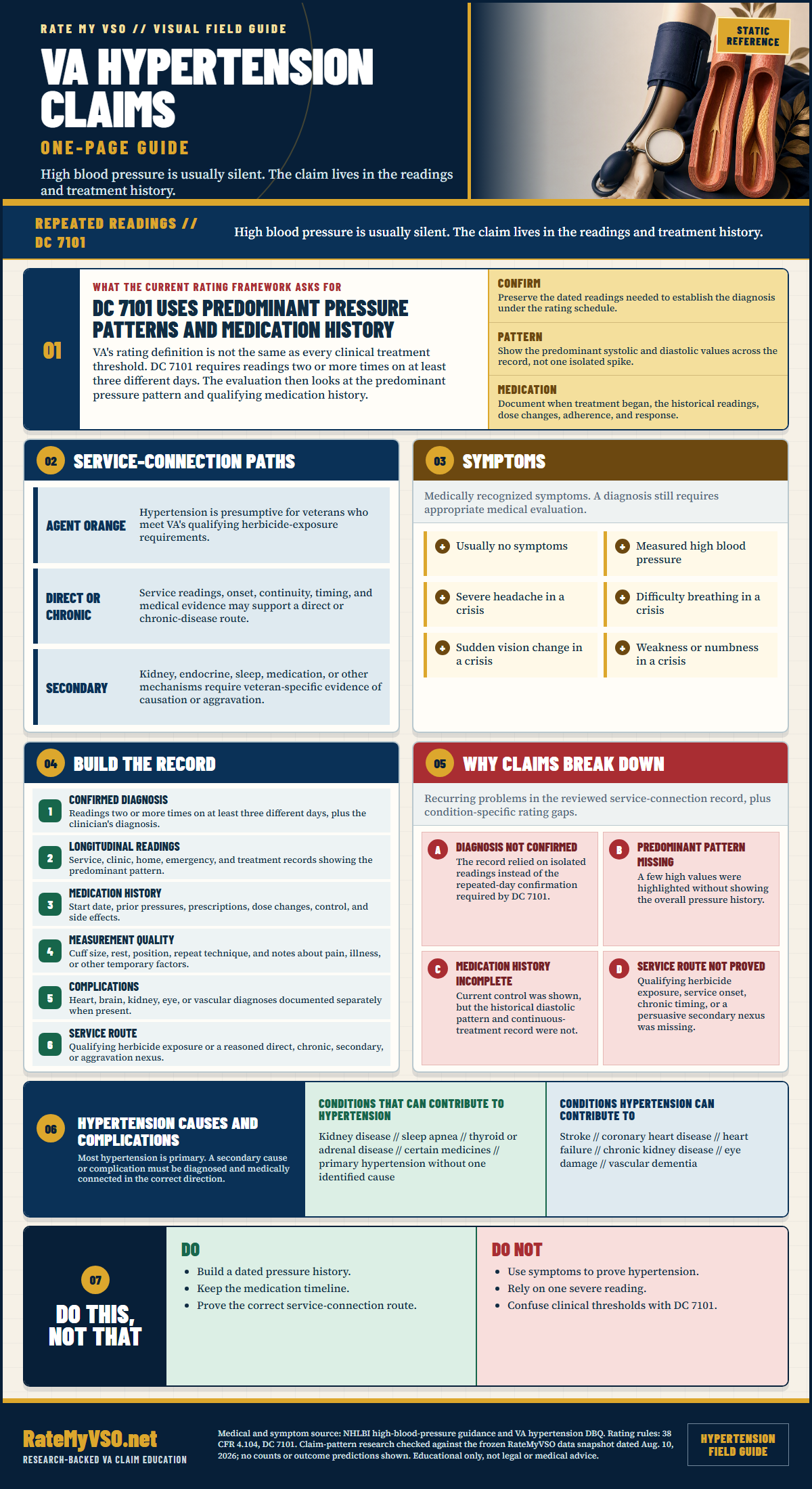 One-page guide: VA Hypertension Claims in One Page
Hypertension guide covering repeated-day confirmation, predominant pressure patterns, medication history, Agent Orange and other service paths, crisis warning signs, evidence, and common claim gaps. Opens the full-size chart, free to save or print.
One-page guide: VA Hypertension Claims in One Page
Hypertension guide covering repeated-day confirmation, predominant pressure patterns, medication history, Agent Orange and other service paths, crisis warning signs, evidence, and common claim gaps. Opens the full-size chart, free to save or print.
Start with the essentials
- 01Service Connection
The ways service connection can be established for this condition.
- 02Diagnosis and Evidence
Common symptoms and the evidence cited in published Board appeals.
- 03Your History
What you experienced, what others observed, and what treatment changed.
Understand the claim
Overview
Hypertension is rated under DC 7101 within 38 CFR 4.104 (Schedule of Ratings, Cardiovascular System). Unlike most VA disabilities, the rating does not ask how the condition affects your daily function, it asks what your blood pressure actually was, confirmed under the specific diagnostic rule covered next. Published Board decisions show grants coming in three main flavors: direct (blood pressure readings that met the threshold in service), secondary (an already service-connected condition caused or worsened it), and presumptive (herbicide/Agent Orange exposure under the PACT Act, or the 1-year chronic-disease rule). Denials on the merits, by contrast, are concentrated in a small set of recurring problems: no current diagnosis, no in-service link even argued, or a related-but-different condition (like high cholesterol) mistaken for hypertension itself.
What the VA Counts as Hypertension
For VA purposes, hypertension has a specific technical meaning under 38 CFR 4.104 that is stricter than a civilian diagnosis. There are two recognized types, both rated under DC 7101.
Hypertension (diastolic)
The bottom number (diastolic) is predominantly 90 mm Hg or higher. "Predominantly" means that the majority of your readings, not just one or two, fall at or above that level. A single high reading does not qualify.
Isolated systolic hypertension
The top number (systolic) is predominantly 160 mm Hg or higher AND the diastolic is under 90. This is typically seen in older veterans and is rated under the same DC 7101 table as standard hypertension.
ICD-10 Diagnosis Codes
The ICD-10 diagnosis codes most commonly used for DC 7101, Hypertensive vascular disease (hypertension and isolated systolic hypertension) (the kind on your medical records, decision letter, or C&P exam report). VA rates the disability and its residuals, not the diagnosis itself, so coding can vary.
How Service Connection Works, At a High Level
Before getting into the specific pathways below, it helps to understand the three things every direct hypertension claim ultimately has to show. This is the same basic test that applies to any VA disability claim, applied here to hypertension.
- A current diagnosis. A doctor must confirm you have hypertension now, meeting the VA's own diagnostic threshold described above. Claims are denied where the record shows no formal hypertension diagnosis at all, or shows a related but distinct condition, like high cholesterol, instead.
- An in-service event, or a service-connected condition behind it. Either blood pressure readings or documentation from your time in service, or a disability VA has already service-connected that caused or worsened your hypertension.
- A medical nexus. A doctor's opinion connecting your hypertension to service, or to the service-connected condition behind it, and explaining the reasoning, not just stating a conclusion.
How Hypertension Gets Service Connected
Service connection for hypertension can be established through several distinct pathways. Published Board decisions show wins coming in roughly three flavors, direct, secondary, and presumptive, so it is worth working through all of them rather than assuming only one applies.
Direct service connection
Direct service connection requires a current diagnosis of hypertension meeting the VA's standards, an in-service event or onset, and a nexus linking them. For hypertension this means blood pressure readings in service that met the diagnostic threshold on multiple days, or a service diagnosis that satisfies the 2-readings-on-3-days rule. If in-service readings were only in the prehypertension range, direct service connection is difficult without additional evidence. Old service treatment records showing elevated readings on more than one occasion, especially when paired with other in-service risk indicators such as high cholesterol findings or documented counseling to reduce salt intake and exercise more, can be enough to tie the diagnosis to service even without a formal in-service hypertension diagnosis.
1-year presumptive (38 CFR 3.309(a))
Hypertension is listed as a chronic disease under 38 CFR 3.309(a). If you are diagnosed with hypertension to a compensable degree (10% or more) within one year of separation from active duty, service connection is presumed. You do not need to show any specific in-service event or nexus. See DC 7101 and the presumptive check tool.
Agent Orange presumptive (PACT Act 2022)
The PACT Act of 2022 added hypertension as a presumptive condition for veterans with qualifying Agent Orange exposure. Veterans who served in Vietnam, the Korean demilitarized zone, certain other locations, or who handled Agent Orange as part of their duties can now claim hypertension as service connected without proving a nexus. See the Agent Orange presumptive page for qualifying service locations and the full list of covered conditions. Even before this presumptive existed, some veterans won direct service connection for hypertension with a private medical opinion linking it to herbicide exposure.
Established secondary pathways include:
Secondary to PTSD or other mental health conditions (DC 9411)
Stress from PTSD and related mental health conditions is medically documented to cause and worsen hypertension through chronic activation of the sympathetic nervous system. Winning cases have linked hypertension to service-connected anxiety and tinnitus together, and to depression or PTSD together. Under 38 CFR 3.310, a secondary claim requires a current diagnosis of hypertension and a medical nexus opinion stating that the service-connected mental health condition caused or aggravated it. See the PTSD claims guide and nexus letters.
Secondary to obstructive sleep apnea (DC 6847)
Sleep apnea is strongly associated with hypertension. Repetitive hypoxia from OSA activates the renin-angiotensin system and raises baseline blood pressure. If you have service-connected sleep apnea, a medical nexus linking it to your hypertension can support a secondary claim under 38 CFR 3.310. A combination of alcohol use disorder and sleep apnea has also supported a grant on this theory. See the sleep apnea claims guide.
Secondary to diabetes mellitus (DC 7913)
Type 2 diabetes causes vascular damage and kidney involvement that raise blood pressure. Many veterans with service-connected diabetes, especially under the Agent Orange and PACT Act presumptives, can pursue a secondary claim for hypertension. A nexus opinion from a treating provider or independent medical examiner is the key piece of evidence.
Secondary to kidney disease
Chronic kidney disease (CKD) is both a cause and a consequence of hypertension. If you have service-connected kidney disease, and hypertension arose or worsened after that diagnosis, a secondary claim under 38 CFR 3.310 may be available. Watch the nephritis exception: nephritis and hypertension cannot be rated separately under 38 CFR 4.115 because the rule combines them. If the kidney condition is nephritis specifically, a separate DC 7101 rating is not available; see the pyramiding section below.
Obesity as an intermediary
When a service-connected condition, for example a spine, knee, or hip disability that limits activity, or a psychiatric condition, has caused or significantly worsened obesity, and that obesity has caused or aggravated hypertension, VA can recognize the full causal chain as secondary service connection. This has supported grants where joint disabilities drove weight gain, and where a combined psychiatric-and-joint disability chain was documented. The controlling authority is Walsh v. Wilkie, applying VA General Counsel Precedent Opinion 1-2017, whether the service-connected disability caused the weight gain or merely aggravated it. This requires documentation at each link in the chain: the service-connected condition, the resultant weight gain, and the causal role of obesity in the hypertension diagnosis.
Toxic exposure (TERA) and other paths
Hypertension can also be claimed through direct service connection based on documented toxic exposure risk activities (TERA), as an aggravation of a pre-existing condition under 38 CFR 3.306, or as an automatic secondary to certain service-connected amputations (see the FAQ below for the amputation-related presumptive).
The "but for" causation standard for secondary claims. Secondary service connection under 38 CFR § 3.310(a) and (b) covers disabilities that are the result of, or would not have occurred but for, a service-connected disability. This tracks the causation standard applied in Spicer v. McDonough, which held that secondary service connection requires actual but-for causation. A service-connected condition that merely coexists with hypertension, without causing or aggravating it, is not enough. Because hypertension is multifactorial, with contributing causes such as weight, age, diet, and family history, a nexus opinion is stronger when it addresses those other recognized causes and explains why they do not account for the diagnosis in this veteran.
Service connection by aggravation
When a veteran had documented pre-service hypertension that was significantly worsened beyond its natural progression by military service, aggravation-based service connection under 38 CFR § 3.306 is available. Aggravation of an already service-connected condition into hypertension counts too, not just direct causation, the medical opinion just needs to say so explicitly.
What VA Looks For: Tests, Records, and Diagnostic Codes
Whether you are filing directly, under a presumptive, or secondary to another condition, the record VA actually reviews centers on a small set of documents and data points.
- The blood pressure readings themselves: at least six individual readings, two or more on each of at least three different days, showing whether your diastolic and systolic numbers are predominantly at or above the relevant threshold.
- Medication records: whether you currently require continuous medication for control, and, if so, what your diastolic history was before treatment started.
- The diagnostic codes involved: DC 7101 for the hypertension itself, plus whatever code applies to the condition you're connecting it to, for example DC 9411 (PTSD), DC 6847 (sleep apnea), or DC 7913 (diabetes mellitus). Kidney disease and nephritis are addressed under the genitourinary schedule at 38 CFR 4.115.
- The actual form the examiner fills out: a Disability Benefits Questionnaire (DBQ) specific to hypertension, discussed in more detail later in this guide.
Symptoms and rating
DC 7101 Rating Levels: Hypertensive Vascular Disease
The full name in the schedule is "hypertensive vascular disease (hypertension and isolated systolic hypertension)." Both types are rated on the same table. Rating is determined almost entirely by blood pressure numbers, specifically the predominant diastolic reading or, at lower levels, the systolic reading.
Go deeper: open the full hypertension breakdown- What the VA measures at your C&P exam
- Evidence that has won at the Board
- Inside the rater's playbook: grant, denial, and remand rates
- Secondary condition map
60% is the maximum schedular rating for hypertension alone. There is no 100% rating under DC 7101. If hypertension has caused secondary heart disease, kidney disease, or stroke, those conditions may be separately rated (see the pyramiding section below).
Notes from the regulation:
- Note 2: When hypertension results from aortic insufficiency or hyperthyroidism, evaluate it as part of that condition rather than by a separate DC 7101 rating.
- Note 3: Evaluate hypertension separately from hypertensive heart disease and from other types of heart disease (ischemic heart disease, valvular disease, and similar). You can receive a separate percentage for each.
Pyramiding: What Can and Cannot Be Rated Separately
The VA's pyramiding rules prevent paying twice for the same symptoms. For hypertension, the specific rule at 38 CFR 4.104, Note 3 says the opposite of what many veterans expect: hypertension must be evaluated separately from hypertensive heart disease and from other cardiac conditions (ischemic heart disease, valvular disease, and similar). You are entitled to a separate percentage for each. The exception is Note 2: when hypertension is caused by aortic insufficiency or hyperthyroidism, it is rated as part of that condition, not separately.
The other exception comes from 38 CFR 4.115: nephritis and hypertension cannot be rated separately. If you have nephritis that is service connected, the two are combined and only one rating applies.
The 2-Readings-on-3-Days Rule (Note 1)
Note 1 to DC 7101 under 38 CFR 4.104 states that hypertension or isolated systolic hypertension must be confirmed by readings taken two or more times on at least three different days. That is a minimum of six readings. The purpose, as stated in the rulemaking, is to prevent a diagnosis based on a single unrepresentative reading.
What this means for your claim:
- An in-service diagnosis supported by only one or two readings on one day may not satisfy the VA's standard, even if a military provider documented it as hypertension.
- A private DBQ completed for your claim should identify the specific dates and readings the examiner relied on to calculate predominance. If the examiner simply writes a conclusion without citing the underlying readings, the rater may reject it.
- Blood pressure readings used for rating should generally be current (within six months), unless you qualify for the medication-controlled exception described above.
Evidence and Board research
Evidence That Wins These Claims
We analyzed the Board's published DC 7101 decisions: a private nexus opinion in the file goes with a much higher grant rate, shown below.
- Multiple dated blood pressure readings. This is the core evidence for both service connection and rating. You need readings on at least three different days. For a DBQ, the examiner should cite specific dates and values, not just a conclusion. In one representative grant, a run of elevated in-service readings on more than one date supported a finding that hypertension started in service; in another, in-service high cholesterol findings and documented counseling to cut salt and exercise more helped tie the diagnosis to service even without a formal in-service label.
- The hypertension DBQ. The VA's Disability Benefits Questionnaire for hypertension is veteran-facing and downloadable from VA.gov. It asks directly whether the diagnosis was confirmed by readings on three different days and captures a history of diastolic elevation above 100. See the DBQ guide.
- Medication records. If your hypertension is controlled by medication, documentation that you currently require continuous medication is what triggers the 10% minimum evaluation. Make sure this is explicitly stated in the DBQ and in your treatment records.
- A nexus letter for secondary claims. For secondary claims (PTSD, sleep apnea, diabetes, kidney disease), a medical opinion explaining the biological mechanism and linking the primary condition to the hypertension is the key document. The single biggest difference between wins and losses in the Board's published record is whether the opinion explains its reasoning: an opinion that walks through the evidence and cites supporting medical literature applied to your own facts carries real weight, while a bare conclusion with no rationale is given little. See nexus letters.
- Service records or STRs showing in-service readings. For direct claims, service treatment records with readings on multiple dates strengthen the timeline. Even readings that were not formally diagnosed may support continuity.
- Your own testimony and consistent statements. A credible, first-person account of ongoing high blood pressure since service, especially given consistently across every form and exam, can carry real weight. A Board hearing lets you explain your history directly to a judge.
- Buddy statements on continuity. A lay statement describing symptoms since service can support the continuity-of-symptom argument, though blood pressure readings carry more weight for hypertension than lay statements do for most other conditions.
Evidence Cited in Published Hypertension Decisions
We analyzed 92,578 published Board decisions involving hypertension for condition-specific evidence, counting only case-specific mentions (boilerplate recitations excluded). "Favorable" is the share of decisions citing that evidence where every issue was granted or the outcome was mixed; the baseline across all these decisions is 48.4%. Evidence appearing in a decision does not mean it decided the case. Descriptive of the published record, not a prediction.
Bar length shows decisions citing the evidence.
Detected by phrase-reading the decision text with condition-specific vocabularies. Source: Board of Veterans' Appeals decisions, RateMyVSO analysis.
Why These Claims Get Denied
Beyond a missing nexus (covered in the mistakes section below), a few specific denial patterns show up often enough in the Board's published record to call out on their own.
- No current, confirmed diagnosis. Multiple hypertension claims are denied purely because the record does not show a current, formal diagnosis of hypertension, even where a related heart or vessel issue is documented. Having some cardiovascular finding in your file is not the same as having a hypertension diagnosis.
- High cholesterol mistaken for hypertension. These are different conditions. Claims are denied where the veteran had documented hyperlipidemia (high cholesterol) but no hypertension diagnosis; high cholesterol is not, on its own, a separately ratable condition.
- No in-service link even argued. Where service records are silent and the veteran does not point to anything connecting the condition to service, the claim is denied on the direct theory, though a presumptive or secondary path may still be available.
- Missing a scheduled VA examination. When a veteran does not show up for a VA exam and gives no good reason, the Board decides the case on the thin existing record, and that usually means a denial. The duty to assist is not a one-way street; you have to cooperate.
- Inconsistent accounts of when symptoms started. When a veteran's later statements about symptom onset conflict with what was told to treating doctors years earlier, the Board can find the later account not credible. Statements made for treatment are generally trusted more than statements made for a claim, so keep your story consistent.
- A VA exam that leans only on silence in old records. An opinion based only on the absence of documentation, without engaging the veteran's in-service readings or lay statements, can be inadequate and can be challenged.
Common Mistakes
Patterns the published DC 7101 decisions and the rating rule flag most often. The chart in this section shows which missing element the Board's current service-connection denials for hypertension turn on.
- No nexus opinion in the file. A private nexus opinion in the file goes with a much higher grant rate. A useful opinion names the in-service event or the service-connected primary and explains the link.
- Relying on home blood-pressure readings alone. The diagnosis must rest on readings taken two or more times on at least three different days (38 CFR 4.104, Note 1). Home logs can support the picture but, on their own, often do not satisfy the rule.
- Not documenting continuous medication. The 10% minimum turns on a current requirement for continuous medication, or a history of diastolic pressure predominantly 100 or more before treatment began. When the DBQ and records do not state it plainly, that minimum is often missed.
- Accepting a single combined heart rating. Note 3 to 38 CFR 4.104 requires hypertension to be rated separately from hypertensive heart disease and other cardiac conditions. Folding it into one heart rating can cost the separate DC 7101 percentage.
- Overlooking the Agent Orange and PACT Act presumptive. Since the 2022 PACT Act, hypertension is presumptive for qualifying Agent Orange exposure, with no nexus required. Veterans previously denied for "no nexus" may fall under the new presumptive.
Do's and Don'ts
A condensed version of everything above, in the order it actually matters when you sit down to build your file.
- Confirm you have a current, written diagnosis of hypertension, not just high cholesterol, from a doctor.
- Request your full service treatment records and look for any blood pressure readings taken during service.
- List every condition VA already covers for you, and ask a doctor whether any of them caused or worsened your blood pressure.
- If a covered condition led to weight gain, raise the obesity-as-intermediary theory in writing.
- If you were exposed to Agent Orange or other herbicides, say so, hypertension is presumptive under the PACT Act.
- Get a nexus opinion that explains its reasoning and cites your specific records, not just a yes or no.
- Attend every scheduled VA examination, and keep your statements about symptom onset consistent across every form and exam.
- If a VA exam ignored your records or leaned only on silence in old files, say so directly in your response or appeal.
- Don't assume a diagnosis alone wins the claim, you still need the connection to service.
- Don't confuse high cholesterol (hyperlipidemia) with hypertension, they are different conditions.
- Don't skip your scheduled VA exam, the Board can decide your case on a thin record if you do.
- Don't expect back pay before August 10, 2022 for a herbicide-based grant, that date is the floor.
- Don't let your account of when symptoms began shift between statements and exams.
- Don't assume medication alone earns a compensable rating, you still need a documented pre-treatment diastolic history of 100 or more.
- Don't treat a few high readings from a stressful medical procedure as your typical blood pressure.
- Don't ignore that being overweight before or during service can break the obesity-intermediary theory.
Secondary relationships
Common Secondary Conditions
We found these are the conditions most often linked with hypertension in the Board's published decisions. Each bar is the BVA grant rate for DC 7101, with the number of decisions below it. They describe what the Board's record shows across many veterans, not a prediction about any one claim.
Conditions that can cause hypertension (hypertension as the secondary)
Claims where hypertension was argued as secondary to an already service-connected condition. This is the "ways to connect via another condition" list, and it's usually the easier route into a grant:
Conditions hypertension can cause (hypertension as the primary)
Conditions veterans have claimed as caused or aggravated by a service-connected hypertension, in other words, conditions secondary to hypertension once hypertension itself is already service-connected:
Prepare and take the next step
Prepare: your own working pages
Optional. These are your own notes, in your own words. They are not a VA form, they are not sent to the VA, and nothing here is a medical finding or a prediction about your claim.
Three reminders while you prepare
- Use the measured record
Organize diagnoses, blood-pressure readings, cardiac testing, treatment, and dates. Do not estimate a test result or rating level. Go to this part
- Describe symptoms and exertional limits
Note symptoms, frequency, treatment response, and what exertion or ordinary activity is limited. Go to this part
- Keep connection and current severity separate
Use the timeline and records to address service connection, then use current testing and treatment for the rating discussion. Go to this part
Sign in or create an account to save your answers and come back to them later. You can fill these in and print them without an account.
Measurements and symptom history
Diagnosis, testing, and treatment
Connection and examination questions
Records and unanswered questions
Decision-letter reading sheet
Quick Checklist Before You File
Bring these together before you submit anything.
- Confirm you have a current, written diagnosis of hypertension (not just high cholesterol) from a doctor.
- Request your full service treatment records and look for any blood pressure readings taken during service.
- List every condition VA already covers for you, and ask a doctor if any of them caused or worsened your blood pressure.
- If a covered condition led to weight gain, raise the obesity-as-intermediary theory in writing.
- If you were exposed to Agent Orange or other herbicides, say so, hypertension is presumptive under the PACT Act.
- Get a nexus opinion that explains its reasoning and cites your specific records, not just a bare conclusion.
- Attend every scheduled VA examination, and keep your statements about symptom onset consistent.
For the mechanics of actually submitting the claim, see the Standard Claim Guide and the Fully Developed Claim Guide (filing with all your evidence up front can speed up the decision).
The Claims Process, Step by Step
Once you file, your claim moves through a series of hand-offs. Understanding who does what helps you know who to contact, and what to expect, at each stage.
- You file the claim. Directly with VA, through VA.gov, or with the help of an accredited representative.
- VA acknowledges the claim and assigns it for development. A Veteran Service Representative (VSR) is assigned to gather your service treatment records, VA and private medical records, and any other evidence needed.
- The VSR orders a Compensation & Pension (C&P) exam if one is needed. Not every claim requires one, but most hypertension claims do, especially secondary claims where a nexus opinion is required.
- The C&P exam is conducted. By a VA clinician or a contracted examiner, who completes a Disability Benefits Questionnaire (DBQ) documenting the diagnosis, blood pressure history, and, where relevant, a nexus opinion.
- The file goes to a Rating Veteran Service Representative (RVSR), the "rater." The rater reviews the complete file, including the exam results and the readings, and decides whether service connection is warranted and at what percentage.
- A senior reviewer may review the decision before it's finalized, depending on the complexity of the claim.
- VA issues the decision letter. This states whether the claim is granted or denied, the rating percentage if granted, and the reasons behind the decision.
- If you disagree, you choose an appeal lane. Higher-Level Review, Supplemental Claim, or a Board appeal, covered later in this guide.
Who's who: VSO vs. VSR vs. Rater vs. C&P Examiner
Your VSO
An accredited representative from a veterans service organization, or an accredited attorney or claims agent. Not a VA employee. Helps you prepare, gather evidence, and file, and can represent you through an appeal. Has no authority to decide your claim.
VSR (Veteran Service Representative)
VA staff who "develops" your claim: requests records, schedules the C&P exam, and assembles the file. Does not decide the rating.
Rater (RVSR)
VA staff who reviews the completed file and makes the actual decision, service connection or denial, and the percentage. This is the person whose judgment the decision letter reflects.
C&P Examiner
A VA clinician or a contracted medical examiner who conducts the exam and completes the DBQ. Documents findings and, where asked, a nexus opinion. Does not decide the claim.
For the full walkthrough of every stage with more detail, see Inside Your Claim and Claim Stages.
DBQs and Your C&P Exam
A Disability Benefits Questionnaire (DBQ) is the standardized form an examiner completes for your condition, it structures the exam findings into the specific data points VA's rating schedule requires (for hypertension, that includes the dated readings, whether the diagnosis was confirmed on three different days, and any history of diastolic elevation above 100). See the DBQ Guide for how these forms work, including whether a private DBQ completed by your own doctor can be submitted instead of relying solely on a VA exam.
Before your C&P exam, bring a clear, specific account of your blood pressure history, including any known readings and dates, and a list of your current medications. Be consistent with what's already in your medical records and prior statements. For a full walkthrough of what to expect and how to prepare, see the C&P Exam Prep Guide.
Reading Your Decision Letter, and What to Do If Denied
Your decision letter has two parts: a narrative section explaining the reasoning (often called "reasons and bases"), and a codesheet showing the actual rating percentage, the effective date, and the diagnostic code used. See the Reading Your Decision Letter Guide for how to find and interpret each part, or use the Letter Interpreter tool to upload your own letter and get a plain-English breakdown.
If your claim is denied, or the rating is lower than you expected, you have three main lanes:
- Supplemental Claim: refile with new and relevant evidence, such as a new nexus opinion or updated blood pressure readings. See Supplemental Claim Guide.
- Higher-Level Review (HLR): a senior reviewer looks at the same evidence again for a difference of opinion, no new evidence is added. See HLR Guide.
- Board Appeal: your case goes to a Veterans Law Judge at the Board of Veterans' Appeals, with options for a direct review, an evidence docket, or a hearing. See Board Appeal Guide.
Not sure which lane fits your situation? See the Appeals decision guide for a side-by-side comparison of all three.
After You Win: Rating, Effective Date, and Maintaining Your Rating
A grant is not always the end of the story. Some of the most common post-grant disputes for hypertension are not about whether the condition is service connected at all, but about the rating percentage or the effective date. A few patterns from the Board's published record are worth knowing:
- Medication alone does not raise your rating. The rating rules under DC 7101 already assume you may be on medication, so you cannot get a higher rating solely because pills are lowering your current readings (McCarroll v. McDonald). To use the medication path to a minimum 10% rating, you still need a documented history of diastolic pressure predominantly 100 or more from before treatment began (Wilson v. McDonough).
- A few high readings during a stressful procedure won't move your rating. Isolated elevated numbers taken during something like a colonoscopy or endoscopy are not treated as your typical blood pressure.
- The herbicide presumptive has an effective-date floor. As covered above, August 10, 2022 is the earliest possible start date for a PACT Act herbicide-based grant, and filing within one year of that date already secures the earliest possible start.
Going forward, keep your treatment consistent, continued blood pressure monitoring and medication records, protects you if VA schedules a future reexamination. Not every rating gets reexamined; understand when a rating becomes protected from future review (including Permanent and Total status) and what to do if VA proposes to reduce it. See Protect Your Rating and Future Reexaminations for the specifics.
If your hypertension worsens after the initial grant, for example your predominant diastolic or systolic readings climb into a higher tier, you can file for an increased rating. See the Rating Increase Guide.
References and related resources
Quick Reference Tables
Secondary Connection Pathways
| Primary Condition | Mechanism | Evidence Needed |
|---|---|---|
| PTSD / other mental health (DC 9411) | Chronic sympathetic nervous system activation from stress | Nexus opinion linking the psychiatric condition to hypertension |
| Sleep apnea (DC 6847) | Repetitive hypoxia activates the renin-angiotensin system | Sleep study + nexus opinion linking OSA to hypertension |
| Diabetes mellitus (DC 7913) | Vascular damage and kidney involvement raise blood pressure | Nexus opinion from a treating provider or independent examiner |
| Kidney disease | CKD is both a cause and a consequence of hypertension | Nephrology records + nexus opinion (nephritis cannot be rated separately, 38 CFR 4.115) |
| Knee, back, hip, or psychiatric disability | Immobility or medication side effects causing weight gain causing hypertension | Three-link documentation: the service-connected condition, the weight gain, and the causal role of obesity in the hypertension |
DC 7101 Rating Levels at a Glance
| Rating | Diastolic | Systolic / other |
|---|---|---|
| 60% | Predominantly 130 or more | — |
| 40% | Predominantly 120 or more | — |
| 20% | Predominantly 110 or more | Or systolic predominantly 200 or more |
| 10% | Predominantly 100 or more | Or systolic predominantly 160 or more, or a history of diastolic 100+ requiring continuous medication |
From Filing to Decision: Who Does What
| Role | Does | Decides your rating? |
|---|---|---|
| VSO / accredited representative | Helps prepare, gather evidence, and file; represents you on appeal | No |
| VSR | Develops the claim: orders records and the C&P exam | No |
| C&P Examiner | Conducts the exam, completes the DBQ, may give a nexus opinion | No / but has a strong impact |
| Rater (RVSR) | Reviews the full file and decides service connection and percentage | Yes |
Frequently Asked Questions
My blood pressure is controlled by medication and looks normal now. Can I still get a rating?
How many blood pressure readings does the VA need?
Is hypertension an Agent Orange presumptive condition?
Can I get rated for hypertension AND heart disease?
Is there an automatic secondary connection between hypertension and amputations?
Do I need to prove hypertension began exactly in service, or are there easier paths?
Related Tools and Guides
Sources
- 38 CFR 4.104, DC 7101, hypertensive vascular disease
- 38 CFR 3.303, basic rules for direct service connection
- 38 CFR 3.309(a), chronic disease presumptives (1-year rule)
- 38 CFR 3.310, secondary service connection, including aggravation
- 38 CFR 3.306, aggravation of a pre-service disability
- 38 CFR 3.307 and 3.309, presumptive service connection and herbicide-related diseases
- 38 USC 1116 and 1116B, herbicide presumption for Vietnam and the Korean DMZ; the PACT Act added hypertension effective August 10, 2022
- 38 CFR 4.115, nephritis and hypertension rated together, not separately
- 38 CFR 3.102 and 38 USC 5107(b), benefit of the doubt
- 38 CFR 3.104(c), VA's favorable findings are binding
- 38 CFR 3.2501, new and relevant evidence to reopen a claim; 38 CFR 3.400, effective dates
- 38 CFR 3.114 and 3.816, effective dates for liberalizing laws and Nehmer
- VA.gov, Agent Orange related diseases (PACT Act hypertension presumptive)
- VA.gov, illnesses within one year of discharge (3.309(a) chronic diseases)
- Walsh v. Wilkie, 32 Vet. App. 300 (2020), obesity as an intermediate step in secondary service connection, whether caused or aggravated by the service-connected disability
- VA General Counsel Precedent Opinion 1-2017, obesity as an intermediate step
- Spicer v. McDonough, 61 F.4th 1360 (Fed. Cir. 2023), but-for causation standard for secondary service connection
- Nieves-Rodriguez v. Peake, 22 Vet. App. 295 (2008), the probative value of a medical opinion comes from its reasoning, not just its conclusion
- McCarroll v. McDonald, 28 Vet. App. 267 (2016), DC 7101 already accounts for the ameliorative effects of blood pressure medication
- Wilson v. McDonough, No. 19-6020 (Vet. App. Dec. 20, 2021), the diastolic history for the 10% medication-based minimum must predate when medication was prescribed