Infectious, Immune, and Nutritional Conditions Rating Guide
Infections, immune disorders, and nutritional conditions look like very different problems, but they share one rating framework under 38 CFR § 4.88. Many are rated 100 percent while the disease is active, then re-rated on what they leave behind once the active phase clears. This guide walks the whole path for this group of conditions: how service connection actually gets proven, the direct and secondary pathways (including the Gulf War presumptive path, which covers specific listed conditions for qualifying service), what evidence wins, why these claims get denied, a filing checklist, what the claims process looks like step by step, how to read your decision letter, and what to do whether you win or you're denied. Learn the shared rules once and you understand how the VA scores this whole group, then use the directory below to open the detailed guide for your specific condition.

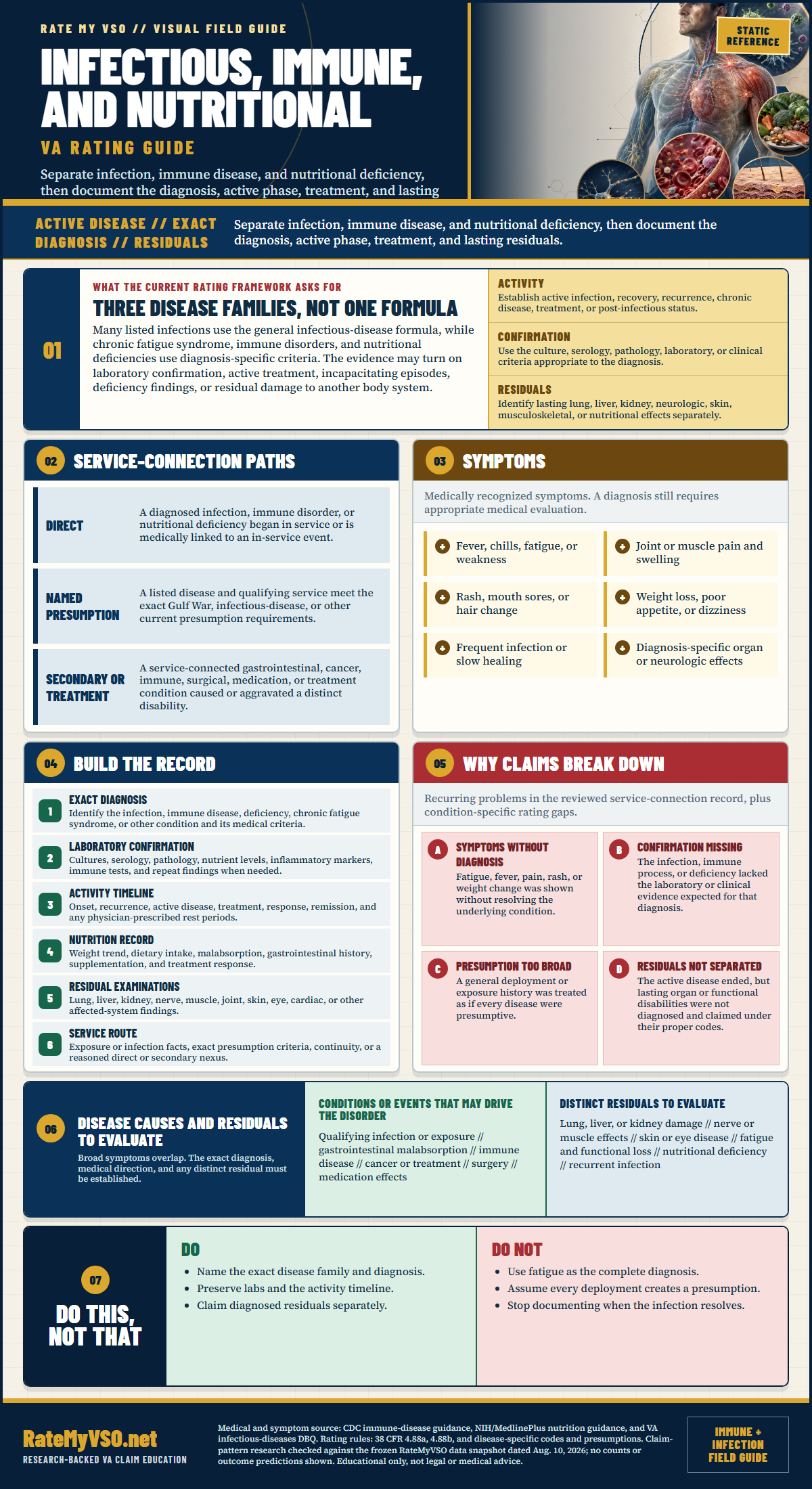 One-page guide: Infectious, Immune, and Nutritional Conditions Rating Guide in One Page
Infectious, immune, and nutritional guide covering exact diagnosis, active disease, laboratory confirmation, treatment, service paths, named presumptions, residuals, symptoms, and common claim gaps. Opens the full-size chart, free to save or print.
One-page guide: Infectious, Immune, and Nutritional Conditions Rating Guide in One Page
Infectious, immune, and nutritional guide covering exact diagnosis, active disease, laboratory confirmation, treatment, service paths, named presumptions, residuals, symptoms, and common claim gaps. Opens the full-size chart, free to save or print.
Start with the essentials
- 01Service Connection
The ways service connection can be established for this condition.
- 02Diagnosis and Evidence
Common symptoms and the evidence that supports this kind of claim.
- 03Your History
What you experienced, what others observed, and what treatment changed.
Understand the claim
How Service Connection Works, At a High Level
Before getting into the specific pathways below, it helps to understand the three things every claim in this group ultimately has to show on the usual, direct path. This is the same basic test that applies to any VA disability claim, applied here to infectious, immune, and nutritional conditions.
- A current diagnosis. A doctor must confirm you actually have the condition now, or had it while your claim was pending. Chronic fatigue syndrome carries an especially strict clinical definition: debilitating fatigue that cuts your daily activity by more than half for at least six months, with other causes ruled out, plus at least six of ten listed symptoms such as muscle aches, headaches, sore lymph nodes, and sleep problems (38 CFR § 4.88a). This is the single most common reason claims in this group fail, so make sure a diagnosis that actually meets the definition is in your file before you file.
- An in-service event, or qualifying service. This can be an event, injury, illness, or toxic exposure documented during service, or, for Gulf War claims, verified service in the Southwest Asia theater (38 CFR § 3.303; 38 CFR § 3.317).
- A medical nexus. A doctor's opinion connecting your current condition to service, explaining the reasoning rather than stating a bare conclusion.
What VA Looks For: Tests, Records, and Diagnostic Codes
Whether you are filing directly, under a presumption, or secondary to another condition, the record VA actually reviews centers on a small set of documents and data points.
- Laboratory confirmation of the infection or immune disorder, the objective proof the diagnosis rests on.
- Records dating the active phase and the residuals, so the file clearly shows when the disease was active and what damage remained afterward.
- A symptom log for chronic fatigue syndrome, a dated record of how often and how severely symptoms restrict your daily activity, which is what sets the rating.
- Proof of qualifying Gulf War or burn-pit service for the presumptive path, so VA can presume the link instead of asking you to prove it.
- The diagnostic codes involved: DC 6354 for chronic fatigue syndrome, plus whatever code applies to a related condition claimed alongside it, for example fibromyalgia (DC 5025), irritable bowel syndrome (DC 7319), or a mental-health condition such as PTSD (DC 9411) or depression (DC 9434/9435) claimed as the cause of secondary CFS.
- The matching DBQ for the condition, which structures the exam findings into the specific data points VA's rating schedule requires. For CFS, the examiner completes a rheumatology DBQ documenting symptom frequency and severity and how much your daily activity is restricted compared to before you were ill. See the DBQ guide.
Service Connection Pathways: Direct, Presumptive, and Secondary
We analyzed published Board decisions for this group and found claims succeed through a handful of well-documented pathways. Which one applies to you determines what evidence actually matters.
Direct Service Connection
A veteran demonstrates that the condition began during, or was caused by, active military service, supported by treatment records and a medical nexus opinion connecting the diagnosis to an in-service event or exposure. A memo conceding toxic exposure (see below) can supply that in-service event even when service records themselves are silent.
Direct connection through conceded toxic exposure
When VA formally concedes a toxic exposure, for example fuels, fumes, or solvents documented through a TERA (Toxic Exposure Risk Activity) memo, that concession can supply the in-service event on its own. Paired with a positive medical opinion tying your specific conditions to that exposure, this has supported direct service connection for chronic fatigue syndrome and related conditions filed together, such as sinusitis, rhinitis, fibromyalgia, and irritable bowel syndrome, in the same decision. See 38 CFR § 3.303 and the PACT Act guide.
Gulf War Presumption (medically unexplained chronic multi-symptom illness)
If you served in the Southwest Asia theater during the Persian Gulf War era, chronic fatigue syndrome, fibromyalgia, and irritable bowel syndrome are presumed related to service as a medically unexplained chronic multi-symptom illness, or MUCMI. You do not have to prove a nexus at all (38 USC § 1117; 38 CFR § 3.317). The PACT Act expanded the qualifying locations and removed the old filing deadline, so the illness can now appear at any time to any degree. This is the shortcut behind most CFS grants in the published record. See the Gulf War Illness Guide.
Secondary Service Connection (38 CFR § 3.310)
A veteran demonstrates that the condition was caused or chronically aggravated by an already service-connected disability. You do not need an in-service event of your own, the connection runs through the condition VA has already service-connected. Across the published record, CFS has been granted as secondary to service-connected anxiety and PTSD, to an infectious disease such as malaria, and to fibromyalgia, and related whole-body conditions have been granted as secondary to a somatic symptom disorder. See our Secondary Service Connection Guide.
How the Board's Explore data breaks this down for CFS, by legal theory:
Service Connection by Aggravation
When a veteran had a documented pre-service condition in this group that was significantly worsened beyond its natural progression by military service, aggravation-based service connection under 38 CFR § 3.306 is available. This works alongside secondary aggravation under § 3.310(b): either a service event, or an already service-connected condition, can be the thing that made the pre-existing condition worse.
Symptoms and rating
The Rules That Decide These Claims
Infectious diseases, immune disorders, and nutritional deficiencies are rated under 38 CFR § 4.88b and 4.89. Instead of one fixed rating table, this group runs on a pattern: score the disease highly while it is doing active damage, then re-score it on the lasting harm once the active phase ends. A few rules shape how that plays out, and they decide far more of these claims than any single number does.
1. Active disease is often rated 100 percent
Many infectious diseases, for example active tuberculosis and certain other infections, are rated 100 percent while the disease is active. The rating then moves to the disease's residuals once the active phase resolves, usually after a mandatory review examination that confirms the disease is no longer active.
2. When the active phase clears, the rating shifts to residuals
Once the active disease is gone, the rating is based on the lasting damage it caused, for example lung, liver, or kidney residuals. Each residual is rated under the body system it affects, not under the infectious-disease code. A cleared infection that scarred the lungs, for instance, is then rated under the respiratory schedule.
3. Some conditions are rated on ongoing symptoms, not an active-versus-residual split
Not everything in this group follows the active-then-residual pattern. Some conditions are rated on ongoing symptoms and functional loss. Chronic fatigue syndrome (DC 6354), for example, is rated on how often and how severely the symptoms restrict your daily activity, not on whether a disease is "active." Fibromyalgia and irritable bowel syndrome, two other conditions frequently claimed alongside CFS, follow a similar symptom-based approach on their own diagnostic codes.
4. Nutritional deficiencies are rated on their effects
Nutritional deficiencies are rated on their measurable effects on the body. The rating follows the damage the deficiency causes, so the objective findings, not the deficiency label alone, drive the level.
5. Presumptions here are diagnosis-specific, not family-wide
A presumption in this group attaches to a specific listed diagnosis plus qualifying service, never to the whole family. Under 38 CFR § 3.317, veterans with qualifying Southwest Asia or Afghanistan service are presumed connected for certain listed infectious diseases (for example malaria, brucellosis, West Nile virus, and tuberculosis), most within set time windows after service, and Persian Gulf veterans are covered for undiagnosed illness and medically unexplained chronic multisymptom illness such as chronic fatigue syndrome. A condition not on a list, or service outside the covered periods and places, needs the ordinary proof. See the PACT Act guide and the Gulf War illness guide for exactly who and what qualifies, and the service connection pathways section below for how the presumptive path actually works as a filing strategy.
For how a condition in this group is actually rated over time, including the full chronic fatigue syndrome rating tiers, see Rating Criteria below.
Rating Criteria: Chronic Fatigue Syndrome (DC 6354)
Chronic fatigue syndrome is the condition most often claimed in this group, and it illustrates rule 3 above: it is rated on ongoing symptoms and functional loss, not on an active-versus-residual split. It is rated under DC 6354, 38 CFR § 4.88b, on how much your symptoms restrict routine daily activity compared to your pre-illness level, or on how many weeks per year you're effectively incapacitated.
Evidence and Board research
Evidence That Wins
Across the Board's published DC 6354 decisions, a private doctor's opinion in the file goes with a meaningfully higher grant rate than a VA-exam-only record, shown below.
A current diagnosis that actually meets the clinical definition. For CFS this means the six-month debilitating-fatigue threshold, other causes ruled out, and at least six of ten listed symptoms (38 CFR § 4.88a). A confirmed diagnosis from your own doctor, or a complete VA exam that actually addresses the criteria, is the single most important item in the file.
Proof of qualifying Gulf War service. Deployment records verifying Southwest Asia theater service let you claim the presumption and skip the nexus requirement entirely.
A private opinion that explains its reasoning and rules out other causes. A well-reasoned private opinion can outweigh a weaker VA opinion, particularly when the private examiner reviews the full record, rules out competing explanations for the fatigue, and cites supporting medical literature applied to your own facts. A bare conclusion with no explanation is given little weight, and an advocate's brief citing general literature is not a substitute for a doctor applying that literature to your specific facts (Nieves-Rodriguez v. Peake, 22 Vet. App. 295 (2008)).
Claiming it as secondary to a condition you already have. If a disability you are already service-connected for caused or worsened your condition, you can win without an in-service event of your own. See the pathway cards above.
A dated symptom log. For CFS specifically, a record kept over time of how often and how severely symptoms restrict your daily activity is the evidence that most directly supports the rating level, because the rating itself is built around that frequency and severity.
Lay statements. First-person descriptions of your symptoms and functional limits, along with statements from people who observed your activity level change, contribute to the record and help establish onset and severity. See our Buddy & Lay Statements Guide.
Why These Claims Get Denied
Among the Board's classified service-connection denials for DC 6354, here is what claims most often fell short on. The gap is large: missing diagnosis is by far the leading reason, well ahead of missing nexus or missing in-service event.
- No current diagnosis in the record. This is the single biggest reason claims in this group fail. Having symptoms, even severe ones, is not enough without a diagnosis that meets the clinical definition. Claims have been denied for exactly this reason even when a VA exam otherwise confirmed the veteran's Gulf War service and the exam simply marked "no" on the current-diagnosis question.
- The veteran's own belief about the cause, without a doctor's opinion behind it. VA treats the medical cause of a condition like CFS as a question a non-doctor cannot answer alone. A personal belief that service caused the condition, without a supporting medical opinion, does not carry a direct claim.
- Fatigue already explained by another diagnosed condition. The Gulf War presumption only covers illness that is medically unexplained. When fatigue is attributed to a known condition, the presumptive CFS claim is denied because the symptom is already accounted for elsewhere, and rating it again separately would double-count the same impairment.
- A bare diagnosis, with nothing else. A diagnosis is only the first of the three elements. Even with a confirmed diagnosis, a claim still needs an in-service cause (or qualifying service) and a nexus connecting them, missing any one element results in denial (Shedden v. Principi, 381 F.3d 1163 (Fed. Cir. 2004)).
- Missing a scheduled VA examination without good cause. VA then decides the service-connection claim on the existing record, and an increased-rating claim is denied outright as a matter of law (38 CFR § 3.655).
Common Mistakes
The section above covers what the evidence record is missing. These are procedural and presentation mistakes, separate from the missing-element problem, that show up often enough in the published decisions to call out on their own.
- Not filing for the residuals. When the active disease resolves and the 100 percent ends, the lasting organ damage does not rate itself. Filing for the residuals is a separate step that is easy to miss.
- Missing the Gulf War presumptive. An undiagnosed illness or chronic fatigue can qualify under the Gulf War presumptive, so covered veterans should not try to prove a medical link the law already presumes.
- No symptom log. Without a dated record of how often symptoms flare and how bad they get, the frequency that sets a chronic-fatigue rating is left unproven.
- Rating organ damage under the wrong schedule. Lung, liver, or kidney residuals belong under the system they actually affect, not under the infectious-disease code.
- Relying on a note that just repeats what you told the provider. An opinion from a provider who did not independently examine you or review your records, and simply restates your own report, is given little to no weight.
- Assuming subjective fatigue by itself is a disability. Pain or fatigue counts as a disability only if it causes functional impairment, for example to your earning capacity, reporting symptoms alone is not enough (Saunders v. Wilkie, 886 F.3d 1356 (Fed. Cir. 2018)).
- Giving different accounts to different examiners. Reporting symptoms one way to a private examiner and a different way at the VA exam undermines the reliability of the whole record. Report your history the same way to everyone.
- Waiting decades with nothing connecting the condition to service. A long gap with silent service records and no theory linking the condition to service weakens a direct claim considerably, especially when a later condition is instead traceable to a non-service-connected cause.
Do's and Don'ts
A condensed version of everything above, in the order it actually matters when you sit down to build your file.
- Get a current diagnosis in writing from a qualified provider before you file, and confirm it actually meets the clinical definition for the condition you're claiming.
- If you served in Southwest Asia, gather your deployment records and claim the Gulf War presumption for CFS, fibromyalgia, or IBS.
- List every service-connected disability that could plausibly have caused or worsened your condition, and claim it as secondary.
- Ask any private provider to review your records, examine you, explain their reasoning, and rule out other causes.
- If VA has conceded a toxic exposure, point to it directly and ask the examiner for a full opinion tying your specific conditions to it.
- Report for every scheduled VA examination and keep your mailing address and phone number current.
- Tell every examiner the same consistent history of your symptoms and when they started.
- Keep a dated symptom log if you're claiming chronic fatigue syndrome; the frequency and severity in that log is what sets the rating.
- If you were denied before, file a Supplemental Claim with new and relevant evidence rather than starting over.
- Don't assume symptoms alone prove a diagnosis, VA needs the clinical criteria actually documented.
- Don't rely only on your own opinion about what caused it, causation for these conditions is treated as a medical question.
- Don't claim CFS separately when your fatigue is already explained by another diagnosed condition, that path is closed and can amount to double-counting the same symptom.
- Don't rely on a provider's note that just repeats what you told them, without an independent exam or record review it carries little weight.
- Don't let your account of symptoms shift between examiners.
- Don't skip a scheduled VA exam, VA can decide against you on the existing record alone.
- Don't forget to file for the residuals once an active-phase 100 percent rating ends.
- Don't wait decades to connect a condition to service with nothing in the file supporting the link.
Secondary relationships
Common Secondary Conditions
Infections and immune disorders rarely stay contained to one system. Because they can damage organs and wear a person down over time, one service-connected condition often opens the door to several secondary claims:
- Organ residuals. After an infection resolves, the lung, liver, or kidney damage it left behind is rated under its own body system as a separate condition.
- Chronic fatigue and pain. Lasting fatigue and pain can overlap with a mental-health condition, and each can be claimed in its own right.
- Conditions from long-term immunosuppression. Treatments that suppress the immune system can lead to further conditions that may be claimed as secondary.
- Depression secondary to a chronic condition. Living with a chronic infectious or immune condition can drive depression and anxiety, which can be claimed as secondary to the physical condition. See secondary conditions.
Each dedicated guide above shows the live Board grant rates for that condition's most common secondary pairings. For chronic fatigue syndrome specifically, here is what the current published record shows for DC 6354:
Conditions that can cause chronic fatigue syndrome (CFS as the secondary)
Claims where chronic fatigue syndrome was argued as secondary to an already service-connected condition. This is the "ways to connect via another condition" list, and PTSD and depression are by far the most common:
Conditions chronic fatigue syndrome can cause (CFS as the primary)
Conditions veterans have claimed as caused or aggravated by a service-connected chronic fatigue syndrome, in other words, conditions secondary to CFS once CFS itself is already service-connected:
Prepare and take the next step
Prepare: your own working pages
Optional. These are your own notes, in your own words. They are not a VA form, they are not sent to the VA, and nothing here is a medical finding or a prediction about your claim.
Three reminders while you prepare
- Start with the confirmed diagnosis and monitoring
Record the diagnosis, laboratory or clinical monitoring, treatment, and dates from the records you have. Go to this part
- Separate the main condition from complications
List symptoms and functional effects, then identify separately diagnosed complications or residuals without assuming they are automatically connected. Go to this part
- Keep the timeline complete
Organize service history, exposures, onset, treatment, and changes over time, and mark missing or unverified records honestly. Go to this part
Sign in or create an account to save your answers and come back to them later. You can fill these in and print them without an account.
Diagnosis, monitoring, and treatment
Symptoms, function, and complications
Connection and examination questions
Records and unanswered questions
Decision-letter reading sheet
Quick Checklist Before You File
Bring these together before you submit anything.
- A current diagnosis in writing from a qualified provider that actually meets the clinical definition for the condition you're claiming.
- If you served in Southwest Asia, your deployment records, so you can claim the Gulf War presumption for CFS, fibromyalgia, or IBS.
- A list of every service-connected disability that could plausibly have caused or worsened your condition, to claim it as secondary.
- A private opinion from a provider who reviewed your records, examined you, explained the reasoning, and ruled out other causes.
- Documentation of any conceded toxic exposure (a TERA memo or similar), if it applies to your case.
- A dated symptom log if you're claiming chronic fatigue syndrome, showing frequency and severity of flare-ups.
- A personal statement describing your symptoms and their onset, consistent with everything else in your file.
- If your fatigue is already explained by another rated condition, focus your claim there rather than filing CFS separately.
- If you were denied before: new and relevant evidence for a Supplemental Claim, not just a repeat of what was already considered.
For the mechanics of actually submitting the claim, see the Standard Claim Guide and the Fully Developed Claim Guide (filing with all your evidence up front can speed up the decision).
The Claims Process, Step by Step
Once you file, your claim moves through a series of hand-offs. Understanding who does what helps you know who to contact, and what to expect, at each stage.
- You file the claim. Directly with VA, through VA.gov, or with the help of an accredited representative.
- VA acknowledges the claim and assigns it for development. A Veteran Service Representative (VSR) is assigned to gather your service treatment records, VA and private medical records, and any other evidence needed.
- The VSR orders a Compensation & Pension (C&P) exam if one is needed. Most claims in this group require one, especially where the current diagnosis or its severity is in question.
- The C&P exam is conducted. By a VA clinician or a contracted examiner, who completes a Disability Benefits Questionnaire (DBQ) documenting the diagnosis, severity, and, where relevant, a nexus opinion.
- The file goes to a Rating Veteran Service Representative (RVSR), the "rater." The rater reviews the complete file, including the exam results, and decides whether service connection is warranted and at what percentage.
- A senior reviewer may review the decision before it's finalized, depending on the complexity of the claim.
- VA issues the decision letter. This states whether the claim is granted or denied, the rating percentage if granted, and the reasons behind the decision.
- If you disagree, you choose an appeal lane. Higher-Level Review, Supplemental Claim, or a Board appeal, covered later in this guide.
Who's who: VSO vs. VSR vs. Rater vs. C&P Examiner
Your VSO
An accredited representative from a veterans service organization, or an accredited attorney or claims agent. Not a VA employee. Helps you prepare, gather evidence, and file, and can represent you through an appeal. Has no authority to decide your claim.
VSR (Veteran Service Representative)
VA staff who "develops" your claim: requests records, schedules the C&P exam, and assembles the file. Does not decide the rating.
Rater (RVSR)
VA staff who reviews the completed file and makes the actual decision, service connection or denial, and the percentage. This is the person whose judgment the decision letter reflects.
C&P Examiner
A VA clinician or a contracted medical examiner who conducts the exam and completes the DBQ. Documents findings and, where asked, a nexus opinion. Does not decide the claim.
For the full walkthrough of every stage with more detail, see Inside Your Claim and Claim Stages.
DBQs and Your C&P Exam
A Disability Benefits Questionnaire (DBQ) is the standardized form an examiner completes for your condition, it structures the exam findings into the specific data points VA's rating schedule requires. For chronic fatigue syndrome, the examiner uses a rheumatology DBQ and documents your reported energy levels, how much your daily activity is restricted compared to before you were ill, and how often you have "crash" periods where you're effectively bedridden. See the DBQ Guide for how these forms work, including whether a private DBQ completed by your own doctor can be submitted instead of relying solely on a VA exam.
Before your C&P exam, bring specific examples of activities you've had to give up or reduce, describe both your worst days and your best days rather than an averaged impression, and be consistent with what's already in your medical records and prior statements. For a full walkthrough of what to expect and how to prepare, see the C&P Exam Prep Guide.
Reading Your Decision Letter, and What to Do If Denied
Your decision letter has two parts: a narrative section explaining the reasoning (often called "reasons and bases"), and a codesheet showing the actual rating percentage, the effective date, and the diagnostic code used. See the Reading Your Decision Letter Guide for how to find and interpret each part, or use the Letter Interpreter tool to upload your own letter and get a plain-English breakdown.
If your claim is denied, or the rating is lower than you expected, you have three main lanes:
- Supplemental Claim: refile with new and relevant evidence, such as a new diagnosis, nexus opinion, or symptom log. See Supplemental Claim Guide.
- Higher-Level Review (HLR): a senior reviewer looks at the same evidence again for a difference of opinion, no new evidence is added. See HLR Guide.
- Board Appeal: your case goes to a Veterans Law Judge at the Board of Veterans' Appeals, with options for a direct review, an evidence docket, or a hearing. See Board Appeal Guide.
Not sure which lane fits your situation? See the Appeals decision guide for a side-by-side comparison of all three.
After You Win: Ratings, Effective Dates, and Maintaining Your Rating
A grant is not always the end of the story. Keep your treatment consistent, continued follow-up and, for CFS, an ongoing symptom log, protects you if VA schedules a future reexamination. Not every rating gets reexamined; understand when a rating becomes protected from future review (including Permanent and Total status) and what to do if VA proposes to reduce it. See Protect Your Rating and Future Reexaminations for the specifics.
A few rating and effective-date rules come up often once service connection for a condition in this group is already granted:
- Some related codes have a rating cap. Irritable bowel syndrome maxes out at a 30 percent rating under Diagnostic Code 7319, so an appeal for more than 30 percent will not succeed on that code alone. Tinnitus is capped at 10 percent regardless of how it's claimed.
- Fatigue can sometimes be rated by analogy to a closely matching diagnostic code when no code exactly fits the condition causing it, for example using the sleep-apnea criteria for persistent daytime sleepiness when chronic fatigue stems from an already service-connected sleep-disordered-breathing condition.
- A liberalizing law sets a floor on the effective date. When your grant comes from a liberalizing law like the PACT Act, the effective date cannot be earlier than the date that law took effect, August 10, 2022 (38 CFR § 3.114).
- Your effective date is usually the claim date, not the symptom-onset date. It is typically the date VA received your claim or intent to file, not the date your symptoms or diagnosis actually began, so file as early as you reasonably can (38 CFR § 3.400).
If your condition worsens after the initial grant, you can file for an increased rating. See the Rating Increase Guide.
References and related resources
Find the Guide for Your Condition
The rules above apply across the board. For the exact rating table, the C&P exam, and the Board data for your specific condition, open the dedicated guide:
| Area | Guide | DC codes |
|---|---|---|
| Gulf War illness and chronic fatigue | Gulf War Illness Guide | 6354 |
| Infection-related cancers | Cancer Claims Guide | varies |
For any code not listed here, including a specific infection, immune disorder, or nutritional deficiency, open its condition lookup page for the rating levels and Board data.
Quick Reference Tables
Service Connection Pathways at a Glance
| Pathway | What it requires | Skips |
|---|---|---|
| Direct | Diagnosis, in-service event, medical nexus | Nothing, all three elements needed |
| Gulf War presumption | Qualifying Southwest Asia service, a matching diagnosis (CFS, fibromyalgia, IBS) | Nexus opinion |
| Conceded toxic exposure | A TERA memo or similar concession, a positive medical opinion | Proving the in-service event yourself |
| Secondary | An already service-connected disability that caused or worsened your condition, a nexus opinion | An in-service event of your own |
| Aggravation | A documented pre-service condition, evidence it worsened beyond natural progression | Proving the condition began in service |
Rating Caps and Special Rules for Related Codes
| Condition | Code | Note |
|---|---|---|
| Chronic fatigue syndrome | 6354 | Rated 10% to 100% on symptom frequency and how much routine activity is restricted; see full tiers above |
| Irritable bowel syndrome | 7319 | Maxes out at 30% |
| Tinnitus | 6260 | Capped at 10%, regardless of how it's claimed |
| Fibromyalgia | 5025 | Also a Gulf War MUCMI presumptive; symptom-based rating, not active-versus-residual |
From Filing to Decision: Who Does What
| Role | Does | Decides your rating? |
|---|---|---|
| VSO / accredited representative | Helps prepare, gather evidence, and file; represents you on appeal | No |
| VSR | Develops the claim: orders records and the C&P exam | No |
| C&P Examiner | Conducts the exam, completes the DBQ, may give a nexus opinion | No / but has a strong impact |
| Rater (RVSR) | Reviews the full file and decides service connection and percentage | Yes |
Frequently Asked Questions
How does the VA rate infectious diseases?
What is the Gulf War presumption?
How is chronic fatigue syndrome rated?
Do I get 100 percent while an infection is active?
What happens at the mandatory review exam?
Can chronic fatigue syndrome be service connected as secondary to another condition?
Why was my chronic fatigue syndrome claim denied?
Sources
- 38 CFR § 4.88b, infectious diseases, immune disorders, and nutritional deficiencies
- 38 CFR § 4.88a, VA diagnostic criteria for chronic fatigue syndrome
- 38 CFR § 3.303, basic rules for direct service connection
- 38 CFR § 3.310, secondary service connection
- 38 CFR § 3.306, aggravation of a pre-service disability
- 38 CFR § 3.317, Gulf War presumption for undiagnosed illness and MUCMI (CFS, fibromyalgia, IBS)
- 38 USC § 1117, compensation for Persian Gulf veterans with a qualifying chronic disability
- 38 CFR § 3.102 and 38 USC § 5107(b), benefit of the doubt
- 38 CFR § 4.114, Diagnostic Code 7319, rating irritable bowel syndrome
- 38 CFR § 3.655, effect of failing to report for a VA examination
- 38 CFR § 3.400 and 38 CFR § 3.114, effective dates, including the liberalizing-law rule
- 38 CFR § 4.14, pyramiding, no double rating for the same symptoms
- 38 CFR § 3.2501, new and relevant evidence to reopen a claim
- Shedden v. Principi, 381 F.3d 1163 (Fed. Cir. 2004), the three elements of service connection
- Saunders v. Wilkie, 886 F.3d 1356 (Fed. Cir. 2018), pain or symptoms causing functional impairment can be a disability
- Nieves-Rodriguez v. Peake, 22 Vet. App. 295 (2008), a medical opinion is persuasive only if it explains its reasoning