Sleep Apnea Secondary to Depressive Disorder Claim Guide
Sleep Apnea (VA diagnostic code 6847) is sometimes claimed as secondary to service-connected Depressive Disorder (code 9435) under 38 CFR 3.310. We analyzed published Board of Veterans' Appeals decisions on that pairing; here is what they show. It is an encyclopedic reference, not a forecast.
The Numbers, from 1.9M Appeals
We analyzed the Board's published decisions and found sleep apnea (DC 6847) claimed as secondary to depressive disorder (DC 9435) is a small but documented claim pool that wins clearly more often than it loses once it reaches a merits decision.
How those 172 issues came out
Start with the essentials
- 01Service Connection
The ways a secondary connection can be established for this pairing.
- 02Diagnosis and Evidence
Common symptoms and the evidence cited in published Board appeals.
- 03Your History
What you experienced, what others observed, and what treatment changed.
Understand the claim
ICD-10 Diagnosis Codes for Sleep Apnea
The ICD-10 diagnosis codes most commonly used for DC 6847, Sleep Apnea (the kind on your medical records, decision letter, or C&P exam report). VA rates the disability and its residuals, not the diagnosis itself, so coding can vary.
What a secondary claim on this pairing needs
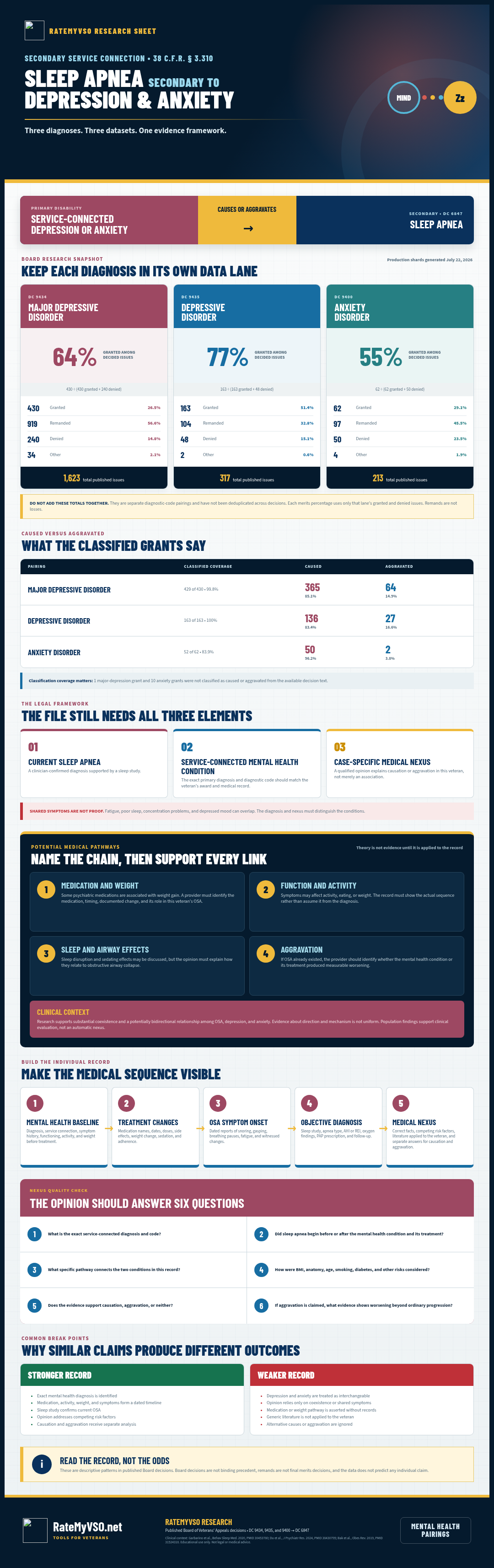
Under 38 CFR 3.310 a secondary claim turns on three elements:
- A current diagnosis: a medical diagnosis of sleep apnea (the secondary).
- A service-connected primary: Depressive Disorder, already service-connected (the primary). A 0% primary still counts.
- A medical nexus: a medical opinion linking the sleep apnea to the depressive disorder, showing the primary caused or aggravated it.
See the Secondary Claim guide for the caused-versus-aggravated split, and the Nexus Letter guide for what makes the medical opinion strong.
Why sleep apnea is claimed secondary to depressive disorder
Whether that medical link exists in any one case is a medical question decided on that case's own evidence (the nexus).
Pairing research and evidence
Symptoms Recorded in Granted Sleep apnea Decisions
We analyzed 12,070 granted Board decisions involving sleep apnea for symptoms named in sentences about the condition (rating-criteria recitations excluded). Descriptive of the published record, what the Board wrote down, not a checklist of what to report.
Bar length shows decisions. Percentages remain context.
Detected by phrase-reading the decision text with condition-specific vocabularies. Source: Board of Veterans' Appeals decisions, RateMyVSO analysis.
Caused By vs Aggravated By: What the Board Found
The outcome split above counts whole issues. This section goes one layer deeper. Under 38 CFR § 3.310 a secondary claim can be won two ways: the depressive disorder caused the sleep apnea (§ 3.310(a)), or it aggravated an existing sleep apnea (§ 3.310(b)). Every grant rests on one or the other, so the numbers below divide up the granted claims only.
Direct causation is the route that carries most grants here: 84% of them found the depressive disorder caused the sleep apnea, the rest found aggravation. A practical consequence for the nexus opinion: it should address both routes, because a medical opinion that only argues causation leaves the aggravation theory, a separate legal basis, on the table. See the caused-vs-aggravated guide for how the two theories differ.
We analyzed published Board decisions on this pairing to build this split. The grant split covers granted claims only; denied, remanded, and dismissed claims are not in it. Descriptive of the published record, not a prediction.
The Middle Step the Board Named
In some findings on this pairing, the Board did not connect sleep apnea to depressive disorder directly. It named a middle step: depressive disorder caused something else first, and that something caused the sleep apnea. That is the two-hop chain pattern explained in the causation chains guide. Counts are a floor from the decisions we have on file, not a total and not a success rate.
- Obesity / weight gain: named as the middle step in 17 Board findings on this chain (example: decision A22009837).
The middle step is a medical question a doctor has to answer with a reason at each link. See nexus letters for what that opinion covers.
What VA Looks For: Tests, Records, and Diagnostic Codes
We analyzed published Board decisions on these claims and ranked the records that appeared most often:
- A medical nexus opinion: the one record VA weighs most on a secondary claim, a doctor's statement linking your sleep apnea to your service-connected depressive disorder and naming the mechanism.
- Sleep study (polysomnography) in the file
- CPAP prescribed or recommended
- In-service fatigue, snoring, or daytime sleepiness
- Witness statements on snoring or stopped breathing
- Weight gain documented during or since service
The diagnostic code involved: DC 6847 (Sleep Apnea). The rating levels for this code are in the rating section below.
Records ranked by how often published Board decisions cited them. The exam that captures most of this is covered in the C&P Exam section below. Source: Board of Veterans' Appeals decisions, RateMyVSO analysis.
The Evidence That Wins Sleep Apnea Secondary Claims
What veterans who win this pairing actually put in the file, and why each piece moves the claim.
- Sleep study (polysomnography): This is the test that proves you actually have sleep apnea, not just poor sleep. It measures how often your breathing stops (the AHI number) and how far your oxygen drops. Without it, VA has no proof the condition exists.
- Your depression rating decision: Get the paperwork showing your depressive disorder is already service connected, at any percentage. Secondary claims only work if the first condition is already on the books.
- Weight records from before and after your depression started: This is the heart of the claim. Depression often drives overeating and appetite changes that pack on weight, and even a modest weight gain sharply raises sleep apnea risk. Pull weigh-ins from your medical file that show the timeline: depression first, weight climbing, then apnea diagnosed.
- Medication list from your depression treatment: Some antidepressants, sedatives, and anti-anxiety drugs cause weight gain or relax the throat muscles that keep your airway open at night. If you take any of these, list them by name. This gives your doctor a second, separate mechanism to point to besides weight.
- CPAP prescription and titration study, plus a Sleep Apnea DBQ: These show how bad the apnea actually is and that you're being treated for it. A filled-out DBQ with real detail on how often you stop breathing, how many times you gasp awake, and your CPAP settings carries far more weight than a checklist with boxes ticked and nothing written in.
- Statements from your spouse or someone who has watched you sleep: Loud snoring, gasping, choking sounds, breathing pauses. A family member's account helps pin down when the apnea actually started, which matters for proving depression came first.
- A nexus letter that explains HOW, not just THAT: The single biggest reason these claims get denied is a letter that names both conditions but never connects them. Your doctor needs to say sleep apnea is "at least as likely as not" caused by your depression, and then walk through the actual mechanism, the weight gain, the medication, or the way depression disrupts the brain's control of breathing during sleep. A letter that treats the two conditions as just "commonly seen together" will not survive review.
- A doctor who has treated you over time, not a one-time exam: A nexus opinion from the provider who watched your depression worsen and your weight climb over months or years carries more credibility than a single visit with someone meeting you for the first time. If your longtime provider can write the letter, use them.
Evidence Cited in Published Sleep apnea Decisions
We analyzed 89,723 published Board decisions involving sleep apnea for condition-specific evidence, counting only case-specific mentions (boilerplate recitations excluded). "Favorable" is the share of decisions citing that evidence where every issue was granted or the outcome was mixed; the baseline across all these decisions is 53.6%. Evidence appearing in a decision does not mean it decided the case. Descriptive of the published record, not a prediction.
Bar length shows decisions citing the evidence.
Detected by phrase-reading the decision text with condition-specific vocabularies. Source: Board of Veterans' Appeals decisions, RateMyVSO analysis.
Board Grants on This Pairing, Dissected
The five decisions below all granted service connection for sleep apnea (DC 6847) as secondary to a service-connected depressive disorder (DC 9435). In each case, the Board found that the depressive disorder, often acting through weight gain or obesity, was at least as likely as not a cause of the veteran's sleep apnea. Board decisions are not binding precedent, and each case turned on its own medical evidence.
Private physician's literature-based opinion outweighs a VA examiner's flawed standard of proof Citation A26033968 (April 14, 2026), Direct Review docket
The record: A private physician who examined the veteran and reviewed his record found it at least as likely as not that his obstructive sleep apnea was aggravated by or the result of his service-connected unspecified depressive disorder with anxious distress and unspecified insomnia disorder. The physician pointed to medical research linking psychiatric disorders to sleep apnea. A September 2024 VA examiner disagreed, stating, "After thorough research, there is no strong medical evidence that directly correlates suffering from anxiety and the development of obesity."
Why it won: The Board found the VA examiner had applied too strict a standard of proof, one higher than the "approximate balance" standard the law requires. Citing Wise v. Shinseki, the Board explained that an adequate medical opinion must be based on the benefit-of-the-doubt standard, even if the broader scientific community would demand more certainty. With the VA opinion discounted, the private opinion stood unopposed, and the Board granted the claim.
Independent medical opinion citing a Mendelian randomization study wins when VA never obtained a competing opinion Citation A26032425 (April 8, 2026), Hearing docket
The record: At a Board hearing, the veteran's representative introduced a private Disability Benefits Questionnaire and nexus opinion from C.M., M.D. Dr. C.M. examined the veteran in person and cited a Mendelian randomization study showing "a significant causal relationship where depression increases the susceptibility to OSA." She explained that weight gain, poor sleep hygiene, and increased muscle tension from the veteran's depressive disorder increased his risk of airway obstruction during sleep. The AOJ never obtained a VA opinion on the sleep apnea claim.
Why it won: The Board found Dr. C.M.'s opinion highly probative because it was based on an in-person exam, cited specific medical literature, and explained the pathophysiological mechanism connecting depression to sleep apnea. Because no VA opinion existed to weigh against it, and the evidence was at least in equipoise, the Board granted the claim under the benefit-of-the-doubt doctrine.
Sleep apnea granted with no VA exam at all, based on the veteran's own credible testimony Citation A26027524 (March 26, 2026), Hearing docket
The record: The veteran testified at a November 2024 Board hearing that his sleep apnea, diagnosed by a 2012 sleep study, was caused by his service-connected major depression with anxious distress. He was never afforded a VA examination on the question of etiology, so there was no competing VA opinion in the file.
Why it won: The Board relied on the veteran's own description of his symptoms and the "intermediary steps" doctrine, noting that medications and treatments for a service-connected disability can serve as links in the causal chain under Walsh v. Wilkie and Spicer v. McDonough. Even without objective medical evidence corroborating ongoing symptoms, the Board found the record as a whole triggered the benefit-of-the-doubt doctrine and granted the claim.
Treating pulmonologist's obesity-as-intermediate-step opinion beats a VA examiner who ignored it Citation A26023404 (March 16, 2026), Hearing docket
The record: A treating pulmonologist, Dr. M.C., opined that the veteran's obesity was "a contributing factor to his sleep apnea" and that the weight gain was "highly likely brought on by depression causing him to lose interest in physical activity resulting in obesity." VA treatment records documented the veteran's ongoing struggle with weight tied to his mental health, and he testified that his depression caused "mental exhaustion" that prevented him from exercising. A September 2020 VA examiner disagreed, finding no medical link between depression and OSA and pointing to the veteran's sex and weight as independent risk factors.
Why it won: The Board found Dr. M.C.'s opinion, combined with years of VA treatment records, persuasive on how the depressive disorder led to obesity, which contributed to the sleep apnea. The VA examiner's opinion was found incomplete because she never addressed Dr. M.C.'s opinion or the supporting treatment records, making it inadequate for adjudication. The Board applied the "obesity as an intermediate step" doctrine from VAOPGCPREC 1-2017 and Walsh v. Wilkie and granted the claim.
Board bypasses inadequate VA opinions and grants based on service and treatment records showing weight gain tied to depression and a knee disability Citation A26022698 (March 12, 2026), Direct Review docket
The record: VA obtained multiple negative nexus opinions attributing the veteran's OSA to weight gain and obesity over time, without linking that weight gain to his service-connected right knee disability or PTSD with depression. Service personnel records documented weight gain and noncompliance with military weight standards after an in-service knee injury, and VA treatment records showed his depression contributed to his weight gain.
Why it won: The Board found the VA opinions inadequate because they failed to address the veteran's lay statements about the continuity of his symptoms and did not address whether his weight gain was caused by his service-connected disabilities. Rather than remand, the Board found the service and treatment records themselves supported a finding that weight gain and obesity leading to OSA resulted from his service-connected right knee disability and depression, and granted the claim.
What the Board Said in Recent Grants
These are the Board's own words, quoted from the findings in 5 recent granted decisions on this pairing. Each sentence is the finding the grant rested on, not a summary of it. Click a citation to read the full decision.
“OSA is caused by his service-connected unspecified depressive disorder with unspecified anxiety disorder and bruxism.”
“The Veteran's diagnosed obstructive sleep apnea is caused by his service-connected unspecified depressive disorder.”
“The probative evidence of record supports a finding that the Veteran's sleep apnea is related to the service-connected unspecified depressive disorder.”
“After resolving all doubt in the Veteran's favor, the Veteran's OSA was aggravated by his unspecified depressive disorder with insomnia.”
“The Veteran's OSA was caused by his service-connected unspecified depressive disorder.”
Quoted from published Board decisions on this pairing, most recent first. Descriptive of the published record, not a prediction about any individual claim. Search the full decisions in BVA Decision Search.
Why VA Denies, and How the Board Answered
The rationales below are the ones VA examiners actually used against this pairing in the published record, each paired with the Board's response.
- Read the left column first: if a VA opinion in your file uses one of these arguments, that is the reasoning your own evidence has to meet.
- The right column is the counter: it shows how the Board actually answered that argument, with the decision cited.
- A rationale appearing here is not a verdict: the same argument won some cases and lost others, on different records.
| VA examiner's rationale | How the Board answered it |
|---|---|
| "There is no strong medical evidence that directly correlates suffering from anxiety and the development of obesity." | The Board found this standard too strict. An adequate opinion must be based on the "approximate balance" standard, not on scientific consensus (A26033968, granted). |
| Sleep apnea "does not share the same pathophysiological mechanisms as depression" and it is "not accepted in the general medical community that depression typically progresses to directly cause obstructive sleep apnea." | The Board found this opinion adequate and probative because it was based on an accurate history with clear conclusions and supporting data. The claim was denied on both direct and secondary theories (A22016376). |
| The veteran's obesity was attributed to cannabis-related increased appetite, not to medication or symptoms from his service-connected mental condition; the prescribed sleep medication was "rarely" taken and had "no indication" it causes weight gain. | The Board found this rationale adequate and persuasive, noting the record contained no competent evidence connecting the mental condition to the veteran's obesity, and denied secondary service connection (A24075467). |
| Two separate VA opinions found "no evidence to support that the Veteran's service-connected disabilities are the sole cause of the Veteran becoming obese," while another examiner called a competing positive opinion speculative for using words like "might" and "may." | The Board agreed the speculative positive opinion deserved no probative value, but still found the remaining negative VA opinions persuasive and denied OSA on secondary grounds, even while granting a related hypertension claim on the same depressive disorder theory (A26032270). |
| Sleep apnea was attributed to unmanaged diabetes allegedly caused by the veteran's service-connected schizophrenia (claimed as depression), rather than to the psychiatric condition itself. | The Board held there was no legal basis for secondary service connection through a nonservice-connected disease. Because diabetes itself was never service connected, the claim failed as a matter of law regardless of any causal chain to depression (24022980). |
If granted: rating and daily function
If Granted: How Sleep Apnea Is Rated
The VA assigns one of these percentages based on what your medical record documents. Plain-language summary of the rating criteria at 38 CFR; the controlling text is the regulation itself.
| Rating | What the record has to show for DC 6847, Sleep Apnea |
|---|---|
| 100% | You qualify at this level if your sleep apnea has caused chronic respiratory failure where your body can't get rid of carbon dioxide properly, or if it has led to cor pulmonale (heart problems caused by lung disease). You also qualify if you need a tracheostomy (a surgical opening in your neck to help you breathe). |
| 50% | You must use a breathing assistance machine like a CPAP device (continuous positive airway pressure machine) to help keep your airways open and support your breathing. |
| 30% | You feel excessively sleepy during the day on a regular, ongoing basis that doesn't go away. This persistent daytime sleepiness (hypersomnolence) means you have trouble staying awake or alert during normal daytime hours, even after what should be a full night's sleep, and it significantly impacts your daily activities. |
| 0% | You have been diagnosed with sleep apnea through a sleep study or other medical testing, but you don't experience any noticeable symptoms from it. Even though the medical tests show you have breathing problems while sleeping (documented sleep disorder breathing), you don't have symptoms like daytime fatigue, morning headaches, or need to use a CPAP machine. |
Do's and Don'ts
Every item below comes from a pattern in the decisions on this pairing, not from general claim advice.
- Get a private opinion that cites specific medical literature or studies connecting depression to sleep apnea, not just a general statement.
- Ask any examiner to explain the specific chain, such as depression leading to low motivation, leading to weight gain, leading to sleep apnea.
- Bring your own detailed and credible testimony about your symptoms and their timeline to a Board hearing if a private nexus opinion is not available.
- Submit VA treatment records that document your struggle with weight, sleep, and mental health together over time. These records can support a private doctor's opinion.
- Point out if a VA examiner never addressed a favorable private opinion or your treatment records. The Board has found such VA opinions incomplete.
- Don't rely on an opinion that uses words like "may" or "might." The Board has treated this kind of language as too speculative to support a grant.
- Don't assume a claim will fail just because there is no VA opinion in the file. In several granted cases, there was no competing VA opinion at all.
- Don't try to link sleep apnea to a disease, like diabetes, that is not itself service connected. The Board has denied claims built this way as a matter of law.
- Don't expect your own lay opinion on medical causation to carry the claim without support. Veterans have been found not competent to diagnose or explain complex conditions like sleep apnea on their own.
- Don't ignore how obesity fits into your claim. The Board has repeatedly analyzed obesity as a possible "intermediate step" between depression and sleep apnea, and it can matter a great deal whether the record addresses this.
Prepare and take the next step
Prepare: your own working pages
Optional. These are your own notes, in your own words. They are not a VA form, they are not sent to the VA, and nothing here is a medical finding or a prediction about your claim.
Three reminders while you prepare
- Keep the two conditions separate
Record the history, diagnosis, symptoms, and treatment for Depressive Disorder and Sleep Apnea separately before describing the possible relationship. Go to this part
- Ask about causing and worsening separately
A clinician may need to address whether Depressive Disorder caused Sleep Apnea, whether it worsened it, and what other explanations the record shows. Go to this part
- Build the timeline from records you have
Mark missing or unverified records honestly. Research from published Board decisions describes the record reviewed; it does not predict an individual claim. Go to this part
Sign in or create an account to save your answers and come back to them later. You can fill these in and print them without an account.
Two-condition timeline
Sleep Apnea: symptoms and daily function
Provider questions about the relationship
Records and unanswered questions
Decision-letter reading sheet
Quick Checklist Before You File
- Service connection already in place for Depressive Disorder, and a current medical diagnosis of sleep apnea.
- Diagnostic testing, imaging, or clinical records documenting the sleep apnea, whatever your provider used to diagnose and track it.
- A nexus opinion, whenever possible from a doctor familiar with sleep apnea, stating it is at least as likely as not caused or aggravated by the depressive disorder, and naming the mechanism rather than just the conclusion.
- Lay statements: spouse, family, friends, or battle buddies describing what they've witnessed or noticed.
- Your STRs and any VA opinions already in the file on either condition. If a VA opinion already went against you, your submitted opinion or statement should address its specific reasoning.
For the mechanics of filing itself, see the Standard Claim Guide and the Fully Developed Claim Guide.
The Claims Process, Step by Step
A secondary claim moves through the same pipeline as any other. Understanding who does what helps you know who to contact and what to expect.
- You file the claim, naming Depressive Disorder as the service-connected primary and sleep apnea as secondary. Directly with VA, through VA.gov, or with an accredited representative's help.
- VA assigns a Veteran Service Representative (VSR) to develop the claim: gather your service treatment records, VA and private medical records, and order a C&P exam if needed.
- The C&P exam is conducted, usually with the examiner asked to address the specific secondary theory (causation and aggravation both).
- The file goes to a Rating Veteran Service Representative (RVSR), the "rater," who weighs the medical evidence and decides service connection and, if granted, the rating percentage.
- VA issues the decision letter stating the outcome and the reasoning.
- If denied or under-rated, you choose an appeal lane, Supplemental Claim, Higher-Level Review, or a Board appeal, covered below.
Who's who: VSO vs. VSR vs. Rater vs. C&P Examiner
Your VSO
An accredited representative, agent, or attorney. Not a VA employee. Helps prepare and file, and can represent you on appeal. Has no authority to decide your claim.
VSR
VA staff who develops the claim: gathers records and schedules the exam. Does not decide the rating.
Rater (RVSR)
VA staff who reviews the complete file and makes the actual decision on service connection and percentage.
C&P Examiner
Conducts the exam and, where asked, gives a nexus opinion. Does not decide the claim, but the opinion's reasoning and legal framing carry real weight.
For the full walkthrough, see Inside Your Claim and Claim Stages.
DBQs and Your C&P Exam
A Disability Benefits Questionnaire (DBQ) is the standardized form the examiner completes for your condition. See the DBQ Guide for how these forms work and whether a private DBQ from your own doctor can be submitted instead of relying solely on a VA exam. For what to expect and how to prepare, see the C&P Exam Prep Guide, and be specific about how your sleep apnea symptoms relate to your depressive disorder timeline, treatment, and any aggravation, that is the detail a nexus opinion relies on.
Reading Your Decision Letter, and What to Do If Denied
Your decision letter has a narrative "reasons and bases" section and a codesheet with the rating and effective date. See the Reading Your Decision Letter Guide or use the Letter Interpreter tool to decode your own letter. If denied, you have three main lanes:
- Supplemental Claim: refile with new and relevant evidence, such as a nexus opinion that addresses the mechanism and the specific VA rationale you're rebutting. See Supplemental Claim Guide.
- Higher-Level Review (HLR): a senior reviewer looks at the same evidence again, useful if the denial rested on a legal error. See HLR Guide.
- Board Appeal: your case goes to a Veterans Law Judge, with a direct review, evidence, or hearing docket. See Board Appeal Guide.
Not sure which lane fits? See the Appeals decision guide for a side-by-side comparison.
After You Win: Maintaining Your Rating
Keep documentation of ongoing treatment, follow-up evaluations, and any updated diagnostic testing for your sleep apnea on file, this protects you if VA schedules a future reexamination. See Protect Your Rating for when a rating becomes protected and Future Reexaminations for what triggers one. If your sleep apnea worsens, see the Rating Increase Guide.
References and related resources
Frequently Asked Questions
Does Depressive Disorder have to be highly rated to support a sleep apnea secondary claim?
No. 38 CFR 3.310 looks at whether the service-connected Depressive Disorder caused or aggravated the sleep apnea, not at how severe the Depressive Disorder rating is. Even a 0% service-connected primary can anchor a secondary claim.
What do the percentages on this page mean?
They are the historical outcomes of 172 published Board decisions on this exact pairing: 50% granted, 7% denied, 42% remanded. They describe decided appeals already on record. They do not predict what would happen in any individual case.
RateMyVSO. Educational resource. Not affiliated with the U.S. Department of Veterans Affairs. Not legal advice. All RateMyVSO tools are free. Find a VSO representative for personalized guidance.