VA Arthritis Claims Guide
Arthritis is one of the most commonly misrated conditions in the VA system. The type of arthritis determines the diagnostic code, the rating scale, and the ceiling on what you can receive. A veteran rated under DC 5010 (traumatic/post-traumatic arthritis) may be capped in a way that DC 5003 (degenerative arthritis) or DC 5002 (rheumatoid arthritis) would not impose. This guide explains how the three types are classified, how each is rated under 38 CFR 4.71a, how the X-ray confirmation and painful-motion rules work, the service connection paths that apply to each, the evidence that tends to win, why these claims get denied, the filing checklist, the claims process step by step, and what to do whether you win or you're denied.
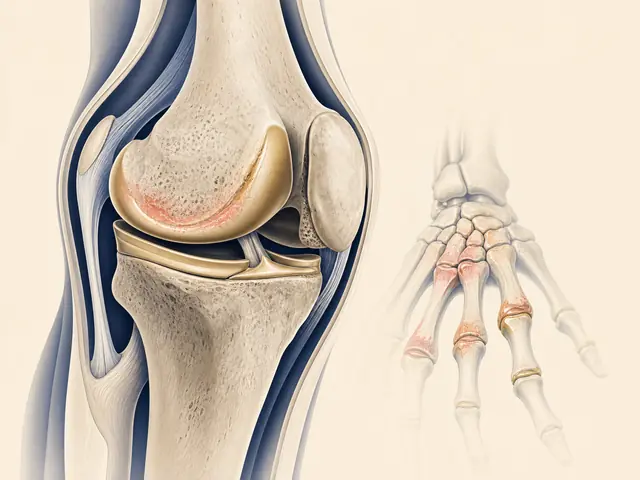
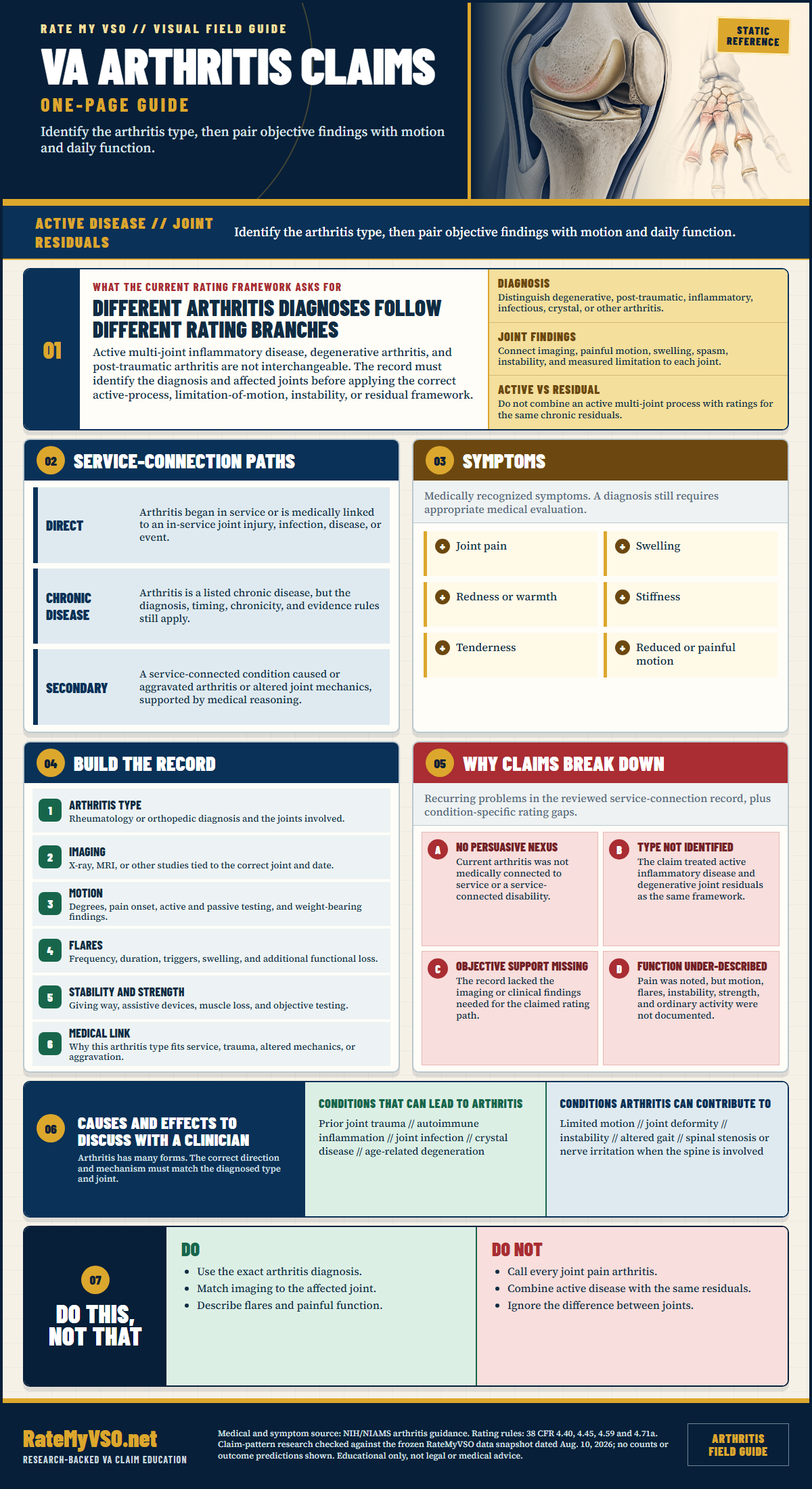 One-page guide: VA Arthritis Claims in One Page
Arthritis guide covering diagnosis-specific rating branches, direct and secondary paths, chronic-disease rules, symptoms, imaging, motion evidence, and common claim gaps. Opens the full-size chart, free to save or print.
One-page guide: VA Arthritis Claims in One Page
Arthritis guide covering diagnosis-specific rating branches, direct and secondary paths, chronic-disease rules, symptoms, imaging, motion evidence, and common claim gaps. Opens the full-size chart, free to save or print.
Start with the essentials
- 01Service Connection
The ways service connection can be established for this condition.
- 02Diagnosis and Evidence
Common symptoms and the evidence cited in published Board appeals.
- 03Your History
What you experienced, what others observed, and what treatment changed.
Understand the claim
Overview
Arthritis means joint damage and pain, and it can affect the knees, hips, spine, shoulders, ankles, hands, and other joints. The VA rating schedule treats arthritis as one of three distinct disabilities under 38 CFR 4.71a (Schedule of Ratings, Musculoskeletal System), depending on its origin: degenerative arthritis (DC 5003), traumatic or post-traumatic arthritis (DC 5010, rated as DC 5003), and rheumatoid arthritis (DC 5002). Which code applies is not a minor paperwork detail, it can cap a veteran at 10% when the correct code would allow 20%, 40%, 60%, or 100%.
Because arthritis is listed as a chronic disease under 38 CFR 3.309(a), it carries some easier paths to service connection that many other conditions don't get, including a continuity-of-symptoms path and a one-year presumptive window, both covered in the Service Connection section below.
ICD-10 Diagnosis Codes
The ICD-10 diagnosis codes most commonly used for DC 5003, Degenerative arthritis, other than post-traumatic (the kind on your medical records, decision letter, or C&P exam report). VA rates the disability and its residuals, not the diagnosis itself, so coding can vary.
How Service Connection Works, At a High Level
Before getting into the specific pathways below, it helps to understand the three things every arthritis claim ultimately has to show. This is the same basic test that applies to any VA disability claim, just applied to this condition.
- A current diagnosis. A doctor's confirmation that you have arthritis now, often shown on an X-ray. Without a current diagnosis for the specific joint you're claiming, there is no valid claim.
- An in-service event, or a service-connected condition behind it. An injury, event, or hard physical duty during service that could have started the arthritis, or a disability VA has already service-connected that caused or worsened it.
- A medical nexus, or a continuous history of symptoms. Usually a medical opinion connects your service to your current arthritis. Because arthritis is a chronic disease, you can sometimes prove this link with a continuous history of symptoms instead of a formal nexus opinion, covered in the Service Connection section below.
What VA Looks For: Tests, Records, and Diagnostic Codes
Records to gather for a direct or secondary claim:
- X-ray or imaging: DC 5003 requires degenerative arthritis to be established by X-ray findings. A clinical impression without imaging often is not enough by itself to invoke the DC 5003 criteria.
- Treatment records: service treatment records and post-service medical records documenting joint pain, swelling, or reduced motion, and whether the complaints have continued since service.
- Range-of-motion measurements: goniometer readings for the affected joint, taken both actively and passively, and whether motion is painful throughout its arc.
- The diagnostic codes involved: DC 5003 for degenerative arthritis, DC 5010 for traumatic arthritis (rated as DC 5003), DC 5002 for rheumatoid arthritis, plus whichever joint-specific limitation-of-motion code applies, for example DC 5260-5261 (knee), DC 5271 (ankle), DC 5201 (shoulder), or DC 5242 (spine).
- The actual form the examiner fills out: a Disability Benefits Questionnaire (DBQ) specific to the affected joint, discussed in more detail later in this guide.
The Three Types and Why Classification Matters
The VA rating schedule treats three forms of arthritis as distinct disabilities under 38 CFR 4.71a. Each has its own diagnostic code, its own rating ladder, and its own ceiling. Getting the code wrong is not a minor paperwork issue. It can cap a veteran at 10% when the correct code would allow 20%, 40%, 60%, or 100%.
DC 5003, Degenerative Arthritis
Also called osteoarthritis. Caused by wear, aging, or unknown origin (not a single trauma). Must be confirmed by X-ray. Rated primarily on limitation of motion of the affected joint. Has a standalone 10% or 20% floor based on X-ray evidence and painful motion, even when motion limitation is non-compensable.
DC 5010, Traumatic (Post-Traumatic) Arthritis
Arthritis caused by an in-service injury to a specific joint. Rated as DC 5003 (degenerative arthritis) under 38 CFR 4.71a, DC 5010. Combined with the limitation-of-motion rating for that joint. Provides no additional benefit above the range-of-motion rating if the joint is at 0%. The range-of-motion codes govern.
DC 5002, Rheumatoid Arthritis
An autoimmune inflammatory disease, not a wear-and-tear or injury condition. Rated either as an active disease process (20/40/60/100%) or on residuals (chronic limitation of motion), whichever is higher. These two paths are evaluated separately and the more favorable rating applies. DC 5002 is not subject to the same non-compensable-motion cap that controls 5003 and 5010.
Service Connection Paths for Arthritis
The standard three-part test applies: a current diagnosis of arthritis, an in-service event or onset, and a medical nexus connecting the two. Because arthritis is a chronic disease under 38 CFR 3.309(a), the law gives you options you do not get for many other conditions.
Direct Service Connection
A veteran demonstrates that arthritis began during or was caused by active military service. For traumatic arthritis (DC 5010) the in-service event is typically a documented injury. For degenerative arthritis the link may be overuse, occupational exposure, or prolonged physical stress from military duties. For rheumatoid arthritis the in-service connection is often established through a medical nexus opinion that addresses the autoimmune origin.
Continuity of Symptoms
Because arthritis is a chronic disease, you can win by showing the problem started in service and your symptoms have continued ever since, even without a formal doctor's nexus opinion. This is one of the easier paths available for arthritis specifically, and it is not available for most other conditions. Buddy statements, family statements, and even a personal record of symptoms over time can help establish that the joint problem began in service and never fully resolved.
Presumptive Service Connection, Chronic Disease Within One Year (38 CFR 3.309(a))
Arthritis is listed as a chronic disease under 38 CFR 3.309(a). For veterans with 90 days or more of continuous active service, if arthritis manifests to a compensable degree within one year of separation from active duty, it is presumed to be related to service. No in-service event and no nexus opinion is required under this path. The condition must be diagnosed and must be at least 10% disabling within the one-year window. This presumptive was not met in cases with long symptom-free gaps between separation and the first diagnosis.
Secondary Service Connection
Arthritis in one joint can develop as a result of a service-connected injury or condition in a different joint or body part. For example, a service-connected knee injury that alters gait may over time cause degenerative arthritis in the hip, the spine, or the opposite knee. That secondary arthritis can be service-connected under the "caused by or aggravated by" standard. See the service connection guide.
Presumptive for Rheumatoid Arthritis (DC 5002)
Rheumatoid arthritis is also listed under 38 CFR 3.309(a). The same one-year window applies. Because rheumatoid arthritis is an autoimmune condition with a different disease course, the VA also accepts nexus letters from rheumatologists linking onset to service stress or environmental factors. The 38 CFR 3.309(a) path is the fastest route when the timeline fits.
Symptoms and rating
Symptoms Recorded in Granted Arthritis Decisions
We analyzed 7,594 granted Board decisions involving arthritis for symptoms named in sentences about the condition (rating-criteria recitations excluded). Descriptive of the published record, what the Board wrote down, not a checklist of what to report.
Bar length shows decisions. Percentages remain context.
Detected by phrase-reading the decision text with condition-specific vocabularies. Source: Board of Veterans' Appeals decisions, RateMyVSO analysis.
Rating Criteria: DC 5003, 5010, and 5002
DC 5003, Degenerative Arthritis
Degenerative arthritis established by X-ray findings is rated on the basis of limitation of motion of the affected joint, using the applicable joint code (for example, DC 5260-5261 for the knee, DC 5200-5203 for the shoulder). If the limitation of motion is non-compensable under the joint code, a separate 10% or 20% rating can still apply under the following floor rule (see 38 CFR 4.71a, DC 5003):
- What the VA measures at your C&P exam
- Evidence that has won at the Board
- Inside the rater's playbook: grant, denial, and remand rates
- Secondary condition map
DC 5010, Traumatic (Post-Traumatic) Arthritis
DC 5010 (traumatic arthritis) is rated as DC 5003 by regulation. The same X-ray requirement and 10/20 floor apply. The key practical difference: when the injury was the origin, the rater uses 5010 as the code but applies the 5003 scale.
Go deeper: open the full traumatic arthritis breakdown- What the VA measures at your C&P exam
- Evidence that has won at the Board
- Inside the rater's playbook: grant, denial, and remand rates
- Secondary condition map
DC 5002, Rheumatoid Arthritis
Rheumatoid arthritis is an autoimmune condition rated on a different scale, using an "active process" track and a "residuals" track. The higher of the two applies.
When the disease is in remission or chronic residuals remain, it is rated on the limitation of motion of the affected joints using the same joint-specific codes (5200, 5260, etc.) that apply to any musculoskeletal condition. The veteran receives whichever track, active process or residuals, produces the higher combined result.
- What the VA measures at your C&P exam
- Evidence that has won at the Board
- Inside the rater's playbook: grant, denial, and remand rates
- Secondary condition map
The X-Ray Requirement and the Painful-Motion Rule
X-ray confirmation is required for DC 5003
The plain text of DC 5003 says degenerative arthritis must be established by X-ray findings. A clinical diagnosis of arthritis without imaging confirmation is not sufficient to invoke the DC 5003 rating criteria. X-ray findings showing narrowing of the joint space, osteophyte formation, or other radiographic signs of degenerative change are what the code requires. Confirm that the C&P exam or VA treatment records include an X-ray and that the findings are documented in the exam report or rating file.
Painful Motion
The regulation states that painful motion is an important factor of disability and that with any form of arthritis, painful motion is to be considered as seriously disabling as though there were some limitation of motion (see 38 CFR 4.59). The practical effect is that a joint that has normal range of motion on paper but produces pain throughout that motion can still be rated at the minimum compensable level for the applicable joint code.
This rule applies to all forms of arthritis covered by 38 CFR 4.71a, including degenerative (5003), traumatic (5010), and rheumatoid (5002).
Active and passive motion must both be tested
The Court held that the VA must assess both active and passive range of motion, and that the rating should reflect the range of motion at its worst, including during flare-ups. An examiner who only tests active motion in a clinical setting, and does not ask about motion during or after exertion or pain flares, may be providing an incomplete picture. Examiners are required to address pain on motion, weakened movement against resistance, and functional loss due to pain. If the C&P examiner did not address these elements, that is a basis for requesting an inadequate examination finding on appeal (DeLuca v. Brown, 8 Vet. App. 202 (1995)).
The painful-motion rule applies independently of the joint codes
The painful-motion rule operates independently of the joint-specific codes in 38 CFR 4.71a. A veteran with arthritis who has painful motion in a joint is entitled to at minimum the lowest compensable rating under the applicable joint code, even if the measured range of motion would otherwise produce a 0% finding. The VA cannot deny a compensable rating solely because the measured degrees of motion fall in a non-compensable range, when arthritis is present and the veteran reports or demonstrates painful motion (Correia v. McDonald, 28 Vet. App. 158 (2016), interpreting 38 CFR 4.59).
The Common Misrating, and What to Look For
The most frequently reported pattern in arthritis claims is a rater defaulting to DC 5010 (traumatic arthritis, rated as DC 5003) when the evidence does not clearly establish that the arthritis arose from a single traumatic event. This matters because:
- DC 5010 is rated as DC 5003. The ceiling is the 5003 rating framework, which for non-compensable motion limitation is 10% (one joint) or 20% (two or more joints).
- If the arthritis is correctly classified as degenerative (DC 5003) affecting multiple joints and is not post-traumatic in origin, the 20% floor applies at the multi-joint level and the range-of-motion codes for each affected joint still apply independently.
- If the arthritis is rheumatoid (DC 5002), the active-process track allows ratings of 20%, 40%, 60%, or 100%, none of which is available under DC 5010 or 5003 alone.
The source of the arthritis, the origin, is the controlling question. If the medical evidence describes a single in-service injury as the cause, 5010 is correct. If the medical evidence describes a degenerative or autoimmune process without a single traumatic origin, 5003 or 5002 should be the controlling code. A rater who assigns 5010 because the veteran had any in-service injury, without evidence that the injury caused the arthritis, has potentially misclassified the condition.
Note that VA raters are not free to choose the code they prefer. The origin of the arthritis, as described in the medical evidence, controls. When the evidence is ambiguous, the benefit of the doubt goes to the veteran under 38 CFR 3.102.
Evidence and Board research
Evidence That Wins These Claims
We found a private medical opinion is the highest-yield evidence for these claims. We analyzed the published DC 5003 record: a private nexus opinion in the file goes with a much higher grant rate, shown below.
X-ray or imaging report: the foundational diagnostic document for degenerative arthritis, showing joint-space narrowing, osteophyte formation, or other radiographic signs of degenerative change, tied to the specific joint being claimed.
In-service records: documentation of the injury, event, or heavy physical duty that could have started the arthritis, for traumatic arthritis this is typically the documented injury itself.
Nexus opinion, or a continuity record: a medical opinion explaining why job duties, repetitive stress, or a specific in-service event caused or contributed to the arthritis, applied to the veteran's own facts rather than a bare conclusion. For arthritis specifically, a well-documented continuity of symptoms, buddy or family statements, or even a personal diary describing joint problems that began in service and never stopped, can substitute for a formal nexus opinion.
Range-of-motion findings: goniometer measurements, both active and passive, and documentation of pain throughout the range of motion, not just at the measured endpoint.
Secondary-connection documentation: where arthritis in one joint is claimed as caused by a service-connected condition elsewhere, evidence showing the mechanism, for example an altered gait from a service-connected knee shifting weight-bearing stress to the hip or spine.
See our Nexus Letters Guide and Buddy & Lay Statements Guide for how to build each of these.
Evidence Cited in Published Arthritis Decisions
We analyzed 109,364 published Board decisions involving arthritis for condition-specific evidence, counting only case-specific mentions (boilerplate recitations excluded). "Favorable" is the share of decisions citing that evidence where every issue was granted or the outcome was mixed; the baseline across all these decisions is 49.1%, combining every diagnostic code below. Evidence appearing in a decision does not mean it decided the case. Descriptive of the published record, not a prediction.
Bar length shows decisions citing the evidence.
By diagnostic code
These codes are grouped together above. They do not perform the same, so find your own code here rather than reading the combined figure. A code retired in the schedule rewrites appears without a link, because its decisions were judged under criteria that no longer apply.
Bar length shows published decisions reviewed.
Detected by phrase-reading the decision text with condition-specific vocabularies. Source: Board of Veterans' Appeals decisions, RateMyVSO analysis.
Board Grants, Dissected
Degenerative arthritis (DC 5003) claims turn heavily on whether there is a documented in-service event and whether a doctor connects that event to the arthritis found years later. The five decisions below show grants for hip, spine, neck, and shoulder arthritis. In each case the Board leaned on a treating or private medical opinion, or found the VA exam too weak to stand against the veteran's own consistent description of his symptoms. Board decisions like these are not binding on future cases, but they show what kind of evidence has persuaded the Board before.
Hip osteoarthritis granted after VA exam skipped the medical evidence entirely Citation A26039198 (April 2026), Direct Review docket
The record: The veteran's private treating physician's assistant, who had been his primary care provider since 2018, reviewed his records and stated in her professional medical opinion that his hip, back, and radiculopathy diagnoses were more likely than not due to years of lifting 100 to 200 pound artillery shells in service. No VA exam was obtained on these claims.
Why it won: The Board found ordering a VA exam at that point would only be development aimed at getting evidence against the veteran, which is not allowed. Citing Mariano v. Principi, the Board held the record already supported the claim and granted service connection for both hips.
Cervical spine "military neck" arthritis tied to a training fall Citation A26039189 (April 2026), Hearing docket
The record: The veteran fell down a hill during a ruck march while carrying an M-249 and a 60 lb rucksack, then re-injured his neck loading gear onto a bus. A private physician's assistant, L.P., who completed VA examiner training and served in Army Special Forces, reviewed the service and private records, cited medical literature on post-traumatic osteoarthritis, and opined it was at least as likely as not that the fall caused the veteran's cervical osteoarthritis with radiculopathy. No VA exam was done on this issue.
Why it won: The Board found L.P.'s opinion thorough and well supported, giving it significant probative weight under Nieves-Rodriguez and Stefl, and granted the claim.
Lumbar and hip osteoarthritis granted despite a negative VA opinion Citation A26038895 (April 2026), Hearing docket
The record: A May 2019 VA examiner found the veteran's back pain in service was not a diagnosis and denied a nexus for her lumbar and bilateral hip osteoarthritis. A private physician, Dr. M.S., found treatment for tender back muscles in service, an abnormal gait that led to hip problems, and no clear intervening injury. A 2021 VA exam disagreed with the private opinion but did not explain why.
Why it won: The Board found the veteran competent and credible about her continuing symptoms since service and gave her statements high probative weight, combined with the STR notation of chronic back pain, to grant service connection.
Right shoulder osteoarthritis granted on credible testimony over a negative VA opinion Citation A26038369 (April 2026), Hearing docket
The record: The rating decision already conceded a current diagnosis of bicipital tendon and supraspinatus tears with glenohumeral and acromioclavicular osteoarthritis, and conceded an in-service event. A September 2019 VA opinion was negative. At his Board hearing the veteran testified to heavy lifting in service followed by continuous, worsening loss of motion that he simply worked through as a barber.
Why it won: The Board found the negative opinion and the lack of documented treatment were not more probative than the veteran's credible testimony of continuous problems since the conceded in-service injury, and resolved doubt in his favor.
Bilateral hip osteoarthritis granted after 135 parachute jumps Citation A26038043 (April 2026), Hearing docket
The record: The veteran testified to 135 parachute jumps and rough landings during his Army career. A VA examiner diagnosed bilateral hip osteoarthritis, femoral acetabular impingement syndrome, and paralabral cysts, but wrote that these conditions are "most commonly resulting from 'wear and tear' over time and/or history of prior injury" without addressing the relationship to service. A private physician assistant, L. Bucholz, opined that military parachuting places abnormal traumatic pressure on the hips and that it was at least as likely as not that the diagnoses were related to his service.
Why it won: The Board found the VA opinion of limited value because it never addressed the relationship between the hip conditions and active service, and found the record at least in equipoise given the private opinion and the veteran's hearing testimony.
Why These Claims Get Denied
Beyond the general "no nexus" and "no X-ray" reasons covered elsewhere in this guide, a few specific denial patterns show up often enough in the Board's published decisions to call out on their own.
- A confirmed diagnosis with no connection to service. Having arthritis, even a clearly diagnosed case, is not enough by itself. Claims are denied where the disability plainly exists but nothing in the record ties it to an in-service injury, event, or a service-connected condition.
- A nexus opinion that only says the records are silent. An opinion reasoning that "nothing else explains it, so service must be the cause," without addressing a normal in-service study or a long symptom-free gap, is often outweighed by a more thorough opposing opinion.
- Continuity of symptoms undercut by the record. Where treatment records repeatedly show years without any joint or knee complaints, a claim of continuous symptoms since service can be found not credible.
- A broad claim without joint-specific diagnoses. Claiming arthritis generally, across the body, is denied where only one joint actually has a confirmed diagnosis. Each joint claimed needs its own current diagnosis.
- A minor soft-tissue injury used to explain degenerative arthritis. A laceration or soft-tissue injury with no bone involvement does not, by itself, establish the chronic repetitive stress that typically underlies degenerative (wear-and-tear) arthritis.
- An in-service record that affirmatively contradicts the claim. Where a veteran specifically denied joint trouble on in-service medical forms, that record can undercut a later claim that the condition began in service.
Common Mistakes
Patterns the published DC 5003 decisions and the rating rules flag most often. The chart in this section shows which missing element the Board's current service-connection denials for arthritis turn on.
- No nexus opinion in the file. In the published decisions, a private nexus opinion goes with a much higher grant rate. A useful opinion names the in-service injury or the service-connected primary and explains the link to the arthritis.
- No X-ray to establish the arthritis. DC 5003 requires the arthritis to be established by X-ray findings. A share of denials turn on no qualifying current diagnosis. A clinical impression without imaging often does not satisfy the code.
- No documented in-service event. Other denials turn on no in-service injury or onset. For traumatic arthritis the file needs the documented in-service injury; for the chronic-disease presumptive it needs onset to a compensable degree within one year of separation.
- Letting painful motion go unrecorded. Under 38 CFR 4.59 and Correia, painful motion supports the minimum compensable rating even when measured degrees fall in the 0% range. When the exam records only a degree value and not pain on motion, that minimum is often missed.
- Accepting a DC 5010 cap on multi-joint or autoimmune arthritis. When arthritis has spread to multiple joints or has features of rheumatoid disease, the DC 5002 active-process track (20/40/60/100%) may apply instead of the 5003 framework folded under 5010.
- Waiting too long to file. Your effective date is usually the date you filed your claim, or the date of a valid Intent to File, not the date your pain began. Waiting years to file, or letting a prior final denial sit unappealed, costs back pay you would otherwise have received.
Do's and Don'ts
A condensed version of everything above, in the order it actually matters when you sit down to build your file.
- Get a current diagnosis of arthritis, confirmed by X-ray, for each joint you're claiming.
- Identify the in-service injury, event, or heavy physical duty that could have started it.
- Lean on continuity of symptoms if arthritis was noted in service or your symptoms never stopped, and gather family, buddy, or personal records showing it.
- Get a nexus opinion that explains its reasoning, tying job duties, repetitive stress, or a specific in-service event to the diagnosis, not a bare conclusion.
- Consider secondary service connection if a service-connected joint is straining or altering the mechanics of another joint.
- File as soon as possible, or file an Intent to File, to protect your effective date.
- Point out when a VA exam ignored your history or rested only on missing records or the passage of time.
- Ask for the benefit of the doubt when the evidence for and against is roughly equal.
- If a rating was reduced, check whether VA proved real, lasting improvement and followed the required notice procedure.
- Don't assume a diagnosis alone will win the claim, you still need the connection to service.
- Don't rely on a nexus opinion that only says "the records are silent, so service must be the cause" without addressing contrary evidence.
- Don't count on continuity of symptoms if the record repeatedly shows years without joint complaints.
- Don't claim arthritis broadly across the body without a diagnosis for each specific joint.
- Don't expect a minor soft-tissue injury alone to prove later degenerative arthritis.
- Don't wait years to file, your effective date is normally the date you filed, not when your pain began.
- Don't accept a DC 5010 rating cap without checking whether the arthritis should have been classified as degenerative (5003) or rheumatoid (5002).
Secondary relationships
Common Secondary Conditions
We found these are the conditions most often linked with arthritis in the Board's published decisions. Each bar is the BVA grant rate for DC 5003, with the number of decisions below it. They describe what the Board's record shows across many veterans, not a prediction about any one claim.
Conditions that can cause arthritis (arthritis as the secondary)
Claims where arthritis was argued as secondary to an already service-connected condition, for example an altered gait from a bad knee shifting stress to the hips or spine. This is the "ways to connect via another condition" list:
Conditions arthritis can cause (arthritis as the primary)
Conditions veterans have claimed as caused or aggravated by a service-connected arthritis:
Prepare and take the next step
Prepare: your own working pages
Optional. These are your own notes, in your own words. They are not a VA form, they are not sent to the VA, and nothing here is a medical finding or a prediction about your claim.
Three reminders while you prepare
- Describe the affected area and each side separately
Record the diagnosis, location, side, onset, and changes over time. Keep different joints, muscles, or body regions separate. Go to this part
- Document function during ordinary use and flares
Note pain, motion, weakness, endurance, stability, assistive devices, and what repeated use or a flare stops you doing. Go to this part
- Use measured findings and your own history together
Keep examination measurements and imaging distinct from your description of daily effects. Do not assign yourself a percentage. Go to this part
Sign in or create an account to save your answers and come back to them later. You can fill these in and print them without an account.
Condition and treatment timeline
Motion, flares, and daily function
Examination and objective findings
Records and unanswered questions
Decision-letter reading sheet
Quick Checklist Before You File
Bring these together before you submit anything.
- A current diagnosis of arthritis for each joint you're claiming, usually confirmed by X-ray.
- The in-service injury, event, or heavy physical duty that could have started it.
- Buddy, family, or personal records (even a diary) showing symptoms have continued since service.
- A nexus opinion that explains its reasoning, not just states a conclusion.
- Whether a secondary claim applies, a service-connected joint straining or altering another joint.
- Filed as soon as possible, or an Intent to File on record, to protect your effective date.
- If a rating was reduced, whether VA proved real, lasting improvement and followed the required notice procedure.
For the mechanics of actually submitting the claim, see the Standard Claim Guide and the Fully Developed Claim Guide (filing with all your evidence up front can speed up the decision).
The Claims Process, Step by Step
Once you file, your claim moves through a series of hand-offs. Understanding who does what helps you know who to contact, and what to expect, at each stage.
- You file the claim. Directly with VA, through VA.gov, or with the help of an accredited representative.
- VA acknowledges the claim and assigns it for development. A Veteran Service Representative (VSR) is assigned to gather your service treatment records, VA and private medical records, and any other evidence needed.
- The VSR orders a Compensation & Pension (C&P) exam if one is needed. Most arthritis claims require one, especially where a nexus opinion or a current range-of-motion measurement is needed.
- The C&P exam is conducted. By a VA clinician or a contracted examiner, who measures active and passive range of motion with a goniometer, notes X-ray findings, and completes a Disability Benefits Questionnaire (DBQ) for the affected joint.
- The file goes to a Rating Veteran Service Representative (RVSR), the "rater." The rater reviews the complete file, including the exam results and any X-rays, and decides whether service connection is warranted, which diagnostic code applies, and at what percentage.
- A senior reviewer may review the decision before it's finalized, depending on the complexity of the claim.
- VA issues the decision letter. This states whether the claim is granted or denied, the rating percentage and diagnostic code if granted, and the reasons behind the decision.
- If you disagree, you choose an appeal lane. Higher-Level Review, Supplemental Claim, or a Board appeal, covered later in this guide.
Who's who: VSO vs. VSR vs. Rater vs. C&P Examiner
Your VSO
An accredited representative from a veterans service organization, or an accredited attorney or claims agent. Not a VA employee. Helps you prepare, gather evidence, and file, and can represent you through an appeal. Has no authority to decide your claim.
VSR (Veteran Service Representative)
VA staff who "develops" your claim: requests records, schedules the C&P exam, and assembles the file. Does not decide the rating.
Rater (RVSR)
VA staff who reviews the completed file and makes the actual decision, service connection or denial, the diagnostic code, and the percentage. This is the person whose judgment the decision letter reflects.
C&P Examiner
A VA clinician or a contracted medical examiner who conducts the exam, measures range of motion, and completes the DBQ. Documents findings and, where asked, a nexus opinion. Does not decide the claim.
For the full walkthrough of every stage with more detail, see Inside Your Claim and Claim Stages.
DBQs and Your C&P Exam
A Disability Benefits Questionnaire (DBQ) is the standardized form an examiner completes for your condition. For arthritis, that means measuring active and passive range of motion with a goniometer for the affected joint, noting whether motion is painful throughout its arc, and recording X-ray findings. See the DBQ Guide for how these forms work, including whether a private DBQ completed by your own doctor can be submitted instead of relying solely on a VA exam.
Before your C&P exam, report pain at every point in the range of motion, not just at the endpoint, and describe how the joint behaves during use, after activity, and during flare-ups. Be consistent with what's already in your medical records and prior statements. For a full walkthrough of what to expect and how to prepare, see the C&P Exam Prep Guide.
Reading Your Decision Letter, and What to Do If Denied
Your decision letter has two parts: a narrative section explaining the reasoning (often called "reasons and bases"), and a codesheet showing the actual rating percentage, the effective date, and the diagnostic code used. See the Reading Your Decision Letter Guide for how to find and interpret each part, or use the Letter Interpreter tool to upload your own letter and get a plain-English breakdown.
If your claim is denied, or the rating is lower than you expected, you have three main lanes:
- Supplemental Claim: refile with new and relevant evidence, such as a new nexus opinion or updated X-ray. See Supplemental Claim Guide.
- Higher-Level Review (HLR): a senior reviewer looks at the same evidence again for a difference of opinion, no new evidence is added. See HLR Guide.
- Board Appeal: your case goes to a Veterans Law Judge at the Board of Veterans' Appeals, with options for a direct review, an evidence docket, or a hearing. See Board Appeal Guide.
Not sure which lane fits your situation? See the Appeals decision guide for a side-by-side comparison of all three.
After You Win: Maintaining and Protecting Your Rating
Many arthritis appeals are not about winning service connection at all, but about the rating percentage or the effective date after arthritis was already service connected. A few rules protect you once you've won:
- VA cannot cut your rating just because a later exam happens to meet a lower number. It must show your arthritis actually improved in your daily life and work, and that the improvement will last (38 CFR 3.344).
- A rating reduction is improper if VA skips the required notice step. VA must propose the cut and give you 60 days' notice before reducing an established rating (38 CFR 3.105).
- Painful motion still earns a minimum rating. Even arthritis that does not limit motion enough to be independently compensable still gets a minimum rating for a painful joint, see the X-Ray and Painful Motion section above (38 CFR 4.59).
- Your effective date is generally the date of your claim or Intent to File, not the date of your earliest medical record (38 CFR 3.400).
- Ankylosis can raise the rating substantially. Arthritis ratings are based on lost joint motion; when a joint becomes fixed (ankylosis), a much higher rating can apply than the standard limitation-of-motion scale (38 CFR 4.71a).
Keep your treatment consistent, continued follow-up with your treating provider and updated imaging protects you if VA schedules a future reexamination. Not every rating gets reexamined; understand when a rating becomes protected from future review (including Permanent and Total status) and what to do if VA proposes to reduce it. See Protect Your Rating and Future Reexaminations for the specifics.
If your arthritis worsens after the initial grant, for example progressing to ankylosis or spreading to additional joints, you can file for an increased rating. See the Rating Increase Guide.
References and related resources
Quick Reference Tables
The Three Diagnostic Codes, Side by Side
| Code | Type | Rated As | Key Rule |
|---|---|---|---|
| DC 5003 | Degenerative (osteoarthritis) | Own criteria: limitation of motion, plus a 10/20 floor | X-ray required; 10% one joint or 20% two or more joints when motion is non-compensable |
| DC 5010 | Traumatic (post-traumatic) | Rated as DC 5003 | Same ceiling as 5003; no added benefit above the joint's own motion rating |
| DC 5002 | Rheumatoid (autoimmune) | Active process (20/40/60/100%) or residuals, whichever is higher | Not capped by the 5003 non-compensable-motion floor |
Service Connection Pathways
| Pathway | What It Needs | Evidence Needed |
|---|---|---|
| Direct | In-service injury, event, or heavy physical duty | Service treatment records + current diagnosis + nexus |
| Continuity of symptoms | Symptoms noted in service, or that started then and never stopped | Service records showing onset, plus buddy, family, or personal records showing continuity |
| One-year presumptive | Compensable degree within one year of separation | Diagnosis and rating evidence dated within the one-year window |
| Secondary | Caused or worsened by an already service-connected condition | Mechanism evidence (e.g. altered gait) + nexus tying the two together |
From Filing to Decision: Who Does What
| Role | Does | Decides your rating? |
|---|---|---|
| VSO / accredited representative | Helps prepare, gather evidence, and file; represents you on appeal | No |
| VSR | Develops the claim: orders records and the C&P exam | No |
| C&P Examiner | Conducts the exam, measures range of motion, completes the DBQ, may give a nexus opinion | No / but has a strong impact |
| Rater (RVSR) | Reviews the full file and decides service connection, diagnostic code, and percentage | Yes |
Frequently Asked Questions
What is the difference between DC 5003 and DC 5010?
Can I be rated for arthritis in multiple joints separately?
Do I need an X-ray to get a rating for arthritis?
What is painful motion and why does it matter?
I was diagnosed with arthritis within one year of discharge. Does the presumptive apply?
Can I win an arthritis claim without a doctor's nexus opinion?
Related Tools and Guides
Sources
- 38 CFR 4.71a, musculoskeletal rating schedule, Diagnostic Codes 5002, 5003, 5010, 5260, 5261, 5271, 5201, 5224, 5228, 5242
- 38 CFR 4.59, painful motion, minimum compensable rating
- 38 CFR 3.303, direct service connection, including continuity of symptomatology
- 38 CFR 3.309(a), and 38 CFR 3.307, arthritis and rheumatoid arthritis as chronic diseases presumed related to service
- 38 CFR 3.310, secondary service connection
- 38 CFR 3.102 and 38 USC 5107(b), benefit of the doubt
- 38 USC 1110 and 38 USC 1131, basic service connection
- 38 CFR 3.400 and 38 USC 5110, effective dates; 38 CFR 3.155, intent to file a claim
- 38 CFR 3.105 and 38 CFR 3.344, rating reductions
- DeLuca v. Brown, 8 Vet. App. 202 (1995), active and passive range of motion, pain on motion, functional loss
- Correia v. McDonald, 28 Vet. App. 158 (2016), painful motion applies independently of the joint codes