Blood and Lymphatic Conditions Rating Guide
If you're a veteran trying to file a claim for a blood or lymphatic condition, most often anemia (low iron or low red blood cells), but also conditions like myelodysplastic syndrome, leukemia, lymphoma, multiple myeloma, and low platelets (thrombocytopenia), this guide walks the whole path: how service connection works, how these conditions get connected to your service (directly, through a presumptive, or secondary to another condition), what evidence wins, why these claims get denied, a checklist before you file, what the claims process looks like step by step, how to read your decision letter, and what to do whether you win or you're denied. Blood and lymphatic conditions share one framework in the rating schedule, 38 CFR § 4.117: Iron-deficiency anemia under DC 7720 is rated based on the treatment it requires, from continuous oral iron to repeated IV iron infusions, while blood cancers follow a 100-percent-then-residuals pattern that surprises many veterans when the automatic rating ends. A blood condition is also often a downstream problem, caused by something else, so how you explain the cause matters as much as the diagnosis itself.
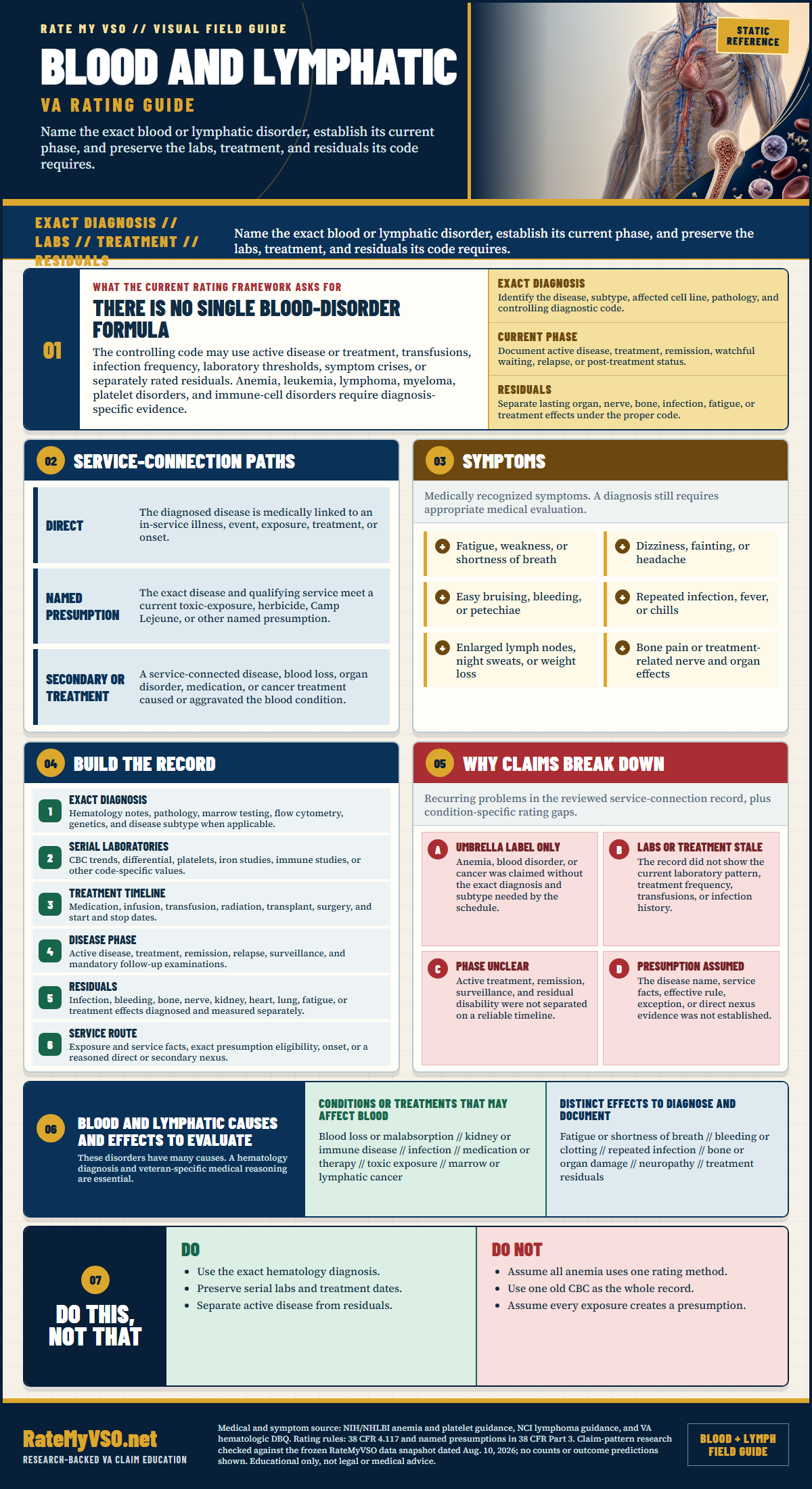 One-page guide: Blood and Lymphatic Conditions Rating Guide in One Page
Blood and lymphatic guide covering diagnosis-specific rating methods, disease phase, laboratories, treatment, named presumptions, residuals, symptoms, evidence, and common claim gaps. Opens the full-size chart, free to save or print.
One-page guide: Blood and Lymphatic Conditions Rating Guide in One Page
Blood and lymphatic guide covering diagnosis-specific rating methods, disease phase, laboratories, treatment, named presumptions, residuals, symptoms, evidence, and common claim gaps. Opens the full-size chart, free to save or print.
The Rules That Decide Every Blood and Lymphatic Claim
The hemic and lymphatic system covers the blood, bone marrow, spleen, and lymph nodes. Conditions here split into two broad groups, and the group decides how the rating works. Anemias and clotting disorders are rated mostly on the treatment they require and the objective problems they cause. Blood and lymphatic cancers are rated on a fixed schedule tied to treatment. A handful of shared rules under 38 CFR § 4.117 sit on top of both groups. This guide is built in part from real Board of Veterans' Appeals decisions on blood and lymph conditions, plain-language patterns drawn from what actually won and what actually lost, not a prediction about any one veteran's claim.
1. Iron-deficiency anemia is rated on the treatment it requires
Under the current schedule, iron-deficiency anemia (DC 7720) is rated on the treatment your condition requires, not on a hemoglobin-plus-symptoms table. Needing intravenous iron infusions 4 or more times in a 12-month period rates 30 percent; needing IV iron 1 to 3 times in a year, or continuous daily oral iron supplementation, rates 10 percent; anemia that is asymptomatic or managed by diet alone rates 0 percent. Your lab work still matters, a complete blood count is how the diagnosis and its persistence get proven, but the rating level follows the documented treatment record.
2. Blood cancers rate 100 percent during active treatment
Blood and lymphatic cancers, including leukemia, lymphoma, Hodgkin's disease, and multiple myeloma, are rated 100 percent while the disease is active and during treatment, and for a set period afterward. During the active phase the VA does not weigh individual symptoms; the diagnosis and active treatment carry the total rating on their own.
3. When treatment ends, a review exam re-rates on residuals
The automatic 100 percent does not last forever. When active treatment ends, the VA schedules a mandatory review examination. At that exam the condition is re-rated on its residuals, the lasting effects on the body, rather than keeping the automatic total rating. If there are no residuals, the rating can drop; if lasting damage remains, that damage is rated on its own under the matching part of the schedule.
4. Ongoing treatment and transfusion dependence factor in
Some conditions are transfusion-dependent or require continuous treatment to keep the blood counts stable. That ongoing need is part of the disability picture and factors into the rating. Documenting how often you need transfusions or infusions, and what happens without them, matters to how the condition is scored.
5. Several blood cancers are presumptive
A number of blood and lymphatic cancers are Agent Orange or other exposure presumptives. Certain leukemias, lymphomas, and multiple myeloma are on the presumptive lists, which means a covered veteran with qualifying service often does not have to prove the link between the exposure and the disease. Separately, under current 38 CFR § 3.320(b), acute and chronic leukemias, multiple myeloma (including monoclonal gammopathy of undetermined significance), myelodysplastic syndromes, and myelofibrosis are presumptive for veterans covered by the PACT Act's toxic-exposure rules, subject to that section's qualifying-service requirements and exceptions. Each presumption attaches only to its listed diagnoses; other blood conditions still need the ordinary proof. See the PACT Act and presumptives guide to check whether your service and condition qualify.
Find the Guide for Your Condition
This system does not yet have a dedicated per-condition guide for every code. For the exact rating levels, the treatment timeline, and the Board data on the conditions that are covered, start here:
| Area | Guide | Conditions |
|---|---|---|
| Blood and lymphatic cancers | Cancer Claims Guide | leukemia, lymphoma, myeloma |
| Anemia (the most-claimed condition in this group) | DC 7720 breakdown | iron deficiency anemia and related anemias |
For anemia and other specific blood conditions, open the condition lookup page for the rating levels and Board data.
How Service Connection Works, At a High Level
Before getting into the specific pathways below, it helps to understand the three things every blood or lymphatic claim ultimately has to show under 38 CFR § 3.303. This is the same basic test that applies to any VA disability claim, just applied to this condition.
- A current diagnosis. You must actually have the condition now, confirmed by lab testing such as a complete blood count. This is the single most common reason blood claims fail, because a condition like anemia can resolve: claims are denied where recent blood work came back normal and no anemia was found, even though the veteran had a documented diagnosis years earlier.
- An in-service cause, or a service-connected cause. The records must show an event, injury, illness, or exposure in service, or a service-connected condition that led to the blood problem. An in-service blood transfusion after a surgery, documented in service records, has supported a grant on its own.
- A medical link (nexus). A qualified provider must connect the current condition to service, and explain why. A private opinion that explained its reasoning has tipped the balance in a veteran's favor, while a bare claim of exposure with no medical link connecting it to the diagnosis has lost.
What VA Looks For: Tests, Records, and Diagnostic Codes
Whether you are filing directly, through a presumptive, or secondary to another condition, the record VA actually reviews centers on a small set of documents and data points.
- A complete blood count (CBC): showing your hemoglobin and platelet levels, the objective backbone of an anemia or clotting claim, and the document that answers whether you have a current diagnosis.
- A bone-marrow biopsy or pathology report: confirming a blood cancer and its specific type, the record that establishes the diagnosis for leukemia, lymphoma, myelodysplastic syndrome, or myeloma.
- Treatment records that date the active phase: showing when chemotherapy, radiation, or other active treatment started and stopped. This timeline drives the 100-percent period and the mandatory review exam.
- Documentation of transfusion dependence or ongoing infusions: how often you need treatment to keep your counts stable, including the frequency of oral iron supplementation versus intravenous iron infusions.
- The diagnostic codes involved: DC 7720 for iron deficiency anemia, plus whatever code applies to the underlying condition you're connecting it to, or the cancer-specific code covered in the Cancer Claims Guide for leukemia, lymphoma, and myeloma.
- The matching Disability Benefits Questionnaire (DBQ): the form that prompts the examiner to capture the labs, symptoms, and residuals the rating depends on, discussed in more detail later in this guide.
Service Connection Pathways: Direct, Presumptive, and Secondary
Blood and lymphatic conditions can reach service connection through several different pathways, and not every claim needs a from-scratch nexus opinion. These are the established routes.
Direct Service Connection
A veteran demonstrates that the condition began during or was caused by active military service. Primary anemia is treated as a chronic disease, so an in-service diagnosis plus continuous symptoms since service can carry the claim on its own (38 CFR § 3.303(b), 3.309(a)). An in-service blood transfusion documented in service records, paired with service records showing continuous anemia afterward, has supported a grant on this theory, as has an in-service diagnosis with continued treatment ever since.
Camp Lejeune presumptive
Aplastic anemia and myelodysplastic syndromes are on the list of conditions presumed related to the contaminated water at Camp Lejeune (August 1953 to December 1987, at least 30 days of service there), under 38 CFR § 3.309(f). A veteran with myelodysplastic syndrome and anemia has won service connection on this basis alone, without needing to separately prove the exposure caused the disease.
PACT Act toxic-exposure presumptive (38 CFR § 3.320(b))
For veterans covered by the PACT Act's toxic-exposure rules, 38 CFR § 3.320(b) presumes service connection for acute and chronic leukemias, multiple myeloma (including monoclonal gammopathy of undetermined significance), myelodysplastic syndromes, and myelofibrosis. The presumption is diagnosis-specific and depends on that section's qualifying service periods, locations, and exceptions, so check the PACT Act guide for whether your service qualifies. A blood condition not on the list still needs the ordinary direct, secondary, or aggravation proof.
Gulf War and toxic exposure (TERA)
Veterans who served in Southwest Asia may qualify through presumptive or toxic-exposure rules under 38 CFR § 3.317 (undiagnosed illness and chronic multi-symptom illness) and 38 U.S.C. § 1117 and 1119, and VA often concedes the exposure itself. This has supported grants tied to burn-pit and particulate exposure, though this pathway is more fact-dependent than the Camp Lejeune presumptive and should be paired with a medical opinion where possible.
Secondary Service Connection (38 CFR § 3.310)
A veteran demonstrates that the blood or lymphatic condition was caused or chronically aggravated by an already service-connected condition. If a condition VA already covers is causing your anemia, claim it as secondary. Anemia has been granted as secondary to a service-connected condition causing heavy internal bleeding (for example, uterine fibroids), and a separate anemia rating has been granted where a service-connected blood disorder was found to be the likely cause. See our Secondary Service Connection Guide.
Service Connection by Aggravation
Where military service significantly worsened a documented pre-service blood or lymphatic condition beyond its natural progression, aggravation-based service connection is available. This is distinct from a congenital condition, discussed below, which cannot be directly service connected even on a worsening theory.
Rating Criteria Under 38 CFR § 4.117
The two groups of conditions in this guide are rated on two different structures.
Anemia (DC 7720)
Anemia is rated on how it is treated.
Blood and Lymphatic Cancers
See the full walkthrough in the Cancer Claims Guide, including the exact treatment-timeline rules and the Board data behind them.
- What the VA measures at your C&P exam
- Evidence that has won at the Board
- Inside the rater's playbook: grant, denial, and remand rates
Evidence That Wins
- A complete blood count showing your hemoglobin and platelet levels, the objective backbone of an anemia or clotting claim, and current enough to establish the diagnosis exists today, not just in the past.
- A bone-marrow biopsy or pathology report confirming a blood cancer and its type, the record that establishes the diagnosis.
- Treatment records that date the active phase, showing when chemotherapy, radiation, or other active treatment started and stopped. This timeline drives the 100-percent period and the review exam.
- Documentation of transfusion dependence or ongoing infusions, showing how often you need treatment to keep your counts stable.
- A nexus opinion that gives its reasons, not just a conclusion. A medical opinion wins when it explains the why. A detailed private opinion has put the evidence in balance against a negative VA opinion and led to a grant, and an opinion with a thorough rationale has been given high weight where a bare conclusion would not be.
- The matching DBQ for the condition, which prompts the examiner to capture the labs, symptoms, and residuals the rating depends on. See the DBQ guide.
Why These Claims Get Denied
Beyond the general "no current diagnosis" and "no nexus" reasons covered above, a few specific denial patterns show up often enough in the Board's decisions to call out on their own.
- A past diagnosis that no longer holds up. Anemia can resolve, and VA rates the present, not your history. Claims have been denied where current labs came back normal even though the veteran had been diagnosed years earlier. A daily multivitamin with iron has not been accepted as proof of ongoing anemia.
- Toxic exposure argued without a medical link. Even a conceded exposure is not enough by itself. A claim has been denied where the veteran had a documented toxic-exposure finding for solvents and gear oils but no medical evidence tied the anemia to that exposure; another claim has failed where there was neither a documented exposure nor a current disease.
- Service that cannot be documented. Unverified service sinks the in-service element. Claims have failed where records could not confirm the specific overseas service claimed, and National Guard training time that was never federalized has not counted as qualifying active duty.
- A congenital condition, claimed as if it were directly service connectable. A condition present from birth is a congenital defect, and cannot be directly service connected even on a worsening theory.
- A secondary claim resting on a primary condition that was itself denied. A secondary claim only works if the underlying condition is service connected; once that underlying claim is denied, the secondary theory fails as a matter of law.
- An obvious non-service cause left unaddressed. Where the record points to a clear cause unrelated to service, such as a later-diagnosed cancer and its chemotherapy, a primary anemia claim has been denied when nothing in the file explained why service, rather than that obvious cause, was the more likely source.
Common Mistakes
Procedural and strategic missteps, distinct from the denial patterns above, that repeatedly cost veterans ground on these claims.
- Not knowing the 100-percent rule. Blood and lymphatic cancers rate 100 percent during active treatment. Some veterans do not realize the total rating is automatic during that phase and undersell the claim.
- Being caught off guard by the review exam. When treatment ends, a mandatory review re-rates the condition on its residuals. Expect it, and keep your records so any lasting effects are documented and rated.
- Not tracing anemia to its cause. Anemia is often a symptom of something else, such as a gastrointestinal bleed. Missing the underlying service-connected cause leaves a valid secondary claim on the table.
- Missing the Agent Orange presumptive. Certain leukemias and lymphomas are presumptive for exposed veterans. Not checking the presumptive lists can mean proving a link you never had to prove.
- Asking for a higher anemia rating without the matching evidence. A request for more than 10 percent has been denied where the veteran took oral iron but had no record of IV infusions. The rating tier you're asking for has to match the treatment documented in the file.
- Not challenging a VA opinion that ignores your history. A negative opinion can be set aside if it is built on gaps rather than facts. The Board has rejected opinions that relied on a lack of records or failed to address the veteran's full history. If an examiner missed your records, say so in writing rather than letting the opinion stand unchallenged.
Do's and Don'ts
A condensed version of everything above, in the order it actually matters when you sit down to build your file.
- Get recent blood work, a complete blood count, close to when you file, and make sure it's in your file.
- Get a nexus opinion that explains its reasoning, not just a yes or no.
- Connect anemia to another service-connected illness if one is causing it, such as a bleeding condition.
- Check presumptive paths like Camp Lejeune or Gulf War service before you file.
- Point to in-service records and continuous symptoms if your condition is chronic.
- Save proof of ongoing treatment, oral iron dates or IV iron infusion dates, for the rating.
- Challenge a VA opinion that ignored your records or history, in writing.
- Keep every treatment record dating the active phase if you have a blood cancer, for the eventual review exam.
- Don't assume a past diagnosis still counts, VA rates the present.
- Don't rely on toxic exposure alone without a medical opinion tying it to your specific diagnosis.
- Don't claim service you cannot document, unverified deployments or unfederalized Guard time will not carry the in-service element.
- Don't expect a congenital condition to be service connected, even on a worsening theory.
- Don't lean on a secondary claim when the underlying primary condition was denied.
- Don't ignore an obvious non-service cause of your anemia, address it directly in your evidence.
- Don't ask for a higher anemia rating without the matching treatment evidence, oral iron alone will not support the 30% tier.
Secondary Conditions
Blood and lymphatic conditions rarely stand alone. Because they affect the whole body, and because treatment leaves its own mark, one service-connected condition often opens the door to several secondary claims, in both directions.
Ways to connect via another condition (this condition as the secondary)
Conditions that can cause or worsen a blood or lymphatic condition, when that other condition is already service connected:
- A bleeding condition causing anemia. A chronic illness or ongoing gastrointestinal bleeding can cause anemia. When the underlying condition is service-connected, the resulting anemia can be claimed as secondary. Anemia has been granted as secondary to a service-connected condition causing heavy internal bleeding.
- Another service-connected blood disorder. A separate anemia rating has been granted where a service-connected blood disorder was found to be the likely cause of the anemia.
- Exposure-linked blood cancers. Certain leukemias, lymphomas, and myeloma are linked to Agent Orange or burn-pit exposure, which is why the presumptive lists matter so much here, even outside a strict secondary theory.
Conditions this condition can cause (this condition as the primary)
Once a blood or lymphatic condition, or its treatment, is itself service connected, it can be the primary condition behind other secondary claims:
- Mental health from a serious diagnosis. The fatigue and strain of a blood disorder or a cancer diagnosis can drive depression and anxiety, which may be claimed as secondary to the physical condition.
- Organ or immune residuals after treatment. Chemotherapy, radiation, and stem-cell treatment can leave lasting organ damage or a weakened immune system that is rated separately. See secondary conditions.
This system does not yet have enough published Board data specific to these diagnostic codes to show grant-rate widgets for this condition group the way it does for higher-volume conditions; the pathways above reflect the documented case patterns instead.
Quick Checklist Before You File
Bring these together before you submit anything.
- Recent blood work (a complete blood count) confirming you have the condition now.
- Service records showing the in-service event, illness, or exposure you are relying on.
- A nexus opinion from a provider that explains the reasoning, not just a yes or no.
- A secondary theory, if a service-connected condition is causing your anemia.
- Presumptive paths checked, such as Camp Lejeune or Gulf War service, before filing.
- Proof of ongoing treatment, oral iron or dates of IV iron infusions, for the rating.
- Written notes if a VA opinion ignored your records or history.
For the mechanics of actually submitting the claim, see the Standard Claim Guide and the Fully Developed Claim Guide (filing with all your evidence up front can speed up the decision).
The Claims Process, Step by Step
Once you file, your claim moves through a series of hand-offs. Understanding who does what helps you know who to contact, and what to expect, at each stage.
- You file the claim. Directly with VA, through VA.gov, or with the help of an accredited representative.
- VA acknowledges the claim and assigns it for development. A Veteran Service Representative (VSR) is assigned to gather your service treatment records, VA and private medical records, and any other evidence needed.
- The VSR orders a Compensation & Pension (C&P) exam if one is needed. Not every claim requires one, but most blood and lymphatic claims do, especially where lab results, biopsy findings, or a nexus opinion are needed.
- The C&P exam is conducted. By a VA clinician or a contracted examiner, who completes a Disability Benefits Questionnaire (DBQ) documenting the diagnosis, current labs, severity, and, where relevant, a nexus opinion.
- The file goes to a Rating Veteran Service Representative (RVSR), the "rater." The rater reviews the complete file, including the exam results, and decides whether service connection is warranted and at what percentage.
- A senior reviewer may review the decision before it's finalized, depending on the complexity of the claim.
- VA issues the decision letter. This states whether the claim is granted or denied, the rating percentage if granted, and the reasons behind the decision.
- If you disagree, you choose an appeal lane. Higher-Level Review, Supplemental Claim, or a Board appeal, covered later in this guide.
Who's who: VSO vs. VSR vs. Rater vs. C&P Examiner
Your VSO
An accredited representative from a veterans service organization, or an accredited attorney or claims agent. Not a VA employee. Helps you prepare, gather evidence, and file, and can represent you through an appeal. Has no authority to decide your claim.
VSR (Veteran Service Representative)
VA staff who "develops" your claim: requests records, schedules the C&P exam, and assembles the file. Does not decide the rating.
Rater (RVSR)
VA staff who reviews the completed file and makes the actual decision, service connection or denial, and the percentage. This is the person whose judgment the decision letter reflects.
C&P Examiner
A VA clinician or a contracted medical examiner who conducts the exam and completes the DBQ. Documents findings and, where asked, a nexus opinion. Does not decide the claim.
For the full walkthrough of every stage with more detail, see Inside Your Claim and Claim Stages.
DBQs and Your C&P Exam
A Disability Benefits Questionnaire (DBQ) is the standardized form an examiner completes for your condition, it structures the exam findings into the specific data points VA's rating schedule requires (for blood and lymphatic conditions, that includes current lab values, treatment dates, and, for cancers, the status of active treatment). See the DBQ Guide for how these forms work, including whether a private DBQ completed by your own doctor can be submitted instead of relying solely on a VA exam.
Before your C&P exam, bring your most recent lab work, a clear timeline of when treatment started and stopped, and a specific account of your symptoms and how they affect daily function. Be consistent with what's already in your medical records and prior statements. For a full walkthrough of what to expect and how to prepare, see the C&P Exam Prep Guide.
Reading Your Decision Letter, and What to Do If Denied
Your decision letter has two parts: a narrative section explaining the reasoning (often called "reasons and bases"), and a codesheet showing the actual rating percentage, the effective date, and the diagnostic code used. See the Reading Your Decision Letter Guide for how to find and interpret each part, or use the Letter Interpreter tool to upload your own letter and get a plain-English breakdown.
If your claim is denied, or the rating is lower than you expected, you have three main lanes:
- Supplemental Claim: refile with new and relevant evidence, such as a new nexus opinion or updated lab work. See Supplemental Claim Guide.
- Higher-Level Review (HLR): a senior reviewer looks at the same evidence again for a difference of opinion, no new evidence is added. See HLR Guide.
- Board Appeal: your case goes to a Veterans Law Judge at the Board of Veterans' Appeals, with options for a direct review, an evidence docket, or a hearing. See Board Appeal Guide.
Not sure which lane fits your situation? See the Appeals decision guide for a side-by-side comparison of all three.
After You Win: Maintaining Your Rating
A grant is not always the end of the story. Keep your treatment consistent, continued follow-up with your treating provider, and records of ongoing labs, transfusions, or infusions, protects you if VA schedules a future reexamination. This matters even more for a blood cancer grant, where the mandatory review exam after active treatment ends is expected, not optional. Not every rating gets reexamined; understand when a rating becomes protected from future review (including Permanent and Total status) and what to do if VA proposes to reduce it. See Protect Your Rating and Future Reexaminations for the specifics.
If your condition worsens after the initial grant, for example needing more frequent iron infusions, or a cancer recurring, you can file for an increased rating. See the Rating Increase Guide.
Quick Reference Tables
Service Connection Pathways
| Pathway | Applies To | Evidence Needed |
|---|---|---|
| Direct / chronic disease | Anemia diagnosed in service with continuous symptoms since | Service records + continuity of treatment |
| Camp Lejeune presumptive | Aplastic anemia, myelodysplastic syndromes | 30+ days at Camp Lejeune, Aug. 1953-Dec. 1987 |
| Gulf War / toxic exposure (TERA) | Blood and lymphatic conditions tied to burn-pit or particulate exposure | Qualifying Southwest Asia service + supporting medical opinion where possible |
| Secondary (38 CFR § 3.310) | Anemia caused by a service-connected bleeding condition or blood disorder | Nexus opinion connecting the service-connected condition to the blood condition |
| Aggravation (38 CFR § 3.306) | Pre-service condition worsened beyond natural progression by service | Baseline severity + evidence of the in-service worsening |
Anemia Rating (DC 7720)
| Rating | Treatment Shown |
|---|---|
| 30% | Intravenous iron infusions 4 or more times a year |
| 10% | Continuous oral iron supplementation |
From Filing to Decision: Who Does What
| Role | Does | Decides your rating? |
|---|---|---|
| VSO / accredited representative | Helps prepare, gather evidence, and file; represents you on appeal | No |
| VSR | Develops the claim: orders records and the C&P exam | No |
| C&P Examiner | Conducts the exam, completes the DBQ, may give a nexus opinion | No / but has a strong impact |
| Rater (RVSR) | Reviews the full file and decides service connection and percentage | Yes |
Frequently Asked Questions
How does the VA rate blood disorders?
Do blood cancers get 100 percent?
How is anemia rated?
What happens at the mandatory review exam?
Are blood cancers presumptive?
Can a congenital blood condition be service connected?
Sources
- 38 CFR § 4.117, Schedule of Ratings, Hemic and Lymphatic Systems, including DC 7720 (iron deficiency anemia)
- 38 CFR § 3.303, basic rules for service connection, including §3.303(b) (chronic disease and continuity of symptoms), §3.303(c) (congenital defects, with 4.9), and §3.303(d) (disease diagnosed after service)
- 38 CFR § 3.310, Secondary Service Connection
- 38 CFR § 3.306, Aggravation of Pre-Service Disability
- 38 CFR § 3.102 and 38 U.S.C. § 5107(b), benefit of the doubt
- 38 CFR § 3.307 and 3.309, presumptive service connection and chronic diseases, including §3.309(f) (Camp Lejeune contaminated water diseases)
- 38 CFR § 3.317, Gulf War undiagnosed and chronic multi-symptom illness
- 38 CFR § 3.104(c), binding favorable findings
- 38 U.S.C. § 1110 and 1131, service connection for wartime and peacetime service
- 38 U.S.C. § 1117 and 1119, Gulf War and toxic exposure