Digestive Conditions Rating Guide
Stomach, bowel, and liver conditions are among the most common VA disability claims, and almost all of them are rated under the same schedule: 38 CFR § 4.114. Each code names the facts it counts, episodes, treatment response, procedures, weight loss, or other objective findings, and one rule about overlapping conditions decides more of them than any other. Learn that pattern once and you understand your whole claim. This guide explains the rules that decide every digestive rating, then points you to the detailed guide for your specific condition.
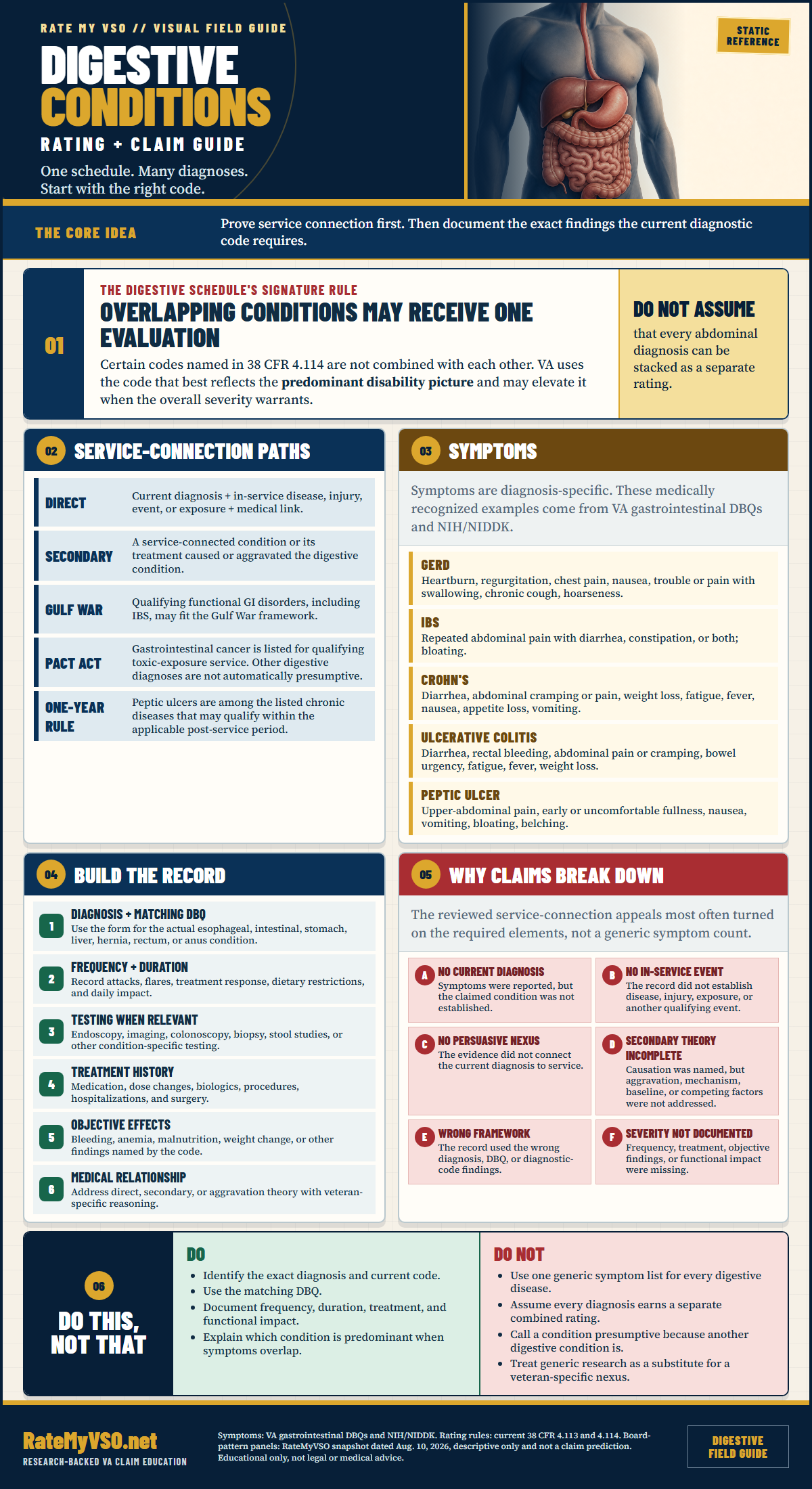 One-page guide: Digestive Conditions Rating Guide in One Page
Digestive system overview covering the predominant-disability rule, service-connection paths, diagnosis-specific symptoms, evidence, and common claim gaps. Opens the full-size chart, free to save or print.
One-page guide: Digestive Conditions Rating Guide in One Page
Digestive system overview covering the predominant-disability rule, service-connection paths, diagnosis-specific symptoms, evidence, and common claim gaps. Opens the full-size chart, free to save or print.
The Rules That Decide Every Digestive Claim
Each digestive code names its own facts, and the rater matches your record against exactly those facts. A string of shared rules sits on top of that, and one of them decides more abdominal claims than anything else.
1. The current schedule is condition-specific, not a generic severity scale
The current digestive schedule is condition-specific. Some codes count episodes or daily symptoms; others turn on procedures, treatment response, bleeding, prescribed dietary changes, weight loss, undernutrition, or other objective findings. Start with the exact diagnostic code, then document the facts that code names. The schedule was revised effective May 19, 2024, so older summaries describing a general mild, moderate, or severe picture no longer match most codes.
2. Weight loss, anemia, and malnutrition raise the rating
Sustained weight loss and lab-confirmed anemia are signs of a more severe condition, and they push several digestive codes into a higher bracket. Malnutrition works the same way. If these are happening and the file does not show them, the rating can come back lower than the condition actually warrants.
3. The coexisting-conditions rule covers named code ranges, not the whole schedule
This is the rule that decides the most digestive claims, and it applies to specific codes rather than to everything in the abdomen. Ratings under diagnostic codes 7301 through 7329, 7331, 7342, 7345 through 7350, 7352, and 7355 through 7357 are not combined with each other. Instead, a single evaluation is assigned under the diagnostic code that reflects the predominant disability, and it can be elevated to the next level when the overall severity warrants (38 CFR § 4.114). The point is to avoid rating the same stomach pain several times over. Knowing this in advance changes how you frame a claim: within those ranges you are usually arguing about which one code best captures the whole picture, not stacking five of them.
4. A few conditions are rated on their own terms
Not everything in the abdomen follows the coexisting-conditions rule. Liver disease, such as hepatitis C, is rated on its own specific findings rather than folded into a single abdominal evaluation. Hemorrhoids and hernias also have their own scales and are handled separately. So a hernia or hemorrhoids can often be claimed alongside a stomach condition that is already rated.
Find the Digestive Rating Lane, Then Build the Record
Digestive conditions do not share one universal rating formula. The useful starting point is the diagnosis family, because each family measures different facts. A symptom diary can help, but it is only useful when it records the events named by the applicable code.
| Diagnosis or rating family | What the schedule may measure | Records that show it |
|---|---|---|
| Esophagus and swallowing | What the schedule may measureTrouble swallowing, dilation or stent history, aspiration, nutrition, weight change, and treatment | Records that show itEndoscopy, swallow study, procedure reports, diet or nutrition records, weights over time, medication history |
| IBS and other functional gastrointestinal disorders | What the schedule may measureAbdominal pain related to bowel movements, change in stool frequency or form, urgency, straining, mucus, bloating, and duration | Records that show itDiagnosis workup, treatment notes, dated symptom record, medication response, functional impact |
| Crohn's disease, ulcerative colitis, and other inflammatory bowel disease | What the schedule may measureDaily symptoms, bleeding, treatment class, response, hospital care, toxicity, anemia, nutrition, and work impact | Records that show itColonoscopy and pathology, laboratory results, infusion or medication records, hospitalization history, weights, clinician restrictions |
| Peptic disease and upper gastrointestinal disease | What the schedule may measureDiagnosis-specific symptoms, bleeding, anemia, treatment response, procedures, and complications | Records that show itEndoscopy, pathology when obtained, blood counts, medication history, procedure or hospitalization reports |
| Resection, ostomy, fistula, and other surgical residuals | What the schedule may measureSurgery performed, residual anatomy, output or leakage, pad or appliance use, nutrition, dehydration, and functional limits | Records that show itOperative report, ostomy or wound-care notes, appliance orders, nutrition records, laboratory results, follow-up examinations |
| Liver, biliary, and pancreatic disease | What the schedule may measureThe diagnosis-specific episodes, treatment, laboratory or imaging findings, procedures, and residuals named by the code | Records that show itLiver and pancreatic testing, imaging, biopsy when performed, medication and procedure history, clinician-documented episodes |
Once the lane is clear, five records cover most of the schedule:
- Frequency and duration: how often the relevant event happens, diarrhea, bleeding, vomiting, trouble swallowing, abdominal distension, leakage, or an attack, and how long each episode lasts.
- Treatment response: daily medication, a diet prescribed by a clinician, dilations, infusions, surgery, hospitalization, or nutrition support, and whether symptoms continue despite the treatment.
- Nutrition and weight: clinically documented weights over time. Under the current definitions, minor involuntary weight loss is 10 to 20 percent of baseline sustained for three months with the required digestive impact; substantial weight loss is more than 20 percent sustained for three months with diminished self-care or work capacity (38 CFR § 4.112). Whether either applies is a clinical determination made from documented weights, not something to self-diagnose.
- Objective findings: the record the condition calls for, endoscopy, colonoscopy, imaging, pathology, blood counts, liver testing, or a procedure report.
- Function: missed work, interrupted sleep, urgent restroom access, restricted eating, and limits on ordinary activity, when those facts are part of the condition's criteria or its functional picture.
The dedicated guides show what each code counts: IBS and IBD, Crohn's disease, ulcerative colitis, peptic ulcer, and GERD.
Different Digestive Conditions Reach Service Connection by Different Routes
The rating lane decides how a condition is scored. A separate question decides whether it is service connected at all, and the digestive system reaches that answer by several different routes.
| Route | What must be established | Important limit |
|---|---|---|
| Direct | What must be establishedA current digestive disability, a disease, injury, exposure, or symptoms in service, and competent evidence connecting the two | Important limitA diagnosis years later is not automatically proof of the link |
| Secondary or aggravated | What must be establishedA current digestive disability and competent evidence that a service-connected condition or its treatment caused or aggravated it | Important limitA medication list or two diagnoses alone does not establish causation; aggravation also requires the applicable baseline analysis (see 38 CFR § 3.310) |
| Gulf War functional gastrointestinal disorder | What must be establishedQualifying service plus a qualifying chronic disability pattern (see 38 CFR § 3.317) | Important limitThe regulation distinguishes functional gastrointestinal disorders from structural gastrointestinal disease. Not every digestive diagnosis is a Gulf War presumption |
| Toxic-exposure or disease-specific presumption | What must be establishedA diagnosis on the applicable list plus the required service, location, and time facts | Important limitPACT Act gastrointestinal cancer and other listed presumptions do not turn every non-cancer digestive disorder into a presumptive condition |
| Treatment or surgical residual | What must be establishedA documented residual linked to treatment or surgery for an already service-connected condition | Important limitThe residual must be distinct and cannot duplicate the same manifestation under another code |
Find the Guide for Your Condition
The rules above apply across the board. For the exact rating levels, the C&P exam, and the Board data for your specific condition, open the dedicated guide:
| Area | Guide | DC codes |
|---|---|---|
| GERD | GERD Claims Guide | 7206 |
| Peptic ulcer | Peptic Ulcer Guide | 7304 |
| IBS and IBD | IBS and IBD Guide | 7319 |
| Ulcerative colitis | Ulcerative Colitis Guide | 7323 |
| Crohn's disease | Crohn's Disease Guide | 7326 |
| Hemorrhoids | Hemorrhoids Guide | 7336 |
| Hernia | Hernia Guide | 7338 |
| Hepatitis C | Hepatitis C Guide | 7354 |
| Celiac disease | Celiac Disease Guide | 7355 |
For any code not listed, open its condition lookup page for the rating levels and Board data.
Every Digestive Diagnostic Code, With Board Outcomes
Every diagnostic code in this body system, ordered by how often it reaches the Board of Veterans' Appeals. Percentages are the share of each code's Board issues granted, denied, or remanded (sent back for more development); dismissed and other outcomes are not shown, so rows do not sum to 100%. Each code links to its full page: rating criteria, evidence notes, and secondary-condition data.
Show 17 more codes with too few Board appeals to report (expand)
| DC | Condition | Board appeals | Granted | Denied | Remanded |
|---|---|---|---|---|---|
| 7201 | Lips, injuries of | Too few Board appeals to report | |||
| 7202 | Tongue, loss of whole or part | Too few Board appeals to report | |||
| 7205 | Esophagus, diverticulum of, acquired | Too few Board appeals to report | |||
| 7303 | Chronic complications of upper gastrointestinal surgery | Too few Board appeals to report | |||
| 7309 | Stomach, stenosis of | Too few Board appeals to report | |||
| 7310 | Stomach, injury of, residuals | Too few Board appeals to report | |||
| 7314 | Chronic biliary tract disease | Too few Board appeals to report | |||
| 7317 | Gallbladder, injury of | Too few Board appeals to report | |||
| 7325 | Enteritis, chronic | Too few Board appeals to report | |||
| 7331 | Peritonitis, tuberculous, active or inactive | Too few Board appeals to report | |||
| 7333 | Rectum and anus, stricture of | Too few Board appeals to report | |||
| 7334 | Rectum, prolapse of | Too few Board appeals to report | |||
| 7337 | Pruritus ani (anal itching) | Too few Board appeals to report | |||
| 7342 | Visceroptosis, symptomatic, marked | Too few Board appeals to report | |||
| 7350 | Liver abscess | Too few Board appeals to report | |||
| 7352 | Pancreas transplant | Too few Board appeals to report | |||
| 7357 | Post pancreatectomy syndrome | Too few Board appeals to report | |||
Counts from RateMyVSO's index of published BVA decisions, refreshed weekly. A remand is not a loss; it means the Board needed more evidence before deciding. Descriptive of the published record, not a prediction for any claim.
Common Secondary Conditions
Digestive problems rarely arrive alone. Because the gut reacts to medication and to stress, one service-connected condition often opens the door to several secondary claims:
- GERD or gastritis from pain medication. Long-term NSAID use for a service-connected condition, a bad back or knee, for example, can irritate the stomach and cause GERD or gastritis as a secondary condition.
- Conditions from a medication regimen. More broadly, a digestive condition can be claimed as secondary to the service-connected medications you have to take for something else.
- Weight loss and malnutrition. A chronic GI condition that keeps you from absorbing or keeping down food can drive weight loss and malnutrition, which are themselves part of the disability picture.
- Depression or anxiety. A chronic, unpredictable, and often embarrassing digestive condition can drive depression and anxiety, which can be claimed as secondary to the physical condition. See secondary conditions.
Each dedicated guide above shows the live Board grant rates for that condition's most common pairings.
Records That Show What the Schedule Measures
A complete digestive record answers five questions, in the terms the applicable code actually uses:
- Exact diagnosis and code family: the specific diagnosis and the diagnostic code family it falls in, because that is what decides which facts matter.
- Dated event record: frequency, duration, bleeding, leakage, bowel pattern, swallowing difficulty, or episodes, recorded in the terms the code names.
- Treatment history and response: prescribed diet, medication, infusion, dilation, procedure, surgery, or nutrition support, and whether symptoms continue despite it.
- Objective findings that fit the diagnosis: imaging, endoscopy or colonoscopy, pathology, laboratory testing including blood counts and liver studies, and clinically documented weights.
- Functional effects: urgent restroom access, interrupted sleep, restricted eating, missed work, and limits on ordinary activity, where the code or the medical picture makes them relevant.
The matching DBQ prompts an examiner to capture most of these fields in the schedule's own terms.
Evidence Cited in Published GERD Decisions
We analyzed 31,329 published Board decisions involving gerd for condition-specific evidence, counting only case-specific mentions (boilerplate recitations excluded). "Favorable" is the share of decisions citing that evidence where every issue was granted or the outcome was mixed; the baseline across all these decisions is 63.6%, combining every diagnostic code below. Evidence appearing in a decision does not mean it decided the case. Descriptive of the published record, not a prediction.
Bar length shows decisions citing the evidence.
By diagnostic code
These codes are grouped together above. They do not perform the same, so find your own code here rather than reading the combined figure. A code retired in the schedule rewrites appears without a link, because its decisions were judged under criteria that no longer apply.
Bar length shows published decisions reviewed.
Evidence Cited in Published Peptic ulcer disease Decisions
We analyzed 7,760 published Board decisions involving peptic ulcer disease for condition-specific evidence, counting only case-specific mentions (boilerplate recitations excluded). "Favorable" is the share of decisions citing that evidence where every issue was granted or the outcome was mixed; the baseline across all these decisions is 51.8%. Evidence appearing in a decision does not mean it decided the case. Descriptive of the published record, not a prediction.
Bar length shows decisions citing the evidence.
Evidence Cited in Published IBS Decisions
We analyzed 20,405 published Board decisions involving ibs for condition-specific evidence, counting only case-specific mentions (boilerplate recitations excluded). "Favorable" is the share of decisions citing that evidence where every issue was granted or the outcome was mixed; the baseline across all these decisions is 60.7%. Evidence appearing in a decision does not mean it decided the case. Descriptive of the published record, not a prediction.
Bar length shows decisions citing the evidence.
Evidence Cited in Published Ulcerative colitis and Crohn’s (IBD) Decisions
We analyzed 4,703 published Board decisions involving ulcerative colitis and crohn’s (ibd) for condition-specific evidence, counting only case-specific mentions (boilerplate recitations excluded). "Favorable" is the share of decisions citing that evidence where every issue was granted or the outcome was mixed; the baseline across all these decisions is 41.1%, combining every diagnostic code below. Evidence appearing in a decision does not mean it decided the case. Descriptive of the published record, not a prediction.
Bar length shows decisions citing the evidence.
By diagnostic code
These codes are grouped together above. They do not perform the same, so find your own code here rather than reading the combined figure. A code retired in the schedule rewrites appears without a link, because its decisions were judged under criteria that no longer apply.
Bar length shows published decisions reviewed.
Detected by phrase-reading the decision text with condition-specific vocabularies. Source: Board of Veterans' Appeals decisions, RateMyVSO analysis.
Symptoms Recorded in Granted GERD Decisions
We analyzed 2,723 granted Board decisions involving gerd for symptoms named in sentences about the condition (rating-criteria recitations excluded). Descriptive of the published record, what the Board wrote down, not a checklist of what to report.
Bar length shows decisions. Percentages remain context.
Symptoms Recorded in Granted Peptic ulcer disease Decisions
We analyzed 471 granted Board decisions involving peptic ulcer disease for symptoms named in sentences about the condition (rating-criteria recitations excluded). Descriptive of the published record, what the Board wrote down, not a checklist of what to report.
Bar length shows decisions. Percentages remain context.
Symptoms Recorded in Granted IBS Decisions
We analyzed 1,485 granted Board decisions involving ibs for symptoms named in sentences about the condition (rating-criteria recitations excluded). Descriptive of the published record, what the Board wrote down, not a checklist of what to report.
Bar length shows decisions. Percentages remain context.
Detected by phrase-reading the decision text with condition-specific vocabularies. Source: Board of Veterans' Appeals decisions, RateMyVSO analysis.
Common Mistakes
- Expecting to stack several overlapping stomach conditions. Within the code ranges named in 38 CFR 4.114, the coexisting-conditions rule collapses conditions like an ulcer (DC 7304), gastritis (DC 7307), IBS (DC 7319), and a hiatal hernia (DC 7346) into a single rating under the predominant code. GERD (DC 7206) sits outside those ranges and keeps its own rating. Going in expecting a separate rating for each in-range condition sets you up for a letdown.
- Not documenting weight loss or anemia. These findings can raise the level, but only if the file shows them. A missing weight log or lab result can leave a rating lower than the condition warrants.
- Not tying a GI condition to your other medications. GERD or gastritis from the NSAIDs you take for a service-connected joint is a real secondary claim that is easy to overlook.
- Treating a normal structural test as the end of the inquiry. A functional gastrointestinal disorder is defined by symptoms that objective structural testing does not explain, so a clean scope does not by itself rule the condition out. It also does not prove a functional diagnosis on its own.
- Claiming only one condition. Some abdominal conditions are rated on their own terms, a hernia or hemorrhoids, for example. If one of those also applies, claiming only the stomach condition leaves it unevaluated.
Frequently Asked Questions
Why does the exact digestive diagnosis matter?
Is a functional gastrointestinal disorder the same as structural disease?
Can several digestive diagnoses receive separate ratings?
Does weight loss matter for my rating?
Is hepatitis C rated here?
Related Tools and Guides
Sources: 38 CFR 4.114, digestive system ratings. Educational only, not legal advice, and not a prediction of any individual claim. Rating criteria change; confirm current details in 38 CFR Part 4. For help with your claim, find a VA-accredited representative.