Hypothyroidism VA Rating Guide
The VA rates hypothyroidism under diagnostic code 7903 in 38 CFR § 4.119. It works differently from most conditions. One word decides your starting evaluation: myxedema. With it, you start at 100%. Without it, 30%. Both ratings are temporary. After a fixed window, the VA stops rating the thyroid number and rates the leftover effects on other body systems. This guide explains how service connection works for hypothyroidism (including the Agent Orange presumptive that lets many veterans skip proving a medical link entirely), the myxedema split, the two initial evaluations and their limits, how the VA rates residuals after that, the evidence that wins, why claims get denied, the claims process step by step, and what to do whether you're denied or after you win.
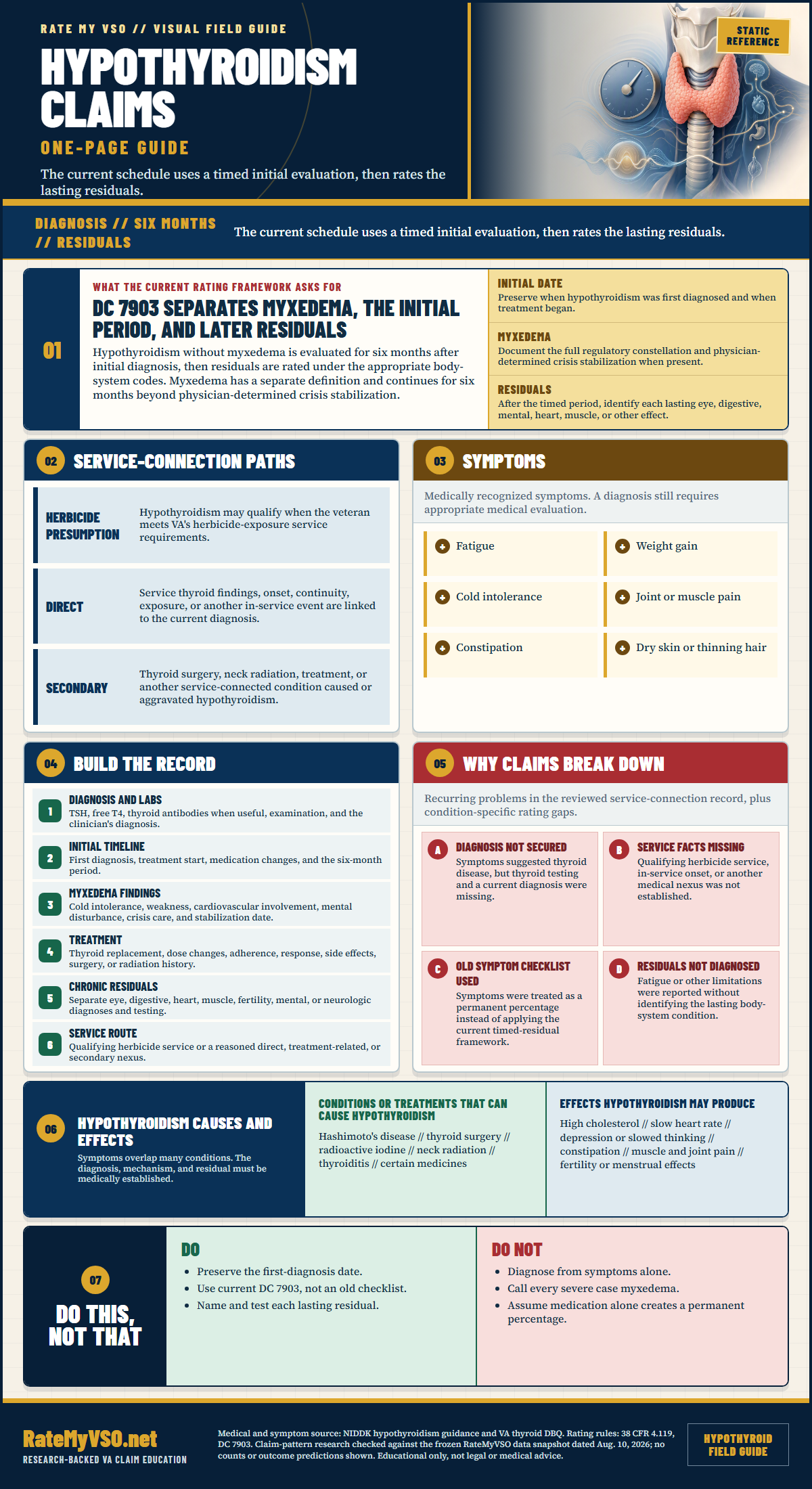 One-page guide: Hypothyroidism Claims in One Page
Hypothyroidism guide covering current DC 7903, myxedema, the timed initial evaluation, later residuals, herbicide and other service paths, symptoms, thyroid testing, evidence, and common claim gaps. Opens the full-size chart, free to save or print.
One-page guide: Hypothyroidism Claims in One Page
Hypothyroidism guide covering current DC 7903, myxedema, the timed initial evaluation, later residuals, herbicide and other service paths, symptoms, thyroid testing, evidence, and common claim gaps. Opens the full-size chart, free to save or print.
Start with the essentials
- 01Service Connection
The ways service connection can be established for this condition.
- 02Diagnosis and Evidence
Common symptoms and the evidence cited in published Board appeals.
- 03Your History
What you experienced, what others observed, and what treatment changed.
Understand the claim
ICD-10 Diagnosis Codes
The ICD-10 diagnosis codes most commonly used for DC 7903, Hypothyroidism (the kind on your medical records, decision letter, or C&P exam report). VA rates the disability and its residuals, not the diagnosis itself, so coding can vary.
How Service Connection Works, At a High Level
Before getting into the specific pathways below, it helps to understand what every hypothyroidism claim ultimately has to show on the merits. This is the same basic test that applies to any VA disability claim, just applied to this condition. To win service connection on the merits you generally must prove three things:
- A current diagnosis. Medical proof you have hypothyroidism now, usually blood tests showing thyroid hormone (TSH) levels and a record of taking thyroid medication. VA has found a current disability even where an examiner would not confirm the diagnosis outright, by giving the veteran the benefit of the doubt based on the overall record and statements.
- An in-service cause or exposure. Something that happened in service. For hypothyroidism this is most often exposure to Agent Orange or another herbicide, but it can also be another documented in-service event or toxic exposure under 38 CFR § 3.303.
- A medical nexus. Unless a presumption applies, a medical opinion connecting your thyroid condition to that in-service event, with a clear explanation of the reasoning, not just a conclusion.
How Hypothyroidism Gets Service Connected: Direct and Secondary Pathways
Several theories can apply. They are routes to service connection, not a ranking.
Direct Service Connection (38 CFR § 3.303)
Diagnosed or began in service, with a current diagnosis and a medical link to service. This is the pathway that needs the full medical nexus opinion when no presumption applies.
Presumptive, Agent Orange (38 CFR § 3.309(e))
Hypothyroidism is on the herbicide presumptive list. For a veteran with qualifying exposure, VA presumes service connection without requiring proof of the medical link. See the dedicated section below.
Secondary (38 CFR § 3.310(a))
A service-connected disability caused the hypothyroidism.
Secondary Aggravation (38 CFR § 3.310(b))
A non-service-connected hypothyroidism is made worse, beyond its natural progression, by a service-connected disability.
Secondary to Thyroid Cancer or Graves' Disease Treatment
Radioactive iodine ablation and surgical thyroidectomy, common treatments for a service-connected toxic goiter (Graves' disease) or a malignant endocrine tumor, routinely destroy or remove enough thyroid tissue that lifelong hypothyroidism follows as a direct medical consequence of treating the primary condition. This is a well-documented iatrogenic pathway distinct from an independent thyroid disease theory: the file needs to show the primary condition was service connected, the treatment given, and that hypothyroidism followed. See our DC 7901 reference for toxic goiter and DC 7914 for malignant endocrine neoplasms.
In-Service Aggravation (38 CFR § 3.306)
The condition pre-existed service and service permanently worsened it beyond natural progression.
Section 1151 (38 U.S.C. § 1151)
VA medical care caused the disability through negligence or a similar fault. A medication's ordinary, expected side effect is not a 1151 basis.
Toxic Exposure (TERA / PACT Act)
Evaluated as a toxic-exposure risk activity where applicable, separate from the Agent Orange presumptive list.
What VA Looks For: Tests, Records, and Diagnostic Codes
Whether you are filing directly, on a presumptive theory, or secondary to another condition, the record VA actually reviews centers on a small set of documents and data points.
- Blood work: TSH (thyroid-stimulating hormone) lab results confirming the diagnosis, plus records of thyroid replacement medication such as levothyroxine or Synthroid.
- Proof of the diagnosis date and severity: whether myxedema was ever documented, and the date a physician determined any crisis was stabilized, which controls the 100% window discussed below.
- Proof of qualifying exposure, if presumptive: a DD-214 or unit/travel records placing you in Vietnam, the Korean DMZ, Blue Water Navy waters, or a PACT Act location (Thailand, Laos, Cambodia) during the covered period, plus buddy statements or a commendation letter describing your duties where the records themselves are incomplete.
- The diagnostic codes involved: DC 7903 for the hypothyroidism itself, plus whatever code applies to any documented residual, such as a cardiac, mental health, or digestive code, once the initial rating window closes.
- The actual form the examiner fills out: the thyroid and parathyroid Disability Benefits Questionnaire (DBQ), discussed in more detail later in this guide.
What Hypothyroidism Is
Hypothyroidism is an underactive thyroid: the gland does not make enough thyroid hormone, which slows the body down. Common effects are fatigue, weight gain, cold intolerance, dry skin, constipation, slowed thinking, depressed mood, and hair loss. It sits in the endocrine system and is rated under DC 7903. Most people manage it with daily replacement hormone (such as levothyroxine or Synthroid).
The current 7903 criteria took effect December 10, 2017. Claims or rating periods before that date are evaluated under the older multi-step version of 7903 (which had 100/60/30/10 levels), so a staged rating with an earlier effective date can mix the two. Everything below describes the current criteria unless noted otherwise.
The Agent Orange Presumptive
Hypothyroidism was added to the herbicide (Agent Orange) presumptive list under 38 CFR § 3.309(e) by the FY2021 National Defense Authorization Act (Public Law 116-283), effective January 1, 2021, and the 2022 PACT Act (Public Law 117-168) expanded the exposure locations further. For a veteran with qualifying herbicide exposure, a presumptive grant does not require proving the medical link, exposure plus the diagnosed condition is enough. This is by far the easiest path to service connection for this condition and should be the first question any veteran with qualifying service asks.
- Vietnam, on the ground: herbicide exposure is presumed for service in the Republic of Vietnam, and hypothyroidism can be granted on that basis alone (38 U.S.C. § 1116; 38 CFR § 3.307(a)(6)(iii)).
- Blue Water Navy: the presumption also covers service on Vietnam's inland waterways and certain offshore waters (38 U.S.C. § 1116A).
- Korean DMZ: service in or near the Korean Demilitarized Zone during the covered period can also trigger the herbicide presumption, and credible lay statements plus supporting records can establish that you were there (38 CFR § 3.307(a)(6)(iv)).
- PACT Act locations: Thailand, Laos, and Cambodia during set periods (38 U.S.C. § 1116). Hypothyroidism does not have to reach any set severity to qualify under a presumption, presumptive service connection is about the exposure and the diagnosis, not about how severe the condition became.
See the Agent Orange presumptive reference for the full condition list and exposure locations.
Symptoms and rating
Symptoms Recorded in Granted Hypothyroidism Decisions
We analyzed 681 granted Board decisions involving hypothyroidism for symptoms named in sentences about the condition (rating-criteria recitations excluded). Descriptive of the published record, what the Board wrote down, not a checklist of what to report.
Bar length shows decisions. Percentages remain context.
Detected by phrase-reading the decision text with condition-specific vocabularies. Source: Board of Veterans' Appeals decisions, RateMyVSO analysis.
How the VA Rates Hypothyroidism (DC 7903)
Both starting evaluations are temporary by design. The clocks are different:
| Type | Initial rating | How long it runs | Then |
|---|---|---|---|
| With myxedema | 100% | 6 months beyond crisis stabilization | rate residuals |
| Without myxedema | 30% | 6 months after initial diagnosis | rate residuals |
The Myxedema Split (the Part Most People Miss)
Under current 7903 there are only two starting points, and which one applies depends entirely on whether the hypothyroidism reached myxedema.
Hypothyroidism that did not reach myxedema starts at 30%. The difference is not about how bad the long-term symptoms feel, two veterans can end up with the exact same residuals later. The split only controls the starting evaluation and how long it lasts.
After the 6 Months: Residuals
Once the initial window closes, the thyroid number is no longer the rating. The VA evaluates the residuals, the lasting effects of the disease or its treatment, under the most appropriate diagnostic code in each affected body system. Hypothyroidism can leave effects across many systems:
- Cardiovascular: bradycardia, other heart involvement.
- Mental health: depression, cognitive slowing.
- Digestive: constipation and related effects.
- Eyes: the involvement noted above, rated separately.
- Skin, muscular, neurological: documented effects rated under their own codes.
Because the rating shifts to residuals, the long-run evaluation can be higher or lower than the starting number, and it can be 0% if no compensable residual is documented. Unlike the older (pre-2017) version of 7903, the current criteria do not carry an automatic minimum for taking continuous medication, the result depends on what residuals the record shows.
- The grant, denial, and remand picture from published BVA decisions
- Secondary condition map
- What the C&P exam measures
Evidence and Board research
Evidence Cited in Published Hypothyroidism Decisions
We analyzed 7,728 published Board decisions involving hypothyroidism for condition-specific evidence, counting only case-specific mentions (boilerplate recitations excluded). "Favorable" is the share of decisions citing that evidence where every issue was granted or the outcome was mixed; the baseline across all these decisions is 47.5%. Evidence appearing in a decision does not mean it decided the case. Descriptive of the published record, not a prediction.
Bar length shows decisions citing the evidence.
Detected by phrase-reading the decision text with condition-specific vocabularies. Source: Board of Veterans' Appeals decisions, RateMyVSO analysis.
Board Grants, Dissected
The decisions below show that the Board has granted direct service connection for hypothyroidism mainly through the herbicide agent (Agent Orange) presumption, or through a well-supported private medical opinion tying hypothyroidism to a specific in-service exposure. Board decisions are not binding precedent, so each case turns on its own facts and evidence.
Board would not order a new exam just to attack the veteran's case Citation A26039277 (April 28, 2026), Hearing docket
The record: The RO's own rating decision had already found the veteran was diagnosed with hypothyroidism, was exposed to herbicides from service in the waters of Vietnam, and that hypothyroidism was "presumptively linked" to that exposure. The RO then denied the claim anyway, saying the condition was due to an intercurrent thyroid nodule and thyroidectomy, without ever getting a medical opinion to support that claim.
Why it won: The Board held it was bound by the RO's own favorable findings under 38 C.F.R. § 3.104(c). Because those findings already satisfied the elements needed for service connection, the Board found it could not send the case back just to develop evidence meant to rebut the presumption. The Board cited Mariano v. Principi for the rule that VA may not develop evidence for the purpose of working against a veteran's claim.
Private doctor's Chernobyl radiation opinion outweighed a conclusory VA exam Citation A26038977 (April 27, 2026), Hearing docket
The record: The veteran served in Germany from April 1984 to October 1986, within 500 miles of the 1986 Chernobyl accident. His private physician opined it was as likely as not that his hypothyroidism was caused by radiation exposure from Chernobyl, noting he had no family history of hypothyroidism and no evidence of autoimmune thyroiditis. A November 2020 VA examiner opined against service connection, reasoning only that hypothyroidism was not diagnosed in service.
Why it won: The Board found the VA opinion "unsupported by medical rationale, conclusory, and of little probative value" under Nieves-Rodriguez v. Peake, because it ignored the veteran's Chernobyl exposure contention entirely. The private physician's opinion was found competent, credible, and given significant weight.
Herbicide exposure at a Thailand air base supported a facts-found grant Citation A26032667 (April 8, 2026), Hearing docket
The record: The veteran was stationed at U-Tapao Royal Thai Air Force Base in 1975, helping build guard towers on the base perimeter. VA's own Toxic Exposure Risk Activity (TERA) memoranda confirmed herbicide exposure and a current hypothyroidism diagnosis, though that concession initially only applied after the PACT Act's effective date of August 10, 2022.
Why it won: The Board found it was bound by the favorable TERA and diagnosis findings, and that herbicide exposure on a facts-found basis could still be established for the period before the PACT Act took effect, since the presumption regulations do not preclude a facts-found or direct-causation theory under Combee v. Brown. The claim was granted for the earlier period as well.
Five physicians' joint opinion tied thyroid cancer, and the resulting hypothyroidism, to herbicide exposure Citation A26032216 (April 8, 2026), Hearing docket
The record: The veteran's hypothyroidism resulted from a total thyroidectomy needed to treat thyroid cancer. VA had conceded herbicide exposure, but never obtained a nexus opinion. A December 2025 private opinion letter, signed by five physicians, reviewed the veteran's history and cited medical literature to conclude it was at least as likely as not that his thyroid cancer, and the resulting hypothyroidism, were caused by herbicide exposure in service.
Why it won: The Board gave the private letter "significant probative value" because it was based on a thorough review, an accurate history, and cited relevant medical literature. Since no VA opinion addressed nexus at all, there was no competing medical evidence to weigh against it.
Lay statements about herbicide spraying at Fort McClellan tipped the balance Citation A26032194 (April 8, 2026), Direct Review docket
The record: The veteran did not serve in a location with presumed herbicide exposure. He testified that during a 1964 active duty for training period at Fort McClellan, he trained outdoors in areas where he personally saw a grounds crew spraying chemicals on grass and weeds. He supported this with a report from a weed science and horticulture consultant, who opined it was more likely than not that anyone training outdoors at Fort McClellan in that era was exposed to herbicide agents.
Why it won: The Board found the veteran competent to describe what he personally observed, and found the consultant's report competent, credible, and persuasive because it was well-supported and unrebutted. With exposure conceded through the benefit of the doubt, the veteran's hypothyroidism qualified for presumptive service connection under 38 C.F.R. § 3.309(e).
Why These Claims Get Denied
Beyond the general "no nexus" and "no diagnosis" reasons covered above, a few specific denial patterns show up often enough in published Board decisions to call out on their own.
- Assuming a toxic exposure by itself proves the case. Claims have been denied where a toxic exposure (burn pits, general Southwest Asia service, asbestos) was conceded but the examiner found that exposure is not a recognized cause of hypothyroidism and no medical link was otherwise shown. A conceded exposure is not the same as a qualifying presumptive exposure or a medical nexus.
- Relying on Agent Orange registry inclusion as proof of exposure. Being on the registry, often based only on the veteran's own report, is not evidence that exposure actually occurred. Claims have been denied where the veteran pointed to registry inclusion but the official records showed no service in a covered location.
- Claiming service in a place the records do not support. Where a veteran's claimed on-the-ground service in a covered country conflicted with DD-214 and travel records showing assignments elsewhere entirely, the Board found the statements not credible and denied the claim. Statements that contradict your own official records work against you.
- Leaning on your own word for a diagnosis that needs a blood test. A veteran is competent to describe symptoms, but hypothyroidism is diagnosed by blood work, so a personal belief that the condition began in, or was caused by, service is not enough by itself. Continuity-of-symptoms claims have been rejected as not credible where in-service bloodwork was normal.
- A nexus opinion that uses hedging language. A medical opinion stating a service event "could have" caused the condition, without more, has been found too speculative to establish a link. Language such as "could," "may or may not," or "cannot rule out" generally does not meet the standard; an opinion should state it is at least as likely as not, and explain why.
- An unexplained long gap between service and diagnosis. Where hypothyroidism was first diagnosed many years after service with no symptoms documented in between, the Board has treated that gap as evidence against the claim. A large unexplained gap needs to be addressed, ideally with a medical explanation of why the disease can develop slowly.
Pitfalls and Common Mistakes
Patterns the published DC 7903 decisions and the rating rule flag most often. The chart in this section shows which missing element the Board's current service-connection denials for hypothyroidism turn on.
- No nexus opinion in the file. A useful opinion names the in-service event or the service-connected primary and explains the link.
- Treating the 100% as permanent. The 100% myxedema evaluation runs only 6 months beyond crisis stabilization, then the VA rates residuals. Records that never document the stabilization date leave the 100% window unestablished.
- Expecting an automatic rating for daily medication. The current 7903 criteria carry no medication minimum. After the initial window the rating depends on documented residuals, which can be 0% when none are recorded.
- Leaving residuals undocumented by the right provider. A residual in another system, such as a mental-health or cardiac effect, generally needs that specialty's examination. A thyroid DBQ alone does not capture it.
- Overlooking the Agent Orange presumptive. Hypothyroidism joined the herbicide presumptive list effective January 1, 2021, with no nexus required for qualifying exposure. Veterans previously denied for "no nexus" may fall under the presumptive.
- Missing the one-year Board appeal deadline. A Board appeal (VA Form 10182) generally must be filed within one year of the decision. Personal hardship and discouragement have not been accepted as good cause to excuse a late filing, so track the deadline even during a difficult stretch.
Do's and Don'ts
A condensed version of everything above, in the order it actually matters when you sit down to build your file.
- Check whether you qualify for the Agent Orange presumption first, it is by far the easiest path.
- Gather proof you were where herbicides were used: your DD-214, unit records, buddy statements, and any commendation letters describing your duties, if your service record does not clearly place you in a covered location.
- Get a nexus opinion that explains its reasoning, not just a bare conclusion, if no presumption applies.
- Make sure any exam or opinion addresses your actual diagnosis and every theory you raised (direct, presumptive, and secondary).
- Ask VA in writing to resolve reasonable doubt in your favor when the positive and negative evidence are roughly balanced.
- Point out when your service treatment records are missing or incomplete, VA has a heightened duty to help you in that situation.
- Get current medical proof of hypothyroidism, including TSH blood tests and medication records.
- File every form on time, keep copies, and track the one-year deadline to appeal to the Board.
- Don't assume a conceded toxic exposure by itself proves the case, the mechanism still has to connect to hypothyroidism specifically.
- Don't rely on Agent Orange registry inclusion as proof you were actually exposed.
- Don't claim service in a location your DD-214 and travel records don't support.
- Don't rely on your own word alone for a diagnosis that needs a blood test.
- Don't accept a nexus opinion that hedges with "could have" or similar speculative language.
- Don't ignore a long, unexplained gap between service and diagnosis, address it directly if one exists.
- Don't assume the 100% myxedema rating is permanent, it converts to a residual rating after its 6-month window.
- Don't miss the one-year Board appeal deadline, health struggles and discouragement are not accepted as good cause for a late filing.
Evidence for a Hypothyroidism Claim
We analyzed the Board's published DC 7903 decisions: a private nexus opinion in the file goes with a higher grant rate, shown above. For hypothyroidism the outcome usually turns on a few specific records:
- Blood work and medication records: TSH levels and a record of taking thyroid medication such as levothyroxine or Synthroid. Diagnosis is a lab question; a veteran's own belief that they have the condition is not a substitute for the blood test.
- Proof of crisis stabilization and its date. The 100% level turns on medical evidence that the hypothyroidism reached myxedema and was stabilized, and on the date a physician determined that. Without those records (often from a private hospital), the 100% window cannot be established and only the 30% / residual path applies.
- Proof of qualifying exposure, for the presumptive path. A DD-214, unit records, or travel records placing you in a covered location, backed by buddy statements or a commendation letter describing your duties when the official record does not clearly place you there.
- The thyroid and parathyroid DBQ. The questions on signs and symptoms and on residuals (sections 3C and 3E on the VA form) are where the residual picture is documented. A reflex or physical-exam note is not a substitute for the DBQ that covers a specific residual.
- Residual documentation by the right provider. A medical residual in another system (for example a mental-health residual) generally needs that specialty's examination. A thyroid examiner cannot complete a mental-health evaluation.
- Nexus opinion: for a direct or secondary theory, a medical opinion stating it is at least as likely as not that service, or a service-connected condition, caused or aggravated the hypothyroidism, with the reasoning spelled out, not just a bare conclusion. Most of the value of a medical opinion comes from its reasoning. An opinion also needs to address your actual diagnosis and every theory you raised; an opinion analyzing the wrong condition (for example hyperthyroidism instead of the claimed hypothyroidism) or that ignores a theory you raised can be given no weight. See our Nexus Letters Guide.
- For the presumptive path: qualifying herbicide exposure plus the hypothyroidism diagnosis, nothing more.
These are the facts the rating depends on, described from published criteria and decisions. They are not advice about any individual claim.
What Published BVA Decisions Show
From the RateMyVSO index of published Board of Veterans' Appeals decisions, 1,985 issues are tagged to DC 7903 (hypothyroidism). Of the 1,546 that were decided on the merits (grants plus denials), approximately 38% were granted and the rest denied. A further 246 were remanded for more development and the remainder dismissed.
Secondary relationships
Common Secondary Conditions
These are the conditions most often linked with hypothyroidism in the Board's published decisions. Each bar is the BVA grant rate for DC 7903, with the number of decisions below it. They describe what the Board's record shows across many veterans, not a prediction about any one claim.
Conditions that can cause hypothyroidism (hypothyroidism as the secondary)
Claims where hypothyroidism was argued as secondary to an already service-connected condition. This is the "ways to connect via another condition" list:
Conditions hypothyroidism can cause (hypothyroidism as the primary)
Conditions veterans have claimed as caused or aggravated by a service-connected hypothyroidism, in other words, conditions secondary to the thyroid condition once it is already service-connected. Several of these track the residual body systems described above (cardiovascular, mental health):
Prepare and take the next step
Prepare: your own working pages
Optional. These are your own notes, in your own words. They are not a VA form, they are not sent to the VA, and nothing here is a medical finding or a prediction about your claim.
Three reminders while you prepare
- Start with the confirmed diagnosis and monitoring
Record the diagnosis, laboratory or clinical monitoring, treatment, and dates from the records you have. Go to this part
- Separate the main condition from complications
List symptoms and functional effects, then identify separately diagnosed complications or residuals without assuming they are automatically connected. Go to this part
- Keep the timeline complete
Organize service history, exposures, onset, treatment, and changes over time, and mark missing or unverified records honestly. Go to this part
Sign in or create an account to save your answers and come back to them later. You can fill these in and print them without an account.
Diagnosis, monitoring, and treatment
Symptoms, function, and complications
Connection and examination questions
Records and unanswered questions
Decision-letter reading sheet
Quick Checklist Before You File
Bring these together before you submit anything.
- Current medical proof of hypothyroidism, including TSH blood tests and records of thyroid medication.
- Whether you qualify for the Agent Orange presumption (Vietnam, Korean DMZ, Blue Water Navy waters, Thailand, Laos, or Cambodia in the covered periods).
- Proof you were where herbicides were used: DD-214, unit records, buddy statements, and any commendation letters describing your duties.
- If no presumption applies, a nexus letter from a doctor stating it is "at least as likely as not" and explaining why service (or a service-connected condition) caused your condition.
- Confirmation that any exam addresses your actual diagnosis and every theory you raise (direct, presumptive, and secondary).
- A written request that VA resolve reasonable doubt in your favor when the evidence is roughly balanced.
- Copies of every form you file, and the one-year deadline to appeal to the Board marked on your calendar.
For the mechanics of actually submitting the claim, see the Standard Claim Guide and the Fully Developed Claim Guide (filing with all your evidence up front can speed up the decision).
The Claims Process, Step by Step
Once you file, your claim moves through a series of hand-offs. Understanding who does what helps you know who to contact, and what to expect, at each stage.
- You file the claim. Directly with VA, through VA.gov, or with the help of an accredited representative.
- VA acknowledges the claim and assigns it for development. A Veteran Service Representative (VSR) is assigned to gather your service treatment records, VA and private medical records, and any other evidence needed, including personnel or travel records if you are raising a presumptive exposure theory.
- The VSR orders a Compensation & Pension (C&P) exam if one is needed. A presumptive claim with a clear diagnosis and documented qualifying service may not need one for service connection itself, but an exam is still typically needed to establish the rating.
- The C&P exam is conducted, if ordered. By a VA clinician or a contracted examiner, who completes the thyroid and parathyroid Disability Benefits Questionnaire (DBQ) documenting the diagnosis, severity, residuals, and, where relevant, a nexus opinion.
- The file goes to a Rating Veteran Service Representative (RVSR), the "rater." The rater reviews the complete file, including the exam results, and decides whether service connection is warranted, whether myxedema is shown, and at what percentage.
- A senior reviewer may review the decision before it's finalized, depending on the complexity of the claim.
- VA issues the decision letter. This states whether the claim is granted or denied, the rating percentage if granted, and the reasons behind the decision.
- If you disagree, you choose an appeal lane. Higher-Level Review, Supplemental Claim, or a Board appeal, covered later in this guide.
Who's who: VSO vs. VSR vs. Rater vs. C&P Examiner
Your VSO
An accredited representative from a veterans service organization, or an accredited attorney or claims agent. Not a VA employee. Helps you prepare, gather evidence (including exposure-location documentation), and file, and can represent you through an appeal. Has no authority to decide your claim.
VSR (Veteran Service Representative)
VA staff who "develops" your claim: requests records, schedules the C&P exam if needed, and assembles the file. Does not decide the rating.
Rater (RVSR)
VA staff who reviews the completed file and makes the actual decision, service connection or denial, whether myxedema is shown, and the percentage. This is the person whose judgment the decision letter reflects.
C&P Examiner
A VA clinician or a contracted medical examiner who conducts the exam and completes the DBQ. Documents findings and, where asked, a nexus opinion. Does not decide the claim.
For the full walkthrough of every stage with more detail, see Inside Your Claim and Claim Stages.
DBQs and Your C&P Exam
The thyroid and parathyroid Disability Benefits Questionnaire (DBQ) is the standardized form an examiner completes for hypothyroidism. It structures the exam findings into the specific data points VA's rating schedule requires, including the signs-and-symptoms section and the residuals section (sections 3C and 3E on the VA form). A reflex test or a general physical-exam note is not a substitute for the DBQ covering a specific residual. See the DBQ Guide for how these forms work, including whether a private DBQ completed by your own doctor can be submitted instead of relying solely on a VA exam.
Before your C&P exam, bring a clear, specific account of your symptoms and their timeline. Be consistent with what's already in your medical records and prior statements, since an inconsistent onset story is itself a reason claims get denied. If you are raising a residual in a system outside the thyroid itself, for example a mental-health or cardiac effect, make sure that specialty actually examines you, a thyroid examiner cannot complete a mental-health evaluation. For a full walkthrough of what to expect and how to prepare, see the C&P Exam Prep Guide.
Reading Your Decision Letter, and What to Do If Denied
Your decision letter has two parts: a narrative section explaining the reasoning (often called "reasons and bases"), and a codesheet showing the actual rating percentage, the effective date, and the diagnostic code used. See the Reading Your Decision Letter Guide for how to find and interpret each part, or use the Letter Interpreter tool to upload your own letter and get a plain-English breakdown.
If your claim is denied, or the rating is lower than you expected, you have three main lanes:
- Supplemental Claim: refile with new and relevant evidence, such as a new nexus opinion, updated blood work, or newly located exposure records. See Supplemental Claim Guide.
- Higher-Level Review (HLR): a senior reviewer looks at the same evidence again for a difference of opinion, no new evidence is added. See HLR Guide.
- Board Appeal: your case goes to a Veterans Law Judge at the Board of Veterans' Appeals, with options for a direct review, an evidence docket, or a hearing. File VA Form 10182 within one year of the decision, that deadline has been enforced strictly, so track it even through a difficult stretch. See Board Appeal Guide.
Not sure which lane fits your situation? See the Appeals decision guide for a side-by-side comparison of all three.
After You Win: Maintaining Your Rating
A grant is not always the end of the story. Because the 100% and 30% starting evaluations both convert to a residual-based rating after their 6-month window, keeping consistent treatment records, including thyroid labs and notes on any cardiovascular, mental-health, or digestive residuals, protects the value of the file if VA later reviews the rating. Not every rating gets reexamined; understand when a rating becomes protected from future review (including Permanent and Total status) and what to do if VA proposes to reduce it. See Protect Your Rating and Future Reexaminations for the specifics.
If your hypothyroidism or its residuals worsen after the initial grant, you can file for an increased rating. See the Rating Increase Guide. And if you won on the Agent Orange presumptive but were diagnosed before January 1, 2021, double-check the effective date on your rating decision against the liberalizing-law rule described above, see Effective Dates.
References and related resources
Quick Reference Tables
Service Connection Pathways
| Pathway | What It Requires | Evidence Needed |
|---|---|---|
| Agent Orange presumptive (38 CFR § 3.309(e)) | Qualifying herbicide exposure (Vietnam, Korean DMZ, Blue Water Navy, PACT Act locations) | DD-214 / unit or travel records, plus current diagnosis |
| Direct (38 CFR § 3.303) | Diagnosis linked to an in-service event | Diagnosis + nexus opinion explaining the reasoning |
| Secondary (38 CFR § 3.310(a)) | Caused by an already service-connected condition | Nexus opinion addressing causation |
| Secondary aggravation (38 CFR § 3.310(b)) | Worsened beyond natural progression by a service-connected condition | Nexus opinion addressing a baseline and the worsening |
| Secondary to thyroid cancer / Graves' treatment (DC 7901, DC 7914) | Radioactive iodine ablation or thyroidectomy for a service-connected primary condition | Records of the primary condition, the treatment given, and the resulting hypothyroidism |
| In-service aggravation (38 CFR § 3.306) | Pre-existing condition permanently worsened by service | Baseline severity + evidence of in-service worsening |
From Filing to Decision: Who Does What
| Role | Does | Decides your rating? |
|---|---|---|
| VSO / accredited representative | Helps prepare, gather evidence, and file; represents you on appeal | No |
| VSR | Develops the claim: orders records and the C&P exam | No |
| C&P Examiner | Conducts the exam, completes the DBQ, may give a nexus opinion | No / but has a strong impact |
| Rater (RVSR) | Reviews the full file and decides service connection and percentage | Yes |
Frequently Asked Questions
Why did I only get 30% when my buddy got 100% for the same thing?
Does the 100% rating last forever?
I take medication every day. Isn't that an automatic rating?
I was diagnosed years ago. Can I still get the 100% or 30%?
Can hypothyroidism be service connected through Agent Orange?
Does being on the VA Agent Orange registry prove I was exposed?
What if my nexus opinion says service "could have" caused my condition?
Related Tools and Guides
Sources
- 38 CFR § 4.119, DC 7903, Schedule of Ratings, Endocrine System (Hypothyroidism)
- Cornell LII, 38 CFR § 4.119
- 38 CFR § 3.303, basic rules for service connection, including 3.303(d), disease diagnosed after service
- 38 CFR § 3.310, Secondary Service Connection
- 38 CFR § 3.306, Aggravation of Pre-Service Disability
- 38 CFR § 3.309(e), herbicide (Agent Orange) presumptives, including hypothyroidism
- 38 CFR § 3.307(a)(6), herbicide exposure locations (Vietnam and Korean DMZ)
- 38 U.S.C. § 1116 and 38 U.S.C. § 1116A, presumptive service connection for herbicide exposure and Blue Water Navy service
- 38 CFR § 3.102 and 38 U.S.C. § 5107(b), reasonable doubt / benefit of the doubt
- 38 U.S.C. § 1154(a), consideration of the circumstances of service and lay evidence
- 38 U.S.C. §§ 1112, 1113; 38 CFR §§ 3.307(a)(3), 3.309(a), one-year presumption for chronic diseases such as endocrinopathies
- 38 U.S.C. § 1151, disability caused by VA medical care
- 38 CFR § 3.114, effective dates under a liberalizing law; 38 CFR § 3.400 and 38 U.S.C. § 5110, effective dates generally
- Public Law 116-283 (FY2021 NDAA), adding hypothyroidism to the herbicide presumptive list effective January 1, 2021
- Public Law 117-168, the PACT Act, expanding herbicide exposure locations
- RateMyVSO BVA index (DC 7903)