Restless Legs Syndrome VA Claims: Ratings and Service Connection
Restless legs syndrome (RLS) has no diagnostic code of its own in the VA rating schedule, so the VA rates it by analogy to a similar listed condition. Which code the VA picks decides your ceiling: one path caps at 30 percent and another reaches as high as 80 percent. This guide explains how service connection works, the two rating paths, what drives the code choice, the evidence that wins, why these claims get denied, a checklist before you file, what the claims process looks like step by step, how to read your decision letter, and what to do whether you win or you're denied.
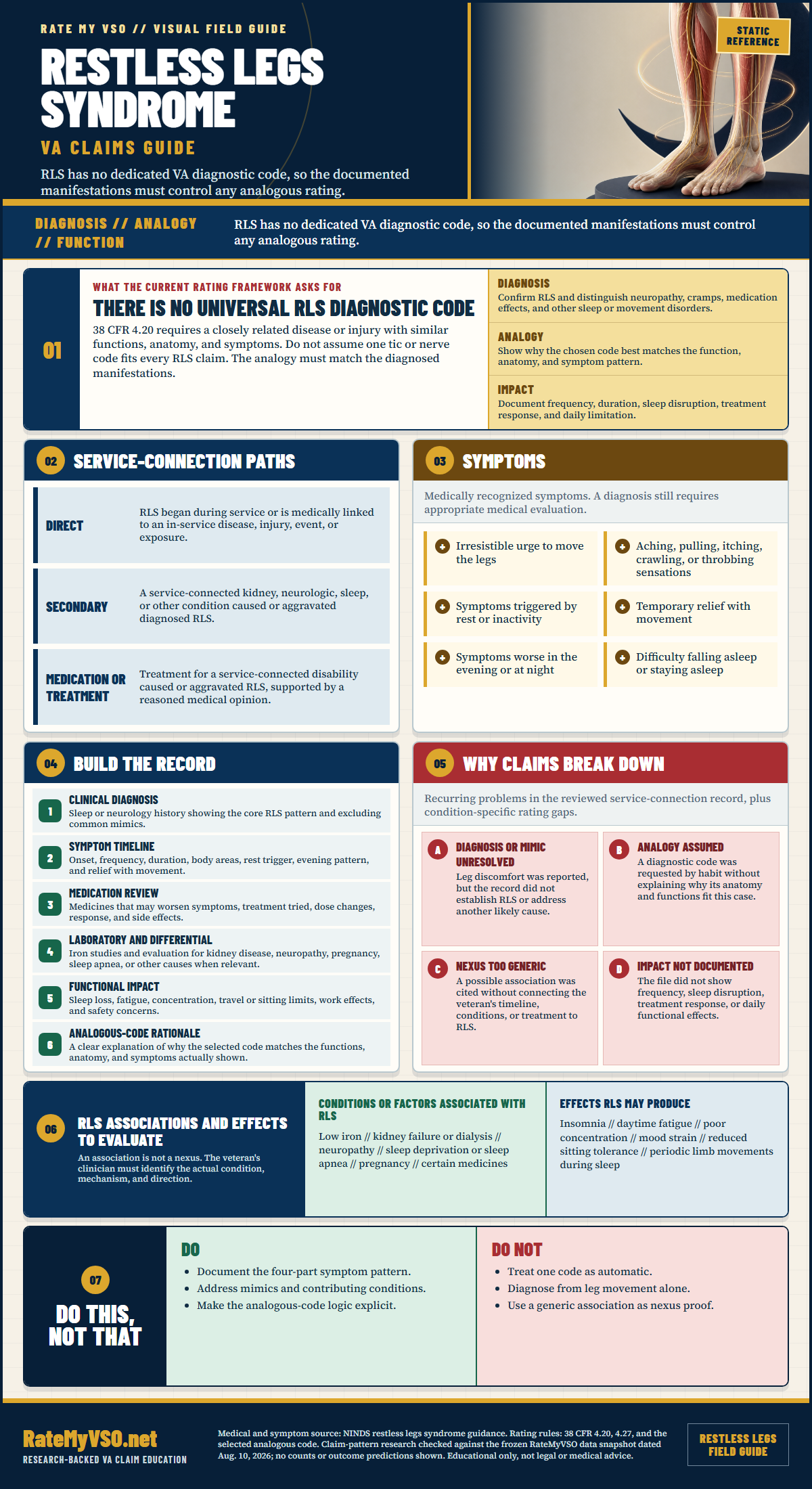 One-page guide: Restless Legs Syndrome Claims in One Page
Restless legs syndrome guide covering diagnosis, analogous-code selection, the core symptom pattern, service paths, mimics, testing, treatment response, functional impact, and common claim gaps. Opens the full-size chart, free to save or print.
One-page guide: Restless Legs Syndrome Claims in One Page
Restless legs syndrome guide covering diagnosis, analogous-code selection, the core symptom pattern, service paths, mimics, testing, treatment response, functional impact, and common claim gaps. Opens the full-size chart, free to save or print.
Overview
Restless leg syndrome is a nervous-system condition that produces a strong, hard-to-resist urge to move your legs, usually when you are resting at night. The VA does not list RLS as its own diagnostic code, so every claim runs through a rating-by-analogy decision and a service-connection analysis at the same time. Across the Board's published RLS decisions, the single biggest reason claims failed was a missing current diagnosis of RLS from a qualified provider in the record, not a weak service-connection argument. Winning claims paired a real, tested diagnosis with a believable link to service.
RLS has no code of its own
RLS is not listed in the VA rating schedule (38 CFR Part 4). When a condition is not listed, the VA rates it by analogy under 38 CFR 4.20, using a closely related listed condition where the functions affected, the body location, and the symptoms are similar. The VA writes the code as a build-up under 38 CFR 4.27, so you will see a hyphenated code such as 8199-8103 or 8799-8520, where the "99" signals an unlisted condition rated by analogy.
How Service Connection Works, At a High Level
Before getting into the specific rating paths and pathways below, it helps to understand the three things every RLS claim ultimately has to show on a direct basis. This is the same basic test that applies to any VA disability claim, just applied to this condition.
- A current diagnosis. A real, current diagnosis of restless leg syndrome from a qualified provider, ideally resting on an exam or objective testing rather than just a transcription of what you reported (38 CFR 3.303). Without proof of a current disability there is no valid claim. This is the step that sinks the most RLS claims.
- An in-service cause or event. An injury, disease, event, or exposure during service, such as Gulf War or other toxic exposure, or a documented in-service symptom.
- A medical nexus. A link between the current RLS and service, shown either by a medical opinion that gives its reasoning, or by believable evidence of continuous symptoms since service.
The two rating paths
The VA rates RLS under one of two analogous codes, and they have very different ceilings.
Path 1: DC 8103, convulsive tic (max 30%)
Used when RLS reads as a sleep-disrupting movement disorder (38 CFR 4.124a). The Board has rated periodic limb movement disorder with RLS features this way.
Go deeper: open the full DC 8103 breakdown- What the VA measures at your C&P exam
- Evidence that has won at the Board
- Inside the rater's playbook: grant, denial, and remand rates
- Secondary condition map
Path 2: DC 8520, sciatic nerve (up to 80%)
Used when RLS reads as a neurological deficit with pain, numbness, tingling, and leg fatigue (38 CFR 4.124a). The neuritis variant is DC 8620. The Board has rated bilateral RLS this way, in one instance assigning two 40 percent ratings for moderately severe incomplete paralysis, one for each leg.
Go deeper: open the full DC 8520 breakdown- What the VA measures at your C&P exam
- Evidence that has won at the Board
- Inside the rater's playbook: grant, denial, and remand rates
- Secondary condition map
What drives the code choice
The choice turns on whether the disability reads as a sleep-disrupting movement disorder or as a neurological deficit. In one decision the Board held the condition was "more closely associated with a sleep disorder" and rejected the Regional Office's switch to a peripheral-nerve code, keeping the convulsive-tic code (8103). Where the medical record documents sciatic-type symptoms (pain radiating down the legs, numbness, tingling, leg fatigue affecting walking or driving), the Board has used the sciatic-nerve code (8520) instead.
What VA Looks For: Tests, Records, and Diagnostic Codes
Whichever pathway you're filing under, the record VA actually reviews centers on a small set of documents and data points.
- A tested, current diagnosis: RLS confirmed by a qualified provider through an exam or objective testing, not just a transcription of your own reported history. A sleep study showing periodic limb movements, where available, supports the sleep-disorder characterization.
- A neurological exam: documenting sensory findings (pain, numbness, tingling) and any motor or atrophy findings. Strength, reflex, and sensory testing during a peripheral-nerve exam are what the Board weighs when deciding whether sciatic-type symptoms are present; normal findings across the board have supported a finding of no RLS on exam.
- The diagnostic codes involved: DC 8103 (convulsive tic, movement-disorder characterization) or DC 8520 (sciatic nerve, neurological-deficit characterization), and the closely related nerve code DC 8521 that some decisions cite instead, all rated under 38 CFR 4.124a.
- A symptom diary or lay statements: describing frequency, severity, sleep loss, and the effect on daily activity, and, where relevant, describing symptoms that began in service and have continued since.
- The actual form the examiner fills out: a Disability Benefits Questionnaire (DBQ), discussed in more detail later in this guide.
Service-connection paths
Beyond the three-part test above, RLS claims can be built on several distinct pathways. Keep all of these in mind together, since more than one can apply to the same claim.
- Direct: RLS that began in service or was caused by an in-service event or exposure. RLS can sometimes be treated as a chronic disease of the nervous system under 38 CFR 3.309(a), which lets a veteran win on continuity of symptoms since service (38 CFR 3.303(b)) rather than requiring a specific documented in-service diagnosis, where the symptoms are credibly reported as continuous from service to now.
- Secondary (38 CFR 3.310): RLS caused or aggravated by an already service-connected condition. Documented medical associations include iron deficiency, kidney disease, diabetes and peripheral neuropathy, and certain medications. Several drug classes can trigger or worsen RLS, including some antidepressants (SSRIs and SNRIs), antihistamines, antipsychotics, and anti-nausea dopamine-blocking drugs. If those drugs treat a service-connected condition, the intermediate-step chain (service-connected condition, then prescribed medication, then RLS) can support a secondary claim. In practice, secondary RLS claims have failed most often not because the theory is wrong but because no supporting medical evidence was actually submitted for it.
- Gulf War (38 CFR 3.317): A Gulf War veteran might argue RLS-type symptoms as part of an undiagnosed-illness or MUCMI cluster, but because RLS is a named diagnosis with a known clinical workup, the Board has repeatedly held that it does not fit the presumptive rule for undiagnosed illnesses or medically unexplained illnesses, so this path is weaker than a direct or secondary claim. RLS is also not on the Camp Lejeune presumptive list.
Gulf War or toxic exposure service still helps a direct claim
Even though RLS does not qualify as an undiagnosed illness, Gulf War or toxic exposure service is not wasted. Once VA concedes you took part in a toxic exposure risk activity (TERA) or served in Southwest Asia, the in-service-event element of the direct three-part test is treated as met, so a direct claim only needs a diagnosis and a nexus. Every published RLS grant reviewed for this guide involved Gulf War or toxic exposure service used this way, not the undiagnosed-illness route.
Secondary to medications
Some antidepressants (SSRIs and SNRIs), antihistamines, antipsychotics, and anti-nausea dopamine-blocking drugs can trigger or worsen RLS. Where one of these medications was prescribed for a service-connected condition, the intermediate-step chain (service-connected condition, then the prescribed medication, then RLS) can support a secondary claim under 38 CFR 3.310, but the nexus opinion needs to name the specific medication and explain the mechanism.
VA-caused harm (38 USC 1151), a separate path outside service connection
There is a path outside service connection entirely: if VA's own medical care caused or aggravated your RLS, for example through a medication error, you may be entitled to compensation under 38 USC 1151 and 38 CFR 3.361 as if the resulting disability were service-connected, even without any tie to your military service. This is a fundamentally different legal theory from direct or secondary service connection and requires evidence of the VA treatment itself and the harm that followed. See the 38 USC 1151 Claims Guide.
Evidence for an RLS Claim
The Board's published DC 8103 and DC 8520 decisions show a similar pattern seen across other conditions: a solid medical opinion in the file goes with a meaningfully different grant rate than an exam or record with no reasoned opinion at all.
- A current, tested diagnosis: the foundational document. RLS confirmed by a qualified provider through an exam or objective testing, for example a sleep study showing periodic limb movements where the sleep-disorder characterization applies. A diagnosis that just repeats what you told the provider, with no testing behind it, is not enough by itself; the Board has found non-physician providers such as chiropractors not competent to diagnose a neurological condition on that basis alone (38 CFR 3.159).
- A neurological exam: documenting sensory findings (pain, numbness, tingling) and any motor or atrophy findings, which support the sciatic-nerve characterization and a potentially higher rating under DC 8520.
- A symptom diary or lay statements: describing frequency, severity, sleep loss, and the effect on daily activity. First-person, personally observed symptoms are competent lay evidence (Jandreau v. Nicholson, 492 F.3d 1372 (Fed. Cir. 2007); Layno v. Brown, 6 Vet. App. 465 (1994)). See our Buddy & Lay Statements Guide.
- A reasoned nexus opinion: for a direct or secondary claim, a medical opinion stating it is at least as likely as not that service, or a service-connected condition or its medication, caused or aggravated the RLS, and explaining the reasoning rather than stating a bare conclusion. The Board gives weight to a medical opinion based on its reasoning, not just its conclusion (Nieves-Rodriguez v. Peake, 22 Vet. App. 295 (2008)). See our Nexus Letters Guide.
- Continuity of symptoms: if your symptoms began in service and have continued since, documenting that continuity (38 CFR 3.303(b)) can support a direct claim treating RLS as a chronic nervous-system disease (38 CFR 3.309(a)), without needing a specific in-service diagnosis.
Why These Claims Get Denied
Beyond the general "no diagnosis" and "no nexus" reasons covered above, a few specific denial patterns show up often enough to call out on their own.
- No current diagnosis in the record. This is the single most common reason RLS claims are denied. Without proof of a current disability, there is no valid claim (Brammer v. Derwinski, 3 Vet. App. 223 (1992)), regardless of how strong the rest of the record is.
- A diagnosis that only repeats the veteran's own history. Where a diagnosis of RLS came from a provider who simply wrote down what the veteran reported, cited general background literature, and performed no independent testing, the Board has given it no weight, especially where the provider was not shown to be competent to diagnose a neurological condition.
- Assuming RLS is an automatic Gulf War presumptive illness. RLS is a known, named clinical diagnosis, so it does not qualify as an undiagnosed illness or medically unexplained chronic multisymptom illness under 38 CFR 3.317, and it is not a Camp Lejeune presumptive condition. Claims that rest only on this theory, without a direct or secondary argument, are denied.
- A bare claim with no detail about onset or cause. A conclusory, generalized statement claiming RLS without any account of when it started or what in service caused it is not enough to even trigger a VA exam.
- A decades-long, unexplained gap between service and diagnosis. Where the earliest documented RLS treatment comes decades after separation and the service records are silent, the Board has found no in-service event. A long gap can be overcome by credible evidence of continuous symptoms bridging it, but silence alone works against the claim.
- Leg symptoms that turn out to be something else. Where an examiner determines the leg symptoms are actually radiculopathy from a nonservice-connected back condition rather than RLS, the claim fails on its own terms, and a secondary theory cannot rescue it if the underlying back condition is not itself service-connected.
Common Mistakes
Patterns that follow from how the VA rates RLS by analogy and the two-code ceiling split, plus procedural mistakes that recur across the Board's published RLS decisions.
- Letting the record support only the convulsive-tic code. When the file documents RLS as a sleep-disrupting movement disorder, the VA rates it under DC 8103, which caps at 30 percent. If sciatic-type symptoms (pain radiating down the legs, numbness, tingling, leg fatigue) go unrecorded, the higher DC 8520 path that reaches 80 percent never comes into view.
- Not documenting each leg separately. When the VA uses the sciatic-nerve code, it evaluates each affected leg. Records that describe bilateral symptoms without distinguishing the two legs can leave a second rating off the table.
- Filing a secondary claim without a medical nexus. A missing medical opinion is a common denial reason. For a secondary claim under 38 CFR 3.310, the opinion has to state it is at least as likely as not that the service-connected condition, or a medication prescribed for it, caused or aggravated the RLS.
- Skipping the medication chain. Several drug classes can trigger or worsen RLS. When those drugs treat a service-connected condition, the intermediate-step chain (service-connected condition, then prescribed medication, then RLS) supports a secondary claim, but only if the record spells out each link.
- Leaning on the Gulf War undiagnosed-illness path. Because RLS is a named diagnosis with a known clinical workup, the 38 CFR 3.317 undiagnosed-illness route is weaker for it than a direct or secondary claim.
- Missing your VA examination. Deciding a case on the existing record when a veteran missed an exam has happened, but it is a rare favorable break, not a strategy (38 CFR 3.655). Missing an exam usually means the claim is rated on a thin record and denied.
Do's and Don'ts
A condensed version of everything above, in the order it actually matters when you sit down to build your file.
- Get a real, current diagnosis of RLS from a qualified provider before anything else, ideally resting on an exam or testing, not just a transcription of what you said.
- Attend every VA examination and clearly describe the urge to move your legs, when it happens, and how often.
- Get a nexus opinion that explains its reasoning, not just its conclusion.
- If your symptoms started in service and never stopped, document that continuity.
- Confirm VA has verified your Gulf War service or toxic exposure risk activity if that applies to you.
- Raise a secondary claim to an already service-connected condition (iron deficiency, kidney disease, diabetes, or a medication) and support it with evidence, raised early and inside the evidence window.
- If the VA uses the sciatic-nerve code, make sure the record documents each leg's symptoms separately.
- Don't assume a bare claim with no detail about onset or cause will trigger a VA exam.
- Don't rely on a diagnosis that just repeats your own reported history with no independent testing behind it.
- Don't assume RLS automatically qualifies as a Gulf War undiagnosed illness, it generally does not.
- Don't ignore a long, unexplained gap between service and your first documented diagnosis.
- Don't confuse RLS-type leg symptoms with radiculopathy from an unconnected back condition without sorting out which one the record actually supports.
- Don't skip your VA examination and hope the case gets decided on the existing record anyway.
- Don't let the record support only the convulsive-tic characterization if sciatic-type symptoms are actually present.
Related Conditions
RLS most often travels alongside iron deficiency, kidney disease, diabetes and peripheral neuropathy, sleep apnea, and medications prescribed for depression, anxiety, psychiatric conditions, allergies, or nausea. Neither DC 8103 nor DC 8520 has enough published Board decisions naming another specific diagnostic code alongside it to show a reliable bidirectional grant-rate chart the way we do for higher-volume conditions, so no chart is shown here; the pathways above describe the documented associations instead.
See the Sleep Apnea Claims Guide for the sleep-disorder side of this overlap.
Quick Checklist Before You File
Bring these together before you submit anything.
- Get a qualified provider to give you a current, documented diagnosis of restless leg syndrome.
- Make sure the diagnosis rests on an exam or testing, not just on repeating your own words.
- Attend every VA examination and clearly describe your urge to move your legs and when it happens.
- Confirm VA has verified your Gulf War service or toxic exposure risk activity, if applicable.
- Get a nexus opinion that explains its reasons and connects your RLS to service or to a service-connected condition.
- If your symptoms started in service and never stopped, document that continuity.
- Consider a secondary claim to an already service-connected condition, and raise it early with evidence.
- If sciatic-type symptoms (pain, numbness, tingling, leg fatigue) are present, make sure each leg is documented separately.
For the mechanics of actually submitting the claim, see the Standard Claim Guide and the Fully Developed Claim Guide (filing with all your evidence up front can speed up the decision).
The Claims Process, Step by Step
Once you file, your claim moves through a series of hand-offs. Understanding who does what helps you know who to contact, and what to expect, at each stage.
- You file the claim. Directly with VA, through VA.gov, or with the help of an accredited representative.
- VA acknowledges the claim and assigns it for development. A Veteran Service Representative (VSR) is assigned to gather your service treatment records, VA and private medical records, and any other evidence needed.
- The VSR orders a Compensation & Pension (C&P) exam if one is needed. Most RLS claims do, since a neurological exam is usually what decides which of the two rating paths applies.
- The C&P exam is conducted. By a VA clinician or a contracted examiner, who completes a Disability Benefits Questionnaire (DBQ) documenting the diagnosis, symptom characterization, severity, and, where relevant, a nexus opinion.
- The file goes to a Rating Veteran Service Representative (RVSR), the "rater." The rater reviews the complete file, including the exam results, and decides whether service connection is warranted, which diagnostic code applies, and at what percentage.
- A senior reviewer may review the decision before it's finalized, depending on the complexity of the claim.
- VA issues the decision letter. This states whether the claim is granted or denied, the diagnostic code and rating percentage if granted, and the reasons behind the decision.
- If you disagree, you choose an appeal lane. Higher-Level Review, Supplemental Claim, or a Board appeal, covered later in this guide.
Who's who: VSO vs. VSR vs. Rater vs. C&P Examiner
Your VSO
An accredited representative from a veterans service organization, or an accredited attorney or claims agent. Not a VA employee. Helps you prepare, gather evidence, and file, and can represent you through an appeal. Has no authority to decide your claim.
VSR (Veteran Service Representative)
VA staff who "develops" your claim: requests records, schedules the C&P exam, and assembles the file. Does not decide the rating.
Rater (RVSR)
VA staff who reviews the completed file and makes the actual decision, service connection or denial, which diagnostic code applies, and the percentage. This is the person whose judgment the decision letter reflects.
C&P Examiner
A VA clinician or a contracted medical examiner who conducts the exam and completes the DBQ. Documents findings and, where asked, a nexus opinion. Does not decide the claim.
For the full walkthrough of every stage with more detail, see Inside Your Claim and Claim Stages.
DBQs and Your C&P Exam
A Disability Benefits Questionnaire (DBQ) is the standardized form an examiner completes for your condition, it structures the exam findings into the specific data points VA's rating schedule requires. For RLS, that means the examiner documents which characterization applies (sleep-disrupting movement disorder versus a neurological deficit) and, if a neurological deficit is documented, the strength, reflex, and sensory testing results for each leg. See the DBQ Guide for how these forms work, including whether a private DBQ completed by your own doctor can be submitted instead of relying solely on a VA exam.
Before your exam, bring a clear, specific account of your symptoms: when the urge to move your legs happens, how often, and how it affects your sleep and daily function. Be consistent with what's already in your medical records and prior statements, since normal strength, reflex, and sensory testing on exam has led examiners to find no RLS present. For a full walkthrough of what to expect and how to prepare, see the C&P Exam Prep Guide.
Reading Your Decision Letter, and What to Do If Denied
Your decision letter has two parts: a narrative section explaining the reasoning (often called "reasons and bases"), and a codesheet showing the actual rating percentage, the effective date, and the diagnostic code used, telling you at a glance whether VA rated your RLS under DC 8103 or DC 8520. See the Reading Your Decision Letter Guide for how to find and interpret each part, or use the Letter Interpreter tool to upload your own letter and get a plain-English breakdown.
If your claim is denied, or the rating is lower than you expected, you have three main lanes:
- Supplemental Claim: refile with new and relevant evidence, such as a new nexus opinion or a neurological exam documenting sciatic-type symptoms. See Supplemental Claim Guide.
- Higher-Level Review (HLR): a senior reviewer looks at the same evidence again for a difference of opinion, no new evidence is added. See HLR Guide.
- Board Appeal: your case goes to a Veterans Law Judge at the Board of Veterans' Appeals, with options for a direct review, an evidence docket, or a hearing. See Board Appeal Guide.
Not sure which lane fits your situation? See the Appeals decision guide for a side-by-side comparison of all three.
After You Win: Maintaining Your Rating
A grant is not always the end of the story. Keep your treatment consistent, continued follow-up with a neurologist or sleep-medicine provider and records documenting your ongoing symptoms, protects you if VA schedules a future reexamination. Not every rating gets reexamined; understand when a rating becomes protected from future review (including Permanent and Total status) and what to do if VA proposes to reduce it. See Protect Your Rating and Future Reexaminations for the specifics.
If your RLS worsens after the initial grant, for example progressing from a movement-disorder presentation to documented sciatic-type nerve involvement, you can file for an increased rating, and the diagnostic code itself can be revisited if the new exam findings support it. See the Rating Increase Guide.
Quick Reference Tables
Which Code Applies
| How RLS Reads | Analogous Code | Ceiling |
|---|---|---|
| Sleep-disrupting movement disorder | DC 8103 (convulsive tic) | 30% |
| Neurological deficit (sciatic nerve pattern) | DC 8520 (sciatic nerve) | 80% (complete paralysis) |
| Neurological deficit (external popliteal/common peroneal nerve pattern) | DC 8521 | 40% complete paralysis; 30% severe incomplete paralysis; 20% moderate; 10% mild |
Service Connection Pathways
| Pathway | Mechanism | Evidence Needed |
|---|---|---|
| Direct, including chronic-disease theory | In-service onset, or continuity of symptoms as an organic nervous-system disease | Current diagnosis + in-service event or continuous symptoms + nexus |
| Secondary: iron deficiency, kidney disease, diabetes/neuropathy | Documented metabolic and neurological associations with RLS | Service-connected primary + nexus opinion addressing the specific link |
| Secondary: medications (SSRIs/SNRIs, antihistamines, antipsychotics, anti-nausea drugs) | Drug-induced or drug-worsened RLS | Nexus naming the specific medication and mechanism |
| Gulf War / TERA exposure | Satisfies the in-service-event element for a direct claim (not the undiagnosed-illness route) | Verified qualifying service + current diagnosis + nexus |
| VA-caused harm (38 USC 1151) | VA medical care itself caused or aggravated the RLS | Records of the VA treatment or medication error and the resulting harm |
From Filing to Decision: Who Does What
| Role | Does | Decides your rating? |
|---|---|---|
| VSO / accredited representative | Helps prepare, gather evidence, and file; represents you on appeal | No |
| VSR | Develops the claim: orders records and the C&P exam | No |
| C&P Examiner | Conducts the exam, completes the DBQ, may give a nexus opinion | No / but has a strong impact |
| Rater (RVSR) | Reviews the full file and decides service connection, diagnostic code, and percentage | Yes |
Frequently asked questions
Does the VA have a rating code for restless legs syndrome?
What is the highest rating for RLS?
Why did I only get 30 percent?
Can RLS be service-connected secondary to another condition?
Can both legs be rated separately?
Does Gulf War or toxic exposure service automatically connect my RLS?
Is there any way to get compensation for RLS that isn't service connection?
Sources
- 38 CFR 4.20, rating by analogy
- 38 CFR 4.124a, neurological rating schedule (DC 8103, 8520, 8521)
- 38 CFR 4.27, hyphenated diagnostic codes for conditions rated by analogy
- 38 CFR 3.303, direct service connection; current disability, in-service event, nexus
- 38 CFR 3.303(b), 3.307, 3.309(a), chronic disease and continuity of symptoms
- 38 CFR 3.310, secondary service connection
- 38 USC 1117 and 38 CFR 3.317, Gulf War undiagnosed illness and medically unexplained chronic multisymptom illness
- 38 USC 1119 and 1120, PACT Act, toxic exposure risk activity, presumed exposure
- 38 CFR 3.320, presumed exposure to fine particulate matter
- 38 USC 1151 and 38 CFR 3.361, compensation for additional disability caused by VA care
- 38 USC 5107(b) and 38 CFR 3.102, benefit of the doubt when evidence is in balance
- 38 CFR 3.159, competency to provide a medical diagnosis
- 38 CFR 3.655, effect of failure to report for a VA examination
- 38 USC 1110 and 1131, basic service connection for a disability from service
- Shedden v. Principi, 381 F.3d 1163 (Fed. Cir. 2004), the three elements of service connection
- Brammer v. Derwinski, 3 Vet. App. 223 (1992), no current disability means no valid claim
- Nieves-Rodriguez v. Peake, 22 Vet. App. 295 (2008), the value of a medical opinion is in its reasoning
- Jandreau v. Nicholson, 492 F.3d 1372 (Fed. Cir. 2007), competency of lay testimony regarding observable symptoms
- Layno v. Brown, 6 Vet. App. 465 (1994), competency of lay evidence describing personally observed symptoms
- Lynch v. McDonough, 21 F.4th 776 (Fed. Cir. 2021), the benefit-of-the-doubt standard