Ulcerative Colitis VA Claims Guide
This guide explains how to file an ulcerative colitis claim and how the VA evaluates it: how service connection works, how ulcerative colitis gets connected to your service (directly, or secondary to another condition, or through a documented toxic exposure), the 2024 DC 7323 rating criteria, the evidence you need, why these claims get denied, a checklist before you file, what the claims process looks like step by step, how to read your decision letter, and what to do whether you win or you're denied. Ulcerative colitis is a chronic, structural autoimmune disease that inflames the lining of the colon and rectum, confirmed by endoscopy and biopsy, and it's one of the two main forms of inflammatory bowel disease (IBD); Crohn's disease is the other.

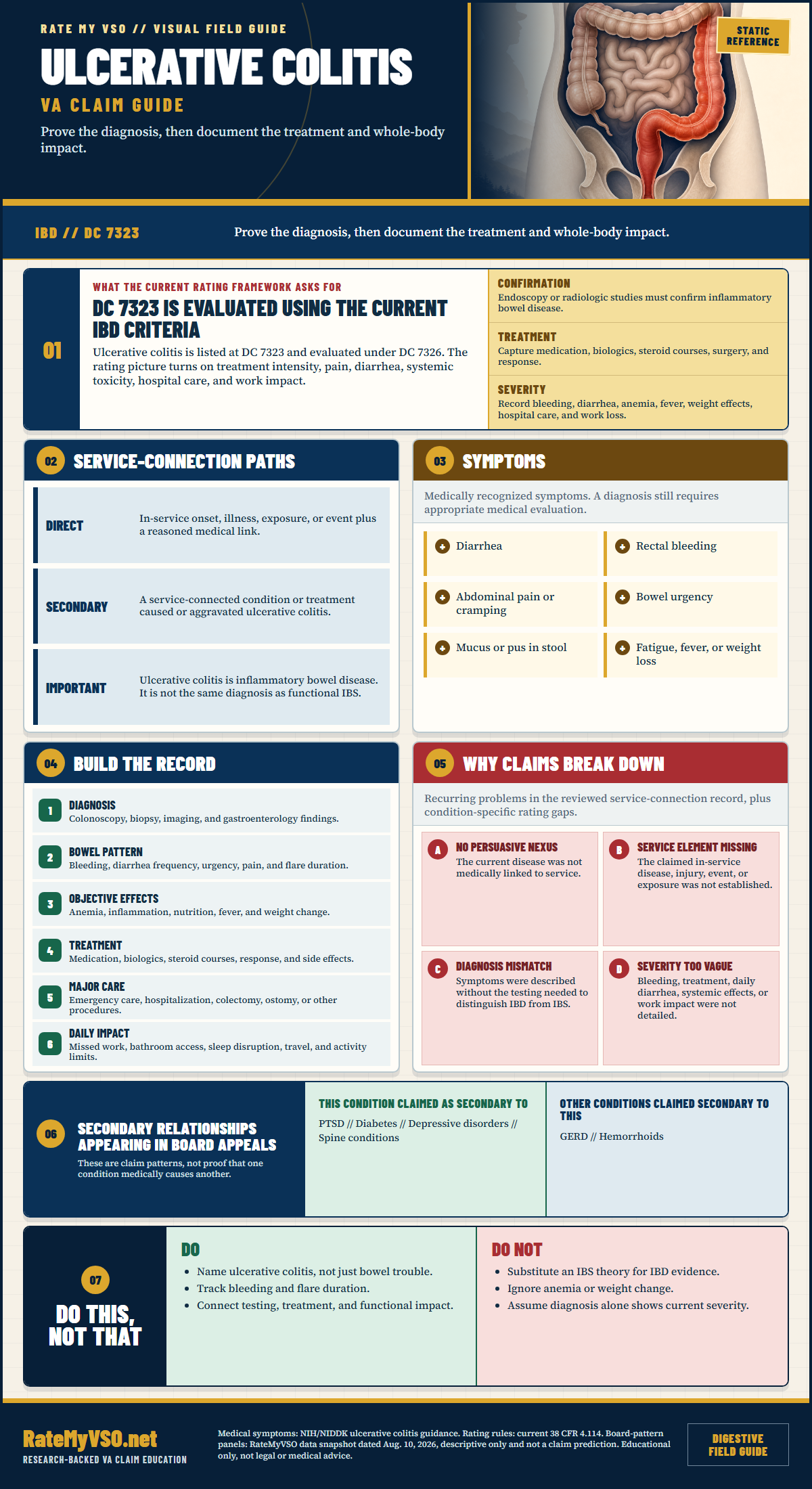 One-page guide: Ulcerative Colitis Claims in One Page
Ulcerative colitis guide covering DC 7323 and 7326, diagnosis confirmation, symptoms, treatment evidence, claim gaps, and secondary-appeal patterns. Opens the full-size chart, free to save or print.
One-page guide: Ulcerative Colitis Claims in One Page
Ulcerative colitis guide covering DC 7323 and 7326, diagnosis confirmation, symptoms, treatment evidence, claim gaps, and secondary-appeal patterns. Opens the full-size chart, free to save or print.
Start with the essentials
- 01Service Connection
The ways service connection can be established for this condition.
- 02Diagnosis and Evidence
Common symptoms and the evidence cited in published Board appeals.
- 03Your History
What you experienced, what others observed, and what treatment changed.
Understand the claim
Overview
Ulcerative colitis is rated under DC 7323 within 38 CFR § 4.114 (Schedule of Ratings, Digestive System). As of the May 19, 2024 digestive-system update, VA rates it on the same 10-to-100-percent inflammatory-bowel-disease ladder it uses for Crohn's disease (DC 7326). The level keys off symptom severity, the treatment that controls it, and signs of systemic toxicity such as fever, tachycardia, or anemia.
Types of Bowel Conditions: Ulcerative Colitis, Crohn's, and IBS
Ulcerative colitis is one of the two main inflammatory bowel diseases; Crohn's disease is the other. Unlike irritable bowel syndrome, which is functional and shows normal scopes, ulcerative colitis is structural: it produces continuous inflammation and ulceration of the colon and rectum that is confirmed on endoscopy and biopsy. Where Crohn's can strike any part of the GI tract and the full bowel wall, ulcerative colitis is limited to the colon and rectum and the inner lining. The diagnosis must be confirmed by endoscopy or radiologic study, and that is written into how the VA rates it.
Why the distinction matters for your claim: irritable bowel syndrome is treated by VA as a "functional gastrointestinal disorder" and, for veterans with qualifying Persian Gulf or PACT Act service, it can qualify as a presumptive chronic multi-symptom illness under 38 CFR § 3.317, meaning no separate medical nexus opinion is required, just the qualifying service and a current diagnosis. Ulcerative colitis, as a diagnosed structural autoimmune disease, does not ride that presumption. If your bowel condition is genuinely functional IBS rather than confirmed structural colitis, the presumptive route may be the easier path, see the IBS and IBD Claims Guide and the Gulf War Illness Claims Guide. If your diagnosis is confirmed ulcerative colitis, service connection runs through the direct, secondary, or toxic-exposure paths described below.
ICD-10 Diagnosis Codes
The ICD-10 diagnosis codes most commonly used for DC 7323, Colitis, ulcerative (the kind on your medical records, decision letter, or C&P exam report). VA rates the disability and its residuals, not the diagnosis itself, so coding can vary.
How Service Connection Works, At a High Level
Before getting into the specific pathways below, it helps to understand the three things every direct ulcerative colitis claim ultimately has to show under 38 CFR § 3.303. This is the same basic test that applies to any VA disability claim, just applied to this condition.
- A current diagnosis. A doctor confirming, by endoscopy and biopsy, that you actually have ulcerative colitis now or during the time your claim was open. A missing in-service event is the single biggest reason bowel-condition claims are denied; missing this specific diagnosis is a common but smaller share.
- An in-service event, or a service-connected condition behind it. Something documented during your service, such as an illness, exposure, or the onset of symptoms, or a disability VA has already service-connected that caused or aggravated the colitis.
- A medical nexus. A doctor's opinion connecting your ulcerative colitis to service, or to the service-connected condition, and explaining the reasoning, not just stating a conclusion.
Service Connection Pathways: Direct, Secondary, and Toxic Exposure
Ulcerative colitis is not on VA's presumptive list as a structural, diagnosed disease. Service connection must be established through one of the following pathways.
Direct Service Connection
A veteran demonstrates that ulcerative colitis began during or was caused by active military service. Even when the formal diagnosis comes after separation, records or a medical opinion showing the onset of symptoms during or soon after service can carry the claim. Supporting evidence includes the endoscopy and biopsy report, service treatment records documenting bowel complaints, and a medical nexus opinion linking the diagnosis to in-service events. See our Service Connection Guide.
Secondary to PTSD (DC 9411)
Stress and trauma affect the gut, and a well-supported secondary path ties ulcerative colitis to service-connected PTSD. The Board has granted service connection for ulcerative colitis as secondary to PTSD where a medical opinion stated it was at least as likely as not that the PTSD contributed to the digestive condition. As with any secondary claim, the opinion's value comes from its reasoning; an opinion that states a conclusion without explaining why the connection exists carries little weight. See the PTSD Claims Guide.
Secondary via Long-Term Medication
Long-term medication prescribed for a service-connected condition is another recognized secondary theory under 38 CFR § 3.310. If a medication taken for a different service-connected disability caused or aggravated your ulcerative colitis, a nexus opinion naming the specific medication and mechanism supports the claim. See the Secondary Service Connection Guide.
Toxic Exposure
Ulcerative colitis is not a presumptive toxic-exposure condition, but documented exposure can support a direct nexus. PFAS "forever chemicals" in firefighting foam (AFFF), contaminated water at Camp Lejeune, and other chemical exposures are raised as direct-nexus theories where research and the record connect the exposure to autoimmune or inflammatory disease. List the base assignments and exposure period, and have the medical opinion address the exposure. See PACT Act and Toxic Exposure (TERA) Appeals.
Service Connection by Aggravation
When a veteran had documented pre-service ulcerative colitis or bowel disease that was chronically worsened beyond its natural progression by military service, aggravation-based service connection under 38 CFR § 3.306 is available. A medical opinion addressing secondary or aggravation-based connection should speak to both the causation question and the aggravation question; an opinion that addresses only one is incomplete.
What VA Looks For: Tests, Records, and Diagnostic Codes
Whether you are filing directly, secondary to another condition, or on a toxic-exposure theory, the record VA actually reviews centers on a small set of documents and data points.
- The endoscopy and biopsy report: the diagnostic document confirming continuous inflammation and ulceration of the colon and rectum. Confirmation by endoscopy or radiologic study is written into the rating criteria.
- Treatment records that name the medication: whether you are on a biologic or immunosuppressant on an outpatient basis is built into the 60 percent rating level, so the file needs to say so by name, not just describe symptoms.
- A symptom diary: a record of daily diarrhea and rectal-bleeding episode counts. The rating ladder turns on these frequencies (three or fewer, four to five, or six or more per day), so a count is more useful than a general description of "frequent flares."
- Hospitalization records and bloodwork: hospitalization at least once a year feeds the 100 percent level; bloodwork documenting anemia and any weight loss supports the systemic-toxicity signs at the higher levels.
- The diagnostic codes involved: DC 7323 for the ulcerative colitis itself, plus whatever code applies to the condition you're connecting it to or that it caused, for example DC 9411 (PTSD), DC 9434 (depression), DC 7206 (GERD), or DC 7319 (IBS, if that turns out to be the correct diagnosis instead).
- The actual form the examiner fills out: the intestinal-conditions Disability Benefits Questionnaire (DBQ), discussed in more detail later in this guide.
Symptoms and rating
How the VA Rates Ulcerative Colitis, DC 7323
Under the 2024 schedule, ulcerative colitis is rated on the inflammatory-bowel-disease ladder. The level keys off severity, the treatment that controls it, and signs of systemic toxicity (fever, tachycardia, or anemia). Whether you are on a biologic or immunosuppressant is built into the ladder.
The 2024 Change, and the Increase Opportunity
The May 19, 2024 digestive-system amendment rewrote DC 7323 around treatment and toxicity, the same ladder it gave the new Crohn's code (DC 7326). The old criteria described colitis as moderate, moderately severe, severe, or pronounced; the new ones turn on diarrhea frequency, the medications controlling it, and systemic signs.
Evidence and Board research
Evidence Cited in Published Ulcerative colitis and Crohn’s (IBD) Decisions
We analyzed 4,703 published Board decisions involving ulcerative colitis and crohn’s (ibd) for condition-specific evidence, counting only case-specific mentions (boilerplate recitations excluded). "Favorable" is the share of decisions citing that evidence where every issue was granted or the outcome was mixed; the baseline across all these decisions is 41.1%, combining every diagnostic code below. Evidence appearing in a decision does not mean it decided the case. Descriptive of the published record, not a prediction.
Bar length shows decisions citing the evidence.
By diagnostic code
These codes are grouped together above. They do not perform the same, so find your own code here rather than reading the combined figure. A code retired in the schedule rewrites appears without a link, because its decisions were judged under criteria that no longer apply.
Bar length shows published decisions reviewed.
Detected by phrase-reading the decision text with condition-specific vocabularies. Source: Board of Veterans' Appeals decisions, RateMyVSO analysis.
Board Grants, Dissected
The decisions below all involve claims for irritable bowel syndrome (IBS), a functional digestive condition that VA often evaluates using some of the same rules that apply to other bowel conditions, including presumptive rules for Southwest Asia service. None of the cases reviewed for this page granted service connection specifically for ulcerative colitis. Board decisions are not binding precedent, and each case is decided on its own record, so these examples show patterns, not guarantees.
Persian Gulf presumptive service connection for IBS Citation A26028223 (March 27, 2026), evidence submission docket
The record: The veteran served in the Southwest Asia theater during the Persian Gulf War. A January 2022 VA examiner diagnosed IBS but said it was less likely than not related to service because there was no in-service evaluation or diagnosis for it. A July 2022 private examination documented ongoing bowel disturbance and abdominal distress.
Why it won: The Board found the VA examiner's opinion inadequate because it relied only on the absence of in-service treatment records, citing Dalton v. Nicholson. The Board noted that functional gastrointestinal disorders, including IBS, are qualifying chronic disabilities under 38 C.F.R. § 3.317, and found the veteran qualified as a Persian Gulf veteran with a current diagnosis manifested to a compensable degree. Service connection was granted on a presumptive basis.
GERD, IBS, and fibromyalgia granted together on benefit of the doubt Citation A26028208 (March 27, 2026), hearing docket
The record: The veteran had later rating decisions granting these same conditions in 2023 and 2024 based on newer diagnoses. He testified at two Board hearings that his GERD, IBS, and fibromyalgia symptoms had been present for years, and a 2020 Walter Reed evaluation documented an "unknown" gastrointestinal disorder and recommended a rheumatology referral.
Why it won: The Board found that the same symptoms described in 2020 and at the hearings were the basis for the later 2023 and 2024 diagnoses. Affording the veteran the benefit of the doubt on the current-diagnosis question, and given his conceded Southwest Asia service, the Board granted IBS and fibromyalgia on a presumptive basis and GERD on a direct basis due to continuity of symptoms.
IBS granted after Board found an examiner's diagnosis change unpersuasive Citation A26027746 (March 26, 2026), hearing docket
The record: A January 2020 VA examiner found no current diagnosis of IBS, instead diagnosing ulcerative colitis. However, a June 2018 VA treatment record showed a colonoscopy had ruled out ulcerative colitis and confirmed IBS instead. The January 2020 examiner did not address this earlier finding or perform a new colonoscopy.
Why it won: The Board found the evidence at least in equipoise on whether the veteran had IBS, given the unaddressed 2018 colonoscopy finding. Resolving reasonable doubt in the veteran's favor, and given his conceded Southwest Asia service, the Board granted service connection for IBS on a presumptive basis under 38 C.F.R. § 3.317.
IBS with chronic diarrhea granted with private opinion, testimony, and buddy statements Citation A26027202 (March 25, 2026), hearing docket
The record: A January 2020 VA examiner diagnosed chronic diarrhea and opined it was at least as likely as not related to service, citing in-service documentation and continuous treatment. The veteran's treating physician separately opined by letter that his "Irritable Bowel Syndrome with diarrhea" had been a persistent issue since around 2007. Two fellow servicemembers submitted lay statements describing his "stomach" and "gut problems" beginning during Desert Storm service.
Why it won: The Board found the VA opinion, the private opinion, the veteran's own credible testimony, and the buddy statements all consistent with a grant. It found the evidence at least in approximate balance and granted service connection for IBS, including chronic diarrhea, on both direct and presumptive grounds.
IBS granted as secondary to service-connected PTSD despite five negative VA opinions Citation A26026589 (March 24, 2026), direct review docket
The record: Five separate VA medical opinions (July 2023, December 2023, May 2024, November 2024, February 2025) found insufficient medical literature to link PTSD to IBS or GERD. The veteran submitted competing opinions from a psychiatric pharmacist, a certified family nurse practitioner, and a physician assistant, each citing medical literature connecting stress, PTSD, and gastrointestinal symptoms.
Why it won: The Board weighed the positive and negative opinions and found the evidence in approximate balance on whether IBS was caused by the veteran's service-connected PTSD. It resolved reasonable doubt in the veteran's favor and granted service connection for IBS (and GERD) as secondary to PTSD.
Why These Claims Get Denied
Beyond the general "no diagnosis" and "no nexus" reasons covered above, a few specific denial patterns show up often enough to call out on their own.
- Symptoms without a confirmed diagnosis. Abdominal pain, diarrhea, or constipation by themselves are not enough. Where the examiner finds the symptoms do not add up to any diagnosable intestinal disability, the claim is denied for lack of a current disability.
- A letter that just repeats the veteran's own story. A report from a provider outside the relevant specialty (for example, a chiropractor) that recites the veteran's statements and declares the condition service connected is given little or no weight, because it carries no rationale and, for a gut condition, is outside that provider's area of expertise.
- Assuming a diagnosis alone proves the connection. Having ulcerative colitis now does not by itself connect it to service. On the direct path you still need an in-service event and a reasoned nexus; claims fail where service records show no related event and any in-service note had resolved.
- Treating the Gulf War/IBS presumption as if it covers confirmed colitis. Some denials happen because a veteran leans on the 38 CFR § 3.317 functional-illness presumption for a diagnosis that is genuinely structural ulcerative colitis, not functional IBS, so the presumption does not apply.
- Assuming any base assignment equals a toxic-exposure presumption. Serving at a listed location is not the same as qualifying for a presumption; a veteran who served at a site like Camp Lejeune outside the specific covered exposure window does not get the presumptive benefit, and the theory has to stand on its own direct-nexus evidence instead.
- A missed one-year Board appeal deadline. The deadline to file a Board appeal (VA Form 10182) is one year from the decision notice. Late appeals are treated as untimely and dismissed absent good cause.
Pitfalls and Common Mistakes
These are procedural and documentation gaps, distinct from the clinical denial patterns above.
- Records that don't name the treatment. The 60 percent level requires being on a biologic or immunosuppressant. A file that documents symptoms but not the medication leaves the rater without the fact that sets that level.
- No episode count. The ladder turns on three-or-fewer, four-to-five, or six-or-more daily episodes of diarrhea or rectal bleeding. "Frequent flares" without a count leaves the percentage unsupported.
- An old rating left untouched. A pre-2024 rating is not updated automatically; reaching the new 60 or 100 percent level generally requires filing for an increase.
- Skipping the secondary and toxic-exposure paths. If a direct in-service onset is hard to show, the PTSD-secondary path and documented PFAS or Camp Lejeune exposure are the routes the Board has recognized.
- A VA exam that leans only on missing records. An opinion that relies only on a gap in the paperwork and ignores your reported symptoms is inadequate; the Board has sent such claims back for a new exam. If an examiner discounts your history without explaining why, say so in your response or appeal.
- Not filing an intent to file. Filing an intent to file first, and then continuously pursuing the claim, can push your effective date back to the earliest filing date; skipping this step can cost you months or years of back pay.
Do's and Don'ts
A condensed version of everything above, in the order it actually matters when you sit down to build your file.
- Get a confirmed diagnosis, endoscopy and biopsy, into the record before you file.
- Make sure your treatment records name the specific medication (biologic or immunosuppressant), not just your symptoms.
- Track how often you have bowel pain, diarrhea, and rectal bleeding to support the rating level you're seeking.
- Get a nexus opinion that explains its reasoning and cites your specific medical history, not a bare conclusion.
- Add buddy statements and your own statement describing bowel symptoms during and since service.
- If you have Southwest Asia or PACT Act service and your diagnosis is genuinely IBS rather than confirmed colitis, raise the 38 CFR § 3.317 presumptive theory explicitly and in writing.
- Confirm your base assignment falls inside the specific qualifying window before relying on a toxic-exposure presumption.
- File an intent to file early to protect your effective date.
- File any Board appeal (VA Form 10182) within one year of the decision.
- If a VA exam ignored your lay statements or leaned only on a gap in the records, say so directly in your response or appeal.
- Don't assume a diagnosis alone wins the claim, you still need the in-service event and the nexus.
- Don't rely on a letter from a provider outside the relevant specialty that just repeats your own account.
- Don't assume the Gulf War/IBS presumption applies to a confirmed structural ulcerative colitis diagnosis.
- Don't assume serving at Camp Lejeune or any listed base automatically qualifies for a toxic-exposure presumption.
- Don't leave an old pre-2024 rating unexamined if your treatment or symptoms have changed.
- Don't let your account of when symptoms began shift between statements and exams.
- Don't miss your one-year Board appeal deadline.
Evidence for an Ulcerative Colitis Claim
We analyzed the Board's published DC 7323 decisions: a private nexus opinion in the file goes with a different grant rate than a VA exam alone, shown below.
- A confirmed diagnosis: the endoscopy and biopsy report. Confirmation by endoscopy or radiologic study is part of the rating criteria, and a missing confirmed diagnosis is a common (though not the single largest) reason these claims are denied , a missing in-service event is.
- Treatment records that name the medication. Whether you are on a biologic or immunosuppressant is built into the 60 percent level.
- A symptom diary recording daily diarrhea and rectal-bleeding episodes, which separate the rating levels.
- Hospitalization records, which feed the 100 percent level, plus bloodwork documenting anemia and any documented weight loss.
- The intestinal-conditions DBQ, which captures episode frequency, toxicity signs, and treatment type. See the DBQ Guide.
- A nexus letter for service connection (using "at least as likely as not"), explaining its reasoning rather than stating a bare conclusion. See Nexus Letters.
- Buddy or lay statements on symptom continuity, from you and from people who served alongside you or knew you well, describing bowel symptoms during and since service. See Buddy & Lay Statements.
Secondary relationships
Secondary Conditions
Ulcerative colitis can cause complications throughout the body. These are frequently rated as their own service-connected conditions once the colitis is service-connected, each with its own diagnosis and nexus.
- Arthritis. Inflammatory joint disease, including peripheral arthritis and ankylosing spondylitis, in the lower back, hips, and knees.
- Osteoporosis or low bone density. Common in IBD from chronic inflammation, poor absorption, and long-term steroid use; shown on a DEXA scan.
- Skin disorders. Erythema nodosum (painful red nodules), ulcerating skin lesions, and psoriasis flares.
- Anemia. Iron-deficiency anemia from bleeding during flares, a frequent and fatigue-worsening complication.
- Mental health conditions. Depression, anxiety, and PTSD are recognized as valid secondary claims for veterans living with IBD; rated under 38 CFR 4.130.
- Colorectal cancer. Long-term colon inflammation raises colorectal cancer risk well above the general population.
- Liver disease. Primary sclerosing cholangitis (PSC) is a serious liver disease associated with IBD.
The bars below show the same relationships in the Board's published DC 7323 decisions, both directions. They describe what the Board's record shows across many veterans, not a prediction about any one claim.
Conditions that can cause ulcerative colitis (colitis as the secondary)
Claims where ulcerative colitis was argued as secondary to an already service-connected condition, the "ways to connect via another condition" list:
Conditions ulcerative colitis can cause (colitis as the primary)
Conditions veterans have claimed as caused or aggravated by a service-connected ulcerative colitis, once the colitis itself is already service-connected:
See the secondary conditions overview and the secondary map on the DC 7323 page.
Prepare and take the next step
Prepare: your own working pages
Optional. These are your own notes, in your own words. They are not a VA form, they are not sent to the VA, and nothing here is a medical finding or a prediction about your claim.
Three reminders while you prepare
- Build a symptom and treatment timeline
Record when symptoms began, how they changed, the diagnosis, treatment, and periods of improvement or recurrence. Go to this part
- Describe frequency and functional effects
Note episodes, pain, bowel or digestive changes, nutrition or weight effects, and what the condition interrupts in ordinary life. Go to this part
- Keep the diagnosis, connection, and rating evidence separate
Use tests and clinician findings for the diagnosis, your history for daily effects, and the guide for the legal pathway. Do not choose your own rating. Go to this part
Sign in or create an account to save your answers and come back to them later. You can fill these in and print them without an account.
Digestive symptom and episode log
Diagnosis, testing, and treatment
Service-connection and examination questions
Records and unanswered questions
Decision-letter reading sheet
Quick Checklist Before You File
Bring these together before you submit anything.
- A current, documented diagnosis of ulcerative colitis from a qualified provider, endoscopy and biopsy confirmed.
- Treatment records that name the specific medication (biologic or immunosuppressant) if you're on one.
- A nexus opinion that explains its reasoning and is tied to service, to a specific service-connected condition, or to a documented toxic exposure.
- If you have Southwest Asia or PACT Act service and your diagnosis is genuinely IBS, the 38 CFR § 3.317 presumptive theory raised in writing.
- Your symptom diary tracking daily diarrhea and rectal-bleeding episodes.
- Buddy statements and your own personal statement describing symptoms and their onset, consistent with everything else in your file.
- An intent to file submitted early to protect your effective date.
- If you were denied before: new and relevant evidence for a Supplemental Claim, not just a repeat of what was already considered.
For the mechanics of actually submitting the claim, see the Standard Claim Guide and the Fully Developed Claim Guide (filing with all your evidence up front can speed up the decision).
The Claims Process, Step by Step
Once you file, your claim moves through a series of hand-offs. Understanding who does what helps you know who to contact, and what to expect, at each stage.
- You file the claim. Directly with VA, through VA.gov, or with the help of an accredited representative.
- VA acknowledges the claim and assigns it for development. A Veteran Service Representative (VSR) is assigned to gather your service treatment records, VA and private medical records, and any other evidence needed.
- The VSR orders a Compensation & Pension (C&P) exam if one is needed. Not every claim requires one, but most ulcerative colitis claims do, especially secondary and toxic-exposure claims where a nexus opinion is required.
- The C&P exam is conducted. By a VA clinician or a contracted examiner, who completes an intestinal-conditions Disability Benefits Questionnaire (DBQ) documenting the diagnosis, severity, and, where relevant, a nexus opinion.
- The file goes to a Rating Veteran Service Representative (RVSR), the "rater." The rater reviews the complete file, including the exam results, and decides whether service connection is warranted and at what percentage.
- A senior reviewer may review the decision before it's finalized, depending on the complexity of the claim.
- VA issues the decision letter. This states whether the claim is granted or denied, the rating percentage if granted, and the reasons behind the decision.
- If you disagree, you choose an appeal lane. Higher-Level Review, Supplemental Claim, or a Board appeal, covered later in this guide.
Who's who: VSO vs. VSR vs. Rater vs. C&P Examiner
Your VSO
An accredited representative from a veterans service organization, or an accredited attorney or claims agent. Not a VA employee. Helps you prepare, gather evidence, and file, and can represent you through an appeal. Has no authority to decide your claim.
VSR (Veteran Service Representative)
VA staff who "develops" your claim: requests records, schedules the C&P exam, and assembles the file. Does not decide the rating.
Rater (RVSR)
VA staff who reviews the completed file and makes the actual decision, service connection or denial, and the percentage. This is the person whose judgment the decision letter reflects.
C&P Examiner
A VA clinician or a contracted medical examiner who conducts the exam and completes the DBQ. Documents findings and, where asked, a nexus opinion. Does not decide the claim.
For the full walkthrough of every stage with more detail, see Inside Your Claim and Claim Stages.
DBQs and Your C&P Exam
A Disability Benefits Questionnaire (DBQ) is the standardized form an examiner completes for your condition; it structures the exam findings into the specific data points VA's rating schedule requires. For ulcerative colitis, the intestinal-conditions DBQ captures episode frequency, systemic toxicity signs, and the specific treatment or medication you're on. See the DBQ Guide for how these forms work, including whether a private DBQ completed by your own doctor can be submitted instead of relying solely on a VA exam.
Before your C&P exam, bring a clear, specific account of your symptoms: your worst days, how often you have diarrhea or rectal bleeding, and how the condition affects daily function, not just how you feel on an average day. Be consistent with what's already in your medical records and prior statements. For a full walkthrough of what to expect and how to prepare, see the C&P Exam Prep Guide.
Reading Your Decision Letter, and What to Do If Denied
Your decision letter has two parts: a narrative section explaining the reasoning (often called "reasons and bases"), and a codesheet showing the actual rating percentage, the effective date, and the diagnostic code used. See the Reading Your Decision Letter Guide for how to find and interpret each part, or use the Letter Interpreter tool to upload your own letter and get a plain-English breakdown.
If your claim is denied, or the rating is lower than you expected, you have three main lanes:
- Supplemental Claim: refile with new and relevant evidence, such as a new nexus opinion, updated endoscopy report, or symptom diary. See Supplemental Claim Guide.
- Higher-Level Review (HLR): a senior reviewer looks at the same evidence again for a difference of opinion, no new evidence is added. See HLR Guide.
- Board Appeal: your case goes to a Veterans Law Judge at the Board of Veterans' Appeals, with options for a direct review, an evidence docket, or a hearing. See Board Appeal Guide.
Not sure which lane fits your situation? See the Appeals decision guide for a side-by-side comparison of all three.
After You Win: Maintaining Your Rating
A grant is not always the end of the story. Keep your treatment consistent, continued follow-up with a gastroenterologist, ongoing symptom tracking, and records of any medication changes, protects you if VA schedules a future reexamination. Not every rating gets reexamined; understand when a rating becomes protected from future review (including Permanent and Total status) and what to do if VA proposes to reduce it. See Protect Your Rating and Future Reexaminations for the specifics.
If your ulcerative colitis worsens after the initial grant, for example progressing to daily episode counts or systemic toxicity signs at a higher level on the ladder, or you move onto a biologic or immunosuppressant, you can file for an increased rating. See the Rating Increase Guide.
References and related resources
Quick Reference Tables
Service Connection Pathways
| Path | Mechanism | Evidence Needed |
|---|---|---|
| Direct | Onset or diagnosis during or soon after service | Endoscopy/biopsy + service records + nexus opinion |
| Secondary to PTSD (DC 9411) | Stress and trauma affecting gut function | Nexus opinion stating "at least as likely as not" |
| Secondary via medication | A drug prescribed for another service-connected condition causes or worsens colitis | Nexus naming the specific medication and mechanism |
| Toxic exposure (PFAS, Camp Lejeune) | Chemical exposure linked to autoimmune/inflammatory disease | Confirmed exposure window + nexus addressing the exposure |
| Aggravation | Pre-existing colitis worsened beyond natural progression by service | Baseline severity + evidence of the in-service worsening |
Diagnostic Codes Referenced in This Guide
| Code | Condition |
|---|---|
| DC 7323 | Ulcerative colitis |
| DC 7326 | Crohn's disease (shares the IBD rating ladder with 7323) |
| DC 7319 | Irritable bowel syndrome (the functional diagnosis often confused with colitis) |
| DC 9411 | PTSD (a common secondary pathway into colitis) |
| DC 9434 | Major depressive disorder (mental health as a secondary of colitis, or vice versa) |
| DC 7206 | GERD (a condition ulcerative colitis has been linked to secondarily) |
From Filing to Decision: Who Does What
| Role | Does | Decides your rating? |
|---|---|---|
| VSO / accredited representative | Helps prepare, gather evidence, and file; represents you on appeal | No |
| VSR | Develops the claim: orders records and the C&P exam | No |
| C&P Examiner | Conducts the exam, completes the DBQ, may give a nexus opinion | No / but has a strong impact |
| Rater (RVSR) | Reviews the full file and decides service connection and percentage | Yes |
Frequently Asked Questions
Is ulcerative colitis rated under the same code as Crohn's?
What is the highest VA rating for ulcerative colitis?
Can ulcerative colitis be service-connected as secondary to PTSD?
I was rated for colitis before 2024. Should I do anything?
Is ulcerative colitis a Gulf War presumptive?
My claim was filed as ulcerative colitis, but it might really be IBS. Does that matter?
Can VA take away my colitis rating just by recharacterizing the diagnosis?
Related Tools and Guides
Sources
- 38 CFR § 4.114, DC 7323, Schedule of Ratings, Digestive System (Ulcerative Colitis)
- Federal Register, Schedule for Rating Disabilities: The Digestive System (effective May 19, 2024)
- VA News, VA updates the digestive-system rating schedule
- 38 CFR § 3.303, basic rules for service connection, including 3.303(b) and 3.303(d) on chronic-disease continuity and disease diagnosed after service
- 38 CFR § 3.304, direct service connection principles
- 38 CFR § 3.310, Secondary Service Connection, including aggravation
- 38 CFR § 3.306, Aggravation of Pre-Service Disability
- 38 CFR § 3.317, Persian Gulf War presumptive service connection; IBS as a functional gastrointestinal disorder
- 38 CFR §§ 3.307 and 3.309, chronic-disease presumptions within one year
- 38 CFR § 3.102 and 38 USC § 5107(b), benefit of the doubt
- 38 CFR § 3.400 and 38 USC § 5110, effective dates
- 38 CFR § 3.155, intent to file and complete claim
- 38 CFR §§ 3.2500 and 3.2501, continuous pursuit; new and relevant evidence
- 38 CFR § 3.156(c), earlier effective date from later-discovered service records
- 38 CFR § 3.105, severance of service connection; clear and unmistakable error
- 38 USC §§ 1110 and 1131, basic service connection
- 38 USC § 1117, Persian Gulf qualifying chronic disability
- 38 USC § 1168, toxic-exposure risk-activity examinations (PACT Act)
- 38 CFR § 3.951(b), Protection of Ratings