Carpal Tunnel Syndrome Claims Guide
Carpal tunnel syndrome is the median nerve being squeezed at the wrist, causing numbness, tingling, and weakness in the thumb and first three fingers. The VA rates it as median nerve impairment under diagnostic code 8515, and two things drive the rating that surprise most veterans: whether it is your dominant or non-dominant hand, and whether the nerve loss is more than just sensory. This guide covers how service connection works, why carpal tunnel is so often connected as secondary to diabetes, how DC 8515 is scored, the nerve-study evidence that wins, why claims get denied, a filing checklist, the claims process step by step, and what to do whether you're denied or you win.
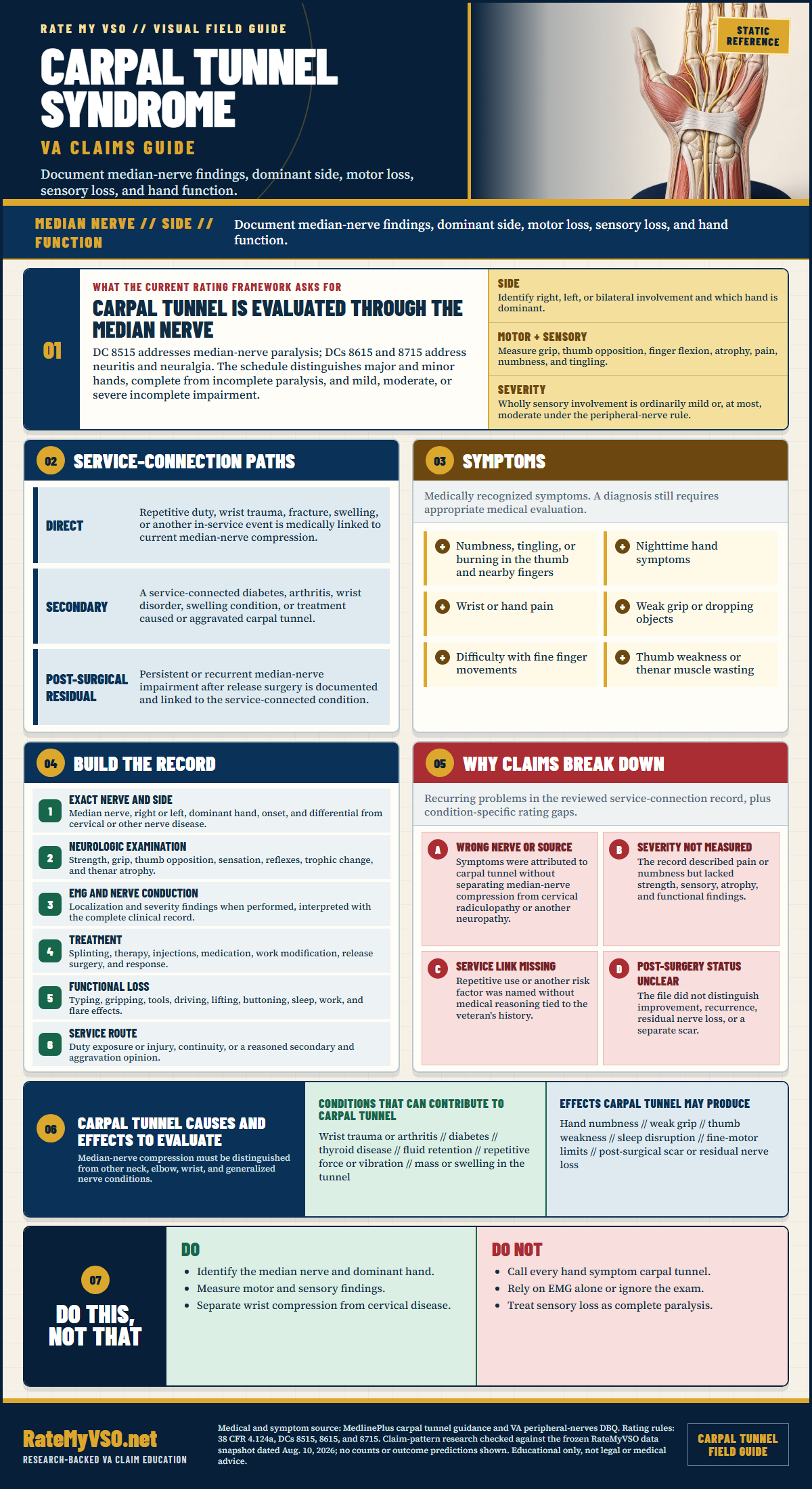 One-page guide: Carpal Tunnel Syndrome Claims in One Page
Carpal tunnel guide covering the median nerve, dominant-hand and severity rules, service paths, symptoms, EMG and examination evidence, treatment, function, and common claim gaps. Opens the full-size chart, free to save or print.
One-page guide: Carpal Tunnel Syndrome Claims in One Page
Carpal tunnel guide covering the median nerve, dominant-hand and severity rules, service paths, symptoms, EMG and examination evidence, treatment, function, and common claim gaps. Opens the full-size chart, free to save or print.
Start with the essentials
- 01Service Connection
The ways service connection can be established for this condition.
- 02Diagnosis and Evidence
Common symptoms and the evidence cited in published Board appeals.
- 03Your History
What you experienced, what others observed, and what treatment changed.
Understand the claim
ICD-10 Diagnosis Codes
The ICD-10 diagnosis codes most commonly used for DC 8515, Paralysis of median nerve (the kind on your medical records, decision letter, or C&P exam report). VA rates the disability and its residuals, not the diagnosis itself, so coding can vary.
How Service Connection Works, At a High Level
Before getting into the specific pathways below, it helps to understand the three things every direct carpal tunnel claim ultimately has to show (38 CFR § 3.303; Shedden v. Principi, 381 F.3d 1163 (Fed. Cir. 2004)). This is the same basic test that applies to any VA disability claim, just applied to this condition.
- A current diagnosis. A present diagnosis of carpal tunnel syndrome, usually confirmed by a nerve conduction study (NCS) or EMG. Without a current disability there is no valid claim (Brammer v. Derwinski, 3 Vet. App. 223 (1992)).
- An in-service event, or a service-connected condition behind it. An injury, disease, or repetitive-motion activity documented in service, or a disability VA has already service-connected (most often diabetes) that caused or worsened the nerve damage.
- A medical nexus. A doctor's opinion connecting your carpal tunnel to service, or to the service-connected condition, and explaining the reasoning, not just stating a conclusion. This is the element that most often decides the case, and a veteran's own belief about the cause is not enough on its own (Jandreau v. Nicholson, 492 F.3d 1372 (Fed. Cir. 2007)).
Service Connection Pathways: Direct and Secondary
- Secondary to diabetes (the common path). Diabetic nerve damage is a leading cause of carpal tunnel, so if diabetes is already service-connected, carpal tunnel is often claimed as secondary with a medical link to the diabetes. Hypothyroidism and rheumatoid arthritis can do the same. See the diabetes guide and secondary conditions.
- Direct. Repetitive-use work in service (typing, tools, mechanics, weapons handling) or a wrist injury, with a current diagnosis and a nexus back to service.
- Aggravation during service. Carpal tunnel existed before service and increased in severity during service. The VA must determine whether the increase was caused by service or was simply the condition's natural progression.
- Secondary aggravation. A service-connected disability, such as diabetes, worsened carpal tunnel. The worsening does not have to be permanent, but the medical evidence must establish the carpal tunnel's baseline severity so the VA can measure the additional disability caused by the service-connected condition. See aggravation.
Established pathways to service connection include:
Direct Service Connection
A veteran demonstrates that carpal tunnel began during or was caused by active military service, most often from repetitive hand and wrist tasks. Point to the exact duties your military job required, a concrete description of repetitive motion (for example, years of repetitive typing and desk work in a technical role) is stronger than a vague statement. Supporting evidence includes a nerve conduction study, service records documenting hand or wrist complaints, and a medical nexus opinion linking the diagnosis to those in-service duties or events.
Secondary to Diabetes, Hypothyroidism, or Rheumatoid Arthritis
A veteran demonstrates that carpal tunnel was caused or aggravated by an already service-connected metabolic or autoimmune condition. Diabetic peripheral nerve damage is a medically recognized and frequently claimed cause of carpal tunnel, and this is often the easier of the two main routes: many veterans win not by proving the nerve damage started in service, but by showing a condition VA has already service-connected caused or worsened it. See our Secondary Service Connection Guide.
Secondary to a Cervical Spine Condition
Nerve symptoms in the hand and wrist can also be connected as secondary to a service-connected neck (cervical spine) disability, where compression or radiculopathy higher up the nerve pathway contributes to the wrist-level nerve damage. As with any secondary theory, this needs a medical opinion tying the two conditions together rather than a diagnosis alone.
Continuity of Symptoms (Chronic Disease Path)
Because carpal tunnel is classified as an organic disease of the nervous system, and VA lists organic nervous-system diseases as chronic under 38 CFR § 3.309(a), a veteran who shows symptoms starting in service and continuing without a real gap afterward can establish service connection through that continuity alone, even where the nexus opinion is not airtight. A documented in-service note of numbness or tingling, paired with consistent post-service reporting, has carried claims on this theory.
Across published DC 8515 decisions, here is how often the Board granted by the legal theory the claim was argued on:
What VA Looks For: Tests, Records, and Diagnostic Codes
Records to gather for a direct or secondary claim:
- The nerve study itself: a nerve conduction study (NCS) or EMG grading how badly the median nerve is slowed or damaged, and whether the involvement is sensory-only or includes motor loss.
- Treatment and service records: any documented in-service hand or wrist complaints, a separation Report of Medical History noting numbness or tingling, and ongoing post-service treatment records showing continuity.
- The diagnostic codes involved: DC 8515 for the median nerve, which is how carpal tunnel itself is rated. DC 8516 covers ulnar-nerve impairment, and DC 8513 covers all radicular groups; those apply only when the testing shows that broader involvement, and separate ratings require distinct, non-overlapping symptoms. Add whatever code applies to the condition you're connecting it to, most often diabetes.
- The actual form the examiner fills out: the Peripheral Nerve Conditions Disability Benefits Questionnaire (DBQ), discussed in more detail later in this guide.
What Carpal Tunnel Syndrome Is
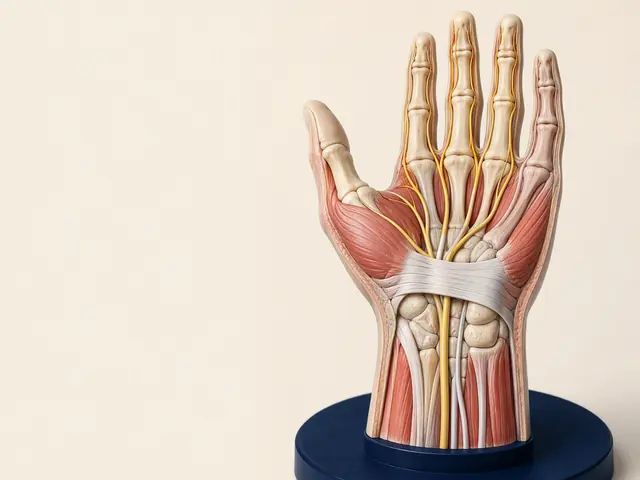
The median nerve runs through a narrow passage in the wrist called the carpal tunnel. When that passage swells or narrows, the nerve is compressed, and you feel numbness, tingling, burning, or weakness in the thumb, index, middle, and half of the ring finger. Left alone it can progress to a weak grip and wasting of the muscle at the base of the thumb. The VA rates carpal tunnel as impairment of the median nerve, diagnostic code 8515, under 38 CFR § 4.124a. Carpal tunnel is also legally classified as an "organic disease of the nervous system," which VA treats as a chronic disease under 38 CFR § 3.309(a), a classification that opens an extra path to service connection covered below.
Symptoms and rating
Symptoms Recorded in Granted Carpal tunnel and upper-extremity nerve Decisions
We analyzed 1,773 granted Board decisions involving carpal tunnel and upper-extremity nerve for symptoms named in sentences about the condition (rating-criteria recitations excluded). Descriptive of the published record, what the Board wrote down, not a checklist of what to report.
Bar length shows decisions. Percentages remain context.
Detected by phrase-reading the decision text with condition-specific vocabularies. Source: Board of Veterans' Appeals decisions, RateMyVSO analysis.
How the VA Rates the Median Nerve (DC 8515)
The rating is set by how badly the nerve works, from mild incomplete paralysis (impaired but not lost) up to complete paralysis, and it is higher for your dominant (major) hand than your non-dominant (minor) hand.
| Severity of median nerve involvement | Dominant (major) hand | Non-dominant (minor) hand |
|---|---|---|
| Mild incomplete paralysis | 10% | 10% |
| Moderate incomplete paralysis | 30% | 20% |
| Severe incomplete paralysis | 50% | 40% |
| Complete paralysis | 70% | 60% |
Complete paralysis is the extreme case, the hand pulled toward the little-finger side, the first two fingers unable to bend, the thumb unable to oppose, and the muscle at the base of the thumb wasted away. Most carpal tunnel claims fall in the mild-to-moderate range.
If other nerves are also affected: Carpal tunnel itself is rated as median-nerve impairment under DC 8515. If testing also identifies ulnar-nerve impairment or broader radicular-group involvement, the VA must determine which rating approach best reflects the disability. Separate ratings require distinct, non-overlapping symptoms. Otherwise, combined nerve injuries are rated under the code for the major nerve involved or, when sufficiently extensive, an appropriate radicular-group code such as DC 8513. (Ulnar-nerve impairment has its own code, DC 8516.)
If you're already service-connected and are pursuing a higher rating or an earlier effective date, the evidence changes focus: what matters is documenting how severe the nerve impairment has become (sensory-only versus motor loss) and the earliest date it is factually clear the condition worsened, under 38 CFR § 3.400. A lay statement, including from a spouse, describing when the worsening was first noticed can support that date. Generally you need to have kept the claim alive through continuous appeals, or show a factually clear worsening date; missing a filing deadline, even because a representative did not act in time, does not by itself earn an earlier effective date, so keep track of your own deadlines.
The Wholly-Sensory Cap
This is why two veterans with "the same" carpal tunnel can land far apart. If you have real weakness or muscle wasting, make sure the exam and the nerve study capture it, because that is what moves the rating past the sensory ceiling.
Evidence and Board research
Evidence That Wins
We analyzed the Board's published DC 8515 decisions: a private nexus opinion in the file goes with a higher grant rate, shown below.
- A nerve conduction study (NCS) or EMG. This is the objective test that confirms carpal tunnel and grades how badly the median nerve is slowed or damaged. It is the single most useful piece of evidence for DC 8515.
- A neurological exam documenting which hand, sensation, grip strength, and any thumb-muscle atrophy, so the rater can separate sensory-only from motor loss.
- A nexus opinion from a specialist who explains the reasoning. The strongest grants tend to come from a treating specialist, for example a hand or microsurgery provider, who explains with a clear rationale how a veteran's specific repetitive-motion duties or a service-connected metabolic condition caused the nerve damage. An opinion that connects the medical evidence to a reasoned conclusion carries far more weight than a bare statement of agreement (Nieves-Rodriguez v. Peake, 22 Vet. App. 295 (2008)). For a secondary claim, the opinion should connect the median nerve damage to the service-connected condition, not just restate the diagnosis. See nexus letters.
- The Peripheral Nerve Conditions DBQ, which records the nerve, side, and severity the rating turns on. See the DBQ guide.
- A separation Report of Medical History or in-service treatment note mentioning hand numbness or tingling, paired with consistent post-service reporting, to support a continuity-of-symptoms theory.
- Your own account of dropping things, waking with numb hands, and losing grip, which supports the motor-loss finding, plus buddy statements from people who observed your symptoms.
Evidence Cited in Published Carpal tunnel and upper-extremity nerve Decisions
We analyzed 25,517 published Board decisions involving carpal tunnel and upper-extremity nerve for condition-specific evidence, counting only case-specific mentions (boilerplate recitations excluded). "Favorable" is the share of decisions citing that evidence where every issue was granted or the outcome was mixed; the baseline across all these decisions is 60.5%, combining every diagnostic code below. Evidence appearing in a decision does not mean it decided the case. Descriptive of the published record, not a prediction.
Bar length shows decisions citing the evidence.
By diagnostic code
These codes are grouped together above. They do not perform the same, so find your own code here rather than reading the combined figure. A code retired in the schedule rewrites appears without a link, because its decisions were judged under criteria that no longer apply.
Bar length shows published decisions reviewed.
Detected by phrase-reading the decision text with condition-specific vocabularies. Source: Board of Veterans' Appeals decisions, RateMyVSO analysis.
Board Grants, Dissected
The Board decisions below all involve claims for carpal tunnel syndrome or related median nerve conditions decided as direct or secondary service connection issues. Keep in mind that published Board decisions are not binding precedent, and each case turns on its own record. Still, these cases show some common threads in how veterans have succeeded with median nerve claims.
Overuse of one hand after an injury to the other led to carpal tunnel on the "good" side Citation A26039418 (April 28, 2026), Direct Review docket
The record: The veteran had service-connected limitation of motion of the left wrist. Four VA opinions (July 2023, August 2024, November 2024, March 2025) found no relationship between right carpal tunnel syndrome and service, but none of them addressed secondary service connection. A private physician, Dr. D.B., gave a December 2024 opinion explaining that the veteran's left hand injury forced him to overuse his right hand, causing repetitive stress and eventual compression of the median nerve in the right wrist.
Why it won: The Board found the private opinion and the VA opinions both competent, but noted the VA opinions never addressed the secondary theory of entitlement at all. With a well reasoned positive opinion on secondary connection and no opinion actually rebutting it, the Board found the evidence at least in approximate balance and granted the claim.
Continuity of symptoms tied to a demanding job carried the claim despite silent exam findings Citation A26039129 (April 27, 2026), Direct Review docket
The record: Service treatment records documented right wrist tendinitis but were silent as to the left wrist and hand. The veteran's June 2004 in-service claim reported pain in his fingers and wrists. The AOJ obtained only Gulf War and toxic exposure opinions, not a opinion on direct service connection, and never addressed the veteran's lay statements or the chronic disease presumption.
Why it won: The Board found the absence of left-side treatment notes in service was not substantive evidence against the claim. It found the veteran's account of in-service onset credible, backed by his personnel records showing decades of intensive typing as a senior intelligence analyst. Because carpal tunnel syndrome is a chronic disease under 38 C.F.R. § 3.309(a), continuity of symptomatology alone supported the grant.
Dueling opinions from a private doctor and a VA examiner led to a tie, and the tie went to the veteran Citation A26038310 (April 23, 2026), Hearing docket
The record: The veteran, a combat engineer, testified at a December 2025 Board hearing that his bilateral carpal tunnel syndrome with ulnar sensory neuropathy came from his MOS duties. The record held a November 2024 private opinion and an April 2025 VA examination that disagreed on the etiology question.
Why it won: The Board found both the private clinician and the VA examiner competent and credible, and found the two opinions left the record in relative equipoise. Applying the benefit of the doubt, the Board granted service connection for both wrists.
A VA examiner's mistaken statement that there was "no diagnosis" was outweighed by the veteran's own hearing testimony Citation A26037324 (April 21, 2026), Hearing docket
The record: Service treatment records showed right thumb pain in 2017, numbness and tingling in the right upper extremity in December 2018, and an actual February 2019 in-service diagnosis of carpal tunnel syndrome with a wrist splint prescribed. A July 2020 VA examiner stated the veteran did not have a carpal tunnel diagnosis, relying only on a January 2019 imaging report that showed tendinosis. The veteran testified at a November 2024 hearing that his pain and numbness began in 2012 and continued to worsen.
Why it won: The Board gave the July 2020 VA opinion limited weight because it never addressed the February 2019 in-service diagnosis. Weighing the veteran's competent and credible testimony of continuing symptoms against that flawed opinion, the Board found the evidence at least in equipoise and granted the claim.
A VA examiner's own list of "risk factors" ended up supporting the veteran instead of the government Citation A26036658 (April 20, 2026), Hearing docket
The record: The veteran was stabbed in the right hand during service in February 1979 and worked as an aircraft maintenance mechanic. A September 2020 VA examiner gave a negative opinion, reasoning there was no evidence of chronicity of care, but the same examiner listed repetitive mechanical stress as a recognized risk factor for carpal tunnel syndrome.
Why it won: The Board found the examiner's own rationale, describing repetitive mechanical stress as a risk factor, actually supported the veteran given his in-service stabbing injury and mechanic duties. The Board noted no non-service risk factors were identified in the record, and resolved reasonable doubt in the veteran's favor.
Why These Claims Get Denied
Beyond the general "no nexus" and "no current diagnosis" reasons covered above, a few specific denial patterns show up often enough in the Board's published DC 8515 decisions to call out on their own.
- A diagnosis plus a repetitive-work story, without a nexus tying it to service. A confirmed carpal tunnel diagnosis is not enough by itself. Claims are denied where the only medical evidence ties the repetitive-motion cause to work done after service, for example a later civilian job, rather than to military duties.
- The veteran's own belief about the cause, without a doctor's opinion behind it. VA treats the cause of carpal tunnel as a medical question a non-doctor cannot answer on their own. A veteran's personal opinion that service caused the condition, without a supporting medical nexus, does not carry the claim (Jandreau v. Nicholson).
- An unexplained long gap between service and diagnosis. A gap of many years between separation and the first carpal tunnel diagnosis has weighed against claims where nothing in the record explains why a condition first appearing that late would still be related to service.
- Toxic exposure or presumptive-list arguments used alone. Carpal tunnel is not on the Agent Orange, burn pit, or Gulf War presumptive lists, and it is not treated as an undiagnosed illness under 38 CFR § 3.317. A claim that rests only on a presumptive-exposure argument, with no direct or secondary medical link, does not substitute for one.
- A private opinion based on a phone call instead of an exam. A private doctor's statement about severity has been given little to no weight where it rested on a phone interview rather than an in-person examination and review of records.
- Missing a scheduled VA examination without good cause. When a veteran misses the VA hand and nerve exam, the Board can decide the claim on the existing record, which usually means a denial. Missing the exam removes your best chance to build the medical evidence.
Common Mistakes
The patterns above are about the medical case falling short. These are the procedural and rating-side missteps that account for most lost or under-rated carpal tunnel claims. Among the Board's classified service-connection denials for the median nerve, here is what claims most often fell short on:
- Skipping the nerve study. Carpal tunnel is graded on objective nerve findings. Without an EMG or nerve conduction study, the severity is often scored low or the diagnosis is questioned.
- Expecting a high rating on numbness alone. The sensory cap holds wholly-sensory involvement to mild-to-moderate. Severe or complete needs documented motor loss: weak grip, trouble opposing the thumb, or muscle wasting.
- Claiming one hand when both are affected. Each wrist is rated on its own, and both hands together may pick up the bilateral factor. A single-hand claim leaves the other rating and the bilateral add-on on the table.
- Missing the secondary link to diabetes. When carpal tunnel is claimed as secondary, a missing in-service event, not a missing nexus, is the more common denial reason DC-wide. The file needs a medical opinion connecting the nerve damage to the service-connected diabetes or thyroid condition, not just a diagnosis.
- Ignoring the dominant-hand difference. The same severity pays more on the dominant hand. Make sure the record states which hand is dominant.
Do's and Don'ts
A condensed version of everything above, in the order it actually matters when you sit down to build your file.
- Get a nerve conduction study or EMG before you file, and make sure the report is actually in your file.
- Get a nexus opinion from a specialist that explains its reasoning and ties your carpal tunnel to specific repetitive duties or events in service, or to a specific service-connected condition.
- If you have diabetes, hypothyroidism, or rheumatoid arthritis already service-connected, raise secondary service connection.
- Show that your symptoms started in service and never stopped, this alone can carry the claim under the chronic-disease rule.
- Collect a separation Report of Medical History or any service record mentioning hand numbness or tingling.
- Attend every scheduled VA examination, and make sure any private opinion rests on a real exam, not a phone call.
- If a VA opinion ignored your in-service evidence or your ongoing complaints, say so directly in your response or appeal.
- If you were denied before, file a Supplemental Claim with new and relevant evidence rather than starting over.
- Don't assume a diagnosis plus a repetitive-work story wins by itself, the nexus still has to point back to service.
- Don't rely only on your own opinion about what caused it, causation for carpal tunnel is treated as a medical question.
- Don't leave a long gap between service and diagnosis unexplained, get medical evidence addressing it.
- Don't count on Agent Orange, burn pit, or Gulf War presumptions to cover carpal tunnel, it isn't on those lists.
- Don't submit a phone-only or exam-less private opinion, it can be given no weight.
- Don't skip your scheduled VA examination, it can cost you the claim on the existing record alone.
- Don't claim only one hand when both are affected, and don't forget the bilateral factor.
Secondary relationships
Secondary Conditions
Carpal tunnel sits in the middle of a chain: it is frequently caused by another service-connected condition, and its own nerve loss can spill into further claims. Each bar below is the Board's grant rate for DC 8515 in that pairing, with the number of decisions under it. They describe the published record across many veterans, not a prediction about any one claim.
Conditions that can cause carpal tunnel (carpal tunnel as the secondary)
Claims where carpal tunnel was argued as secondary to an already service-connected condition, most often diabetes. This is the "ways to connect via another condition" list, and it's usually the easier route into a grant:
Conditions carpal tunnel can cause (median nerve as the primary)
Conditions veterans have claimed as caused or aggravated by a service-connected median nerve condition, in other words, conditions secondary to carpal tunnel once it is already service-connected:
Prepare and take the next step
Prepare: your own working pages
Optional. These are your own notes, in your own words. They are not a VA form, they are not sent to the VA, and nothing here is a medical finding or a prediction about your claim.
Three reminders while you prepare
- Separate the right and left sides
Record symptoms, testing, treatment, and function for each hand and wrist, including which hand is dominant. Go to this part
- Distinguish sensory findings from motor loss
Use the examination and test results actually in the record. Note numbness and pain separately from weakness, grip loss, muscle change, or other motor findings. Go to this part
- Organize the pathway and the next examination
Connect the timeline to service or an applicable secondary condition, then list missing records and questions without choosing your own nerve-severity label. Go to this part
Sign in or create an account to save your answers and come back to them later. You can fill these in and print them without an account.
Right and left hand history
Sensory, motor, and functional findings
Testing and service-connection questions
Records and unanswered questions
Decision-letter reading sheet
Quick Checklist Before You File
Bring these together before you submit anything.
- A current carpal tunnel diagnosis confirmed by nerve testing (EMG or nerve conduction study).
- A nexus opinion, ideally from a hand or nerve specialist, with a full rationale linking your carpal tunnel to specific repetitive duties or events in service, or to a specific service-connected condition.
- Service records, buddy statements, and any separation Report of Medical History that mentions hand numbness or tingling.
- A continuous line of symptoms from service to the present, if you're relying on the chronic-disease path.
- A plan to attend every VA examination, and confirmation any private opinion is based on a real exam, not a phone call.
- A note of which hand is dominant, and whether both hands are affected (for the bilateral factor).
- If you were denied before: new and relevant evidence for a Supplemental Claim, not just a repeat of what was already considered.
For the mechanics of actually submitting the claim, see the Standard Claim Guide and the Fully Developed Claim Guide (filing with all your evidence up front can speed up the decision).
The Claims Process, Step by Step
Once you file, your claim moves through a series of hand-offs. Understanding who does what helps you know who to contact, and what to expect, at each stage.
- You file the claim. Directly with VA, through VA.gov, or with the help of an accredited representative.
- VA acknowledges the claim and assigns it for development. A Veteran Service Representative (VSR) is assigned to gather your service treatment records, VA and private medical records, and any other evidence needed.
- The VSR orders a Compensation & Pension (C&P) exam if one is needed. Most carpal tunnel claims do, especially secondary claims where a nexus opinion is required.
- The C&P exam is conducted. By a VA clinician or a contracted examiner, who completes a Peripheral Nerve Conditions Disability Benefits Questionnaire (DBQ) documenting the diagnosis, severity, and, where relevant, a nexus opinion.
- The file goes to a Rating Veteran Service Representative (RVSR), the "rater." The rater reviews the complete file, including the exam results, and decides whether service connection is warranted and at what percentage.
- A senior reviewer may review the decision before it's finalized, depending on the complexity of the claim.
- VA issues the decision letter. This states whether the claim is granted or denied, the rating percentage if granted, and the reasons behind the decision.
- If you disagree, you choose an appeal lane. Higher-Level Review, Supplemental Claim, or a Board appeal, covered later in this guide.
Who's who: VSO vs. VSR vs. Rater vs. C&P Examiner
Your VSO
An accredited representative from a veterans service organization, or an accredited attorney or claims agent. Not a VA employee. Helps you prepare, gather evidence, and file, and can represent you through an appeal. Has no authority to decide your claim.
VSR (Veteran Service Representative)
VA staff who "develops" your claim: requests records, schedules the C&P exam, and assembles the file. Does not decide the rating.
Rater (RVSR)
VA staff who reviews the completed file and makes the actual decision, service connection or denial, and the percentage. This is the person whose judgment the decision letter reflects.
C&P Examiner
A VA clinician or a contracted medical examiner who conducts the exam and completes the DBQ. Documents findings and, where asked, a nexus opinion. Does not decide the claim.
For the full walkthrough of every stage with more detail, see Inside Your Claim and Claim Stages.
DBQs and Your C&P Exam
The Peripheral Nerve Conditions Disability Benefits Questionnaire (DBQ) is the standardized form an examiner completes for a nerve condition like carpal tunnel, it structures the exam findings into the specific data points VA's rating schedule requires: which nerve, which side, sensory versus motor involvement, and grip strength. See the DBQ Guide for how these forms work, including whether a private DBQ completed by your own doctor can be submitted instead of relying solely on a VA exam.
Before your C&P exam, bring a clear, specific account of your symptoms, focus on grip strength, dropped objects, and thumb weakness, not just numbness and tingling, since motor loss is what moves the rating past the sensory cap. Be consistent with what's already in your medical records and prior statements, and attend the exam, missing it without good cause can lead to a decision on the existing record alone. For a full walkthrough of what to expect and how to prepare, see the C&P Exam Prep Guide.
Reading Your Decision Letter, and What to Do If Denied
Your decision letter has two parts: a narrative section explaining the reasoning (often called "reasons and bases"), and a codesheet showing the actual rating percentage, the effective date, and the diagnostic code used. See the Reading Your Decision Letter Guide for how to find and interpret each part, or use the Letter Interpreter tool to upload your own letter and get a plain-English breakdown.
If your claim is denied, or the rating is lower than you expected, you have three main lanes:
- Supplemental Claim: refile with new and relevant evidence, such as a new nexus opinion or updated nerve study. See Supplemental Claim Guide.
- Higher-Level Review (HLR): a senior reviewer looks at the same evidence again for a difference of opinion, no new evidence is added. See HLR Guide.
- Board Appeal: your case goes to a Veterans Law Judge at the Board of Veterans' Appeals, with options for a direct review, an evidence docket, or a hearing. See Board Appeal Guide.
Not sure which lane fits your situation? See the Appeals decision guide for a side-by-side comparison of all three.
After You Win: Maintaining Your Rating
A grant is not always the end of the story. Keep your treatment consistent, continued follow-up with a hand or nerve specialist and records showing ongoing symptom severity, protects you if VA schedules a future reexamination. Not every rating gets reexamined; understand when a rating becomes protected from future review and what to do if VA proposes to reduce it. See Protect Your Rating and Future Reexaminations for the specifics.
If your carpal tunnel worsens after the initial grant, for example progressing from sensory-only symptoms to documented motor loss, you can file for an increased rating. See the Rating Increase Guide. Track the date your symptoms noticeably worsened, since that can matter for the effective date of any increase.
References and related resources
Quick Reference
Secondary Connection Pathways
| Primary Condition | Mechanism | Evidence Needed |
|---|---|---|
| Diabetes | Diabetic peripheral nerve damage | Nerve study + nexus opinion linking diabetes to the median nerve damage |
| Hypothyroidism / rheumatoid arthritis | Metabolic or autoimmune nerve involvement | Nerve study + nexus opinion |
| Cervical spine disability | Nerve compression or radiculopathy contributing to wrist-level nerve damage | Nerve study + neurological nexus opinion |
| Repetitive-motion service duties (direct) | Chronic wrist compression from repeated hand and wrist tasks | Service records or lay statements describing the duties + nexus opinion |
From Filing to Decision: Who Does What
| Role | Does | Decides your rating? |
|---|---|---|
| VSO / accredited representative | Helps prepare, gather evidence, and file; represents you on appeal | No |
| VSR | Develops the claim: orders records and the C&P exam | No |
| C&P Examiner | Conducts the exam, completes the DBQ, may give a nexus opinion | No / but has a strong impact |
| Rater (RVSR) | Reviews the full file and decides service connection and percentage | Yes |
Frequently Asked Questions
What code does the VA use for carpal tunnel?
Why is my carpal tunnel only rated 10 percent?
Can I connect carpal tunnel to my diabetes?
Does dominant hand really matter?
Can I get a rating for both wrists?
Can I win without a strong nexus opinion?
Do Agent Orange or burn pit presumptions cover carpal tunnel?
Related Tools and Guides
Sources
- 38 CFR § 4.124a, Schedule of Ratings, Neurological Conditions, Diagnostic Code 8515 (median nerve), Diagnostic Code 8513 (all radicular groups), Diagnostic Code 8516 (ulnar nerve)
- 38 CFR § 3.303, basic rules for service connection, incl. § 3.303(b) continuity of symptomatology for chronic diseases and § 3.303(d) disease diagnosed after discharge
- 38 CFR § 3.310, Secondary Service Connection
- 38 CFR § 3.309(a), chronic disease presumption, organic diseases of the nervous system
- 38 CFR § 3.317, Persian Gulf undiagnosed illness / qualifying chronic disability
- 38 CFR § 3.400, effective dates; 38 CFR § 3.156(d) and 3.2501, new and relevant evidence to readjudicate
- 38 CFR § 3.102, reasonable doubt (benefit of the doubt); 38 USC § 1110 and 1131, basic entitlement; 38 USC § 5107(b), benefit of the doubt
- Shedden v. Principi, 381 F.3d 1163 (Fed. Cir. 2004), the three-element service connection test
- Brammer v. Derwinski, 3 Vet. App. 223 (1992), a current diagnosis is required
- Jandreau v. Nicholson, 492 F.3d 1372 (Fed. Cir. 2007), competency of lay testimony regarding observable symptoms and the limits of lay opinion on medical causation
- Layno v. Brown, 6 Vet. App. 465 (1994), competency of lay evidence describing personally observed symptoms
- Walker v. Shinseki, 708 F.3d 1331 (Fed. Cir. 2013), continuity of symptomatology for chronic diseases
- Nieves-Rodriguez v. Peake, 22 Vet. App. 295 (2008), what makes a medical opinion adequate
- Lynch v. McDonough, 21 F.4th 776 (Fed. Cir. 2021), the benefit-of-the-doubt standard
- CCK Law, "Carpal Tunnel Syndrome and VA Disability"
- Hill & Ponton, "Carpal Tunnel and VA Disability"