VA Care for Dementia and Alzheimer's
The VA supports veterans with dementia and Alzheimer's through four largely separate systems: clinical and long-term care, caregiver support, pension and compensation payments, and disability compensation. Getting care does not require service connection. Getting paid for the dementia itself does. This guide keeps those two questions separate on purpose, walks through the full filing process for a dementia disability claim, the evidence that tends to win, and the mistakes that sink claims, and is honest about a fact many veteran-facing sites get wrong: dementia is not on any VA presumptive list.
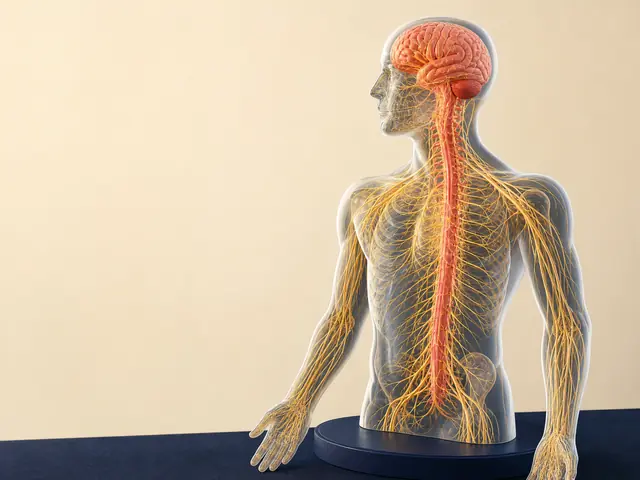
The two doors
A veteran with dementia can walk through the care door even if the dementia has nothing to do with military service. The compensation door is where service connection matters. Keeping these straight prevents most of the confusion families run into.
| Question you're asking | Which door | What determines access |
|---|---|---|
| Can the VA help care for a veteran's dementia? | Healthcare / GEC | Enrollment in VA health care and clinical need; income and rating can affect copays |
| Will the VA pay a monthly check for the dementia itself? | Compensation | Service connection, proving the dementia is linked to service |
| Can we get paid to be the caregiver? | Caregiver support | PCAFC needs a 70%+ service-connected rating; PGCSS does not |
| Is there extra money for needing daily help? | Both doors | Aid and Attendance (pension side) or SMC (compensation side) |
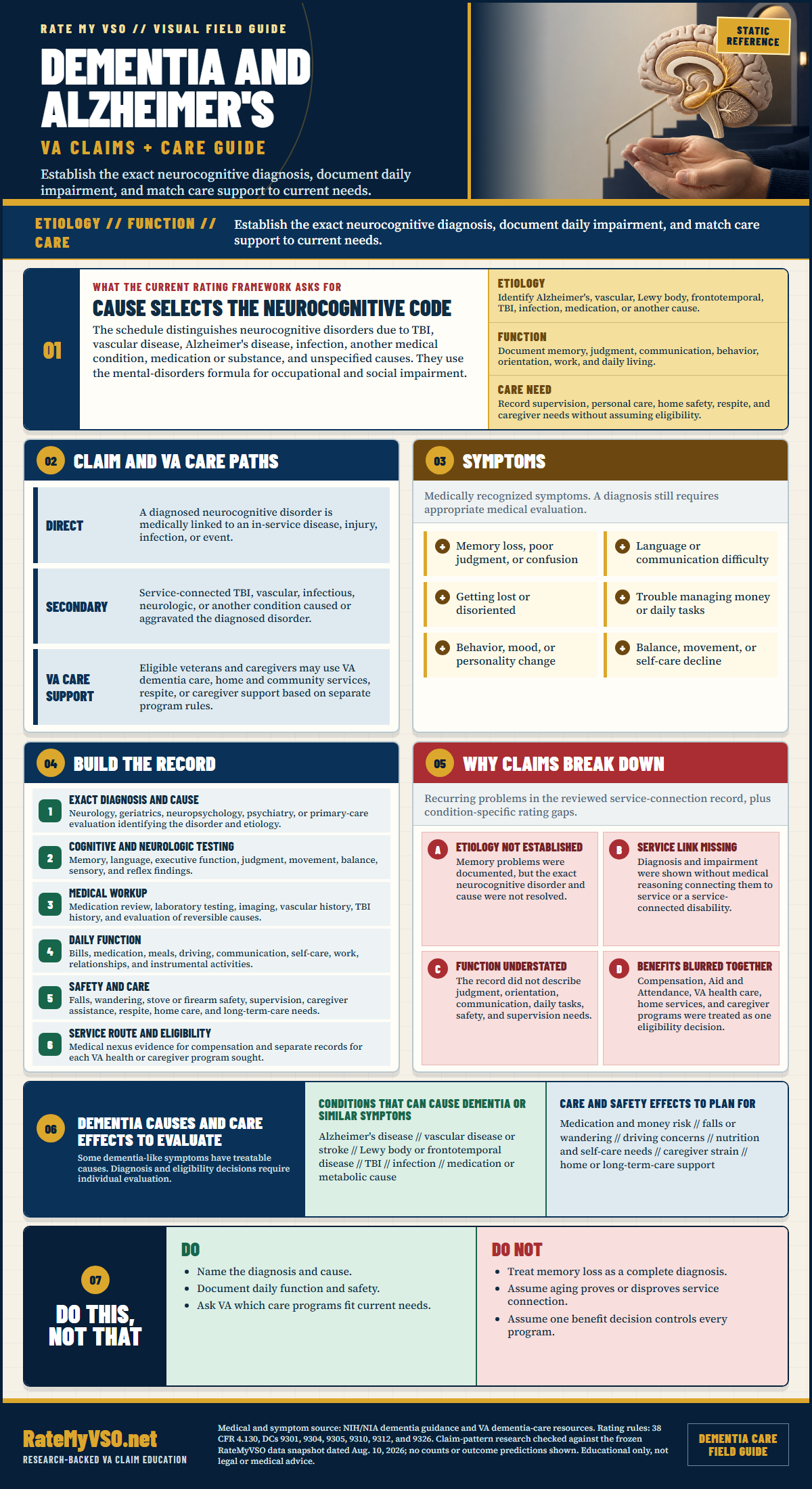 One-page guide: VA Care for Dementia and Alzheimer's in One Page
Dementia and Alzheimer's guide covering diagnosis and etiology, neurocognitive rating codes, daily function, service paths, VA care and caregiver support, safety planning, and common claim gaps. Opens the full-size chart, free to save or print.
One-page guide: VA Care for Dementia and Alzheimer's in One Page
Dementia and Alzheimer's guide covering diagnosis and etiology, neurocognitive rating codes, daily function, service paths, VA care and caregiver support, safety planning, and common claim gaps. Opens the full-size chart, free to save or print.
Overview
Dementia is a broad diagnosis, memory and thinking problems severe enough to interfere with daily life, and Alzheimer's disease is its most common cause. Across published Board of Veterans' Appeals decisions on dementia, the outcome usually comes down to the strength of one thing: the medical opinion linking the diagnosis to service or to a condition VA has already service-connected. Claims with a clear, well-reasoned nexus opinion tend to succeed; claims that rest only on the veteran's or a family member's belief about the cause, without a supporting medical opinion, tend to fail.
Two questions are worth separating before you do anything else. First: does the veteran need care right now? That question runs through VA health care and does not depend on service connection. Second: should the veteran file a disability claim for the dementia itself? That question runs through the compensation system and does depend on service connection. Sections below cover both, starting with care and caregiver support, then walking through the full filing process for a dementia disability claim.
Types of Dementia VA Rates
All dementia diagnoses are rated under the same mental-disorders formula, but the underlying diagnostic code depends on the cause. Knowing which type is documented in your medical records matters because it points to a specific service-connection pathway.
- Alzheimer's disease (DC 9312): the most common cause of dementia, a progressive neurodegenerative disease. Not on any presumptive list; requires a direct nexus opinion, a TBI-secondary theory, or a toxic-exposure opinion.
- Vascular dementia (DC 9305): caused by reduced blood flow to the brain, often following a stroke or a series of smaller strokes (transient ischemic attacks, sometimes called mini-strokes). A common secondary theory when the underlying stroke or cardiovascular condition is already service-connected.
- Dementia due to traumatic brain injury (DC 9304): the pathway with the strongest regulatory backing, covered in detail below.
- Frontotemporal dementia and dementia with Lewy bodies: these do not have their own numbered diagnostic code in the schedule. VA generally rates them under DC 9310 (unspecified neurocognitive disorder) or whichever code most closely matches the documented etiology, using the same rating formula. Frontotemporal dementia is one of the specific conditions named in the 15-year TBI presumption discussed below.
- Dementia due to another medical condition (DC 9326): used when the dementia is attributed to a diagnosed medical cause other than Alzheimer's, vascular disease, or TBI.
Diagnosis requires a doctor's evaluation, not just a screening score. A cognitive screening tool alone, without a follow-up diagnostic workup, is often not enough to establish a current dementia diagnosis.
How VA organizes dementia care
Dementia and Alzheimer's care lives inside a VA umbrella called Geriatrics and Extended Care (GEC). Care is available throughout the full range of VA health services, and depending on need may include home-based primary care, homemaker and home health aide services, respite care, adult day health care, outpatient and inpatient care, nursing home care, palliative care, or hospice. The programs are designed to flex as the disease progresses, so a veteran may use one, some, or all of them at different stages, rather than committing to a single path up front.
Home and community-based services
Most families want to keep the veteran at home as long as it's safe. These programs can be combined and adjusted as needs change.
Home-Based Primary Care (HBPC)
A doctor-led team, typically a physician or nurse practitioner, nurse, social worker, physical therapist, psychologist, dietitian, and pharmacist, that comes to the home and provides long-term primary medical care. Started in 1970, it's built for veterans whose condition makes regular clinic visits difficult, a common situation in mid-stage dementia.
Homemaker and Home Health Aide (H/HHA)
A trained aide comes to the home to help with bathing, dressing, and other daily tasks, under VA case management. This is a service, not a cash payment to a family member, that distinction matters when comparing it to the caregiver stipend in Caregiver Support.
Adult Day Health Care (ADHC)
A supervised daytime program for social activities, cognitive stimulation, exercise, and some health services, with the veteran returning home at night. It does two jobs at once: keeps the veteran engaged and gives the caregiver hours back in the day.
Respite care
A planned break for the caregiver, the VA temporarily takes over care, at home or in a facility, generally available up to 30 days each calendar year for enrolled veterans. Caregiver burnout is one of the biggest reasons home care collapses, so setting up respite early is one of the most practical steps a family can take.
Tele-geriatrics and memory evaluation
Some VA sites offer tele-geriatrics that co-manages dementia, medication load, functional limits, and falls, along with cognitive evaluations and advance-care planning, by clinic visit or video. Availability is site-specific, ask the local VA what exists in the area rather than assuming.
Skilled care versus custodial help
The VA distinguishes skilled home care (nursing, therapy) from custodial help (bathing, supervision). Both exist, but they're authorized through different mechanisms and one doesn't automatically include the other. If a social worker authorizes an aide, confirm in writing what tasks are covered.
Residential and institutional long-term care
When home is no longer safe, often when wandering, aggression, or round-the-clock needs appear, the VA offers several residential options. They differ in who owns them, who qualifies, and who pays.
| Setting | Owner | Skilled nursing? | VA pays room and board? |
|---|---|---|---|
| Community Living Center (CLC) | VA | Yes, 24-hour | Yes, if eligible (see rule below) |
| State Veterans Home | State + VA per diem | Yes (most) | Partial, each state sets its own rules |
| Community Nursing Home | Private, VA-contracted | Yes | Yes, if eligible |
| Community Residential Care (CRC) | Private | No, custodial only | No, room and board is on the family |
CLCs are VA-owned nursing facilities serving veterans with chronic stable conditions including dementia, those needing short-term rehab, and those needing end-of-life comfort care. There are over 100 nationwide. State Veterans Homes are state-owned and VA-certified; many have dedicated dementia or memory-care units. Community Nursing Homes are private facilities under VA contract, with monthly VA oversight visits, useful when no CLC is nearby. CRC is assisted-living-style care for veterans who need daily help but not skilled nursing, with over 550 VA-inspected settings nationwide, some offering dementia-specific care.
Who qualifies for VA-paid nursing home care
This is the rule that trips people up. Nursing home care is available to veterans enrolled in VA health care who need it for a service-connected disability, or who have a 70% or greater service-connected rating, or who have a rating of total disability based on individual unemployability (TDIU). Those veterans have mandatory eligibility for extended care and can receive indefinite care in a VA or VA-contracted nursing home. Veterans without that status can still apply, but access depends on available resources and income, and copays may apply.
Caregiver support programs
The VA runs two caregiver programs, and confusing them is one of the most expensive mistakes a family can make. One pays a monthly stipend, the other does not. Both matter for dementia.
PCAFC (stipend program)
Pays a monthly stipend to a primary family caregiver, plus education, mental health counseling, at least 30 days of respite a year, travel assistance, and CHAMPVA health coverage if the caregiver is otherwise uninsured.
PGCSS (no rating required)
Open to caregivers of any veteran enrolled in VA health care. Offers skills training, coaching, peer support, and self-care resources, but not a monthly stipend.
The PCAFC eligibility gate: 70% and a personal-care need
PCAFC requires a genuine service-connected disability rated at 70% or more, individually or combined. The veteran must also need in-person personal care for at least six continuous months, based on an inability to perform an activity of daily living, a need for supervision or protection due to neurological impairment, or a need for regular instruction or supervision. That middle criterion, supervision due to neurological impairment, is the one dementia most naturally fits, but only if the dementia (or another qualifying condition) is service-connected and reaches 70%. Since October 1, 2022, PCAFC covers veterans of all service eras. A caregiver must be at least 18 and be the veteran's spouse, child, parent, extended family member, or someone who lives full-time with the veteran.
How much the stipend is
The stipend is tied to a federal pay locality rate, not a flat national number, calculated from the OPM General Schedule grade 4, step 1 annual rate for the veteran's locality, divided by 12. Level One multiplies that by 0.625; Level Two, for a veteran unable to self-sustain in the community, multiplies by 1.00. Because it's locality-based, the same care need pays different amounts in different cities. Figures change; confirm the current rate on VA's Caregiver Support Program page for the veteran's specific locality.
Dementia-specific caregiver support: REACH VA
Some VA sites run REACH VA, a structured telephone support-group program teaching caregivers problem-solving, stress management, and coping skills, aimed specifically at those caring for a veteran with dementia. There's also a national Caregiver Support Line (see Action Checklist and Contacts).
Paying for care
Four money levers apply here. Two live on the healthcare side (copays and their exemptions), and two are cash benefits (pension-side Aid and Attendance, and compensation-side Special Monthly Compensation). Treat this as a map, not a calculator, the exact dollar figures live on the dedicated pages linked below and change over time.
Copays and who is exempt
A 100% service-connected rating provides access to long-term care without copays or deductibles. Even a 0% service-connected condition can be treated without copay when that specific condition is the reason for the care. Long-term care copays do not begin until the 22nd day of care in a 12-month period, and hospice carries no copay in any setting. The VA also protects assets for a spouse still living in the community through the community spouse resource allowance (CSRA) when calculating extended-care copays. Current copay tiers and the CSRA figure are on VA's health care copay rates page.
Wartime pension and Aid and Attendance
This is frequently the benefit that actually pays an assisted-living or memory-care bill, and it does not require service connection. It requires wartime service, limited income, and a care need. Aid and Attendance is an increased monthly pension paid when the veteran needs help with daily functions like bathing, eating, or dressing, is bedridden, or is a nursing home patient. For dementia, the need for supervision typically satisfies this, though help with medication management, meals, transportation, and housekeeping alone (instrumental activities of daily living) does not by itself qualify, most dementia cases also involve true ADL help or supervision that does. Full eligibility rules, current MAPR rates, and a calculator are on the Aid and Attendance pension guide and the VA Pension guide.
Special Monthly Compensation
SMC is extra tax-free compensation for severe service-connected situations, including needing the regular aid and attendance of another person (SMC-L and above) or being housebound (SMC-S). Because SMC requires service connection, it only helps with dementia if the dementia, or the condition driving the care need, is itself service-connected. One item worth flagging: SMC-T is the TBI-specific level, built for veterans whose TBI residuals require regular aid and attendance and who would otherwise need institutional care (see Service Connection Pathways). That last part is a high bar, and it is not the only route: SMC-L turns on the functional need for regular aid and attendance from service-connected disabilities, with no rating percentage required and no need to go through SMC-T. A veteran whose care need does not reach the institutional-care standard may still qualify under SMC-L. Current rates and eligibility are on the SMC-L Aid and Attendance and SMC-S Housebound pages.
How Service Connection Works, At a High Level
The rest of this guide shifts from care to compensation, actually filing a claim so the dementia itself is service-connected. Before getting into the specific pathways, it helps to understand the three things every dementia claim ultimately has to show. This is the same basic test that applies to any VA disability claim, just applied to this condition.
- A current diagnosis. A doctor must confirm the veteran actually has dementia now, from a real diagnostic workup, not just an unclear screening score. Claims have failed at this very first step when the record showed no dementia diagnosis at all.
- An in-service cause or exposure, or a service-connected condition behind it. Something that happened or was documented in service, such as a head injury or a toxic exposure, or a disability VA has already service-connected that caused or worsened the dementia (38 CFR § 3.303; 38 CFR § 3.310).
- A medical nexus. A doctor's opinion tying the dementia to that in-service cause or to the service-connected condition, and explaining the reasoning, not just stating a conclusion.
What VA Looks For: Tests, Records, and Diagnostic Codes
Whether you are filing directly, secondary to another condition, or on a toxic-exposure theory, the record VA actually reviews centers on a small set of documents and data points.
- A documented diagnostic workup: a neuropsychological evaluation or a geriatric/memory clinic assessment, not a bare screening score. A cognitive screening tool such as an MMSE or MoCA can flag a concern, but VA generally wants the full workup that produced an actual diagnosis.
- Imaging where relevant: MRI or CT findings can help distinguish vascular dementia (evidence of stroke or reduced blood flow) from Alzheimer's or another etiology, which matters for picking the right pathway and diagnostic code.
- Treatment records: ongoing neurology, geriatric, or primary care notes documenting the diagnosis, its stage, and any medications.
- The diagnostic codes involved: DC 9312 (Alzheimer's), DC 9305 (vascular), DC 9304 (due to TBI), DC 9310 (unspecified), or DC 9326 (due to another medical condition), plus whatever code applies to the condition you're connecting it to, for example DC 8045 (TBI residuals) or the veteran's already-rated hearing loss, tinnitus, or vascular condition.
- The actual form the examiner fills out: a Disability Benefits Questionnaire (DBQ) specific to dementia and cognitive impairment, discussed in more detail later in this guide.
Service Connection Pathways: Direct, Secondary, and Exposure
Secondary to TBI, the pathway that is nearly presumptive (38 CFR §3.310(d))
In a veteran with a service-connected TBI, certain conditions are held to be the proximate result of that TBI absent clear evidence to the contrary. For dementia, the regulation lists presenile dementia of the Alzheimer type, frontotemporal dementia, and dementia with Lewy bodies, if manifest within 15 years following a moderate or severe TBI. This rule came from a National Academy of Sciences review and was finalized in the Federal Register in December 2013.
Three limits to notice. The TBI itself must be service-connected. It must have been moderate or severe, mild TBI does not trigger the dementia presumption. And the dementia must appear within 15 years. Missing that window is not automatically fatal, the regulation also allows service connection for conditions shown by other evidence to be proximately due to the TBI, it just means losing the presumption and having to prove causation the ordinary way. A documented in-service head injury can also support frontotemporal dementia specifically outside the presumption, when a treating specialist ties the diagnosis to the injury and describes the personality or behavioral changes that followed. The full TBI rating breakdown, including diagnostic code 8045 and all five presumptive secondaries, is in the TBI claims guide.
Secondary to hearing loss, tinnitus, or another already-rated condition (38 CFR §3.310(a))
Published Board decisions have granted dementia as secondary to service-connected hearing loss, and to hearing loss and tinnitus together, when a doctor's opinion explained the connection and cited supporting medical literature. Research associates PTSD with meaningfully elevated dementia risk in some veteran studies too, but that's an association, not a VA presumption, a claim linking dementia to service-connected PTSD still needs a genuine medical nexus opinion, the same as any other secondary theory. See our Secondary Service Connection Guide.
Secondary to a stroke or mini-stroke (vascular dementia)
When a service-connected stroke or transient ischemic attack (TIA, sometimes called a mini-stroke) has damaged blood flow to the brain, vascular dementia (DC 9305) that follows can be service-connected as secondary to that event. This pathway pairs naturally with imaging that documents the vascular event and a nexus opinion connecting it to the subsequent cognitive decline.
Toxic exposure, with a positive medical opinion, not the exposure alone
Dementia and Alzheimer's do not appear on the Agent Orange presumptive list, and they are not Gulf War presumptive conditions either, that framework covers undiagnosed illnesses and medically unexplained chronic multisymptom illnesses, which by definition excludes a diagnosed disease like Alzheimer's. Even so, a claim can still succeed on this theory when a doctor gives a positive opinion actually tying the dementia to a specific exposure, such as herbicide (Agent Orange) exposure or contaminated water at a base like Camp Lejeune, ideally supported by referenced medical literature. A lot of content correctly notes that veterans have elevated risk factors for dementia from toxic exposures, and then slides from "higher risk" to "service-connected," which are not the same thing. Elevated risk supports a nexus argument. It does not create a presumption.
Direct service connection
A veteran demonstrates the dementia, or the specific injury or event that caused it, began during or was caused by active military service, most plausible for a documented in-service brain injury, with a medical nexus. This is harder to build for idiopathic Alzheimer's disease with no documented in-service trigger, and more plausible when a specific injury or exposure is in the service record. See our Service Connection Guide.
Service Connection by Aggravation
A service-connected condition worsening a non-service-connected dementia beyond its natural progression can support service connection for the increase in severity, under 38 CFR §3.306 (pre-service) or 38 CFR §3.310(b) (aggravation by a service-connected condition), measured against a documented baseline before the worsening.
How Dementia Is Rated
If dementia is service-connected, the VA rates it as a mental disorder using the General Rating Formula for Mental Disorders in 38 CFR §4.130, the same formula used for PTSD and depression. Ratings are not a continuous scale, the available percentages are 0%, 10%, 30%, 50%, 70%, and 100% only, based on occupational and social impairment.
The diagnostic codes
| Code | Covers |
|---|---|
| 9312 | Major or mild neurocognitive disorder due to Alzheimer's disease |
| 9304 | Due to traumatic brain injury |
| 9305 | Vascular |
| 9310 | Unspecified neurocognitive disorder |
| 9326 | Due to another medical condition |
Status note: the VA has proposed a substantial overhaul of §4.130 that would move to a five-domain functional model. Confirm whether it has been finalized before relying on the current symptom-list formula for a live claim.
Separate ratings for distinct complications, and the anti-pyramiding rule
Once dementia is service-connected, a veteran can also get a separate, additional rating for a genuinely distinct complication, for example a separate rating for urinary leakage caused by the dementia (rated under the voiding-dysfunction criteria at 38 CFR §4.115a/4.115b, DC 7542). What does not work is rating the same symptom twice under two different codes, for example an abnormal, shuffling gait that is already accounted for by another rated condition cannot also draw its own separate rating. This is the anti-pyramiding rule at 38 CFR §4.14, no paying twice for the same underlying problem.
- What the VA measures at your C&P exam
- Evidence that has won at the Board
- Inside the rater's playbook: grant, denial, and remand rates
- Secondary condition map
Evidence for a Dementia Claim
Dementia claims are decided almost entirely by the medical opinion that links the disease to service or to a service-connected condition. We analyzed the Board's published dementia-due-to-TBI decisions: a private nexus opinion in the file goes with a notably different grant rate, shown below.
A current, written diagnosis: from a neuropsychological evaluation or a geriatric/memory clinic, not an informal impression.
Nexus opinion that explains its reasoning: judges give the most weight to an opinion that explains why, not one that just states a conclusion. An opinion that links dementia to an already-rated condition and cites supporting medical studies, applied to the veteran's own facts, carries far more weight than a bare statement that two conditions are linked or occur together.
Documentation of every plausible connecting condition: hearing loss, tinnitus, TBI, a stroke or TIA, or a toxic exposure that is already, or could be, service-connected.
Proof of any in-service head injury or toxic exposure: service treatment records documenting a head injury, or personnel/deployment records placing the veteran within a qualifying herbicide or contaminated-water time and place.
Family and lay statements: a spouse's or family member's account of when memory problems started and how they changed over time can help establish onset, even though only a doctor can speak to the medical cause. See our Buddy & Lay Statements Guide. (Jandreau v. Nicholson, 492 F.3d 1372 (Fed. Cir. 2007); Layno v. Brown, 6 Vet. App. 465 (1994), competency of lay testimony to describe observed symptoms, not medical causation.)
For general guidance on getting a strong medical opinion written, see our Nexus Letters Guide.
Evidence Cited in Published Neurocognitive disorder (dementia) Decisions
We analyzed 2,149 published Board decisions involving neurocognitive disorder (dementia) for condition-specific evidence, counting only case-specific mentions (boilerplate recitations excluded). "Favorable" is the share of decisions citing that evidence where every issue was granted or the outcome was mixed; the baseline across all these decisions is 30.9%, combining every diagnostic code below. Evidence appearing in a decision does not mean it decided the case. Descriptive of the published record, not a prediction.
Bar length shows decisions citing the evidence.
By diagnostic code
These codes are grouped together above. They do not perform the same, so find your own code here rather than reading the combined figure. A code retired in the schedule rewrites appears without a link, because its decisions were judged under criteria that no longer apply.
Bar length shows published decisions reviewed.
Detected by phrase-reading the decision text with condition-specific vocabularies. Source: Board of Veterans' Appeals decisions, RateMyVSO analysis.
Why These Claims Get Denied
Beyond the general "no diagnosis" and "no nexus" reasons, a few specific denial patterns show up often enough in published decisions to call out on their own.
- No current dementia diagnosis in the record. Several claims failed at the very first step because the file showed no actual dementia diagnosis, only an unclear screening score, or the veteran had never been evaluated by a doctor for it. Without a current disability, there is no valid claim.
- Assuming Agent Orange or Camp Lejeune coverage is automatic. Dementia is not an enumerated presumptive condition under either exposure category. Claims that rested only on "I was exposed, therefore it's covered" were denied where the file lacked a direct medical opinion connecting the exposure to the diagnosis.
- A secondary theory built on a condition that isn't actually service-connected. Secondary service connection only works if the disability said to have caused the dementia is itself already service-connected. A claim naming hypertension as the cause, when the hypertension itself was never service-connected, cannot succeed on that theory regardless of the medical reasoning.
- A weak opinion that only notes a link or a shared pathway. An opinion has to say the connection is at least as likely as not, not simply that two conditions are associated or share biological pathways. A statement that two conditions occur together, without a causation opinion, is not enough.
- General medical literature with no doctor applying it to the veteran's own facts. Citing studies in an appeal brief, without a treating or examining doctor tying that literature to this veteran's specific history, is not medical evidence.
- Missing the exact presumptive place-and-date window. Herbicide and other exposure presumptions attach only to specific service locations and date ranges. Service just outside those windows, or at a non-qualifying location, does not receive the presumption, even where the veteran's actual exposure experience felt similar.
- The veteran's or family's own belief about the cause, without a doctor's opinion behind it. The cause of dementia is treated as a complex medical question a non-doctor cannot answer on their own. A personal or family belief that service or an exposure caused the condition, without a supporting medical nexus, does not carry the claim.
Pitfalls and Common Mistakes
Distinct from the denial reasons above, these are procedural missteps, ways a claim gets weakened or delayed even when the underlying facts might have supported it. Among the Board's classified dementia-due-to-TBI denials, here is what claims most often fell short on.
- Not raising every plausible theory up front. Raising every theory of service connection early, direct, secondary, exposure-based, before the rating decision, gives VA a duty to help develop all of them. Adding a theory only on appeal starts that development late.
- Missing a scheduled VA examination. A missed C&P exam, without good cause, can result in the claim being decided on the record as it stands, or denied outright for certain claim types.
- Treating a screening score as a diagnosis. A cognitive screening tool can flag a concern, but it is not the same as a completed diagnostic workup with an actual dementia diagnosis in the file.
- Leaving the specific dementia type out of the record. Alzheimer's, vascular, and TBI-related dementia connect to service through different mechanisms, so documentation identifying the type (imaging, workup notes) helps the nexus opinion match the correct pathway.
- Not documenting onset and progression. Family statements describing when memory problems started and how they changed over time strengthen both the diagnosis timeline and, where relevant, an aggravation argument.
- Filing a secondary theory without first confirming the primary condition's status. Check that the condition said to have caused the dementia is actually rated as service-connected before building a claim on it.
Do's and Don'ts
A condensed version of everything above, in the order it actually matters when you sit down to build the file.
- Get and keep a current, written dementia diagnosis from a doctor, not just a screening score.
- Identify every already-service-connected condition that could plausibly have caused or worsened the dementia (hearing loss, tinnitus, TBI, a stroke or TIA).
- Get a nexus opinion that explains its reasoning and cites supporting medical studies applied to the veteran's own facts, not a bare conclusion.
- Gather proof of any in-service head injury or toxic exposure, including the exact dates and locations.
- Have family write down when memory problems started and how they changed over time.
- Raise every theory of service connection early, before the rating decision.
- Report for every scheduled VA examination.
- If you were denied before, file a Supplemental Claim with new and relevant evidence rather than starting over.
- Don't assume Agent Orange, Camp Lejeune, or the PACT Act automatically covers dementia, none of them do.
- Don't rely on a secondary theory unless the condition doing the causing is already service-connected.
- Don't lean on an opinion that only says two conditions are linked or share pathways, it has to say the connection is at least as likely as not.
- Don't rely on general medical articles alone, a doctor has to apply them to the veteran's specific facts.
- Don't count on presumed exposure without checking the exact place-and-date rules first.
- Don't try to prove the medical cause with the veteran's or family's own belief, causation for dementia is treated as a medical question.
- Don't skip a scheduled C&P exam.
Common Secondary Conditions
We found these are the conditions most often linked with dementia due to TBI (DC 9304) in the Board's published decisions. Each bar is the BVA grant rate, with the number of decisions below it. They describe what the Board's record shows across many veterans, not a prediction about any one claim.
Conditions that can cause dementia (dementia as the secondary)
Claims where dementia due to TBI was argued as secondary to an already service-connected condition, the "ways to connect via another condition" list:
Conditions dementia can cause (dementia as the primary)
Conditions veterans have claimed as caused or aggravated by a service-connected dementia due to TBI, in other words, conditions secondary to the dementia once it's already service-connected. This corpus is comparatively small, so treat these as directional rather than definitive:
Data limited to the DC 9304 (dementia due to TBI) grain. Alzheimer's (9312), vascular (9305), and unspecified (9310) dementia do not yet have enough classified secondary-condition volume in the corpus to show a reliable widget here; that gap is noted rather than filled with a guess.
Quick Checklist Before You File
Bring these together before you submit anything.
- A current, written dementia diagnosis from a doctor.
- If a service-connected condition (hearing loss, tinnitus, TBI, or a stroke) may have caused the dementia, claim it as secondary.
- A nexus opinion that explains its reasoning and cites medical studies, tied to service or to a specific service-connected condition.
- Proof of any in-service head injury or toxic exposure (Agent Orange, Camp Lejeune, lead), including exact dates and locations.
- Family statements describing when memory problems started and how they changed over time.
- Every theory raised early, before the rating decision, so VA's duty to assist covers all of them.
- A plan to attend every scheduled VA examination.
- If you were denied before: new and relevant evidence for a Supplemental Claim, not just a repeat of what was already considered.
For the mechanics of actually submitting the claim, see the Standard Claim Guide and the Fully Developed Claim Guide (filing with all your evidence up front can speed up the decision).
The Claims Process, Step by Step
Once you file, the claim moves through a series of hand-offs. Understanding who does what helps you know who to contact, and what to expect, at each stage.
- You file the claim. Directly with VA, through VA.gov, or with the help of an accredited representative.
- VA acknowledges the claim and assigns it for development. A Veteran Service Representative (VSR) is assigned to gather service treatment records, VA and private medical records, and any other evidence needed.
- The VSR orders a Compensation & Pension (C&P) exam if one is needed. Most dementia claims do, especially secondary claims where a nexus opinion is required.
- The C&P exam is conducted. By a VA clinician or a contracted examiner, who completes a Disability Benefits Questionnaire (DBQ) documenting the diagnosis, cognitive testing results, severity, and, where relevant, a nexus opinion.
- The file goes to a Rating Veteran Service Representative (RVSR), the "rater." The rater reviews the complete file, including the exam results, and decides whether service connection is warranted and at what percentage.
- A senior reviewer may review the decision before it's finalized, depending on the complexity of the claim.
- VA issues the decision letter. This states whether the claim is granted or denied, the rating percentage if granted, and the reasons behind the decision.
- If you disagree, you choose an appeal lane. Higher-Level Review, Supplemental Claim, or a Board appeal, covered next.
Who's who: VSO vs. VSR vs. Rater vs. C&P Examiner
Your VSO
An accredited representative from a veterans service organization, or an accredited attorney or claims agent. Not a VA employee. Helps prepare, gather evidence, and file, and can represent the veteran through an appeal. Has no authority to decide the claim.
VSR (Veteran Service Representative)
VA staff who "develops" the claim: requests records, schedules the C&P exam, and assembles the file. Does not decide the rating.
Rater (RVSR)
VA staff who reviews the completed file and makes the actual decision, service connection or denial, and the percentage. This is the person whose judgment the decision letter reflects.
C&P Examiner
A VA clinician or a contracted medical examiner who conducts the exam and completes the DBQ. Documents findings and, where asked, a nexus opinion. Does not decide the claim.
For the full walkthrough of every stage with more detail, see Inside Your Claim and Claim Stages.
DBQs and Your C&P Exam
A Disability Benefits Questionnaire (DBQ) is the standardized form an examiner completes for a condition, it structures the exam findings into the specific data points VA's rating schedule requires. For dementia and other cognitive impairments, that includes cognitive testing results, functional status, and, where relevant, a nexus opinion. See the DBQ Guide for how these forms work, including whether a private DBQ completed by the veteran's own doctor can be submitted instead of relying solely on a VA exam.
Before the C&P exam, bring a clear, specific account of how the condition affects daily function, memory lapses, disorientation, changes in behavior or personality, and how they've progressed, not just a general description. A family member's presence and observations can help fill in details the veteran may not recall clearly. For a full walkthrough of what to expect and how to prepare, see the C&P Exam Prep Guide.
Reading the Decision Letter, and What to Do If Denied
The decision letter has two parts: a narrative section explaining the reasoning (often called "reasons and bases"), and a codesheet showing the actual rating percentage, the effective date, and the diagnostic code used. See the Reading Your Decision Letter Guide for how to find and interpret each part, or use the Letter Interpreter tool to upload the letter and get a plain-English breakdown.
If the claim is denied, or the rating is lower than expected, there are three main lanes:
- Supplemental Claim: refile with new and relevant evidence, such as a new nexus opinion or updated diagnostic workup. See Supplemental Claim Guide.
- Higher-Level Review (HLR): a senior reviewer looks at the same evidence again for a difference of opinion, no new evidence is added. See HLR Guide.
- Board Appeal: the case goes to a Veterans Law Judge at the Board of Veterans' Appeals, with options for a direct review, an evidence docket, or a hearing. See Board Appeal Guide.
Not sure which lane fits the situation? See the Appeals decision guide for a side-by-side comparison of all three.
After You Win: Maintaining the Rating
A grant is not always the end of the story. Continued follow-up with a neurology, geriatric, or memory-clinic provider, and records documenting the disease's progression, protects the veteran if VA schedules a future reexamination. Progressive conditions like dementia are less likely to be reexamined once advanced, but understanding when a rating becomes protected from future review (including Permanent and Total status) and what to do if VA proposes to reduce it still matters. See Protect Your Rating and Future Reexaminations for the specifics.
If the dementia worsens after the initial grant, or a genuinely distinct complication develops, see How Dementia Is Rated above on separate ratings for distinct complications, or the Rating Increase Guide for filing an increase.
Advance planning, safety, and decision-making
Dementia is progressive, so the VA emphasizes planning while the veteran can still participate. The VA recommends that veterans, families, and caregivers consider future treatment options, including care the veteran does not want, especially important for a condition that will affect decision-making capacity over time.
Shared decision-making and advance directives
The VA describes Shared Decision Making as a collaborative, patient-directed process that helps veterans and caregivers set goals and make choices consistent with the veteran's values. Completing advance directives early, while capacity exists, is the single most useful planning step, because it prevents crises later. If a veteran's capacity to manage their own VA benefits becomes a concern, see the incompetency and fiduciary guide for how the VA handles that determination and appoints a fiduciary.
Home safety, wandering, driving, and firearms
The VA publishes dementia-specific safety guidance covering home safety, emergency preparedness, and fall prevention. On driving, veterans in early stages may benefit from a formal driving evaluation, while those in more advanced stages generally should no longer drive. Some VA sites run home visits that specifically cover fall prevention, firearm storage, and wandering risk, firearm storage is treated as its own safety topic given how common firearms are in veteran households.
GeriPACT
For veterans with multiple chronic conditions, dementia, or geriatric syndromes, some VA sites offer GeriPACT, a geriatric patient-aligned care team. Availability varies by facility, ask the local VA what's offered.
Action checklist and key contacts
The order most families follow, starting with the benefit that's actually reachable:
- Confirm VA health-care enrollment (VA Form 10-10EZ if not already enrolled). Almost every care benefit above requires it.
- Ask the VA primary care team for a GEC or social work referral. A social worker is the gateway to home-based primary care, aides, adult day care, and respite.
- Request a memory or geriatric evaluation. This documents the diagnosis and stage, which drives eligibility for nearly everything else, including a future disability claim.
- Set up respite early, before the caregiver is in crisis.
- Look into both caregiver programs. If the veteran is 70%+ service-connected, PCAFC (VA Form 10-10CG) is the stipend path. If not, PGCSS is open regardless of rating.
- Look into Aid and Attendance. With wartime service and a care need, this pension benefit may pay for care regardless of service connection.
- Only then weigh a dementia compensation claim, and be realistic about service connection per Service Connection Pathways.
- Complete advance directives while the veteran can participate.
Key phone numbers
| Line | Number | Use it for |
|---|---|---|
| VA Caregiver Support Line | 1-855-260-3274 | PCAFC/PGCSS questions, local team locator |
| VA general / long-term care | 1-877-222-8387 | Health care enrollment, nursing home access |
| Veterans Crisis Line | 988, then press 1 | Any mental-health crisis, 24/7 |
Quick Reference Tables
Service Connection Pathways at a Glance
| Pathway | Mechanism | Evidence Needed |
|---|---|---|
| Secondary to TBI (DC 8045) | Near-presumptive within 15 years of a moderate/severe TBI (38 CFR §3.310(d)) | Service-connected TBI + dementia diagnosis within the 15-year window |
| Secondary to hearing loss, tinnitus, or other rated condition | Ordinary secondary service connection (38 CFR §3.310(a)) | Nexus opinion connecting the already-rated condition to the dementia |
| Secondary to stroke/TIA | Vascular damage causing vascular dementia (DC 9305) | Imaging documenting the vascular event + nexus opinion |
| Toxic exposure | Herbicide or contaminated-water exposure, not presumptive for dementia | Exact place/date match for the exposure + a positive nexus opinion |
| Direct service connection | In-service head injury or documented onset | Service treatment records + medical nexus |
| Aggravation | Service-connected condition worsens dementia beyond natural progression | Documented baseline + medical opinion on the increase in severity |
From Filing to Decision: Who Does What
| Role | Does | Decides the rating? |
|---|---|---|
| VSO / accredited representative | Helps prepare, gather evidence, and file; represents the veteran on appeal | No |
| VSR | Develops the claim: orders records and the C&P exam | No |
| C&P Examiner | Conducts the exam, completes the DBQ, may give a nexus opinion | No / but has a strong impact |
| Rater (RVSR) | Reviews the full file and decides service connection and percentage | Yes |
Frequently asked questions
Is dementia covered by the PACT Act?
Do we need service connection to get VA care for dementia?
Will the VA pay for assisted living or memory care?
What's the difference between PCAFC and PGCSS?
What's the difference between Pension Aid and Attendance and SMC Aid and Attendance?
My father has PTSD and is now showing dementia symptoms. Is that automatic?
The TBI happened 18 years ago and dementia just started. Are we out of luck?
What if my nexus opinion only says my condition is "linked to" or "commonly occurs with" a service-connected condition?
Sources
- 38 CFR §3.303: direct service connection, current disability, in-service event, and a nexus
- 38 CFR §3.310: secondary service connection, including the §3.310(d) TBI presumptive secondaries (dementia within 15 years)
- 38 CFR §3.306: aggravation of a pre-service disability
- 38 CFR §3.102 and 38 USC §5107(b): benefit of the doubt when the evidence is in balance
- 38 CFR §3.307 and §3.309, including §3.307(a)(6) Agent Orange and §3.307(a)(7)(iii) Camp Lejeune water; §3.309(e) herbicide diseases and §3.309(f) Camp Lejeune diseases; 38 USC §1116, Agent Orange presumption of exposure
- 38 CFR §4.130: General Rating Formula for Mental Disorders, diagnostic codes 9304, 9305, 9310, 9312, 9326
- 38 CFR §4.115a and §4.115b, Diagnostic Code 7542: rating voiding dysfunction as a separate complication
- 38 CFR §4.14: rule against pyramiding, no separate rating for a symptom already covered by another rated condition
- Federal Register (Dec. 17, 2013): Secondary Service Connection for Diagnosable Illnesses Associated With Traumatic Brain Injury (final rule)
- Jandreau v. Nicholson, 492 F.3d 1372 (Fed. Cir. 2007), competency of lay testimony regarding observable symptoms
- Layno v. Brown, 6 Vet. App. 465 (1994), competency of lay evidence describing personally observed symptoms
- VA Geriatrics and Extended Care: dementia care program overview
- VA health care copay rates: current copay tiers and the community spouse resource allowance
- VA Caregiver Support Program: PCAFC eligibility and stipend formula, PGCSS, legacy transition status
- VA Family Caregiver benefits: PCAFC stipend, CHAMPVA, respite, Form 10-10CG
- VA Elderly Veterans: Aid and Attendance and Housebound
- VA Presumptive Service Connection Information: confirms dementia is not a Gulf War or Agent Orange presumptive condition