Muscle Injuries Rating Guide
Muscle injuries, often from shrapnel, gunshot, blast, or surgery, and sometimes from a repeated strain rather than a wound, are rated differently from joints. Instead of measuring degrees of motion, 38 CFR § 4.73 sorts the body's muscles into 23 muscle groups and scores each injury from slight to severe, based on the damage the wound or strain left behind. This guide walks the whole path: how service connection works, direct and secondary pathways, how the muscle group and severity grade are chosen, the evidence that wins, why these claims get denied, a checklist before you file, what the claims process looks like step by step, how to read your decision letter, and what to do whether you win or you're denied.
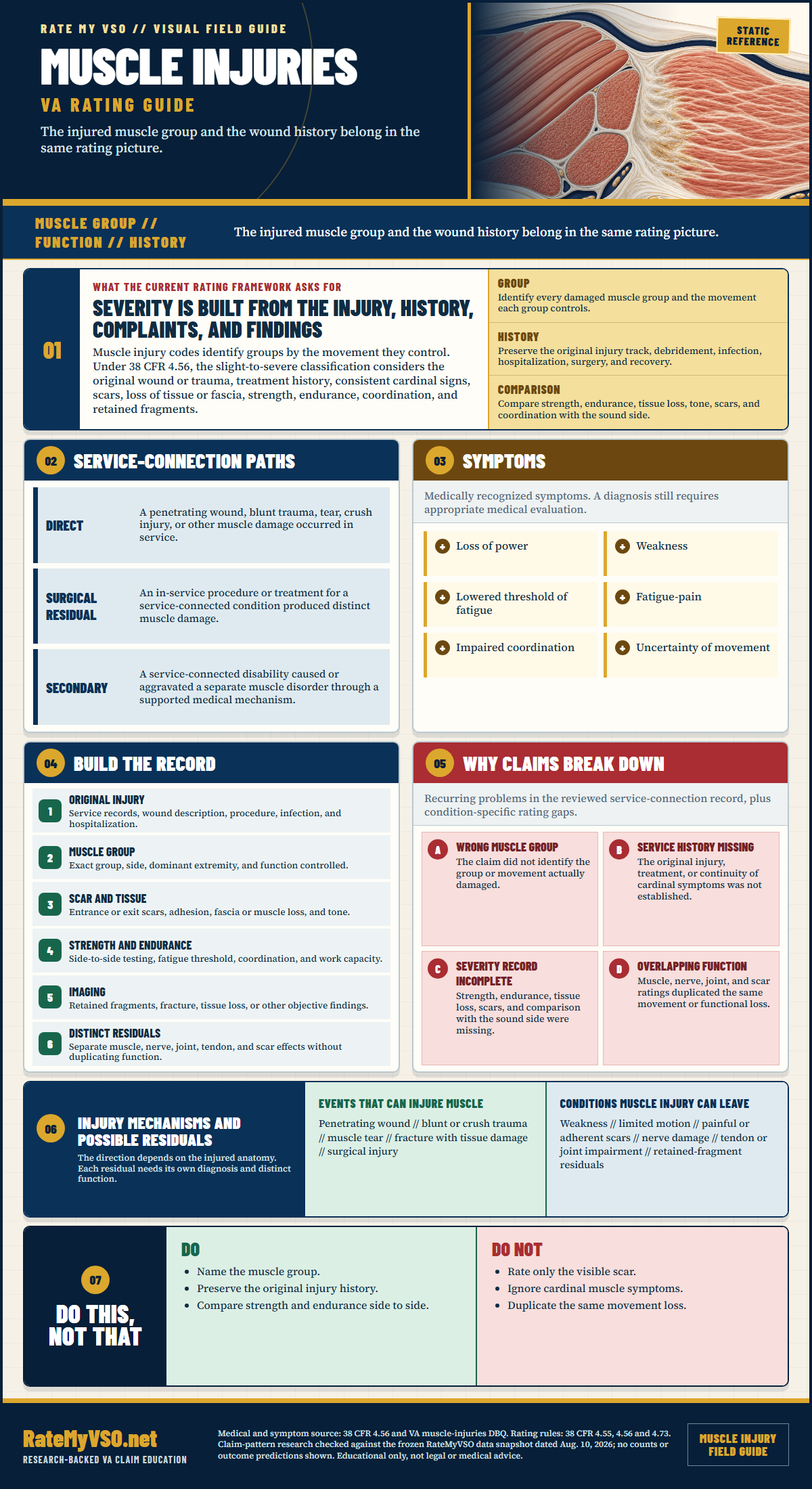 One-page guide: Muscle Injuries Rating Guide in One Page
Muscle-injury guide covering the damaged muscle group, original injury history, cardinal symptoms, tissue and scar findings, strength and endurance, residuals, and common claim gaps. Opens the full-size chart, free to save or print.
One-page guide: Muscle Injuries Rating Guide in One Page
Muscle-injury guide covering the damaged muscle group, original injury history, cardinal symptoms, tissue and scar findings, strength and endurance, residuals, and common claim gaps. Opens the full-size chart, free to save or print.
Start with the essentials
- 01Service Connection
The ways service connection can be established for this condition.
- 02Diagnosis and Evidence
Common symptoms and the evidence that supports this kind of claim.
- 03Your History
What you experienced, what others observed, and what treatment changed.
Understand the claim
Overview
Muscle injuries covered here include both wounds, such as gunshot and shrapnel wounds, and muscle strains, and they are rated under 38 CFR § 4.73, Diagnostic Codes 5301 through 5323 (this guide's meta also spans the broader 5301-5329 range some references use for the muscle groups). A muscle-injury claim really involves two separate fights: whether the muscle condition connects to your service at all, and, once it is connected, how severe VA rates it under 38 CFR § 4.56. In practice, most veterans who bring a muscle-injury issue to an appeal have already won service connection, the real dispute is the rating percentage, a separate rating for a second muscle group, the effective date, or occasionally a clear-and-unmistakable-error motion. Knowing which fight you're actually in tells you where to focus your evidence.
ICD-10 Diagnosis Codes
The ICD-10 diagnosis codes most commonly used for DC 5301, Group I. Function: Upward rotation of scapula; elevation of arm above shoulder level. Extrinsic muscles of shoulder girdle: (1) Trapezius; (2) levator scapulae; (3) serratus magnus (the kind on your medical records, decision letter, or C&P exam report). VA rates the disability and its residuals, not the diagnosis itself, so coding can vary.
How Service Connection Works, At a High Level
Before getting into the specific pathways below, it helps to understand the three things every muscle-injury claim ultimately has to show. This is the same basic test that applies to any VA disability claim, just applied to this condition.
- A current diagnosis. You need a muscle condition, diagnosed now. With no current diagnosis actually documented in the record, there is no valid claim, even if a wound or strain clearly happened in service.
- An in-service cause. An injury or event during service, such as a gunshot or shrapnel wound, a fall, a blast, surgery, or a repeated strain. Both wounds and strains count under 38 CFR § 3.303.
- A medical nexus. A medical opinion connecting your current muscle condition to that in-service event, or to a service-connected condition behind it, and explaining the reasoning, not just stating a conclusion. An opinion that explains its reasoning is given more weight than a bare conclusion.
Service Connection Pathways: Direct and Secondary
Muscle injuries are not a VA presumptive condition category on their own. Service connection must be established through one of the following pathways.
Direct Service Connection
A veteran demonstrates that the muscle injury, whether a wound or a strain, began during or was caused by active military service. Wounds and strains both count. Supporting evidence includes service treatment and hospital records describing the injury, and a medical nexus opinion linking the current muscle condition to that in-service event. This is the most straightforward pathway when the wound or strain is documented in service records. See our Service Connection Guide.
Secondary via Altered Gait or Overuse Compensation
A service-connected condition in one limb, such as a knee, ankle, hip, or back disability, can change how a veteran walks or moves to avoid pain. Over time, that altered gait or compensating movement pattern can overload and strain muscle groups in the same limb, the opposite limb, or the back that were never directly injured. This is a recognized biomechanical-compensation theory of secondary service connection: the original service-connected condition is the cause, and the new muscle strain is the effect. A nexus opinion should describe the specific compensating movement and how it plausibly overloaded the muscle group at issue.
Secondary via Scar Tissue or Adhesions
Scar tissue or adhesions from an original wound, surgery, or debridement to one muscle group can restrict movement or place abnormal strain on an adjoining muscle group as it works around the restriction. Where a nexus opinion documents that mechanism, connecting the adjacent muscle group's condition back to the original, already service-connected wound, this can support a secondary claim distinct from the original muscle rating itself.
Secondary Service Connection Generally (38 CFR § 3.310)
Beyond the two pathways above, a veteran can demonstrate that a muscle condition was caused or chronically aggravated by any already service-connected condition, not only a limb or scar. See our Secondary Service Connection Guide.
Service Connection by Aggravation
When a veteran had a documented pre-service muscle condition that was significantly worsened beyond its natural progression by military service, aggravation-based service connection under 38 CFR § 3.306 is available.
Reopening With New Service Records
If official service records surface later that were not part of the file when an earlier decision was made, VA can reconsider that decision as if it had never been finally decided, rather than requiring an ordinary new-and-material-evidence reopening. See 38 CFR § 3.156(c).
What VA Looks For: Tests, Records, and Diagnostic Codes
Whether you are filing directly, secondary to another condition, or fighting over the severity grade, the record VA actually reviews centers on a small set of documents and data points.
- The wound or strain history: service treatment and hospital records describing the type of wound, any surgery, debridement, whether the wound was through-and-through, a prolonged infection, and how long treatment or hospitalization lasted. This history is what sets the severity grade under 4.56.
- Strength testing and the cardinal signs: documented findings of loss of power, weakness, a lowered threshold of fatigue, fatigue-pain, impairment of coordination, and uncertainty of movement.
- Imaging: X-ray, CT, or MRI showing retained metal fragments still in the muscle, or lost muscle tissue (substance) and deep fascia damage.
- The resulting scar: its size, and whether it is deep, tender, ragged, or adherent, so it can be documented and rated separately under the scar codes.
- The diagnostic codes and muscle group involved: DC 5301 through 5329 by muscle group (I through XXIII), plus, where relevant, the joint code under 4.71a that the muscle moves, or a nerve code if the same wound also struck a nerve.
- The matching DBQ: the Disability Benefits Questionnaire specific to muscle injuries, which prompts the examiner to capture the wound history and the cardinal signs, discussed in more detail later in this guide.
Symptoms and rating
Muscle Groups and How Severity Is Graded
A muscle injury is not rated on range of motion the way a joint is. It is rated on which muscle group was hit and how badly it was damaged. A handful of shared rules decide both, and they apply the same way to a thigh wound, a shoulder wound, and a forearm wound.
1. Every injury is assigned to one of 23 muscle groups
The VA divides the body's muscles into 23 muscle groups, numbered with Roman numerals I through XXIII, organized by body region and by the movement the muscles perform. The group your injury falls into determines which diagnostic code and which rating scale applies. Muscle codes run from DC 5301 to DC 5329.
2. The injury is graded slight, moderate, moderately severe, or severe (38 CFR 4.56)
Within a group, the wound is graded on a four-step scale: slight, moderate, moderately severe, or severe. The grade comes from the "cardinal signs and symptoms of muscle disability": loss of power, weakness, a lowered threshold of fatigue, fatigue-pain, impairment of coordination, and uncertainty of movement. The more of these signs the injury produces, and the more strongly, the higher the grade.
3. The wound history is part of the grade
The severity grade is not read from strength alone. The history of the wound counts too. A through-and-through or deep penetrating wound, debridement (surgical cleaning of the wound), a prolonged infection or hospitalization, retained metal fragments visible on x-ray, loss of muscle tissue (substance), and deep, ragged, or adherent scarring all point toward the higher grades. A small, clean, well-healed wound points toward the lower grades. A through-and-through wound is graded at least moderate for each muscle group it passed through, regardless of how mild it otherwise looks.
4. Muscle groups in the same limb do not simply add (38 CFR 4.55)
When more than one muscle group in the same limb is injured, the ratings do not just add together. 38 CFR § 4.55 sets specific rules for combining them, and it also ties muscle injuries to the joints they move: an injury to a muscle group that moves a joint is considered alongside any limitation of motion of that same joint, so the two are weighed together rather than counted as if they were unrelated. Muscle groups in different body regions, by contrast, can each earn their own separate rating. Either way, rating the same symptoms twice under two different codes (pyramiding) is not allowed under 38 CFR § 4.14.
How VA Grades Severity Under 38 CFR 4.56
Each muscle group's diagnostic code (DC 5301 through 5329) carries its own percentage table, and the exact percentage at each grade varies by group and by limb (dominant vs. non-dominant). What is constant across all 23 groups is the four-step severity scale itself, defined in 38 CFR § 4.56. Check your specific muscle group's own DC page for the percentage that applies at each grade.
Evidence and Board research
Board Grants, Dissected
The Board decisions below involve direct service-connection claims for muscle strain affecting Group I muscles, the trapezius, levator scapulae, and serratus magnus, which control upward rotation of the scapula and raising the arm above shoulder level. Board decisions are not binding precedent, and each case turns on its own record. The cases below show that these claims are often won with a documented in-service injury, a current diagnosis, and a doctor's opinion connecting the two, even when a VA exam initially returns a negative opinion.
Right shoulder muscle strain tied to documented in-service treatment Citation 1818697 (March 28, 2018), Board decision
The record: Service treatment records showed complaints of right shoulder pain after falling directly onto it in 1992, with repeated complaints in 1994 and 1995. A March 1996 separation exam noted tenderness on palpation and the Veteran reported a history of shoulder pain. A November 2009 VA treatment record noted arthralgia in the right shoulder. An October 2010 VA examiner found negative X-rays and did not render a diagnosis, but still opined the condition was at least as likely as not caused by the in-service shoulder injury. A private physician, Dr. G.U., reviewed the file in April 2016 and diagnosed muscle strain of the right shoulder, explaining that X-rays do not capture soft tissue, muscle, or tendon damage.
Why it won: The Board found there was no competent medical opinion contrary to service connection. It accepted the private doctor's explanation that a negative X-ray does not rule out a muscle strain diagnosis, and it relied on the VA examiner's own favorable nexus opinion even though that examiner found no diagnosis on imaging alone.
Board rejects a VA opinion that ignored the Veteran's account of the injury Citation 1750383 (November 7, 2017), Board decision
The record: The Veteran filed a pre-discharge claim and his service treatment records documented shoulder pain treatment on numerous occasions. He testified that his shoulder problems began from lifting heavy missiles onto aircraft wings. Outpatient and private treatment records showed ongoing bilateral shoulder bursitis and arthralgia after service. A March 2009 VA exam and a private physician, Dr. J.S., who had treated the Veteran for "many years," both linked the current bilateral shoulder strain with trapezius muscle pain to service. A May 2017 VA nurse practitioner found the condition less likely than not related to service, stating there was "no injury in service."
Why it won: The Board found the May 2017 VA examiner's opinion unpersuasive because it disregarded the Veteran's competent, lay-observable report of an in-service lifting injury and his prior diagnoses of strain and bursitis. The Board held that examiners are not free to ignore a Veteran's statements about lay-observable symptoms, and found the evidence at least in equipoise.
Left trapezius strain granted while related back and neck claims were denied Citation 0811322 (April 4, 2008), Board decision
The record: Service treatment records documented a left trapezius strain diagnosis in September 1988, with repeated complaints of left trapezius and shoulder discomfort on at least four occasions in service. A September 2006 VA examiner had stated there was no evidence of chronic complaints involving the left trapezius, but the Board found this factually inaccurate on review of the file. A November 2007 VA physician reviewed the complete record and found the left trapezius muscle problem began in September 1988 in service, describing it as "a specific problem relating to this one muscle" distinct from the Veteran's neck and back complaints.
Why it won: The Board relied on the more thorough November 2007 VA medical opinion, which specifically traced the trapezius strain to the documented in-service complaints and separated it from the unrelated neck, back, headache, and insomnia claims that were denied in the same decision.
Why These Claims Get Denied
Beyond the general "no nexus" and "no diagnosis" reasons, a few specific denial patterns show up often enough in published Board decisions to call out on their own.
- A diagnosis tied only to a cause unrelated to service. A confirmed muscle or nerve condition, connected only to years of civilian work or another cause after discharge rather than to anything documented in service, does not establish service connection by itself.
- No proof of a current condition at all. With no current diagnosis actually shown in the record, there is no valid claim, even where other conditions in the same file are well documented (Brammer v. Derwinski, 3 Vet. App. 223 (1992)).
- The veteran's own belief about the cause, without a doctor's opinion behind it. VA treats the cause of a complex muscle or nerve condition as a medical question a non-doctor generally cannot answer alone. A veteran's personal opinion that service caused the condition, without a supporting medical nexus, does not carry the claim (Jandreau v. Nicholson).
- A long, unexplained gap between service and the first record of the condition. Decades between discharge and the first documented complaint or diagnosis can be weighed as evidence against an in-service onset.
- Expecting a higher severity grade without objective findings. Moving from moderate to moderately severe or severe usually needs objective proof, prolonged hospitalization, loss of muscle substance or deep fascia, or measured loss of strength, not just reported pain. Normal strength testing with no atrophy and no prolonged infection tends to keep a claim at a lower grade.
- A medical opinion built on a wrong fact. An opinion that overlooks or misstates an actual period of service, an event, or a record in the file is treated as unreliable and given little weight (Reonal v. Brown, 5 Vet. App. 458 (1993)).
Common Mistakes
- Assuming a muscle injury and a joint limitation cannot both be rated. They measure different things and often both apply. A muscle-group rating and a limitation-of-motion rating are weighed together under 4.55, not simply canceled.
- Not documenting the cardinal signs. Loss of power, weakness, fatigue, fatigue-pain, and impaired coordination are what set the severity grade. If the exam does not record them, the grade drops.
- Overlooking retained fragments and scars. Metal fragments left in the muscle and the scar the wound left are separate parts of the rating, not just background detail.
- Not describing the original wound in enough detail. A through-and-through wound, debridement, or a long infection all justify a higher grade, but only if the record actually describes them.
- Treating a clear-and-unmistakable-error (CUE) motion as an easy fix. A CUE motion requires an error that is undebatable and would have changed the outcome, a very high bar under 38 CFR § 3.105. Motions to backdate an old muscle-injury grant by decades often fail because the old records do not clearly show a muscle disability at that earlier time.
- Missing the one-year window to appeal. Effective-date and rating-percentage disputes have a one-year deadline to appeal. Missing it closes off most of the ordinary paths to correct the decision.
Do's and Don'ts
A condensed version of everything above, in the order it actually matters when you sit down to build your file.
- Get examined and make sure a current diagnosis of your muscle condition is actually in the file.
- Gather your service treatment and hospital or wound-care records, including any debridement, infection, or hospitalization history.
- Get a nexus opinion that explains its reasoning and cites your specific medical history, not a bare conclusion.
- Write down every cardinal sign, weakness, fatigue-pain, loss of power, lowered fatigue threshold, coordination trouble, and how each limits your work and daily activities.
- Ask VA to rate each injured muscle group separately when more than one is hurt.
- Read your VA exam reports and flag any wrong dates or missed events.
- Seek treatment and file as early as you can.
- Appeal within one year if you disagree with the rating percentage or the effective date.
- Don't assume a diagnosis alone wins the claim, you still need the connection to service.
- Don't file without a current diagnosis actually documented in the record.
- Don't rely only on your own opinion about what caused a complex muscle condition.
- Don't expect a jump to a higher severity grade without objective findings like measured strength loss, muscle-substance loss, or hospitalization.
- Don't wait years without treatment or filing, an unexplained gap can be weighed against you.
- Don't count on a CUE motion to fix an old effective date, the bar is very high and it often fails on older, incomplete records.
- Don't miss the one-year deadline to appeal a rating or effective-date decision.
Evidence for a Muscle Injury Claim
Service treatment, hospital, and wound-care records: describing the type of wound or strain, any surgery, debridement, a prolonged infection, and how long treatment or hospitalization lasted. Newly found official service records can even reopen an old rating as if it had never been decided.
Strength testing: documenting the weakness and the lowered threshold of fatigue the severity grade depends on.
Imaging (X-ray, CT, or MRI) showing lost muscle tissue, deep fascia damage, or retained metal fragments still in the muscle. This is often the difference between a mid-tier and a higher severity grade.
Documentation of the resulting scar: its size, and whether it is deep, tender, ragged, or adherent, so it can be rated separately under the scar codes.
A nexus opinion that explains its reasoning: for direct or secondary claims, a medical opinion from a treating provider or qualified clinician connecting the current muscle condition to service or to a service-connected condition, and explaining how, not just stating a conclusion. An opinion that cites the veteran's specific history and applies medical literature to those facts carries more weight than a bare conclusion, and outweighs a VA opinion that only points to gaps in treatment.
A detailed record of your cardinal symptoms: loss of power, weakness, a lowered threshold of fatigue, fatigue-pain, impairment of coordination, and uncertainty of movement, described specifically and tied to how they limit work and daily activities. A later exam that documents more of these signs can raise the severity grade.
The matching DBQ for the muscle injury, which prompts the examiner to capture the wound history and the cardinal signs. See the DBQ Guide.
Lay statements: your own first-person description of symptoms and how they limit function is useful supporting evidence, but a complex medical cause generally still needs a doctor's opinion behind it; a lay account alone typically does not outweigh a specialist's contrary opinion on causation. See our Buddy & Lay Statements Guide. (Jandreau v. Nicholson, 492 F.3d 1372 (Fed. Cir. 2007).) See our Nexus Letters Guide.
Secondary relationships
Common Secondary Conditions
A muscle wound rarely affects only the muscle. Because the muscle moves a joint and sits next to nerves, skin, and the opposite limb, one injury often opens the door to several related claims:
- Limitation of motion of the joint the muscle moves. A damaged muscle can no longer move its joint through the full range, so the joint's lost motion is weighed alongside the muscle rating.
- The opposite limb. Overcompensating for a weak or painful muscle overloads the other side over time, the way a weak leg makes you lean on the good one.
- Scars from the original wound. The scar the wound left is rated separately under the scar codes, on top of the muscle rating. See the scars and burns guide.
- Nerve damage. If the same wound also struck a nerve, that nerve injury is rated separately under the nerve codes. See the neurological guide.
For how a service-connected condition supports a related claim, see secondary conditions.
Prepare and take the next step
Prepare: your own working pages
Optional. These are your own notes, in your own words. They are not a VA form, they are not sent to the VA, and nothing here is a medical finding or a prediction about your claim.
Three reminders while you prepare
- Describe the affected area and each side separately
Record the diagnosis, location, side, onset, and changes over time. Keep different joints, muscles, or body regions separate. Go to this part
- Document function during ordinary use and flares
Note pain, motion, weakness, endurance, stability, assistive devices, and what repeated use or a flare stops you doing. Go to this part
- Use measured findings and your own history together
Keep examination measurements and imaging distinct from your description of daily effects. Do not assign yourself a percentage. Go to this part
Sign in or create an account to save your answers and come back to them later. You can fill these in and print them without an account.
Condition and treatment timeline
Motion, flares, and daily function
Examination and objective findings
Records and unanswered questions
Decision-letter reading sheet
Quick Checklist Before You File
Bring these together before you submit anything.
- A current diagnosis of your muscle condition from a doctor.
- Your service treatment records, including any hospital or wound-care records.
- A medical nexus opinion that explains its reasoning and cites your history.
- A written record of your cardinal symptoms: weakness, fatigue-pain, loss of power, and how they limit work and daily life.
- If more than one muscle group is injured, a request that VA consider a separate rating for each affected group.
- Your VA exam reports, reviewed for any wrong dates or missed events.
- A plan to appeal within one year if you disagree with the rating percentage or the effective date.
For the mechanics of actually submitting the claim, see the Standard Claim Guide and the Fully Developed Claim Guide (filing with all your evidence up front can speed up the decision).
The Claims Process, Step by Step
Once you file, your claim moves through a series of hand-offs. Understanding who does what helps you know who to contact, and what to expect, at each stage.
- You file the claim. Directly with VA, through VA.gov, or with the help of an accredited representative.
- VA acknowledges the claim and assigns it for development. A Veteran Service Representative (VSR) is assigned to gather your service treatment and hospital records, VA and private medical records, and any other evidence needed.
- The VSR orders a Compensation & Pension (C&P) exam if one is needed. Most muscle-injury claims do, especially where the severity grade or a secondary nexus opinion is at issue.
- The C&P exam is conducted. By a VA clinician or a contracted examiner, who completes a muscle-injury Disability Benefits Questionnaire (DBQ) documenting the diagnosis, the cardinal signs, the wound history, and, where relevant, a nexus opinion.
- The file goes to a Rating Veteran Service Representative (RVSR), the "rater." The rater reviews the complete file, including the exam results, and decides the muscle group, the severity grade, and the percentage.
- A senior reviewer may review the decision before it's finalized, depending on the complexity of the claim.
- VA issues the decision letter. This states whether the claim is granted or denied, the rating percentage if granted, and the reasons behind the decision.
- If you disagree, you choose an appeal lane. Higher-Level Review, Supplemental Claim, or a Board appeal, covered later in this guide.
Who's who: VSO vs. VSR vs. Rater vs. C&P Examiner
Your VSO
An accredited representative from a veterans service organization, or an accredited attorney or claims agent. Not a VA employee. Helps you prepare, gather evidence, and file, and can represent you through an appeal. Has no authority to decide your claim.
VSR (Veteran Service Representative)
VA staff who "develops" your claim: requests records, schedules the C&P exam, and assembles the file. Does not decide the rating.
Rater (RVSR)
VA staff who reviews the completed file and makes the actual decision, service connection or denial, the muscle group and severity grade, and the percentage. This is the person whose judgment the decision letter reflects.
C&P Examiner
A VA clinician or a contracted medical examiner who conducts the exam and completes the DBQ. Documents findings and, where asked, a nexus opinion. Does not decide the claim.
For the full walkthrough of every stage with more detail, see Inside Your Claim and Claim Stages.
DBQs and Your C&P Exam
A Disability Benefits Questionnaire (DBQ) is the standardized form an examiner completes for your condition, it structures the exam findings into the specific data points VA's rating schedule requires (for a muscle injury, that includes the wound history, the cardinal signs, strength testing, and scar documentation). See the DBQ Guide for how these forms work, including whether a private DBQ completed by your own doctor can be submitted instead of relying solely on a VA exam.
Before your C&P exam, bring a clear, specific account of your symptoms, focus on your worst days and how the condition affects daily function and work, not just how you feel on an average day. Be consistent with what's already in your medical records and prior statements. For a full walkthrough of what to expect and how to prepare, see the C&P Exam Prep Guide.
Reading Your Decision Letter, and What to Do If Denied
Your decision letter has two parts: a narrative section explaining the reasoning (often called "reasons and bases"), and a codesheet showing the actual rating percentage, the effective date, and the diagnostic code used. See the Reading Your Decision Letter Guide for how to find and interpret each part, or use the Letter Interpreter tool to upload your own letter and get a plain-English breakdown.
If your claim is denied, or the rating is lower than you expected, you have three main lanes:
- Supplemental Claim: refile with new and relevant evidence, such as a new nexus opinion, updated imaging, or newly located service records. See Supplemental Claim Guide.
- Higher-Level Review (HLR): a senior reviewer looks at the same evidence again for a difference of opinion, no new evidence is added. See HLR Guide.
- Board Appeal: your case goes to a Veterans Law Judge at the Board of Veterans' Appeals, with options for a direct review, an evidence docket, or a hearing. See Board Appeal Guide.
Not sure which lane fits your situation? See the Appeals decision guide for a side-by-side comparison of all three.
After You Win: Maintaining Your Rating
A grant is not always the end of the story. Keep your treatment consistent, continued follow-up documenting your strength, cardinal signs, and any scar or hardware findings, protects you if VA schedules a future reexamination. A rating held at the same level for 20 years becomes protected and generally cannot be reduced. Not every rating gets reexamined; understand when a rating becomes protected from future review (including Permanent and Total status) and what to do if VA proposes to reduce it. See Protect Your Rating and Future Reexaminations for the specifics.
If your muscle injury worsens after the initial grant, for example progressing to a higher severity grade, you can file for an increased rating. See the Rating Increase Guide. And if official service records related to your injury surface later that were not in the file at the time of an earlier decision, that decision can be reconsidered as if it had never been finally decided.
References and related resources
Find the Guide for Your Condition
The muscle-group system has no single per-condition guide, because each of the 23 groups sits in a different part of the body. The closest related pages are the joint side the muscles move and the scar left by the wound:
| Area | Guide | DC codes |
|---|---|---|
| Joints the muscles move | Musculoskeletal Guide | 5301-5329 related |
| Scars from the wound | Scars & Burns Guide | 7800-7805 |
Muscle codes run from 5301 to 5329. For any specific muscle group, open its condition lookup page for the exact rating levels and Board data.
Quick Reference Tables
Severity Grades at a Glance (38 CFR 4.56)
| Grade | What Points This Way |
|---|---|
| Severe | Prolonged hospitalization, scattered metal fragments on x-ray, ragged or adherent scars, measured loss of strength or muscle substance |
| Moderately Severe | Longer-acting through-and-through or deep wound, hospitalization, a moderate number of cardinal signs consistently shown on exam |
| Moderate | Any through-and-through or deep penetrating wound (minimum grade for the group it passed through), some cardinal signs present |
| Slight | Simple wound or strain, minimal scar, little to no limitation of function, few or no cardinal signs |
Service Connection Pathways
| Pathway | Mechanism | Evidence Needed |
|---|---|---|
| Direct | Wound (gunshot, shrapnel, blast) or repeated strain during service | Service treatment/hospital records + nexus opinion linking the current condition to that event |
| Secondary, altered gait or overuse | A service-connected limb or back condition changes movement patterns, overloading another muscle group | Nexus opinion describing the compensating movement and its overload mechanism |
| Secondary, scar tissue or adhesions | Scar tissue from an original wound restricts or strains an adjoining muscle group | Nexus opinion tracing the adjacent group's condition back to the original wound |
| Aggravation | Pre-service muscle condition worsened beyond natural progression by service | Baseline severity before service + evidence of the in-service worsening |
From Filing to Decision: Who Does What
| Role | Does | Decides your rating? |
|---|---|---|
| VSO / accredited representative | Helps prepare, gather evidence, and file; represents you on appeal | No |
| VSR | Develops the claim: orders records and the C&P exam | No |
| C&P Examiner | Conducts the exam, completes the DBQ, may give a nexus opinion | No / but has a strong impact |
| Rater (RVSR) | Reviews the full file and decides service connection, muscle group, grade, and percentage | Yes |
Frequently Asked Questions
How does the VA rate muscle injuries?
What are the muscle groups?
What makes an injury "severe" instead of "moderate"?
Can a muscle injury and a joint condition both be rated?
Do retained shrapnel fragments raise the rating?
Can a muscle injury be service connected secondary to another condition?
Is a clear-and-unmistakable-error (CUE) motion a good way to fix an old rating?
Related Tools and Guides
Sources
- 38 CFR § 4.73, muscle injury diagnostic codes 5301 to 5329
- 38 CFR § 4.56, evaluation of muscle disabilities (slight, moderate, moderately severe, severe)
- 38 CFR § 4.55, multiple muscle group injuries
- 38 CFR § 4.14, avoidance of pyramiding
- 38 CFR § 4.40, 4.45, 4.59, functional loss and painful motion
- 38 CFR § 4.3, 4.7, reasonable doubt and the higher of two ratings
- 38 CFR § 3.303, basic rules for service connection, and § 3.303(d), disease diagnosed after service
- 38 CFR § 3.310, secondary service connection
- 38 CFR § 3.306, aggravation of a pre-service disability
- 38 CFR § 3.156, new and material evidence, including 3.156(c) newly found service records
- 38 CFR § 3.307, 3.309, chronic and presumptive conditions; 38 CFR § 3.317, Gulf War undiagnosed illness
- 38 CFR § 3.105, clear and unmistakable error
- 38 CFR § 3.951, protection of ratings after 20 years
- 38 CFR § 3.102, benefit of the doubt; 38 USC § 5107(b), same, in statute
- 38 USC § 1110, 1131, basic service connection; 38 USC § 1155, rating schedule; 38 USC § 5108, reopening a claim
- Brammer v. Derwinski, 3 Vet. App. 223 (1992), a current disability is required for a valid claim
- Reonal v. Brown, 5 Vet. App. 458 (1993), a medical opinion based on an inaccurate factual premise has no probative value
- Jandreau v. Nicholson, 492 F.3d 1372 (Fed. Cir. 2007), competency of lay testimony regarding observable symptoms versus complex medical causation
- Grantham v. Brown, 114 F.3d 1156 (Fed. Cir. 1997), timely appeal of a distinct issue such as the rating percentage or effective date