Neurological Conditions Rating Guide
Nerve and brain conditions are among the most common and most under-rated VA disability claims. Almost all of them are rated under the same schedule: 38 CFR § 4.124a. A pinched nerve, a seizure disorder, a migraine, and the lasting effects of a head injury are scored by the same handful of rules. The schedule turns on which nerve is damaged and how badly, on how often seizures occur, and on how often headaches force you to stop. Learn the pattern once and you understand your whole claim. This guide explains the rules that decide every neurological rating, then points you to the detailed guide for your specific condition.
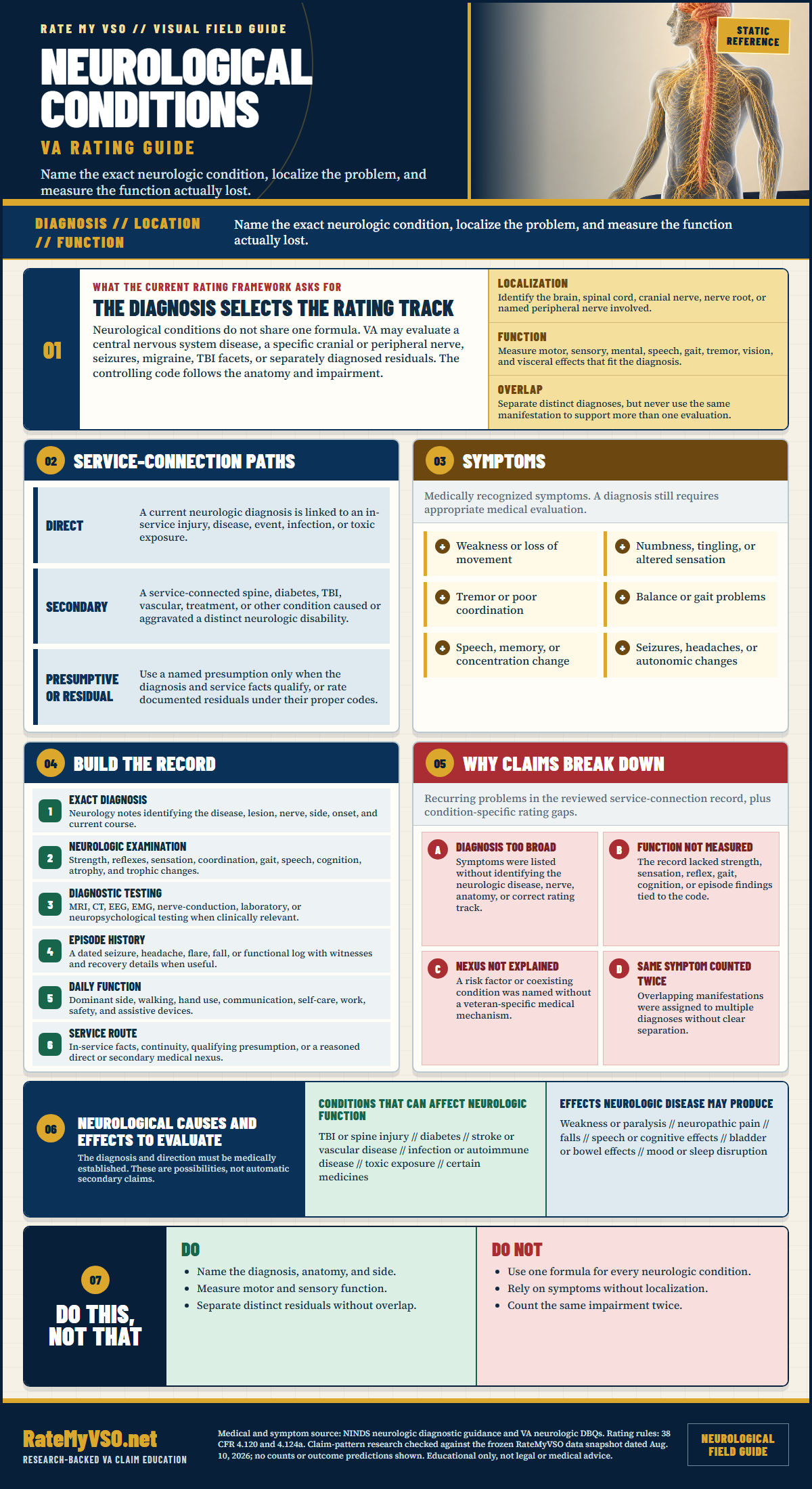 One-page guide: Neurological Conditions Rating Guide in One Page
Neurological-system guide covering code selection, localization, motor, sensory and mental function, service-connection paths, symptoms, diagnostic testing, evidence, residuals, and common claim gaps. Opens the full-size chart, free to save or print.
One-page guide: Neurological Conditions Rating Guide in One Page
Neurological-system guide covering code selection, localization, motor, sensory and mental function, service-connection paths, symptoms, diagnostic testing, evidence, residuals, and common claim gaps. Opens the full-size chart, free to save or print.
The Rules That Decide Every Neurological Claim
Neurological conditions cover a wide range, from nerve damage in an arm or leg, to seizures, to migraines, to the lasting effects of a head injury. They look different, but the same schedule (38 CFR § 4.124a) rates almost all of them, and a small set of rules decides how. Understand these five ideas and you can read any neurological rating on the schedule.
1. Nerve conditions are rated on the nerve and the degree of paralysis
A peripheral nerve condition is rated on the specific nerve affected and how complete the paralysis is. Complete paralysis of a nerve carries a set rating for that nerve. Anything less is incomplete paralysis, graded mild, moderate, or severe. Neuritis (an inflamed, painful nerve) and neuralgia (nerve pain without the inflammation) are rated on the same nerve scales. Each nerve, for example the sciatic, median, ulnar, radial, or peroneal, has its own diagnostic code and its own maximum rating, so the nerve involved sets the ceiling before the degree of paralysis sets the level.
2. The rating follows the function lost, not the diagnosis label
What raises a nerve rating is how much function you have lost, not the name of the diagnosis. Sensory-only loss (numbness, tingling, altered sensation) generally caps at a lower level than loss that also includes muscle weakness, wasting, or atrophy. Two veterans with the same diagnosis on paper can land at very different ratings because one has motor loss and the other does not. This is why an exam that documents strength and muscle wasting, not just where it feels numb, matters so much.
3. Seizure disorders are rated by type and frequency over time
Convulsive disorders are rated under epilepsy, grand mal (DC 8910) and petit mal (DC 8911), on the type and frequency of seizures over time. Major (grand mal) and minor (petit mal) seizures are counted separately, because they weigh differently in the schedule. The whole rating stands or falls on frequency, so a reliable, witnessed seizure diary, dates, type, and duration, is what the rating is built on. Seizures are unpredictable and rarely happen in front of an examiner, which is exactly why the written record does the work.
4. Migraine and headaches are rated by how often they are "prostrating"
Migraine and other headaches (DC 8100) are rated by how often "prostrating" attacks occur. A prostrating attack is one that produces extreme exhaustion or powerlessness and stops ordinary activity. Lying down in a dark room can be evidence of severity, but it is not a separate words-in-the-regulation requirement. Ordinary headaches you can work through do not drive the rating. The schedule looks at how frequently the prostrating attacks come, how long they last, and how much they interfere with work, so the useful evidence is a dated log of the disabling attacks, not a count of every headache.
5. TBI residuals are rated across facets, highest facet sets the rating
Traumatic brain injury residuals (DC 8045) are rated across three areas of function: cognitive, emotional or behavioral, and physical. The examiner assigns a level to each measurable facet (memory, judgment, social interaction, and so on), and the single highest facet level sets the overall rating. Just as important, any residual that can be separately diagnosed, for example migraines or a mood disorder that grew out of the injury, is rated under its own diagnostic code rather than folded into the TBI rating. This keeps the schedule from double-counting (pyramiding) while making sure every distinct residual is captured.
Choose the Neurological Rating Lane and Localize the Disability
Neurological claims start with localization: which nerve, which disease, which residual. Find the lane, then document what that lane actually reads:
| Rating lane | What controls | Records that show it |
|---|---|---|
| Peripheral nerve | What controlsExact nerve, side and dominant hand when applicable, sensory loss, motor loss, reflexes, atrophy, and incomplete or complete paralysis. Wholly sensory involvement is Mild, or at most moderate, under the schedule's general rule | Records that show itNeurological examination, strength, sensation and reflex findings, nerve testing when medically indicated, functional record |
| Cranial nerve | What controlsThe exact cranial nerve and the loss of motor, sensory, or organ function it causes | Records that show itCranial-nerve examination and condition-specific eye, ear, speech, swallow, or facial findings |
| Migraine or headache | What controlsFrequency of characteristic prostrating attacks, duration, treatment, and occupational effect; the 50-percent level also requires very frequent, completely prostrating and prolonged attacks productive of severe economic inadaptability | Records that show itDated attack log, treatment records, work or ordinary-activity effect, clinician assessment |
| Seizure disorder | What controlsType and verified frequency over time; competent and consistent lay evidence can establish frequency (see 38 CFR § 4.121) | Records that show itMedical diagnosis, treatment, witnessed descriptions, a consistent seizure record, hospitalization when applicable |
| Central or degenerative disease | What controlsActive disease, the code's minimum rule, progression, and distinct residuals | Records that show itNeurological diagnosis, imaging and testing as medically indicated, serial examinations, mobility and function |
| Traumatic brain injury | What controlsHighest facet for cognitive and other unclassified residuals, plus separate evaluation of distinct diagnoses without rating the same manifestation twice | Records that show itTBI examination, cognitive testing, mental-health and neurologic evaluation, residual-specific examinations |
Track detail: migraines, TBI, carpal tunnel, sciatica and radiculopathy, and restless legs.
Neurological Disease Can Produce Residuals Across the Body
A nervous-system diagnosis often shows up as a problem somewhere else. Each residual has to be distinguished and documented where it is evaluated:
| Residual group | Examples to distinguish | Rating location |
|---|---|---|
| Motor and sensory | Examples to distinguishWeakness, paralysis, numbness, pain, atrophy | Rating locationThe exact peripheral or cranial nerve, or the disease code |
| Gait and balance | Examples to distinguishFalls, ataxia, dizziness, assistive devices | Rating locationThe neurological or vestibular code as applicable |
| Speech and swallowing | Examples to distinguishDysarthria, aphasia, dysphagia | Rating locationThe distinct diagnosis or the applicable neurologic residual code |
| Vision, hearing, smell, and taste | Examples to distinguishSensory loss tied to the neurologic disease or to TBI | Rating locationThe appropriate eye, ear, or neurologic code |
| Cognition and mood | Examples to distinguishMemory, judgment, executive function, a diagnosed mental disorder | Rating locationA TBI facet or a separate mental diagnosis, without rating the same manifestation twice |
| Bladder and bowel | Examples to distinguishNeurogenic bladder, incontinence, bowel dysfunction | Rating locationThe appropriate genitourinary or digestive code when distinctly diagnosed |
| Autonomic and endocrine | Examples to distinguishBlood-pressure regulation, sweating, hormone deficiency, other autonomic effects | Rating locationThe applicable body-system code with competent relationship evidence |
Neurological Presumptions Are Disease-Specific, Not System-Wide
There is no presumption for nervous-system conditions as a group. Each rule below names its own disease and its own service requirements:
| Disease or route | Current rule to explain |
|---|---|
| Amyotrophic lateral sclerosis | Current rule to explainALS developing at any time after separation is enough to establish service connection, subject to the exceptions, which include willful misconduct, affirmative evidence against incurrence, and a requirement of 90 days or more of continuous active service (see 38 CFR § 3.318) |
| Multiple sclerosis | Current rule to explainThe chronic-disease framework uses a seven-year manifestation period rather than the ordinary one year (see 38 CFR § 3.307 and § 3.309) |
| Other listed chronic nervous-system disease | Current rule to explainThe exact disease and its applicable manifestation period control. A neurological symptom by itself is not a system-wide presumption |
| Parkinson's disease or Parkinsonism | Current rule to explainCurrent VA herbicide-presumptive lists apply when the exposure and service requirements are met |
| Specified conditions after traumatic brain injury | Current rule to explainParkinsonism, unprovoked seizures, specified dementias, depression, and certain hormone-deficiency diseases are held proximately due to a service-connected moderate or severe TBI under the regulation's severity and time limits (see 38 CFR § 3.310(d)). Conditions outside those exact rules use the ordinary secondary-evidence path |
| Direct or secondary | Current rule to explainA current diagnosis, the relevant service or service-connected condition, and competent evidence connecting them |
Find the Guide for Your Condition
The rules above apply across the board. For the exact rating levels, the C&P exam, and the Board data for your specific condition, open the dedicated guide:
| Area | Guide | DC codes |
|---|---|---|
| Traumatic brain injury (TBI) | TBI Claims Guide | 8045 |
| Migraine and headaches | Migraine Claims Guide | 8100 |
| Carpal tunnel (median nerve) | Carpal Tunnel Guide | 8515 |
| Sciatica and radiculopathy | Sciatica & Radiculopathy Guide | 8520 |
Most peripheral-nerve codes (the 8510 to 8540, 8610 to 8640, and 8710 to 8740 ranges) rate by incomplete paralysis graded mild, moderate, or severe; seizure disorders sit at 8910 and 8911. For any code not listed, open its condition lookup page for the rating levels and Board data.
Every Neurological Diagnostic Code, With Board Outcomes
Every diagnostic code in this body system, ordered by how often it reaches the Board of Veterans' Appeals. Percentages are the share of each code's Board issues granted, denied, or remanded (sent back for more development); dismissed and other outcomes are not shown, so rows do not sum to 100%. Each code links to its full page: rating criteria, evidence notes, and secondary-condition data.
Show 46 more codes with too few Board appeals to report (expand)
Counts from RateMyVSO's index of published BVA decisions, refreshed weekly. A remand is not a loss; it means the Board needed more evidence before deciding. Descriptive of the published record, not a prediction for any claim.
Common Secondary Conditions
Nerve conditions are unusual in that they are just as often the secondary claim as the primary one. A nerve problem frequently traces back to another service-connected condition, and a brain or nerve injury in turn opens the door to further secondary claims:
- Peripheral neuropathy secondary to diabetes. Diabetic nerve damage in the hands and feet is one of the most common secondary claims, flowing from a service-connected diabetes rating.
- Radiculopathy secondary to a spine condition. A service-connected back or neck disability that pinches a nerve root produces radiating leg or arm pain, rated separately under the nerve codes. See the lumbar spine guide and the sciatica guide.
- Depression or anxiety secondary to chronic pain or TBI. Long-term nerve pain and the lasting effects of a head injury drive mental-health conditions, which can be claimed as secondary. See secondary conditions.
- Migraines secondary to TBI or a neck injury. Headaches that begin after a head or neck injury are commonly rated as secondary to that injury under DC 8100.
Each dedicated guide above shows the live Board grant rates for that condition's most common secondary pairings.
Records That Show What the Schedule Measures
A neurological file has to localize the disability and describe function. Beyond the complete report fields above, these are the records each lane leans on:
- Nerve conduction studies and EMG for neuropathy. These objective tests help identify which nerve is affected and distinguish sensory from motor loss. The rating still follows the complete clinical record, strength, reflexes, sensation, atrophy, pain, and functional loss, so they strengthen a claim without being a universal prerequisite.
- A witnessed seizure log that records date, type (major or minor), duration, recovery, witness, and treatment. Because seizures rarely happen in front of an examiner, competent and consistent lay evidence can establish frequency (38 CFR 4.121); the strongest diary carries those details, though the record as a whole still has to hold together.
- A prostrating-attack headache diary, tracking how often the disabling attacks come and what you cannot do during them, so the examiner can rate the frequency the schedule asks about.
- Neuropsychological testing for TBI, which measures the cognitive facets (memory, attention, judgment) that set the residual rating.
- Imaging and disease-specific testing where the diagnosis calls for it, plus serial examinations for a progressive condition, so the record shows the course over time rather than one visit.
- A residual inventory across systems, documenting gait, balance, speech, swallowing, vision, hearing, bladder or bowel, and autonomic findings in the body system that evaluates each one.
- The matching DBQ for the condition, which prompts the examiner to capture the right findings. See the DBQ guide.
Evidence Cited in Published Migraines Decisions
We analyzed 70,852 published Board decisions involving migraines for condition-specific evidence, counting only case-specific mentions (boilerplate recitations excluded). "Favorable" is the share of decisions citing that evidence where every issue was granted or the outcome was mixed; the baseline across all these decisions is 60%. Evidence appearing in a decision does not mean it decided the case. Descriptive of the published record, not a prediction.
Bar length shows decisions citing the evidence.
Evidence Cited in Published Traumatic brain injury Decisions
We analyzed 24,825 published Board decisions involving traumatic brain injury for condition-specific evidence, counting only case-specific mentions (boilerplate recitations excluded). "Favorable" is the share of decisions citing that evidence where every issue was granted or the outcome was mixed; the baseline across all these decisions is 55.6%. Evidence appearing in a decision does not mean it decided the case. Descriptive of the published record, not a prediction.
Bar length shows decisions citing the evidence.
Evidence Cited in Published Sciatic nerve (radiculopathy) Decisions
We analyzed 63,783 published Board decisions involving sciatic nerve (radiculopathy) for condition-specific evidence, counting only case-specific mentions (boilerplate recitations excluded). "Favorable" is the share of decisions citing that evidence where every issue was granted or the outcome was mixed; the baseline across all these decisions is 64%, combining every diagnostic code below. Evidence appearing in a decision does not mean it decided the case. Descriptive of the published record, not a prediction.
Bar length shows decisions citing the evidence.
By diagnostic code
These codes are grouped together above. They do not perform the same, so find your own code here rather than reading the combined figure. A code retired in the schedule rewrites appears without a link, because its decisions were judged under criteria that no longer apply.
Bar length shows published decisions reviewed.
Evidence Cited in Published Parkinson's disease Decisions
We analyzed 5,286 published Board decisions involving parkinson's disease for condition-specific evidence, counting only case-specific mentions (boilerplate recitations excluded). "Favorable" is the share of decisions citing that evidence where every issue was granted or the outcome was mixed; the baseline across all these decisions is 50.7%. Evidence appearing in a decision does not mean it decided the case. Descriptive of the published record, not a prediction.
Bar length shows decisions citing the evidence.
Detected by phrase-reading the decision text with condition-specific vocabularies. Source: Board of Veterans' Appeals decisions, RateMyVSO analysis.
Symptoms Recorded in Granted Migraines Decisions
We analyzed 6,219 granted Board decisions involving migraines for symptoms named in sentences about the condition (rating-criteria recitations excluded). Descriptive of the published record, what the Board wrote down, not a checklist of what to report.
Bar length shows decisions. Percentages remain context.
Symptoms Recorded in Granted Traumatic brain injury Decisions
We analyzed 1,502 granted Board decisions involving traumatic brain injury for symptoms named in sentences about the condition (rating-criteria recitations excluded). Descriptive of the published record, what the Board wrote down, not a checklist of what to report.
Bar length shows decisions. Percentages remain context.
Symptoms Recorded in Granted Sciatic nerve (radiculopathy) Decisions
We analyzed 5,283 granted Board decisions involving sciatic nerve (radiculopathy) for symptoms named in sentences about the condition (rating-criteria recitations excluded). Descriptive of the published record, what the Board wrote down, not a checklist of what to report.
Bar length shows decisions. Percentages remain context.
Symptoms Recorded in Granted Parkinson's disease Decisions
We analyzed 965 granted Board decisions involving parkinson's disease for symptoms named in sentences about the condition (rating-criteria recitations excluded). Descriptive of the published record, what the Board wrote down, not a checklist of what to report.
Bar length shows decisions. Percentages remain context.
Detected by phrase-reading the decision text with condition-specific vocabularies. Source: Board of Veterans' Appeals decisions, RateMyVSO analysis.
Common Mistakes
- Claiming "headaches" without documenting prostrating frequency. DC 8100 rates how often prostrating attacks occur, attacks of extreme exhaustion or powerlessness that stop ordinary activity. A claim that describes headaches but never records those attacks gives the examiner nothing to rate.
- A thin clinical record for neuropathy. EMG and nerve-conduction testing can help identify the affected nerve and distinguish sensory from motor loss, but the regulation does not make them a universal prerequisite; the rating follows the complete clinical record. What sinks claims is a record with no measured strength, reflexes, sensation, or functional loss at all.
- Letting a TBI absorb separately-ratable residuals. Migraines, a mood disorder, or other distinct residuals of a head injury are rated under their own codes, not folded into the TBI rating. Rolling them together can cost a higher combined rating.
- Not connecting the nerve condition to its cause. Neuropathy tied to diabetes, or radiculopathy tied to the spine, is a secondary claim. Filing the nerve condition on its own, without linking it, misses the connection the schedule rewards.
- No seizure diary. Frequency is the whole rating for a seizure disorder. With no witnessed log of dates and type, the frequency, and therefore the rating, is left unproven.
Frequently Asked Questions
How does the VA rate nerve damage?
What makes a headache "prostrating"?
How is epilepsy rated?
How are TBI residuals rated?
Is nerve-conduction or EMG testing always required?
Are all neurological diseases presumptive?
Is neuropathy from diabetes ratable?
Related Tools and Guides
Sources: 38 CFR 4.124a, neurological conditions and convulsive disorders. Educational only, not legal advice, and not a prediction of any individual claim. Rating criteria and case law change; confirm current details in 38 CFR Part 4. For help with your claim, find a VA-accredited representative.