Skin Conditions (Dermatitis and Eczema) Claims Guide
Chronic skin conditions like dermatitis, eczema, and psoriasis are rated in an unusual way: the VA looks at how much of your body is affected and what treatment it takes to control, then pays on whichever is higher. This guide walks the whole path: how service connection works, how a skin condition gets connected to your service (directly, through a toxic exposure, secondary to another condition, or by aggravation), how DC 7806 is rated, the flare-up timing that can make or break the exam, the evidence that wins, why these claims get denied, a checklist before you file, what the claims process looks like step by step, and what to do whether you win or you're denied.
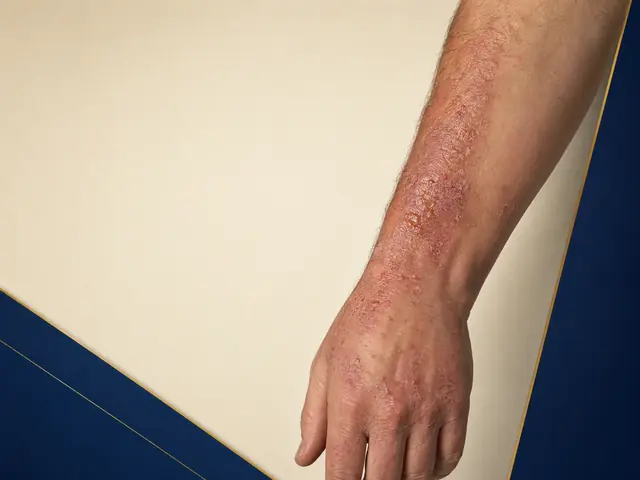
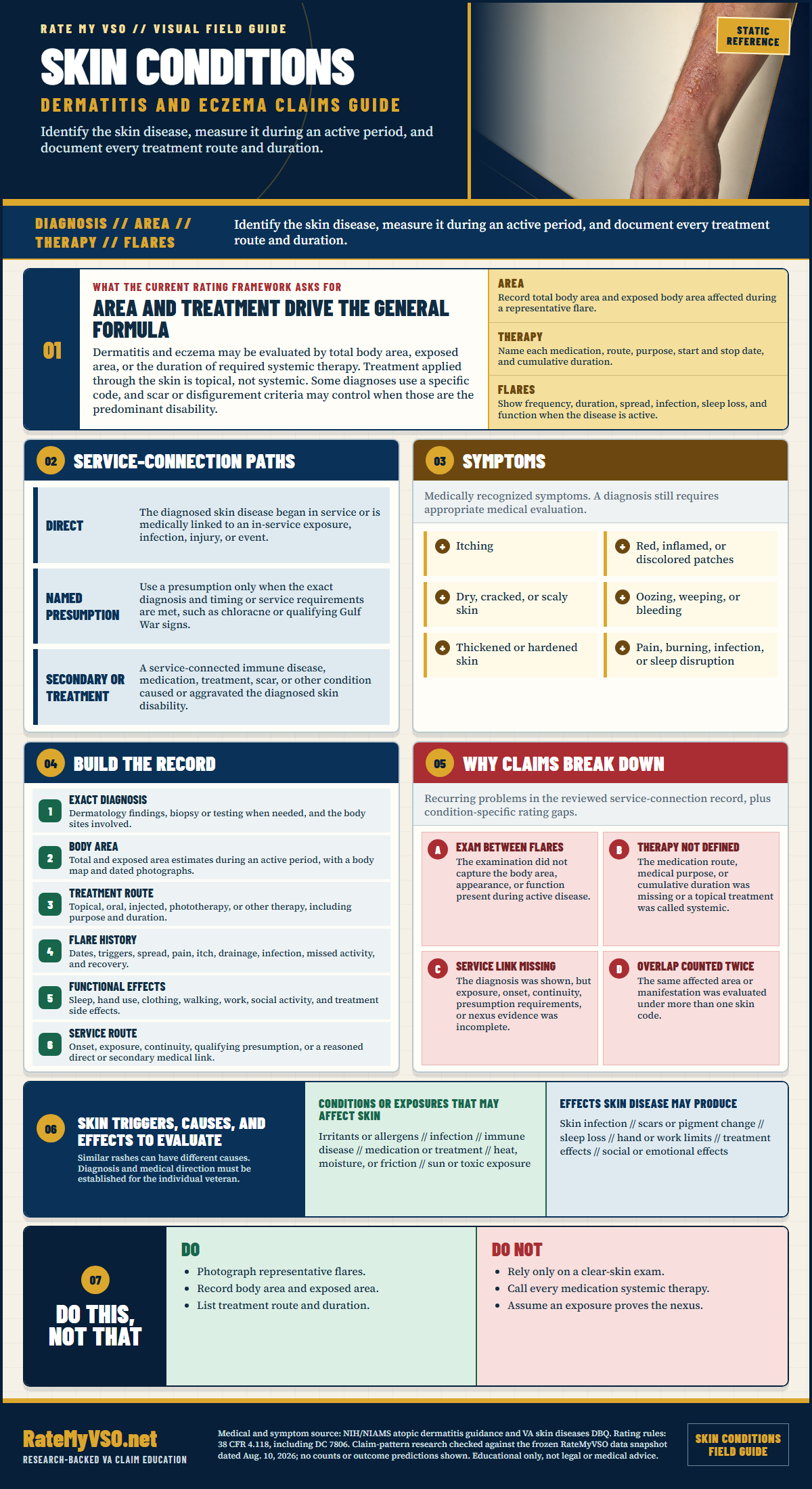 One-page guide: Skin Conditions and Eczema Claims in One Page
Skin conditions and eczema guide covering diagnosis, body and exposed area, topical and systemic therapy, flares, service paths, symptoms, evidence, overlap rules, and common claim gaps. Opens the full-size chart, free to save or print.
One-page guide: Skin Conditions and Eczema Claims in One Page
Skin conditions and eczema guide covering diagnosis, body and exposed area, topical and systemic therapy, flares, service paths, symptoms, evidence, overlap rules, and common claim gaps. Opens the full-size chart, free to save or print.
Overview
Most chronic rashes are rated as dermatitis or eczema, diagnostic code 7806, under the skin schedule (see 38 CFR § 4.118). The same rating framework covers several related conditions, and many of them point back to DC 7806 for how they are scored. Skin cases have a twist that other conditions don't: rashes come and go, so proving you still have the condition, and that it started in or was caused by service, is often the hardest part of the claim.
Disfiguring scars of the head, face, or neck are rated separately under the scar codes. See the scars and burns guide.
Types of Skin Conditions Covered
- Eczema and dermatitis: DC 7806, the most commonly claimed code in this group, and the one this guide focuses on.
- Psoriasis: DC 7816, rated on the same body-area and systemic-therapy scale as DC 7806.
- Fungal infections and ringworm (tinea): DC 7813, including tinea pedis (athlete's foot), tinea cruris, and tinea versicolor.
- Other skin infections and disorders: DC 7820 and neighboring codes, including folliculitis and seborrheic dermatitis.
- Chloracne: an acne-like condition specifically linked to Agent Orange and other herbicide exposure, discussed in the toxic-exposure pathway below.
A single claim can involve more than one of these codes at once, for example atopic dermatitis alongside folliculitis, or a rash alongside plantar xerosis (dry, cracked skin sometimes called "jungle rot"). Diagnosis requires a clinician's examination; a veteran's report of a rash alone, without any exam findings, is not enough to establish a current disability.
How Service Connection Works, At a High Level
Before getting into the specific pathways below, it helps to understand the three things every skin condition claim ultimately has to show on a direct basis. This is the same basic test that applies to any VA disability claim, just applied to skin conditions.
- A current diagnosis, or a current impairment. You need a skin condition now, or at some point during your claim. VA treats this as the foundation of the claim, and many claims are lost only because the skin looked normal at the exam. Even without a formal diagnosis, ongoing symptoms that impair your ability to work can count as a disability.
- An in-service event, or a service-connected condition behind it. Service records showing a rash, dermatitis, chemical or fungal irritation, or a shaving problem, or credible statements that symptoms began in service, or a disability VA has already service-connected that caused or worsened the skin condition.
- A medical nexus. Evidence tying today's skin condition back to service. For a skin condition specifically, a veteran's own credible report of continuous symptoms since service can help supply this link, because rashes and itching are things anyone can see and describe.
What VA Looks For: Tests, Records, and Diagnostic Codes
Whether you are filing directly, on a toxic-exposure theory, or secondary to another condition, the record VA actually reviews centers on a small set of documents and data points.
- Exam findings during an active flare: the single biggest reason skin claims fail is that the exam happened to fall on a day the skin was clear, so there was nothing to measure. See the flare-up rule below.
- Body-surface-area documentation: the percentage of the whole body affected, and separately the percentage of exposed areas (face, neck, hands) affected, since the rating uses whichever is higher. This measurement, taken during a flare, is the single most important data point in the file.
- Treatment records: what medication or therapy was used, whether it was topical (a cream applied to the skin) or systemic (a pill, injection, biologic, or light/PUVA therapy that acts on the whole body), and the total time on it over the past 12 months.
- Service treatment records: documented in-service rashes, dermatitis, folliculitis, chemical or fungal irritation, or a shaving-related skin problem.
- The diagnostic codes involved: DC 7806 for dermatitis and eczema, DC 7816 for psoriasis, DC 7813 for tinea, or the scar codes if the condition is a disfiguring scar rather than an active skin disease.
- The actual form the examiner fills out: the Skin Diseases Disability Benefits Questionnaire (DBQ), discussed in more detail later in this guide.
Service Connection Pathways
Across published DC 7806 decisions, here is how often the Board granted by the legal theory the claim was argued on:
Direct Service Connection
A veteran demonstrates that a skin condition began during or was caused by active military service. Supporting evidence includes service treatment records documenting a rash, dermatitis, chemical or fungal irritation, or a shaving-related skin problem, and a nexus connecting today's diagnosis to what happened in service. Because rashes and itching are visible symptoms, a veteran's own credible, consistent report that symptoms have continued since service can itself help supply the medical link. See our Service Connection Guide.
Toxic Exposure (Agent Orange, Gulf War, Burn Pits)
Some skin conditions are tied to a specific service exposure. Chloracne, an acne-like eruption, is linked to Agent Orange and other herbicide exposure. Unexplained chronic rashes in Gulf War veterans can be claimed as an undiagnosed illness. See Agent Orange and the Gulf War illness guide.
Secondary Service Connection (38 CFR § 3.310)
A skin condition caused or worsened by another already service-connected condition, or by the medication used to treat it, can be covered under this pathway. You still have to prove you currently have the skin condition; a secondary theory does not excuse the current-disability requirement. See our Secondary Conditions Guide.
Aggravation of a Pre-Service Condition (38 CFR § 3.306)
If a skin condition existed before you joined but was noted at enlistment and then worsened during service beyond its natural course, VA presumes the condition was aggravated by service. VA can only defeat that presumption with "clear and unmistakable" evidence, a very high bar to meet. Point to the entrance exam findings and to every in-service flare or treatment record showing the worsening.
The Two Rating Paths (This Is the Whole Game)
DC 7806 gives you two ways to reach a rating, and the VA uses whichever is higher:
- How much skin is affected: the percentage of your entire body or of exposed areas (face, neck, hands) covered by the condition.
- What treatment it takes: the total time over the past 12 months you needed systemic therapy, corticosteroids or other immunosuppressive drugs, biologics, or light/PUVA therapy that act on the whole body.
How the VA Rates Dermatitis and Eczema (DC 7806)
Skin conditions are rated under DC 7806 and the General Rating Formula for the Skin (38 CFR § 4.118), based on the two things covered above: how much of your body is affected, and what kind of treatment you need. Take the higher of the two paths.
Psoriasis (DC 7816) uses the same body-area and systemic-therapy scale. Some skin conditions rated as scars or disfigurement are scored under the scar codes instead; see the scars and burns guide.
Symptoms Recorded in Granted Skin conditions Decisions
We analyzed 3,025 granted Board decisions involving skin conditions for symptoms named in sentences about the condition (rating-criteria recitations excluded). Descriptive of the published record, what the Board wrote down, not a checklist of what to report.
Bar length shows decisions. Percentages remain context.
Detected by phrase-reading the decision text with condition-specific vocabularies. Source: Board of Veterans' Appeals decisions, RateMyVSO analysis.
- What the VA measures at your C&P exam
- Evidence that has won at the Board
- Inside the rater's playbook: grant, denial, and remand rates
- Secondary condition map
The Flare-Up Rule (Time the Exam Right)
Keep dated photographs of your skin during flares and note how often they happen and how long they last. That record helps show the true extent when the exam happens to fall on a good day, and it is also the strongest counter-evidence if a VA exam undercounts your coverage.
Evidence That Wins
- Exam findings during an active flare. Try to be seen by a doctor while your skin is actively broken out, and make sure the flare and the affected body areas are written into the record. This is the single most effective thing you can do for a skin claim.
- A treatment record showing systemic therapy, the drug, the dose, and the total time on it over the past year, since that path can carry a higher rating than body area alone.
- A body-area measurement of the percentage of the whole body and of exposed areas affected, taken during an active flare.
- Dated flare photographs and a log of how often and how long flares last, to counter an exam done on a clear day.
- Service treatment records showing a rash or skin treatment. In-service documentation of dermatitis, folliculitis, chemical or fungal irritation, or treatment for a rash or athlete's foot is powerful corroboration. Request your complete service treatment records and flag every skin entry.
- A clear, unbroken statement of continuous symptoms. A credible personal statement that a rash or itch began in service and has continued since, with no gaps, can carry real weight on its own for a visible condition like a skin disease.
- A nexus opinion linking the condition to service, a toxic exposure, or another service-connected condition. An opinion that explains its reasoning and, where relevant, cites supporting medical literature applied to your own facts carries far more weight than a bare conclusion; VA gives an opinion weight based on the quality of its reasoning, not just who wrote it. See our Nexus Letters Guide.
- The Skin Diseases DBQ, which records the coverage, the treatment, and the flare pattern the rating depends on. See the DBQ guide.
Evidence Cited in Published Skin conditions Decisions
We analyzed 59,885 published Board decisions involving skin conditions for condition-specific evidence, counting only case-specific mentions (boilerplate recitations excluded). "Favorable" is the share of decisions citing that evidence where every issue was granted or the outcome was mixed; the baseline across all these decisions is 50.9%, combining every diagnostic code below. Evidence appearing in a decision does not mean it decided the case. Descriptive of the published record, not a prediction.
Bar length shows decisions citing the evidence.
By diagnostic code
These codes are grouped together above. They do not perform the same, so find your own code here rather than reading the combined figure. A code retired in the schedule rewrites appears without a link, because its decisions were judged under criteria that no longer apply.
Bar length shows published decisions reviewed.
Detected by phrase-reading the decision text with condition-specific vocabularies. Source: Board of Veterans' Appeals decisions, RateMyVSO analysis.
Why These Claims Get Denied
Beyond the general "no nexus" reasons, a few specific denial patterns show up often enough in published skin-condition decisions to call out on their own.
- No skin disability at the time of the claim. Several claims failed only because the exam found normal skin and the earlier condition had resolved. VA cannot grant service connection for a symptom that is not present at some point during the claim.
- Relying only on a toxic-exposure or burn-pit theory. VA conceding participation in a Toxic Exposure Risk Activity gets you an exam, not a win. Examiners have repeatedly found no medical link between service toxins and multifactorial skin diseases like psoriasis, eczema, and dermatitis when no other evidence supported the claim.
- Denying a skin problem at separation, then later claiming it started in service. When a veteran's separation paperwork denied any skin disease, the Board has treated that contemporaneous denial as more reliable than a later claim of in-service onset. Inconsistencies between old records and current statements badly hurt credibility.
- Waiting years to seek treatment or file. Long gaps undercut a claim of continuous symptoms. Decisions have noted first treatment more than a decade after service, and have reasoned that a veteran who knew about VA benefits but did not file earlier likely was not experiencing symptoms.
- Trying to prove the medical cause yourself. For complex skin and autoimmune conditions, VA does not accept a veteran's own opinion on what caused the condition; causation is a medical question that needs a clinician. You are always competent to describe your symptoms, but get a clinician to address cause.
- Submitting key evidence after the appeal's evidence window closed. Under the Appeals Modernization Act, each review lane has a strict evidence window. Records showing a rash returned have been excluded because they arrived after the decision under review, even though the proof existed. Know your deadline and submit inside it.
Pitfalls and Common Mistakes
The same handful of missteps account for most lost or under-rated skin claims. Among the Board's classified service-connection denials for dermatitis and eczema, here is what claims most often fell short on:
- Being examined on a clear day. A condition that flares must be assessed during an active phase. An exam during a quiet period undercounts the coverage and the rating.
- Not documenting systemic therapy. The treatment path can pay more than body area, but only if the record shows the drug and the total time on it over the past 12 months.
- Confusing topical with systemic. A cream on a patch of skin is generally not systemic therapy. Know which path your evidence actually supports before you argue the rating.
- Measuring only the whole body. The rating uses the higher of whole-body or exposed-area coverage. A condition concentrated on the face and hands can rate higher on the exposed-area measure.
- Missing the exposure or secondary link. For toxic-exposure or secondary claims, a missing nexus is a leading denial reason. Connect the condition to the exposure, service, or the other service-connected condition.
- Letting your onset story shift. When a veteran's account of when symptoms began changes between statements and exams, that inconsistency itself becomes a reason for denial.
Do's and Don'ts
A condensed version of everything above, in the order it actually matters when you sit down to build your file.
- Get examined while your skin is actively broken out, and make sure the affected body areas are recorded.
- Request your complete service treatment records and flag every rash, dermatitis, fungus, or shaving entry.
- Write a clear statement that your symptoms began in service and have continued since, with no gaps.
- Line up a private nexus opinion that explains its reasoning and, where possible, cites medical literature.
- If a skin condition existed before service and got worse, gather your entrance exam and every in-service flare to argue aggravation.
- Document how much skin is affected during your worst flares, and exactly which treatments you use and for how long.
- Track your appeal's evidence deadline and submit all supporting records inside that window.
- If you were denied before, file a Supplemental Claim with new and relevant evidence rather than starting over.
- Don't assume a diagnosis is guaranteed, or that a past rash by itself is enough; the skin condition has to be present at some point during the claim.
- Don't rely only on a toxic-exposure or burn-pit theory. Pair it with in-service symptoms or a solid nexus opinion.
- Don't deny a skin problem at separation and then say it started in service; the inconsistency will be used against you.
- Don't wait years to seek treatment or file; long gaps undercut a claim of continuous symptoms.
- Don't try to prove the medical cause of a complex skin condition yourself, get a clinician to address it.
- Don't submit key evidence after your appeal's evidence window has closed.
- Don't confuse a topical cream with systemic therapy when arguing which rating path applies.
Common Secondary Conditions
Skin conditions connect to other claims in both directions, often through a shared exposure or a treatment side effect. Each bar below is the Board's grant rate for DC 7806 in that pairing, with the number of decisions under it. They describe the published record across many veterans, not a prediction about any one claim.
Conditions linked as causing the skin condition (dermatitis as the secondary)
Claims where the skin condition was argued as secondary to an already service-connected condition. This is the "ways to connect via another condition" list, and it's often the easier route into a grant:
Conditions the skin condition is linked to causing (dermatitis as the primary)
Conditions veterans have claimed as caused or aggravated by a service-connected skin condition:
Quick Checklist Before You File
Bring these together before you submit anything.
- Get seen by a doctor while your skin is broken out, and make sure the affected body areas are recorded.
- Request your complete service treatment records and mark every rash, dermatitis, fungus, or shaving entry.
- Write a clear statement that your skin symptoms began in service and have continued since, with no gaps.
- Line up a private nexus opinion that explains its reasoning and, if possible, cites medical literature.
- If a rash existed before service, gather your entrance exam and every in-service flare to argue aggravation.
- Do not lean on a toxic-exposure theory alone; add in-service symptoms or a solid medical link.
- Track your appeal's evidence deadline and submit all supporting records inside that window.
- If you were denied before: new and relevant evidence for a Supplemental Claim, not just a repeat of what was already considered.
For the mechanics of actually submitting the claim, see the Standard Claim Guide and the Fully Developed Claim Guide (filing with all your evidence up front can speed up the decision).
The Claims Process, Step by Step
Once you file, your claim moves through a series of hand-offs. Understanding who does what helps you know who to contact, and what to expect, at each stage.
- You file the claim. Directly with VA, through VA.gov, or with the help of an accredited representative.
- VA acknowledges the claim and assigns it for development. A Veteran Service Representative (VSR) is assigned to gather your service treatment records, VA and private medical records, and any other evidence needed.
- The VSR orders a Compensation & Pension (C&P) exam if one is needed. Most skin condition claims do, since the rating depends on measurements (body-area coverage) that only an exam can produce.
- The C&P exam is conducted. By a VA clinician or a contracted examiner, who completes a Skin Diseases Disability Benefits Questionnaire (DBQ) documenting the coverage, the treatment, and, where relevant, a nexus opinion.
- The file goes to a Rating Veteran Service Representative (RVSR), the "rater." The rater reviews the complete file, including the exam results, and decides whether service connection is warranted and at what percentage.
- A senior reviewer may review the decision before it's finalized, depending on the complexity of the claim.
- VA issues the decision letter. This states whether the claim is granted or denied, the rating percentage if granted, and the reasons behind the decision.
- If you disagree, you choose an appeal lane. Higher-Level Review, Supplemental Claim, or a Board appeal, covered later in this guide.
Who's who: VSO vs. VSR vs. Rater vs. C&P Examiner
Your VSO
An accredited representative from a veterans service organization, or an accredited attorney or claims agent. Not a VA employee. Helps you prepare, gather evidence, and file, and can represent you through an appeal. Has no authority to decide your claim.
VSR (Veteran Service Representative)
VA staff who "develops" your claim: requests records, schedules the C&P exam, and assembles the file. Does not decide the rating.
Rater (RVSR)
VA staff who reviews the completed file and makes the actual decision, service connection or denial, and the percentage. This is the person whose judgment the decision letter reflects.
C&P Examiner
A VA clinician or a contracted medical examiner who conducts the exam and completes the DBQ. Documents findings and, where asked, a nexus opinion. Does not decide the claim.
For the full walkthrough of every stage with more detail, see Inside Your Claim and Claim Stages.
DBQs and Your C&P Exam
The Skin Diseases Disability Benefits Questionnaire (DBQ) is the standardized form an examiner completes for your condition, it structures the exam findings into the specific data points VA's rating schedule requires (for skin conditions, that means the percentage of the whole body and of exposed areas affected, and the type and duration of any treatment). See the DBQ Guide for how these forms work, including whether a private DBQ completed by your own doctor can be submitted instead of relying solely on a VA exam.
Before your C&P exam, try to schedule it, or reschedule it, for a time your skin is actively flaring. Bring a clear, specific account of your worst flares, not just how your skin looks on an average day, and be consistent with what's already in your medical records and prior statements. For a full walkthrough of what to expect and how to prepare, see the C&P Exam Prep Guide.
Reading Your Decision Letter, and What to Do If Denied
Your decision letter has two parts: a narrative section explaining the reasoning (often called "reasons and bases"), and a codesheet showing the actual rating percentage, the effective date, and the diagnostic code used. See the Reading Your Decision Letter Guide for how to find and interpret each part, or use the Letter Interpreter tool to upload your own letter and get a plain-English breakdown.
If your claim is denied, or the rating is lower than you expected, you have three main lanes:
- Supplemental Claim: refile with new and relevant evidence, such as a new nexus opinion, updated flare photographs, or a body-area measurement taken during an active flare. See Supplemental Claim Guide.
- Higher-Level Review (HLR): a senior reviewer looks at the same evidence again for a difference of opinion, no new evidence is added. See HLR Guide.
- Board Appeal: your case goes to a Veterans Law Judge at the Board of Veterans' Appeals, with options for a direct review, an evidence docket, or a hearing. See Board Appeal Guide.
Not sure which lane fits your situation? See the Appeals decision guide for a side-by-side comparison of all three. Remember that each lane has its own evidence-submission window; missing it is one of the more common, and avoidable, reasons a strong claim still loses.
After You Win: Getting the Right Rating and Maintaining It
The effective date for a skin condition is generally tied to the date of your claim, so filing sooner protects back pay. If your rating percentage or effective date is wrong, that is its own dispute, separate from service connection itself, and follows the same appeal lanes described above.
A grant is not always the end of the story. Keep records of how much skin is affected during your worst flares and exactly which treatments you use and for how long, since a future increased-rating claim, or a reexamination, will turn on those same two facts. Continued follow-up with a treating provider, and consistent documentation of flares, protects you if VA schedules a future reexamination. Not every rating gets reexamined; understand when a rating becomes protected from future review (including Permanent and Total status) and what to do if VA proposes to reduce it. See Protect Your Rating and Future Reexaminations for the specifics.
If your skin condition worsens after the initial grant, for example needing constant systemic therapy where you previously needed none, you can file for an increased rating. See the Rating Increase Guide.
Quick Reference Tables
Rating by Body Area or Systemic Therapy (DC 7806)
| Rating | Body area affected | Or systemic therapy in the past 12 months |
|---|---|---|
| 60% | More than 40% of the whole body or of exposed areas | Constant or near-constant systemic therapy |
| 30% | 20 to 40% of the whole body or of exposed areas | Systemic therapy for a total of 6 weeks or more, but not constant |
| 10% | 5 to less than 20% of the whole body or of exposed areas | Systemic therapy for a total of less than 6 weeks |
| 0% | Less than 5% of the whole body and of exposed areas | No systemic therapy needed |
Service Connection Pathways
| Pathway | Mechanism | Evidence Needed |
|---|---|---|
| Direct | Rash, dermatitis, or fungal/chemical irritation documented in service | Service treatment records + nexus, or credible continuity statement |
| Toxic exposure (Agent Orange, Gulf War, burn pits) | Chloracne from herbicide exposure; undiagnosed chronic rash in Gulf War veterans | Exposure documentation + a nexus opinion explaining a specific mechanism, not the exposure theory alone |
| Secondary (38 CFR § 3.310) | Caused or worsened by another service-connected condition or its medication | Current skin diagnosis + nexus tying it to the primary condition or medication |
| Aggravation (38 CFR § 3.306) | Pre-existing condition worsened beyond natural progression by service | Entrance exam findings + in-service flare/treatment records showing the worsening |
From Filing to Decision: Who Does What
| Role | Does | Decides your rating? |
|---|---|---|
| VSO / accredited representative | Helps prepare, gather evidence, and file; represents you on appeal | No |
| VSR | Develops the claim: orders records and the C&P exam | No |
| C&P Examiner | Conducts the exam, completes the DBQ, may give a nexus opinion | No / but has a strong impact |
| Rater (RVSR) | Reviews the full file and decides service connection and percentage | Yes |
Frequently Asked Questions
How does the VA rate eczema?
Does my steroid cream count as systemic therapy?
My C&P exam was on a day my skin was clear. What can I do?
Can I connect my rash to Agent Orange or Gulf War service?
Is a disfiguring scar rated the same way?
What if my skin condition existed before I joined the military?
Do I need a doctor to say my rash started in service?
Sources
- 38 CFR § 4.118, DC 7806, General Rating Formula for the Skin
- 38 CFR § 3.303, basic rules for service connection, including continuity of symptoms (3.303(b)) and disease diagnosed after discharge (3.303(d))
- 38 CFR § 3.304, evidence and soundness on entry
- 38 CFR § 3.306, presumption of aggravation, rebutted only by clear and unmistakable evidence
- 38 CFR § 3.310, Secondary Service Connection
- 38 CFR § 3.102, reasonable doubt / benefit of the doubt; 38 CFR § 4.3, 4.7, reasonable doubt and the higher of two ratings
- 38 CFR § 3.307, 3.309, presumptive and chronic disease rules
- 38 USC § 1110, 1131, basic entitlement to service connection; 38 USC § 1153, aggravation; 38 USC § 1155, disability ratings; 38 USC § 5107(b), benefit of the doubt
- 38 USC § 1119, 1168, PACT Act toxic exposure and Toxic Exposure Risk Activity medical opinions
- Shedden v. Principi, 381 F.3d 1163 (Fed. Cir. 2004), the three-element test for service connection
- Saunders v. Wilkie, 886 F.3d 1356 (Fed. Cir. 2018), pain or impairment alone, without a specific diagnosis, can constitute a current disability
- Nieves-Rodriguez v. Peake, 22 Vet. App. 295 (2008), a medical opinion's probative value comes from its reasoning, not the credentials of who wrote it
- McClain v. Nicholson, 21 Vet. App. 319 (2007), and Romanowsky v. Shinseki, 26 Vet. App. 289 (2013), the current-disability requirement can be met by a diagnosis at any point during the claim, even if resolved by the time of the decision
- Brammer v. Derwinski, 3 Vet. App. 223 (1992), no current disability means no valid claim for service connection
- Johnson v. Shulkin, 862 F.3d 1351 (Fed. Cir. 2017), and Burton v. Wilkie, 30 Vet. App. 286 (2018), what counts as systemic versus topical therapy under DC 7806
- Jandreau v. Nicholson, 492 F.3d 1372 (Fed. Cir. 2007), competency of lay testimony regarding observable symptoms
- Buchanan v. Nicholson, 451 F.3d 1331 (Fed. Cir. 2006), VA cannot rely solely on the absence of records to reject lay evidence of continuity
- CCK Law, eczema and VA disability ratings
- Hill & Ponton, eczema VA disability rating