Knee Claims Guide
The knee is one of the most-claimed VA disabilities, and it is one of the few where a single joint can carry more than one rating at the same time. Instability, lost range of motion, a torn meniscus, and painful motion are compensated under different rules, so a veteran who documents each can stack them. This guide explains the knee diagnostic codes (instability, flexion, extension, meniscus, ankylosis, and replacement), how service connection works, the rule that lets ratings combine without pyramiding, the painful-motion minimum, the evidence that wins, why claims get denied, the claims process step by step, how to read your decision letter, and what to do whether you win or you're denied.
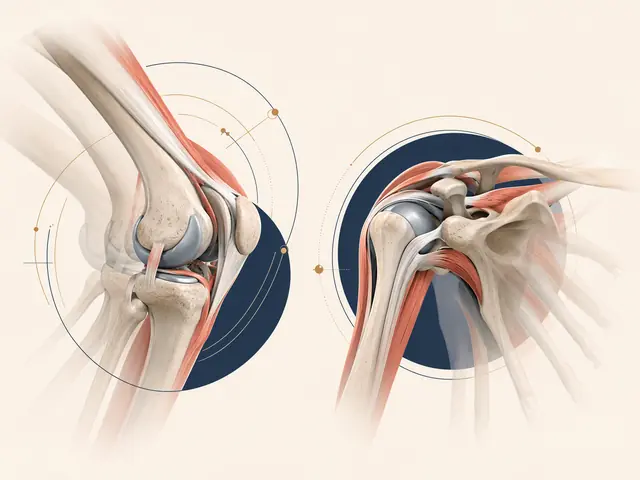
 One-page guide: Knee Claim in One Page
Five-part visual guide to knee claims covering diagnoses, service connection, range of motion, instability, meniscal symptoms, separate rating codes, functional loss, and a filing checklist. Opens the full-size chart, free to save or print.
One-page guide: Knee Claim in One Page
Five-part visual guide to knee claims covering diagnoses, service connection, range of motion, instability, meniscal symptoms, separate rating codes, functional loss, and a filing checklist. Opens the full-size chart, free to save or print.
Start with the essentials
- 01Service Connection
The ways service connection can be established for this condition.
- 02Diagnosis and Evidence
Common symptoms and the evidence cited in published Board appeals.
- 03Your History
What you experienced, what others observed, and what treatment changed.
Understand the claim
Overview
Knee conditions are among the most commonly claimed VA disabilities, most often rated under DC 5257 (instability), DC 5260 (limited flexion), or DC 5261 (limited extension) within 38 CFR § 4.71a. A large share of the Board's published knee decisions involve a knee that is already service connected, where the real fight is over a higher rating, a separate rating for instability or a torn cartilage, an improper rating reduction, or an effective date, not over whether the knee connects to service in the first place. That means many of the lessons in this guide are about proving how bad the knee is and defending a rating you already have, in addition to the basics of winning service connection.
What a Knee Claim Covers
The VA does not rate "a bad knee" as one thing. It rates specific impairments, each with its own diagnostic code under the musculoskeletal schedule (see 38 CFR § 4.71a). The knee codes you are most likely to see:
- Instability or recurrent subluxation: the knee gives way or slips. DC 5257.
- Limitation of flexion: how far you can bend the knee. DC 5260.
- Limitation of extension: how far you can straighten it. DC 5261.
- Meniscus (semilunar cartilage): a dislocated meniscus with locking, pain, and effusion (DC 5258) or a symptomatic meniscus that was removed (DC 5259).
- Ankylosis: the knee is fused or frozen in one position. DC 5256.
- Tibia and fibula impairment: nonunion or malunion of the lower-leg bones. DC 5262.
- Knee replacement: a prosthetic joint. DC 5055.
ICD-10 Diagnosis Codes
The ICD-10 diagnosis codes most commonly used for DC 5257, Knee, other impairment of (the kind on your medical records, decision letter, or C&P exam report). VA rates the disability and its residuals, not the diagnosis itself, so coding can vary.
How Service Connection Works, At a High Level
If you are still trying to get your knee service connected in the first place, rather than fighting over the rating on a knee that is already connected, you generally need to show three things. This is the same basic test that applies to any VA disability claim, just applied to this joint.
- A current disability, usually shown by a diagnosis. A doctor identifies a current knee condition, such as arthritis, a meniscus tear, or instability. In the narrow circumstances recognized in Saunders v. Wilkie, 886 F.3d 1356 (Fed. Cir. 2018), knee pain that causes functional impairment of earning capacity can itself be the disability even without a separate diagnosis. Pain on its own, with no functional impairment, is not enough.
- An in-service event. An in-service injury, disease, or event. Veterans who served in combat can rely on their own credible account of how the injury happened, without needing it separately documented in the service record, under the combat presumption (38 U.S.C. § 1154(b); 38 CFR § 3.304(d)).
- A medical nexus. A medical opinion connecting the current knee condition to service, or to another service-connected condition for a secondary claim (38 CFR § 3.303; 38 CFR § 3.310).
How a Knee Gets Service Connected
Direct Service Connection
An in-service knee injury or onset (a fall, a training injury, years of rucking and jumps) with a current diagnosis and a medical link back to service. See service connection.
Secondary Service Connection (the commonly missed path)
A service-connected condition changes how you walk and wears the knee out. An altered gait from a service-connected back, hip, ankle, or the opposite knee can service-connect the knee as secondary. So can extra load on one knee after the other is injured. See secondary conditions and the lumbar spine guide.
The link still has to be spelled out. A service-connected knee can support a claim that it caused or worsened another condition, or that another condition caused or worsened it, but you still need a medical opinion making that connection explicit. Claims that assume the link is obvious, without a doctor actually tying the two conditions together, are a routinely cited reason for denial.
Aggravation
Two different paths. Pre-service aggravation: a knee disability noted when you entered service that increased in severity during service, under 38 CFR 3.306. Secondary aggravation: a non-service-connected knee disability that increased in severity because of a service-connected condition, under 38 CFR 3.310; the worsening does not have to be permanent. See aggravation.
Knees often come in pairs and chains: one bad knee overloads the other, and a bad back or ankle overloads both. When both knees are service-connected, they are a paired extremity, so the bilateral factor can add to the combined rating.
Across published DC 5257 decisions, here is how often the Board granted by the legal theory the claim was argued on:
What VA Looks For: Tests, Records, and Diagnostic Codes
Whether you are establishing service connection or fighting for the right rating, the record VA actually reviews centers on a small set of documents and data points.
- Range-of-motion testing: flexion and extension measured in degrees with a goniometer, tested actively, passively, and while bearing weight, with the opposite knee tested for comparison.
- Instability testing: Lachman, drawer, or varus/valgus laxity findings, or a veteran's own credible account of the knee giving way, buckling, or causing a fall.
- Assistive-device documentation: whether a brace, cane, or walker was prescribed by a medical provider, not just used on your own initiative.
- The diagnostic codes involved: DC 5257 (instability), 5260 (flexion), 5261 (extension), 5258 and 5259 (meniscus), 5256 (ankylosis), and 5055 (replacement).
- The Knee and Lower Leg DBQ, the standardized form an examiner completes documenting all of the above, discussed in more detail later in this guide.
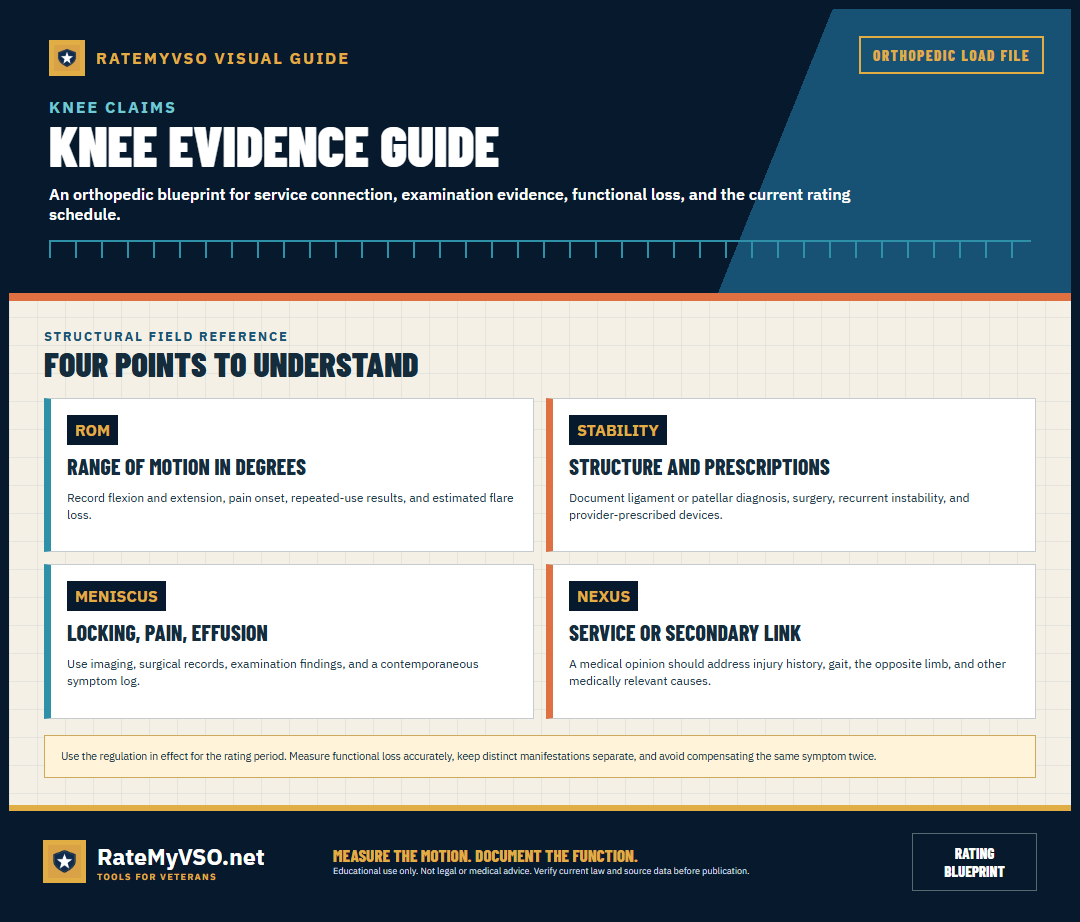 One-page guide: Knee Evidence Guide
Motion, stability, meniscus, and nexus evidence. Opens the full-size chart, free to save or print.
One-page guide: Knee Evidence Guide
Motion, stability, meniscus, and nexus evidence. Opens the full-size chart, free to save or print.
Symptoms and rating
Symptoms Recorded in Granted Knee and lower-leg conditions Decisions
We analyzed 8,481 granted Board decisions involving knee and lower-leg conditions for symptoms named in sentences about the condition (rating-criteria recitations excluded). Descriptive of the published record, what the Board wrote down, not a checklist of what to report.
Bar length shows decisions. Percentages remain context.
Detected by phrase-reading the decision text with condition-specific vocabularies. Source: Board of Veterans' Appeals decisions, RateMyVSO analysis.
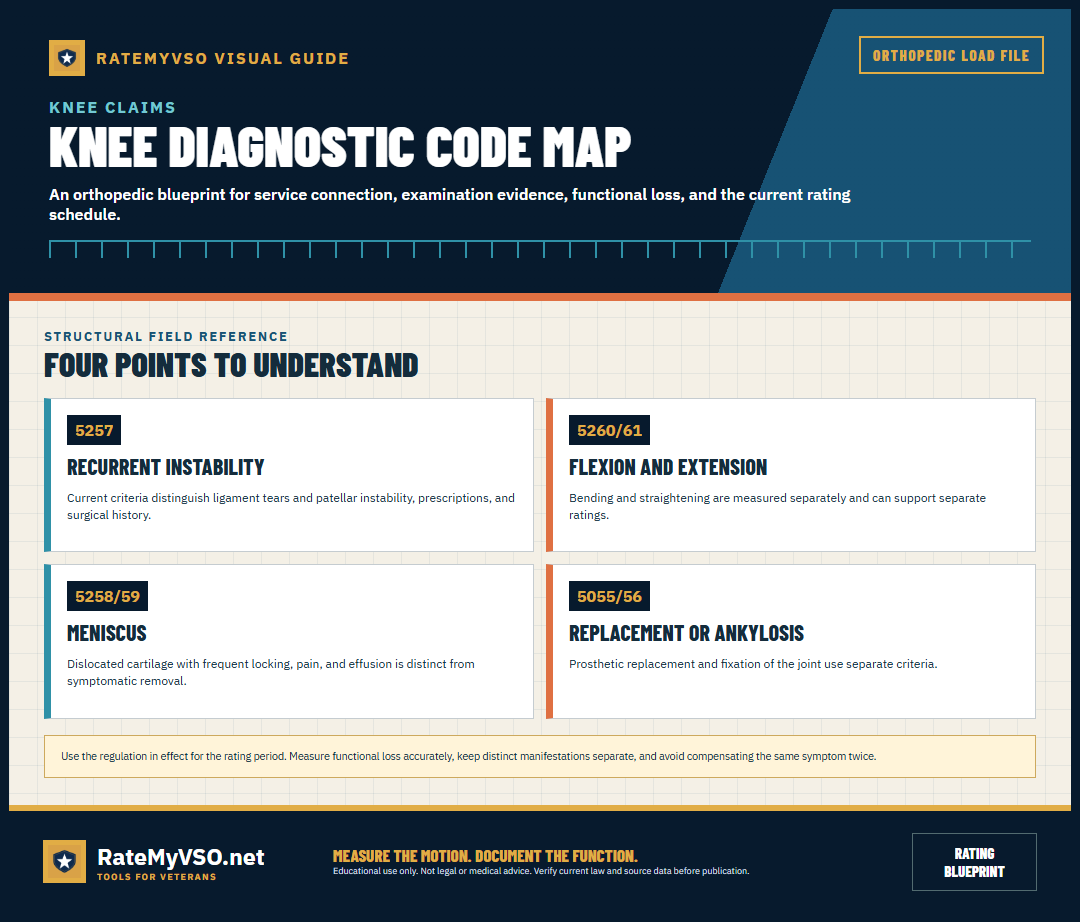
How the VA Rates the Knee
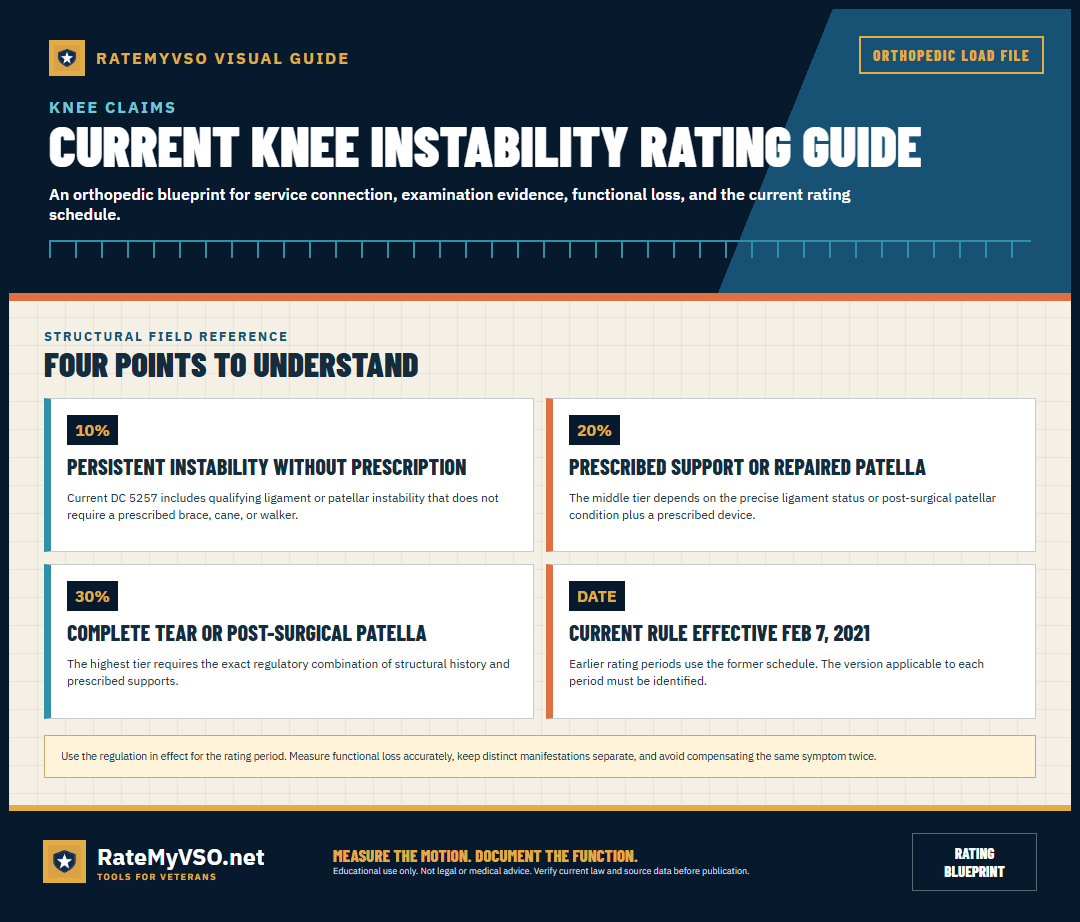
Instability and lost motion are the two ratings most knee claims turn on. Instability is rated under DC 5257 and does not depend on range of motion.
Recurrent subluxation or instability
Patellar instability
The 2021 rewrite added a separate ladder for the kneecap. The patellofemoral complex means the quadriceps tendon, the patella, and the patellar tendon. Surgery that does not repair one of those parts, such as an arthroscopy to remove loose bodies or a joint aspiration, does not count as surgical repair here.
Range of motion is scored separately, and flexion (bending) and extension (straightening) are two different codes. A normal knee bends to about 140 degrees and straightens to 0.
| Rating | Flexion limited to (DC 5260) | Extension limited to (DC 5261) |
|---|---|---|
| 10% | 45 degrees | 10 degrees |
| 20% | 30 degrees | 15 degrees |
| 30% | 15 degrees | 20 degrees |
| 40% | - | 30 degrees |
| 50% | - | 45 degrees |
Other knee codes fill in the rest of the picture:
| Code | Condition | Rating |
|---|---|---|
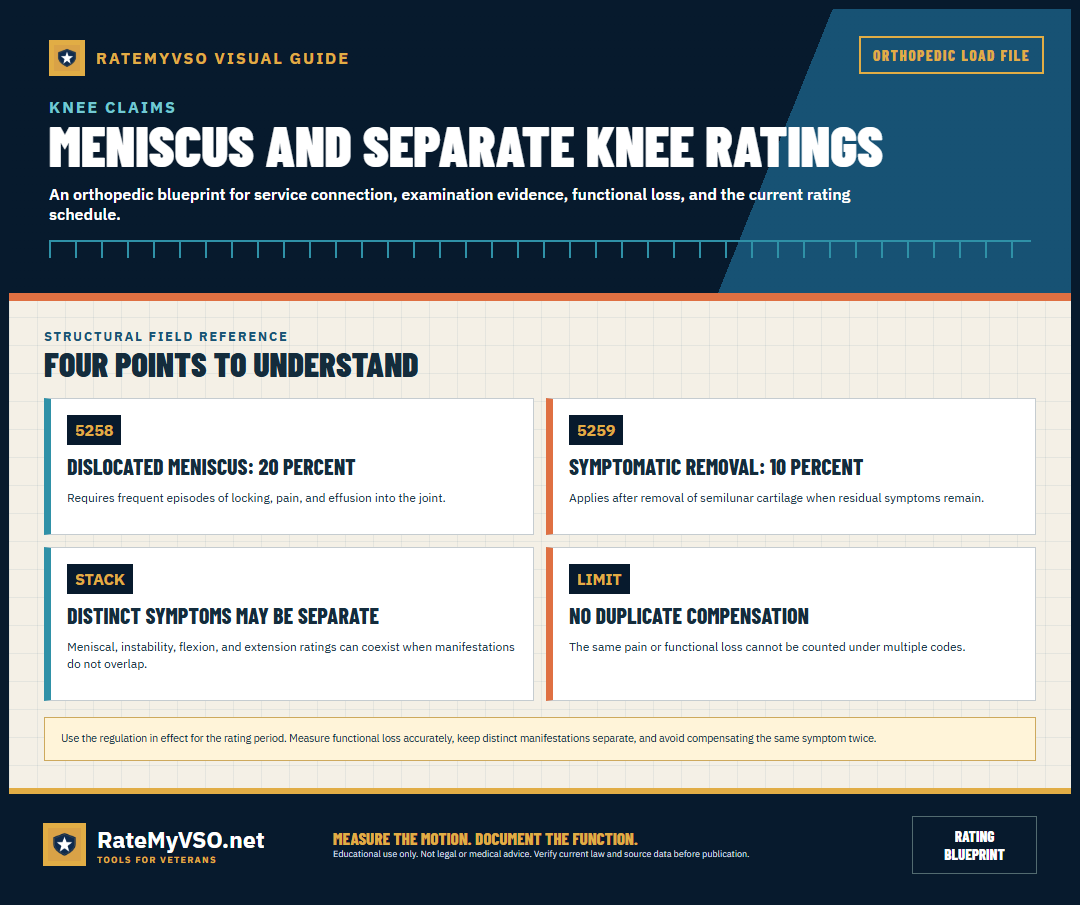
| 5258 | Dislocated meniscus with frequent locking, pain, and effusion | 20% |
| 5259 | Meniscus removed, still symptomatic | 10% |
| 5256 | Ankylosis (knee fused in place) | 30% to 60% by angle |
| 5262 | Tibia and fibula, malunion or nonunion | 10% to 40% |
| 5055 | Knee replacement (prosthesis) | 100% for four months, then 30% to 60% |
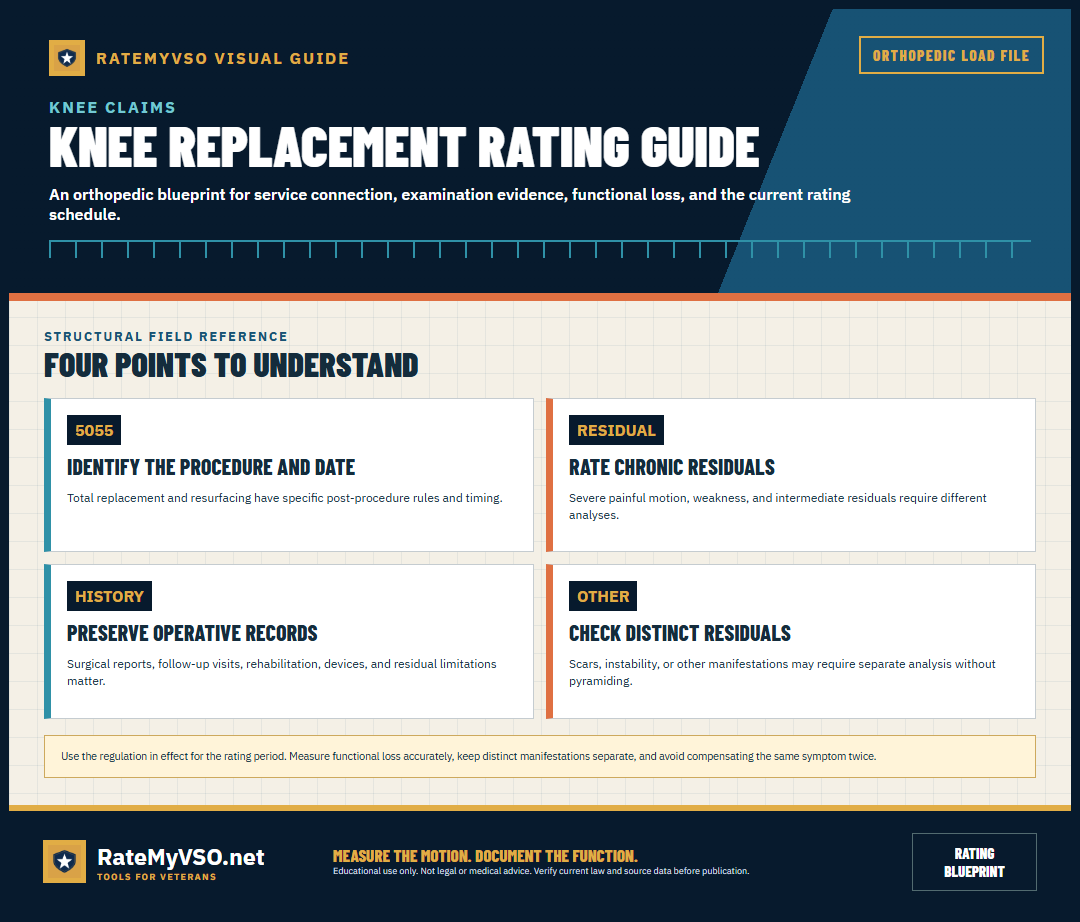 One-page guide: Knee Replacement Rating Guide
Procedure date, chronic residuals, operative records, and distinct-residual analysis. Opens the full-size chart, free to save or print.
One-page guide: Knee Replacement Rating Guide
Procedure date, chronic residuals, operative records, and distinct-residual analysis. Opens the full-size chart, free to save or print.
Why One Knee Can Carry More Than One Rating
This is the part most veterans, and some raters, miss. Because instability and lost motion compensate different problems, the VA's own General Counsel has held they can be rated separately on the same knee. So can limited flexion and limited extension, and so can a meniscal rating alongside either one.
- An instability rating (DC 5257) plus a limitation-of-motion rating, because instability and range of motion measure different impairments (see VAOPGCPREC 23-97 and 9-98).
- A limitation-of-flexion rating (DC 5260) plus a limitation-of-extension rating (DC 5261) on the same knee, when both are limited enough to be compensable (see VAOPGCPREC 9-2004).
- A meniscal rating (DC 5258 or 5259) plus a rating under DC 5257 or 5261, since evaluating a knee under one of those codes does not, by itself, rule out a separate meniscal rating for symptoms that do not overlap (Lyles v. Shulkin, 29 Vet. App. 107 (2017)).
These combine through VA math, not simple addition, and they are not pyramiding, because each pays for a distinct loss. If your rating decision paid only one code for a knee that both gives way and will not bend, that is a common under-rating worth a closer look.
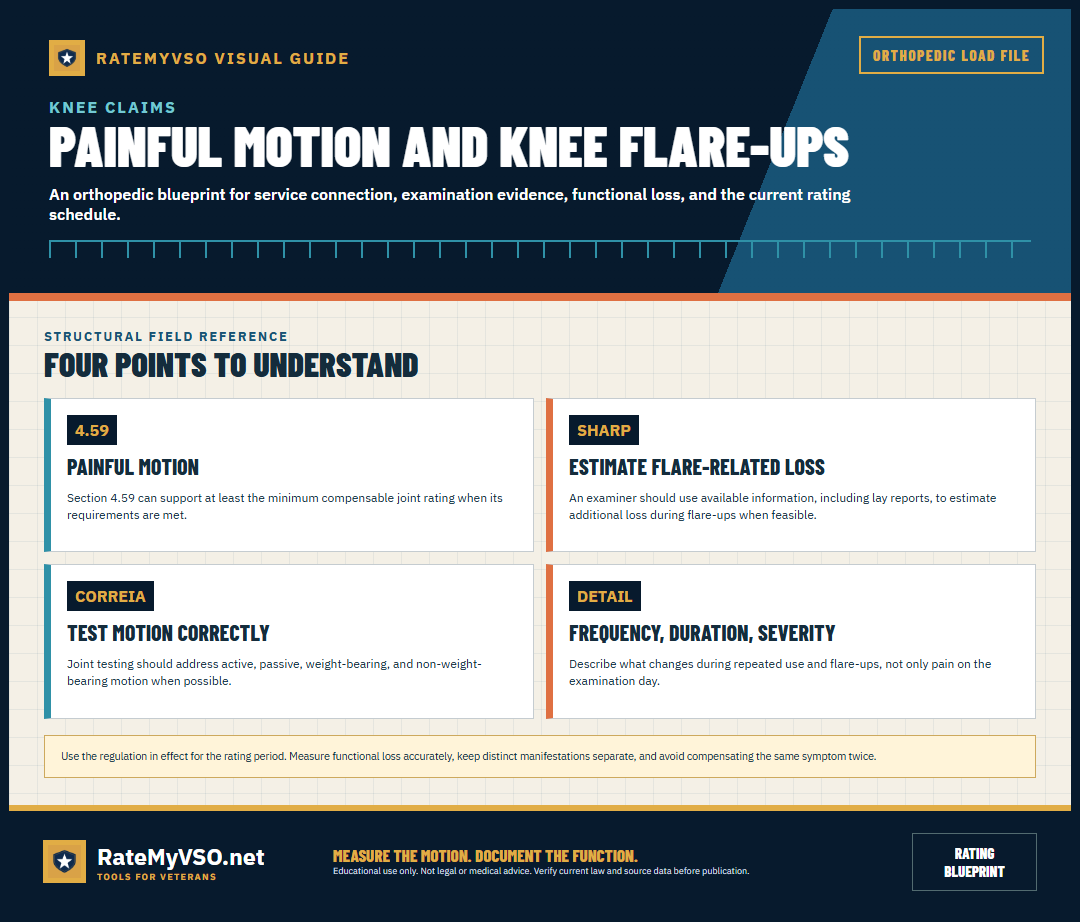 One-page guide: Painful Motion and Knee Flare-Ups
Section 4.59, Sharp, Correia, and flare-detail guide. Opens the full-size chart, free to save or print.
One-page guide: Painful Motion and Knee Flare-Ups
Section 4.59, Sharp, Correia, and flare-detail guide. Opens the full-size chart, free to save or print.
Painful Motion and the 10% Floor
A knee can hurt long before it loses enough motion to reach a 10% row on the table. The rating schedule accounts for that: a joint with painful motion is entitled to at least the minimum compensable rating, generally 10%, even when the measured range of motion is nearly normal (see 38 CFR § 4.59). The VA must also consider how pain, weakness, fatigue, and flare-ups further limit you, not just your best single measurement (DeLuca v. Brown, 8 Vet. App. 202 (1995)).
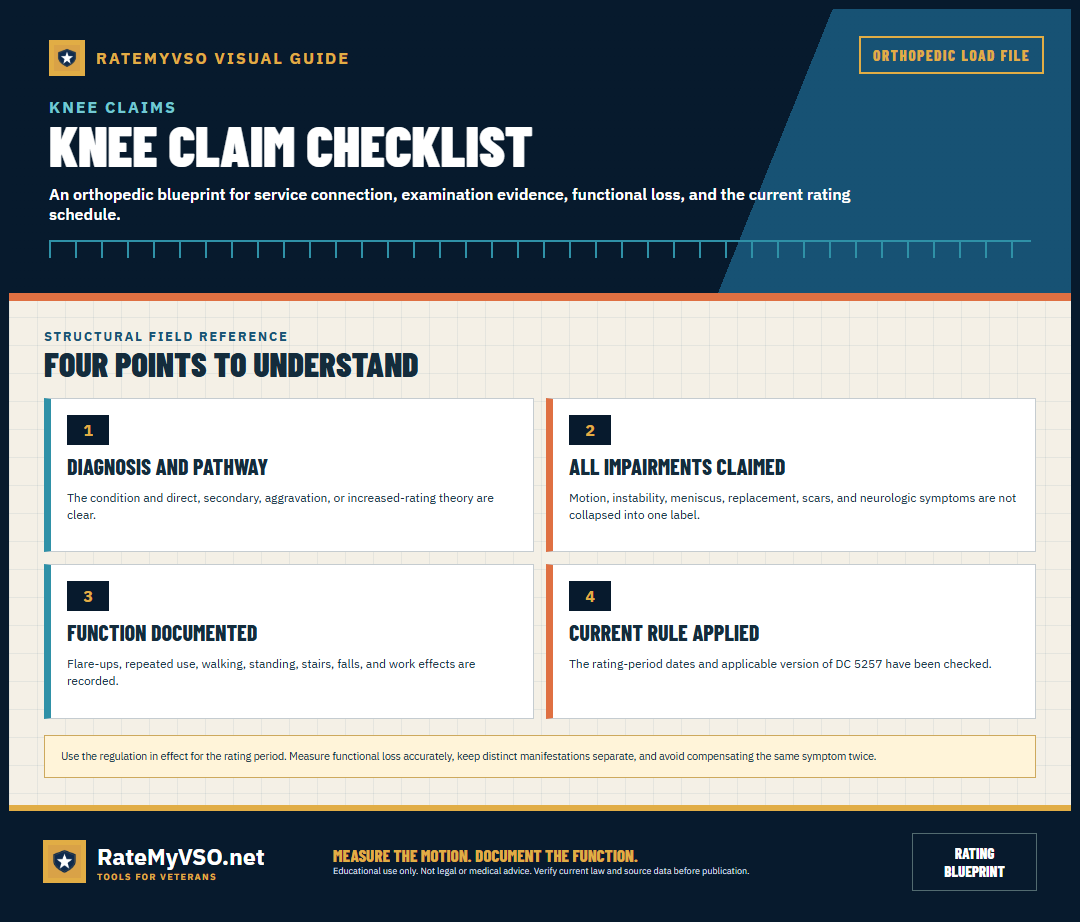 One-page guide: Knee Claim Checklist
Diagnosis, impairment, function, and current-rule checklist. Opens the full-size chart, free to save or print.
One-page guide: Knee Claim Checklist
Diagnosis, impairment, function, and current-rule checklist. Opens the full-size chart, free to save or print.
Evidence and Board research
Evidence That Wins
- Goniometer range-of-motion numbers, in degrees, for flexion and extension, tested active and passive and with weight-bearing, so the rater can place you on the table.
- Objective instability testing (Lachman, drawer, or varus/valgus laxity findings) documenting how much the knee gives way, which is what DC 5257 turns on. Your own account still counts: competent, credible testimony that the knee gives way, buckles, or causes falls is evidence of instability, and the Board cannot reject it categorically just because a stability test came back normal (English v. Wilkie, 30 Vet. App. 347 (2018), decided under the earlier slight/moderate/severe criteria). The percentage under the current DC 5257 also depends on the criteria that code now sets out, including the documented ligament tear or repair and whether a medical provider prescribed a brace or an assistive device.
- A documented prescription for your brace, cane, or walker, in writing from a medical provider. Using an assistive device on your own is not the same as having one prescribed, and whether a knee earns a higher instability rating often turns on this documentation being in the file.
- A simple log of when the knee gives out, locks, catches, or swells, even without a lab test to back it up. This kind of first-person record supports both the instability rating and a separate meniscal rating.
- Imaging and operative records: X-ray, MRI, or surgical notes showing arthritis, a meniscus tear, or a replacement.
- The Knee and Lower Leg DBQ, which captures range of motion, stability, flare-ups, and the functional loss the rating depends on. See the DBQ guide.
- A nexus for a secondary claim: a medical statement linking the knee to a service-connected back, hip, ankle, or opposite knee. See nexus letters.
- Your own account of flare-ups and give-way, including how often the knee buckles and what it stops you from doing, which supports the DeLuca and instability findings.
Evidence Cited in Published Knee and lower-leg conditions Decisions
We analyzed 162,513 published Board decisions involving knee and lower-leg conditions for condition-specific evidence, counting only case-specific mentions (boilerplate recitations excluded). "Favorable" is the share of decisions citing that evidence where every issue was granted or the outcome was mixed; the baseline across all these decisions is 45%, combining every diagnostic code below. Evidence appearing in a decision does not mean it decided the case. Descriptive of the published record, not a prediction.
Bar length shows decisions citing the evidence.
By diagnostic code
These codes are grouped together above. They do not perform the same, so find your own code here rather than reading the combined figure. A code retired in the schedule rewrites appears without a link, because its decisions were judged under criteria that no longer apply.
Bar length shows published decisions reviewed.
Detected by phrase-reading the decision text with condition-specific vocabularies. Source: Board of Veterans' Appeals decisions, RateMyVSO analysis.
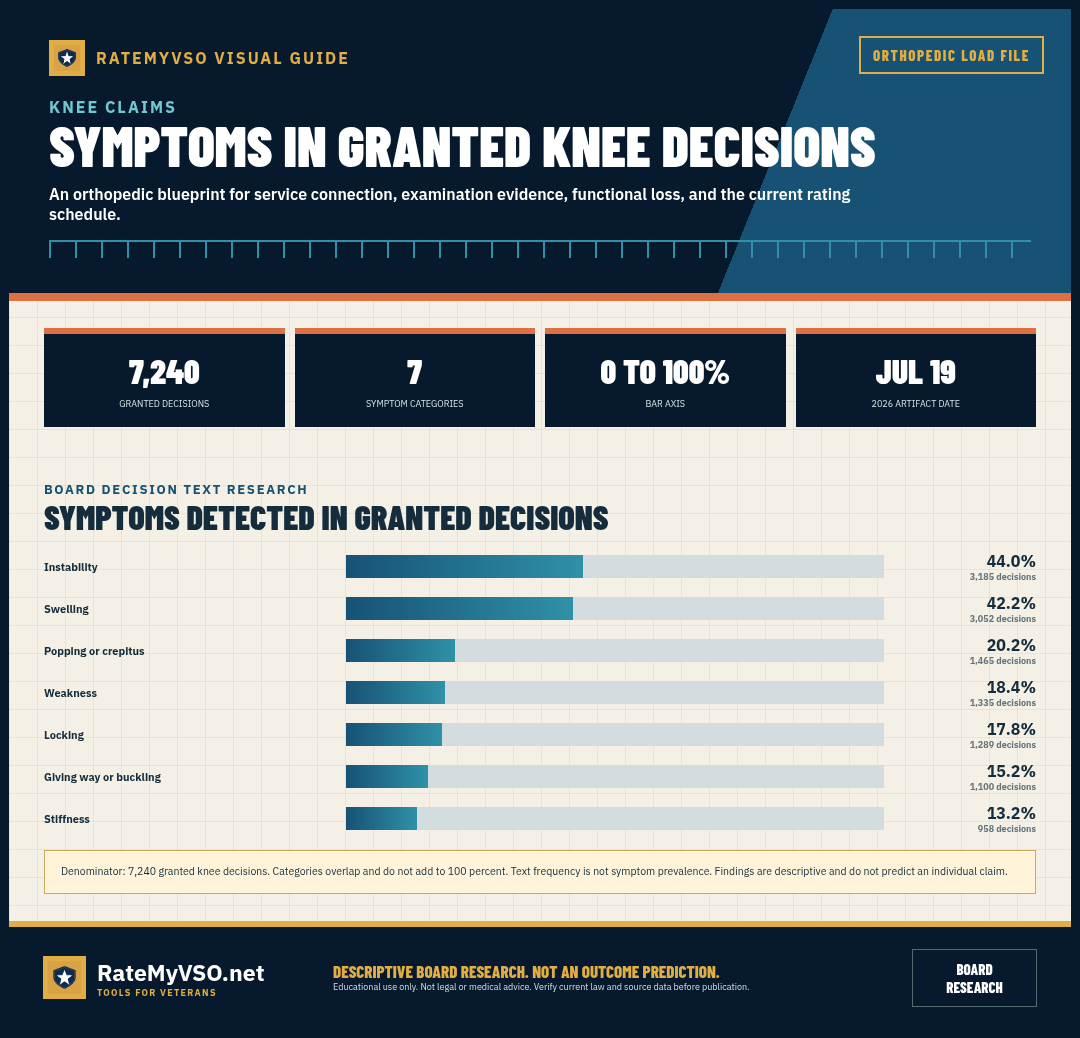 One-page guide: Symptoms in Granted Knee Decisions
Knee: symptom frequencies across 8,481 granted Board decisions. Opens the full-size chart, free to save or print.
One-page guide: Symptoms in Granted Knee Decisions
Knee: symptom frequencies across 8,481 granted Board decisions. Opens the full-size chart, free to save or print.
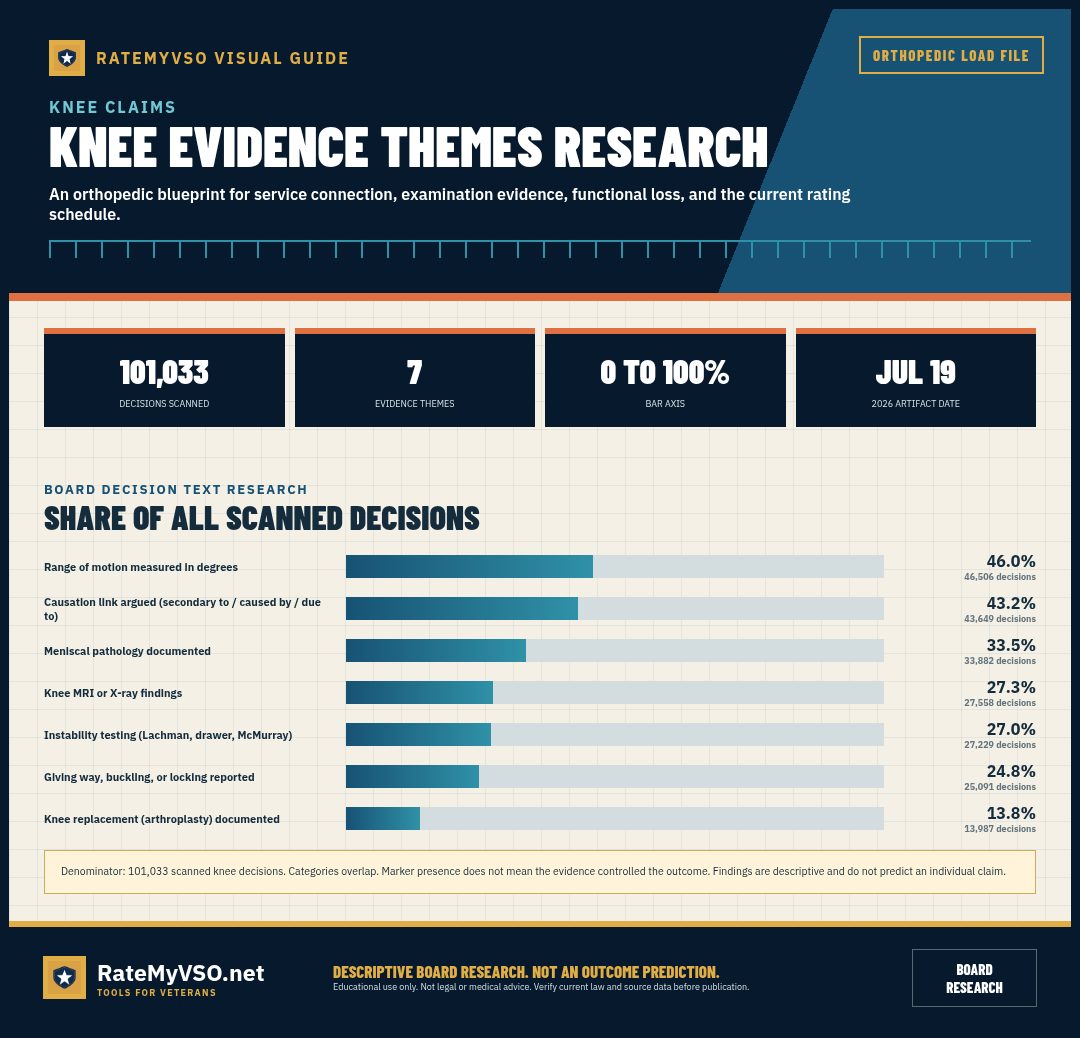 One-page guide: Knee Evidence Themes Research
Knee: overlapping evidence-theme frequencies across 162,513 scanned Board decisions. Opens the full-size chart, free to save or print.
One-page guide: Knee Evidence Themes Research
Knee: overlapping evidence-theme frequencies across 162,513 scanned Board decisions. Opens the full-size chart, free to save or print.
Board Grants, Dissected
The Board decisions collected here show that direct service connection for a knee condition involving instability, giving-way, or looseness (rated under DC 5257) can succeed when a veteran can point to a specific in-service event, credible lay testimony of onset, or a doctor's opinion tying the knee problem to service or to another service-connected body part. Several of these grants involve knee instability as one part of a larger claim, and the Board often leaned on the "benefit of the doubt" rule rather than a single, one-sided medical opinion. These decisions are not binding on future cases, but they illustrate what kinds of evidence the Board has found persuasive.
Board restores a reduced knee instability rating after VA cut it without real proof of improvement Citation A26037548 (April 22, 2026), hearing docket
The record: The Veteran's right knee strain claim was reworked on appeal to include a separate grant for right knee instability. The record showed the Veteran had used a cane and knee brace for years and reported his knee "gives out." No VA examiner offered a contrary medical opinion specifically rejecting instability; the dispute centered on timing and effective dates rather than a battle of medical opinions.
Why it won: The Board found that pain and instability reaching the level of functional impairment can support a grant, and it resolved doubt in the Veteran's favor on when the knee condition began. The Board's separate decision restoring a 20 percent rating for left knee instability in the same general pattern of decisions shows the Board will not let VA drop an instability rating without objective proof of real improvement in ability to function.
Private PA's opinion outweighs two VA exams that ignored the veteran's compensating gait Citation A26032253 (April 8, 2026), hearing docket
The record: The Veteran already had service connection for a left knee ACL tear. He sought secondary service connection for a right knee ACL tear, saying his left knee gave out and injured his right knee, and that he had to overcompensate for years. VA examiners in December 2020 and May 2021 said no orthopedic literature supported one knee injury damaging the other knee, and that the Veteran's right knee ACL tear had known causes like a bad landing or direct blow, not gait changes. In October 2019, P.T., PA-C, gave a private opinion that the right knee strain was at least as likely as not caused by chronic overcompensation for the left knee, aggravated by the Veteran's foot problems and weight gain from reduced ability to exercise.
Why it won: The Board found the private opinion more probative because it considered the Veteran's lay reports of his left knee giving out and causing a right knee injury, while the VA opinions did not properly address those lay statements. The Board noted the Veteran was later granted service connection for bilateral plantar fasciitis, which lent support to the private examiner's theory about altered gait. With the evidence at least in equipoise, the Board resolved doubt in the Veteran's favor.
Sister's lay statement about a jeep accident helps establish left knee pain that began in service Citation A26027148 (March 25, 2026), hearing docket
The record: The Veteran said he fell from a jeep onto concrete pavement during 1983 or 1984 and was knocked unconscious. His sister submitted a statement describing this same accident and stating the family witnessed his pain get worse over the years. VA treatment records showed left lateral compartmental degenerative changes with a probable geode in the proximal tibia, and the Veteran reported chronic pain and swelling. There was no official diagnosis and no VA examiner's opinion in the file addressing this claim.
Why it won: The Board found that pain alone, without a formal diagnosis, can count as a disability if it causes real functional impairment, citing Saunders v. Wilkie. It found the evidence for and against in-service onset "at least in approximate balance" based on the sister's corroborating statement, even though the Veteran had no left knee complaints recorded in service. The Board specifically noted that a remand for a medical opinion was not necessary because the record already supported a full grant.
Bilateral knee pain tied to overcompensating for a service-connected foot injury Citation A26026483 (March 24, 2026), hearing docket
The record: The Veteran was shot in the left foot by an arrow during a 1972 training exercise, a wound already service connected. He testified that he fell onto rocks at the same time and injured his left knee, developing ongoing pain and instability. A VA request for a medical opinion on the left knee went unanswered by the examiner, who addressed only the foot.
Why it won: The Board found the Veteran competent and credible to describe falling on his knee right after the foot injury, and found his current left knee pain and swelling consistent with that history. Because the existing VA opinion was non-responsive on the knee, the Board declined to remand for a new opinion, reasoning that further development could look like an attempt to build a case against the Veteran rather than for him, and it resolved doubt in his favor instead.
Bilateral knee pain granted where records tied overuse of one leg to injury of the other Citation A26026256 (March 24, 2026), evidence submission docket
The record: Among many issues in this large appeal, the Veteran sought service connection for left and right knee pain, arguing it stemmed from overcompensating for other service-connected disabilities, including a left foot surgery. A January 2014 treatment record showed the Veteran complained of knee pain after "hopping around" following left foot surgery, and a February 2014 note attributed right leg and knee pain to compensating for that same surgery. A January 2015 record showed the Veteran reporting back pain radiating to his knees.
Why it won: The Board found the Veteran competent and credible to report pain radiating to his knees and found the treatment records linking his knee symptoms to compensating for his service-connected foot and back disabilities sufficient to establish a nexus. With the evidence at least evenly balanced, the Board resolved doubt in the Veteran's favor and granted service connection for bilateral knee pain as secondary to other service-connected disabilities.
Why These Claims Get Denied
Beyond a missing nexus or an undiagnosed condition, a few specific denial patterns show up often enough in the Board's knee decisions to call out on their own.
- An assistive device that was never prescribed. Using a cane or brace you got on your own is not the same as having one prescribed by a medical provider. A higher instability rating is commonly denied when the record shows use but no prescription.
- A diagnosis with no reported instability. Having an arthritic or otherwise diagnosed knee is not enough by itself to win an instability rating. The file needs an actual report of the knee giving way, buckling, or causing a fall, not just an underlying diagnosis.
- A distant, paid claims-assistance exam standing in for a real one. A brief private questionnaire from a far-away provider, especially one where it is unclear whether an exam was even performed, is routinely given far less weight than a detailed VA or local treating-provider exam.
- Pain without measured loss of motion, used to argue for a higher tier. Painful motion earns the minimum compensable rating, but a higher motion rating needs an actual measured loss, such as flexion limited to 30 degrees. A knee that keeps most of its motion will not reach the higher tiers on pain alone.
- Assuming a service-connected knee automatically connects the back or hips. A bad knee can support a secondary claim for the back, hip, or opposite knee, but the file still needs a medical opinion making that link. Claims that skip the opinion and rely on the connection being obvious are routinely denied.
- Expecting an earlier start date without an earlier claim or clear worsening. An effective date is usually the later of the claim date or the date the worsening can be pinned down in the record, reaching back at most one year if the worsening is shown.
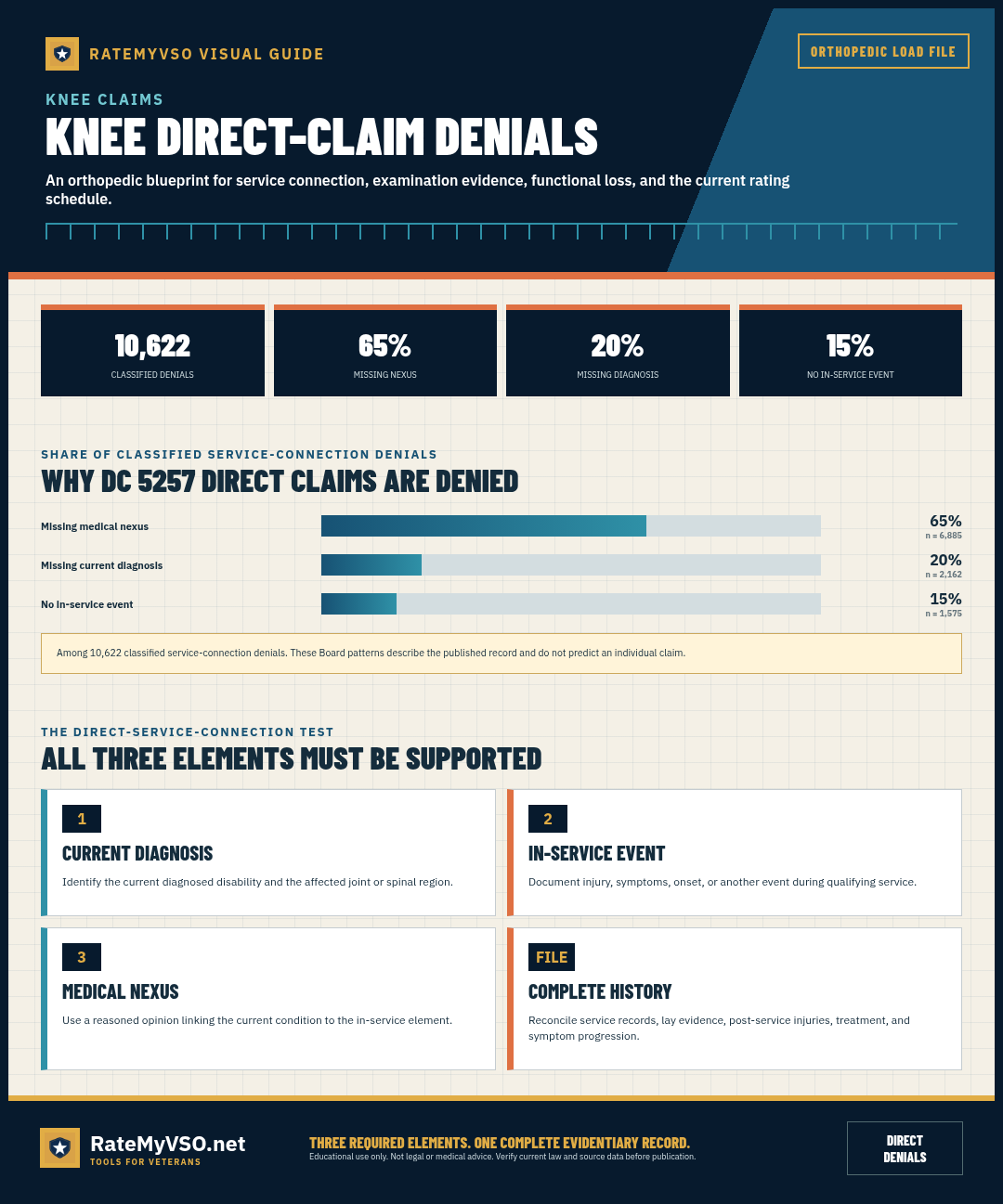 One-page guide: Knee Direct-Claim Denials
10,033 classified knee service-connection denials split by the missing element, with the three required direct-claim elements. Opens the full-size chart, free to save or print.
One-page guide: Knee Direct-Claim Denials
10,033 classified knee service-connection denials split by the missing element, with the three required direct-claim elements. Opens the full-size chart, free to save or print.

Common Mistakes
The same handful of missteps account for most lost or under-rated knee claims. Each follows from how the knee codes are scored. Among the Board's classified service-connection denials for the knee, here is what claims most often fell short on:
- Taking only one rating for a knee that qualifies for two. A knee that both gives way and has lost motion can carry an instability rating plus a range-of-motion rating. Accepting a single code leaves the other percentage on the table.
- Going to the C&P exam on a good day. The rating turns on measured motion, stability, and flare-ups. Describe your worst days and how often the knee buckles, and make sure the examiner tests flexion and extension in degrees.
- Assuming pain alone earns nothing. A knee with painful motion is entitled to at least 10 percent even when motion is close to normal. If the decision gave 0 percent to a painful knee, that is worth challenging.
- Skipping the secondary link. When a knee is claimed as secondary to a service-connected back, hip, or opposite knee, a missing nexus is not the leading denial reason DC-wide (24.1%, behind no in-service event at 40.9% and no diagnosis at 35.0%). The file needs a medical statement connecting them, not just a diagnosis.
- Claiming one knee when both are affected. Each knee is rated on its own, and two service-connected knees are a paired extremity that may pick up the bilateral factor. Leaving the second knee off the claim leaves both that rating and the bilateral add-on unclaimed.
Do's and Don'ts
A condensed version of everything above, in the order it actually matters when you sit down to build your file.
- Get your brace, cane, or walker prescribed in writing by a medical provider, not just used on your own.
- Report every time your knee gives out, buckles, locks, catches, or swells, even without a positive stability test.
- Describe flare-ups fully: how often they happen, how long they last, and how severe they are.
- Ask that your exam measure motion in both active and passive motion, and while bearing weight, with the opposite knee tested for comparison.
- Get a medical opinion that explicitly links your knee to a service-connected back, hip, ankle, or the opposite knee if you're claiming secondary connection.
- Save all VA and private treatment records showing your knee is the same or worse, especially if VA proposes to reduce your rating.
- Claim both knees if both are affected, since each is rated separately and two service-connected knees can pick up the bilateral factor.
- If you were denied before, file a Supplemental Claim with new and relevant evidence rather than starting over.
- Don't assume using a cane or brace you bought yourself will raise your rating without a provider's prescription.
- Don't rely on a diagnosis alone to prove instability, actually report the giving-way and buckling.
- Don't lean on a distant, paid claims-assistance exam in place of a thorough VA or treating-provider exam.
- Don't expect a higher motion rating from pain alone without measured loss of motion.
- Don't assume a service-connected knee automatically connects your back or hips without a medical opinion.
- Don't expect an earlier effective date without an earlier claim or clearly documented worsening.
- Don't take only one rating for a knee that qualifies for two or more.
Secondary relationships
Common Secondary Conditions
A service-connected knee rarely travels alone. Because it changes how you walk, it drives problems higher up the leg and in the back, and it is itself often secondary to a condition that started elsewhere. Each bar below is the Board's grant rate for DC 5257 in that pairing, with the number of decisions under it. They describe the published record across many veterans, not a prediction about any one claim.
Conditions that can cause a bad knee (knee as the secondary)
Claims where the knee was argued as secondary to an already service-connected condition, most often an altered gait from the back, the hip, or the opposite knee. This is the "ways to connect via another condition" list, and it's usually the easier route into a grant:
Conditions a bad knee can cause (knee as the primary)
Conditions veterans have claimed as caused or aggravated by a service-connected knee, as one overloaded joint wears down the rest of the chain:
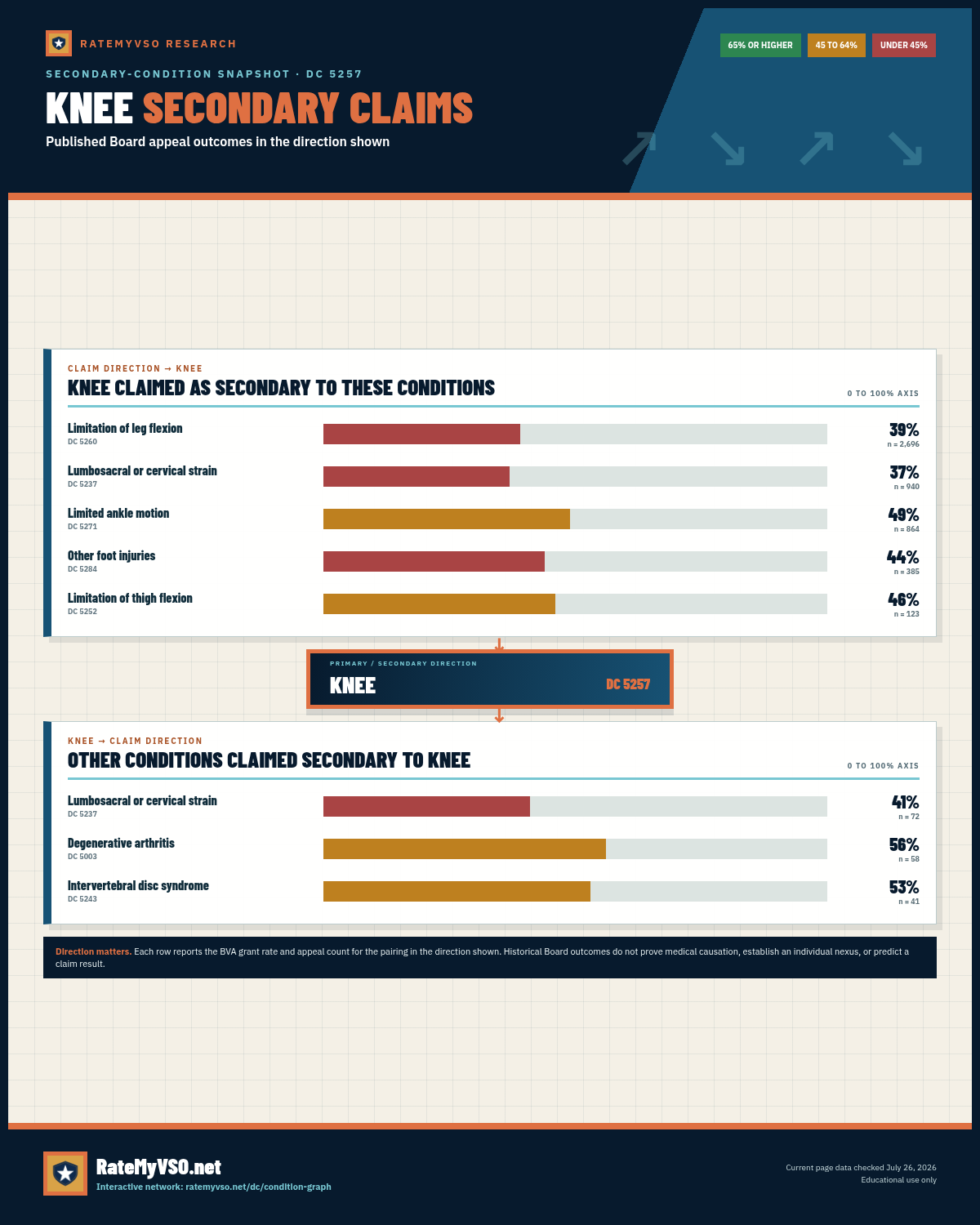 One-page guide: Knee Secondary-Claim Snapshot
Two-direction secondary-claim snapshot for KNEE, showing BVA grant rates and appeal counts for conditions claimed toward and away from KNEE. Opens the full-size chart, free to save or print.
One-page guide: Knee Secondary-Claim Snapshot
Two-direction secondary-claim snapshot for KNEE, showing BVA grant rates and appeal counts for conditions claimed toward and away from KNEE. Opens the full-size chart, free to save or print.
Prepare and take the next step
Prepare: your own working pages
Optional. These are your own notes, in your own words. They are not a VA form, they are not sent to the VA, and nothing here is a medical finding or a prediction about your claim.
Three reminders while you prepare
- Describe the affected area and each side separately
Record the diagnosis, location, side, onset, and changes over time. Keep different joints, muscles, or body regions separate. Go to this part
- Document function during ordinary use and flares
Note pain, motion, weakness, endurance, stability, assistive devices, and what repeated use or a flare stops you doing. Go to this part
- Use measured findings and your own history together
Keep examination measurements and imaging distinct from your description of daily effects. Do not assign yourself a percentage. Go to this part
Sign in or create an account to save your answers and come back to them later. You can fill these in and print them without an account.
Condition and treatment timeline
Motion, flares, and daily function
Examination and objective findings
Records and unanswered questions
Decision-letter reading sheet
Quick Checklist Before You File
Bring these together before you submit anything.
- A doctor's written prescription for your brace, cane, or walker, if one is in use.
- A simple log of when your knee gives out, locks, catches, or swells.
- A full account of your flare-ups for the examiner: how often they happen, how long they last, and how severe they are.
- A request that the exam measure motion with pain, on both active and passive motion, and while bearing weight.
- All VA and private treatment records showing your knee is the same or worse.
- If VA proposes to reduce your rating, records showing there was no real improvement in your daily functioning.
- A medical opinion linking the knee to any back, hip, or other condition you're claiming it caused.
- If you were denied before: new and relevant evidence for a Supplemental Claim, not just a repeat of what was already considered.
For the mechanics of actually submitting the claim, see the Standard Claim Guide and the Fully Developed Claim Guide (filing with all your evidence up front can speed up the decision).
The Claims Process, Step by Step
Once you file, your claim moves through a series of hand-offs. Understanding who does what helps you know who to contact, and what to expect, at each stage.
- You file the claim. Directly with VA, through VA.gov, or with the help of an accredited representative.
- VA acknowledges the claim and assigns it for development. A Veteran Service Representative (VSR) is assigned to gather your service treatment records, VA and private medical records, and any other evidence needed.
- The VSR orders a Compensation & Pension (C&P) exam if one is needed. Most knee claims require one, especially secondary claims and increased-rating claims, where current range of motion and stability need to be measured.
- The C&P exam is conducted. By a VA clinician or a contracted examiner, who completes a Knee and Lower Leg Disability Benefits Questionnaire (DBQ) documenting range of motion, stability, flare-ups, and, where relevant, a nexus opinion.
- The file goes to a Rating Veteran Service Representative (RVSR), the "rater." The rater reviews the complete file, including the exam results, and decides whether service connection is warranted, at what percentage, and whether more than one knee code applies.
- A senior reviewer may review the decision before it's finalized, depending on the complexity of the claim.
- VA issues the decision letter. This states whether the claim is granted or denied, the rating percentage or percentages if granted, and the reasons behind the decision.
- If you disagree, you choose an appeal lane. Higher-Level Review, Supplemental Claim, or a Board appeal, covered later in this guide.
Who's who: VSO vs. VSR vs. Rater vs. C&P Examiner
Your VSO
An accredited representative from a veterans service organization, or an accredited attorney or claims agent. Not a VA employee. Helps you prepare, gather evidence, and file, and can represent you through an appeal. Has no authority to decide your claim.
VSR (Veteran Service Representative)
VA staff who "develops" your claim: requests records, schedules the C&P exam, and assembles the file. Does not decide the rating.
Rater (RVSR)
VA staff who reviews the completed file and makes the actual decision, service connection or denial, and the percentage or percentages. This is the person whose judgment the decision letter reflects.
C&P Examiner
A VA clinician or a contracted medical examiner who conducts the exam and completes the DBQ. Documents findings and, where asked, a nexus opinion. Does not decide the claim.
For the full walkthrough of every stage with more detail, see Inside Your Claim and Claim Stages.
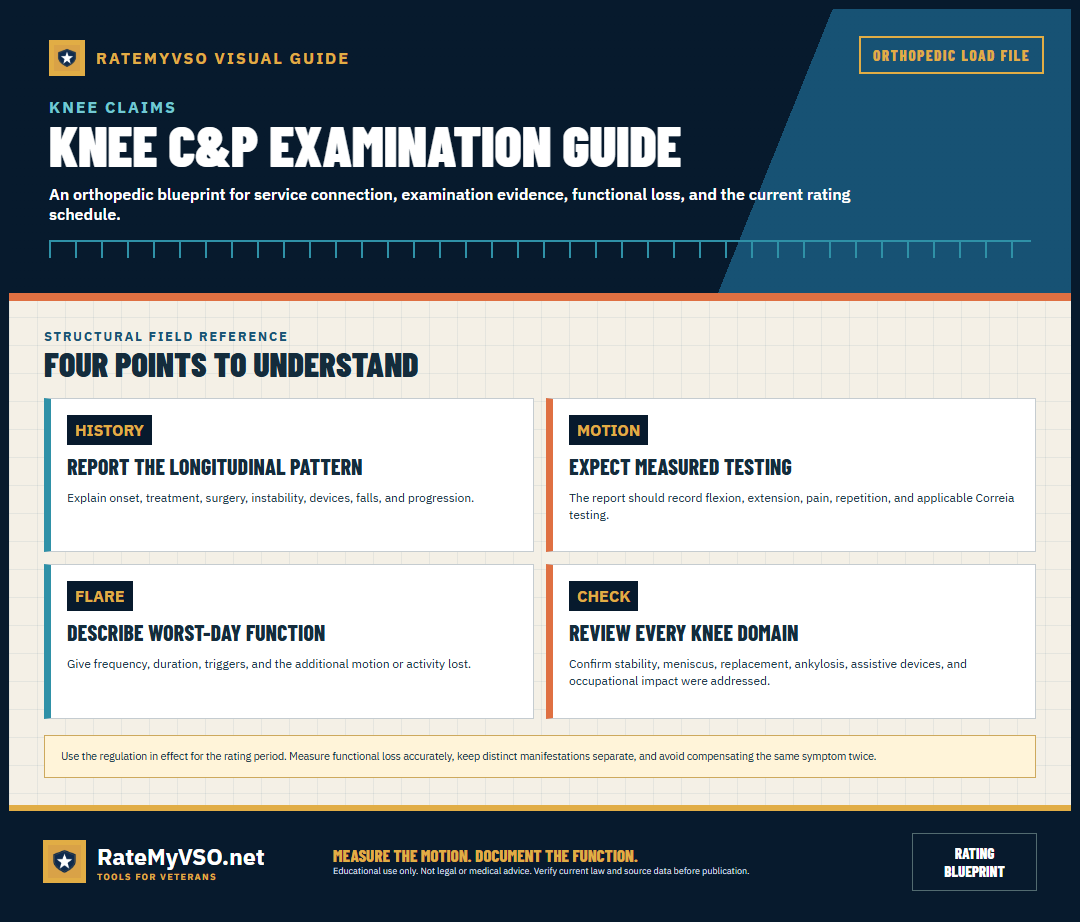 One-page guide: Knee C&P Examination Guide
History, motion testing, flare-ups, and report-review guide. Opens the full-size chart, free to save or print.
One-page guide: Knee C&P Examination Guide
History, motion testing, flare-ups, and report-review guide. Opens the full-size chart, free to save or print.
DBQs and Your C&P Exam
The Knee and Lower Leg Disability Benefits Questionnaire (DBQ) is the standardized form an examiner completes for your knee, it structures the exam findings into the specific data points VA's rating schedule requires: range of motion in degrees, active and passive, weight-bearing and non-weight-bearing, instability testing, and flare-up impact. See the DBQ Guide for how these forms work, including whether a private DBQ completed by your own doctor can be submitted instead of relying solely on a VA exam.
Before your C&P exam, bring a clear, specific account of your symptoms: how often the knee buckles or gives out, how far it bends before it hurts, and how flare-ups affect you on your worst days, not just an average day. Be consistent with what's already in your medical records and prior statements. For a full walkthrough of what to expect and how to prepare, see the C&P Exam Prep Guide.
Reading Your Decision Letter, and What to Do If Denied
Your decision letter has two parts: a narrative section explaining the reasoning (often called "reasons and bases"), and a codesheet showing the actual rating percentage or percentages, the effective date, and the diagnostic codes used. See the Reading Your Decision Letter Guide for how to find and interpret each part, or use the Letter Interpreter tool to upload your own letter and get a plain-English breakdown.
If your claim is denied, the rating is lower than you expected, or VA proposes to reduce an existing rating, you have three main lanes:
- Supplemental Claim: refile with new and relevant evidence, such as updated imaging, a new nexus opinion, or treatment records showing the knee is the same or worse. See Supplemental Claim Guide.
- Higher-Level Review (HLR): a senior reviewer looks at the same evidence again for a difference of opinion, no new evidence is added. See HLR Guide.
- Board Appeal: your case goes to a Veterans Law Judge at the Board of Veterans' Appeals, with options for a direct review, an evidence docket, or a hearing. See Board Appeal Guide.
Not sure which lane fits your situation? See the Appeals decision guide for a side-by-side comparison of all three.
After You Win: Maintaining and Defending Your Rating
A grant is not always the end of the story, especially for a knee, where VA periodically reexamines and sometimes proposes to reduce a rating. Keep your treatment consistent: continued follow-up, imaging, and documentation of ongoing symptoms protects you if VA schedules a future reexamination. VA cannot reduce a rating unless the evidence shows the knee has actually improved in your daily functioning, not just on a single exam (38 CFR § 3.344; 38 CFR § 3.105). A reduction that does not follow these rules, or that ignores records showing the knee is the same or worse, can be reversed and the rating restored. Understand when a rating becomes protected from future review (including Permanent and Total status) and what to do if VA proposes to reduce it. See Protect Your Rating and Future Reexaminations for the specifics.
There is also a ceiling on how high combined knee ratings can go: under the amputation rule, all of your ratings for one leg combined cannot exceed the rating for losing the leg at that level (38 CFR § 4.68).
If your knee worsens after the initial grant, you can file for an increased rating. For an earlier effective date tied to a worsening that was already underway, the key is showing when the worsening could first be factually ascertained in the record, not just the date of your exam (38 CFR § 3.400(o)).
References and related resources
Quick Reference Tables
Secondary Connection Pathways
| Primary Condition | Mechanism | Evidence Needed |
|---|---|---|
| Opposite knee | Overloading from favoring the injured knee | Gait findings + nexus opinion linking the extra load to the second knee |
| Hip | Altered gait mechanics from a compensating stride | Nexus opinion tying the hip condition to the knee-driven gait change |
| Low back (see lumbar spine guide) | Altered gait and posture compensating for the knee | Nexus opinion + treatment history showing the back problem followed the knee |
| Ankle | Extra stress from an altered gait on the same or opposite side | Nexus opinion + imaging or exam findings for the ankle |
From Filing to Decision: Who Does What
| Role | Does | Decides your rating? |
|---|---|---|
| VSO / accredited representative | Helps prepare, gather evidence, and file; represents you on appeal | No |
| VSR | Develops the claim: orders records and the C&P exam | No |
| C&P Examiner | Conducts the exam, completes the DBQ, may give a nexus opinion | No / but has a strong impact |
| Rater (RVSR) | Reviews the full file and decides service connection and percentage(s) | Yes |
Frequently Asked Questions
Can I really get two ratings for one knee?
My knee hurts but the VA gave it 0 percent. Is that right?
How do I connect my knee to my back?
What is the highest a knee can be rated?
Should I claim both knees at once?
Can VA reduce my knee rating later?
Related Tools and Guides
Sources
- 38 CFR § 4.71a, Diagnostic Codes 5256 to 5263, musculoskeletal ratings (instability, meniscus, flexion, extension, ankylosis, replacement)
- 38 CFR § 3.303, basic rules for service connection
- 38 CFR § 3.310, Secondary Service Connection
- 38 CFR § 3.306, Aggravation of Pre-Service Disability
- 38 U.S.C. § 1154(b) and 38 CFR § 3.304(d), combat presumption
- 38 CFR § 4.59, painful motion; 38 CFR § 4.40 and 4.45, functional loss
- 38 CFR § 4.14, rule against pyramiding
- 38 CFR § 4.68, the amputation rule (ceiling on combined ratings for one limb)
- 38 CFR § 3.344 and 3.105, rating reductions
- 38 CFR § 3.400, effective dates, including 3.400(o) for increased ratings
- VAOPGCPREC 23-97 and 9-98, separate ratings for instability and limitation of motion on the same knee
- VAOPGCPREC 9-2004, separate ratings for limited flexion and limited extension on the same knee
- Lyles v. Shulkin, 29 Vet. App. 107 (2017), a rating under DC 5257 or 5261 does not by itself preclude a separate meniscal rating under DC 5258 or 5259
- DeLuca v. Brown, 8 Vet. App. 202 (1995), pain, weakness, fatigue, and flare-ups must be considered beyond the raw range-of-motion number
- Correia v. McDonald, 28 Vet. App. 158 (2016), range of motion must be tested actively, passively, weight-bearing, and non-weight-bearing, with the opposite joint tested for comparison
- Sharp v. Shulkin, 29 Vet. App. 26 (2017), an examiner must estimate additional functional loss during flare-ups using all available information, not decline to opine solely because the exam did not occur during a flare-up
- English v. Wilkie, 30 Vet. App. 347 (2018), the Board cannot categorically favor objective stability testing over a veteran's credible lay report of knee instability
- CCK Law, knee ratings
- Hill & Ponton, knee pain