VA Loss of Smell and Taste Claims Guide
This guide explains how to file a loss of smell or taste claim and how the VA evaluates it: how service connection works, how a loss of smell or taste gets connected to your service (directly, or secondary to another condition), what evidence you need, why these claims get denied, a checklist before you file, what the claims process looks like step by step, how to read your decision letter, and what to do whether you win or you're denied. You will also learn how loss of smell (anosmia, DC 6276) and loss of taste (ageusia, DC 6275) are rated under 38 CFR § 4.87a, and why only a complete loss with a documented, objective cause qualifies.
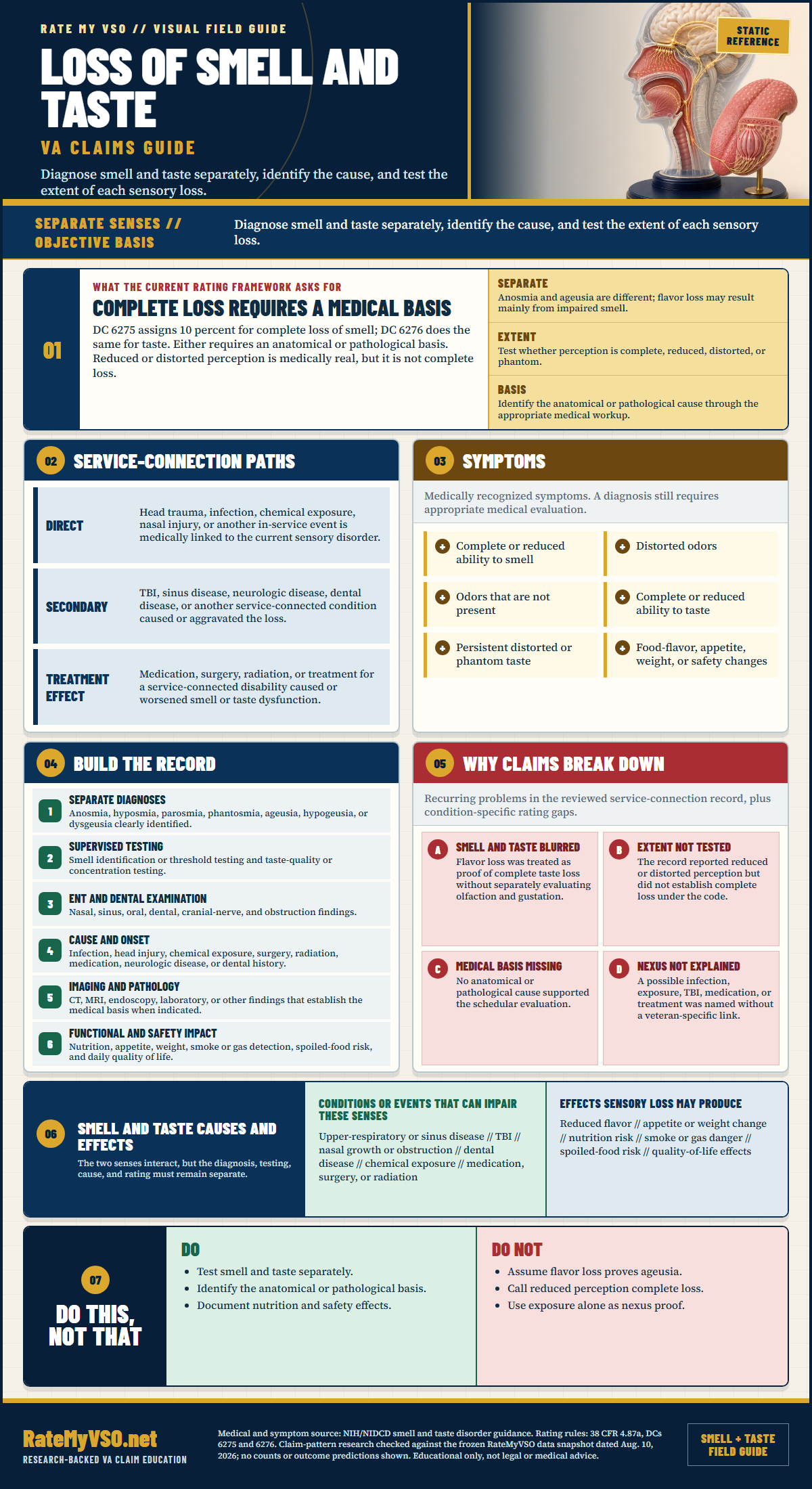 One-page guide: Loss of Smell and Taste Claims in One Page
Smell and taste guide covering DCs 6275 and 6276, separate sensory diagnoses, complete-loss and medical-basis rules, service paths, supervised testing, safety effects, and common claim gaps. Opens the full-size chart, free to save or print.
One-page guide: Loss of Smell and Taste Claims in One Page
Smell and taste guide covering DCs 6275 and 6276, separate sensory diagnoses, complete-loss and medical-basis rules, service paths, supervised testing, safety effects, and common claim gaps. Opens the full-size chart, free to save or print.
Start with the essentials
- 01Service Connection
The ways service connection can be established for this condition.
- 02Diagnosis and Evidence
Common symptoms and the evidence that supports this kind of claim.
- 03Your History
What you experienced, what others observed, and what treatment changed.
Understand the claim
Overview: The Rules That Decide a Smell or Taste Claim
Smell and taste are rated together under 38 CFR § 4.87a, and the schedule for them is short. Two codes cover the whole area, and a few plain rules decide whether the loss counts.
1. The two codes each rate 10 percent
Complete loss of the sense of smell (anosmia, DC 6276) is rated 10 percent, and complete loss of the sense of taste (ageusia, DC 6275) is rated 10 percent. Because they are separate codes, a veteran who has lost both can carry a rating for each.
2. The loss must be complete
These codes rate complete loss only. A partial or reduced sense of smell or taste (hyposmia or hypogeusia) is not compensable under 6275 or 6276. The rating turns on whether the sense is gone, not merely diminished.
3. The loss must have an objective, verifiable cause
The schedule requires evidence of an anatomical or pathological basis for the loss, for example a documented head injury, toxic exposure, or nasal and sinus disease. A report that things do not smell or taste right, on its own, is not enough. There has to be a medical cause the record can point to.
4. Losing smell often takes taste with it
Smell and taste are closely linked, so losing the sense of smell often reduces the sense of taste as well. Because of that connection, both should be evaluated when one is lost, so a second ratable loss is not missed.
We analyzed a set of published Board decisions for this guide and found roughly half turned out not to be about whether service connection was won at all, they were fights over the rating percentage, the effective date, or an improper severance for a veteran already service-connected. Of the decisions that actually decided service connection on the merits, the split was close to even between grants and denials, and every merits denial we found failed for the same reason: no current diagnosis of a smell or taste disability in the record. Keep that distinction in mind as you read the rest of this guide, and the "Why These Claims Get Denied" section below.
ICD-10 Diagnosis Codes
The ICD-10 diagnosis codes most commonly used for DC 6275, Sense of smell, complete loss (the kind on your medical records, decision letter, or C&P exam report). VA rates the disability and its residuals, not the diagnosis itself, so coding can vary.
How Service Connection Works, At a High Level
Before getting into the specific pathways below, it helps to understand the three things every loss of smell or taste claim ultimately has to show. This is the same basic test that applies to any VA disability claim, just applied to this condition.
- A current diagnosis or documented loss. Proof that you actually have the condition now, such as a standardized smell or taste test, or a doctor's diagnosis of anosmia, hyposmia, ageusia, or hypogeusia. This is the single most commonly missing element, and the one every merits denial in the review failed on.
- An in-service event, or a service-connected condition behind it. An event, injury, exposure, or illness documented in service (for example toxic or burn pit exposure, Agent Orange, a nasal surgery, or repeated sinus infections), or a service-connected condition VA has already recognized that caused the loss.
- A medical nexus. Evidence tying the loss to service or to the service-connected condition. This can come from a doctor's opinion or, in some cases, from your own consistent statements about how and when it started, since a loss of smell or taste is something you can observe yourself.
Service Connection Pathways: Direct and Secondary
Loss of smell and taste is not on VA's presumptive list for Agent Orange, Gulf War, or burn pit exposure, so it will not be granted automatically. Service connection must be established through one of the following pathways.
Direct Service Connection
A veteran demonstrates that the loss of smell or taste began during, or was caused by, an event in active military service, such as a documented in-service nasal surgery, a head injury, or a named toxic exposure like Agent Orange. Even though smell and taste loss is not a presumptive condition, a veteran can still win on a direct basis by proving the link with their own evidence, under the rule from Combee v. Brown, 34 F.3d 1039 (Fed. Cir. 1994), that a veteran retains the opportunity to show direct service connection through actual causation even outside a presumptive framework. Reasoned private medical opinions tying the loss to a named in-service exposure or event are the strongest support for this pathway. See our Service Connection Guide.
Secondary to Sinusitis or Rhinitis (38 CFR § 3.310)
This is the pathway that shows up most often, and in practice it is often the easier route into a grant. If VA already service-connects you for chronic sinusitis (DC 6510 through 6513) or rhinitis (DC 6522), you do not have to prove your smell or taste loss started in service, you only have to show the already-service-connected sinus or nasal condition caused it. Chronic nasal obstruction blocks the nasal passages and can shut down the sense of smell, and taste often follows since the two senses are closely linked. A supportive private opinion together with your own consistent account has been enough to carry this pathway. See our Secondary Service Connection Guide and the Sinusitis & Rhinitis Guide.
Secondary to TBI or Facial Trauma (DC 8045)
A traumatic brain injury or a facial fracture can damage the nerves that carry smell and taste signals to the brain. Loss of smell or taste following a documented head injury or facial trauma is a recognized secondary pathway when the TBI or facial injury is already service-connected. See our TBI Claims Guide.
Secondary to, or Following, a Respiratory Illness (including COVID-19)
Sudden loss of smell or taste is a well-documented symptom following certain respiratory infections, including COVID-19. Where the loss began during or shortly after a documented in-service respiratory illness and has continued since, that timeline itself can support either a direct claim or, where the underlying illness is separately service-connected, a secondary claim. As with any pathway, the loss has to be shown as complete and objectively documented, not just self-reported congestion or a temporary symptom.
What VA Looks For: Tests, Records, and Diagnostic Codes
Records to gather for a direct or secondary claim:
- Objective smell or taste testing: a standardized smell-identification test, or an equivalent taste test, documenting that the loss is complete rather than merely reported.
- Documentation of the underlying cause: a head injury, nasal surgery, toxic or burn pit exposure, Agent Orange exposure, or nasal and sinus disease, giving the loss the anatomical or pathological basis the schedule requires.
- Treatment records: notes connecting the loss to that documented cause, and any follow-up showing the loss has continued.
- The diagnostic codes involved: DC 6275 for complete loss of taste, DC 6276 for complete loss of smell, plus whatever code applies to the condition you're connecting it to, for example DC 8045 (TBI), DC 6522 (rhinitis), or DC 6510 through 6513 (sinusitis).
- The matching DBQ: the Disability Benefits Questionnaire for the exam, which prompts the examiner to record the specific findings the rating depends on, discussed in more detail later in this guide.
Symptoms and rating
Current Rating Criteria Under DC 6275 and DC 6276
Loss of smell and taste is rated under 38 CFR § 4.87a. The rating structure is short: two codes, each with a single compensable level.
Evidence and Board research
Evidence That Wins
We analyzed the Board's published DC 6275 and DC 6276 decisions: a private nexus opinion in the file goes with a meaningfully different grant rate, shown below.
- Objective smell or taste testing: for example a standardized smell-identification test, to document that the loss is complete rather than reported.
- Documentation of the underlying cause: such as a head injury, nasal surgery, or sinus disease, that gives the loss the anatomical or pathological basis the schedule requires.
- A treatment record connecting the loss to that cause: tying the missing sense back to the injury or disease that produced it, not left as a standalone complaint.
- A nexus opinion that explains its reasoning: a private doctor's opinion that explains why the loss is linked to service, or to a service-connected condition, can outweigh a VA opinion, especially when the VA examiner's opinion only points to a lack of records. An opinion with no explanation, just a bare conclusion, is given little weight. See our Nexus Letters Guide.
- Consistent statements about when it started and that it continued: your own credible account of losing smell or taste in service, and having it ever since, can carry the claim, because loss of smell and taste is something you can observe yourself. Keep your story consistent everywhere it appears. (Jandreau v. Nicholson, 492 F.3d 1372 (Fed. Cir. 2007).)
- The matching DBQ: for the examination, which prompts the examiner to record the findings the rating depends on. See the DBQ guide.
Board Grants, Dissected
Most published Board decisions that actually grant direct service connection for loss of smell involve either toxic or herbicide exposure, or a documented in-service event (like nasal surgery) followed by credible reports of ongoing smell loss. Board decisions are not binding precedent on other veterans' claims, but the pattern below shows what kind of record has supported a grant. Several other decisions in this batch granted loss of smell only as secondary to a separately service-connected condition like sinusitis or Parkinson's disease, and those are not included here because this page covers direct claims.
Agent Orange exposure tied to anosmia and loss of taste Citation A25103339 (December 2, 2025), Evidence Submission docket
The record: The Veteran served in Vietnam and was diagnosed with anosmia with hypogeusia on a February 2024 VA exam. A VA examiner in February 2024 said it was too speculative to link the condition to service because there was no in-service diagnosis. A second VA examiner in March 2024 said there was no "conclusive evidence" linking herbicides to smell loss and noted the condition isn't on the presumptive list. The Veteran submitted two January 2025 private opinions from separate examiners, both stating that although there is no definitive NIH proof, medical literature shows Agent Orange chemicals can damage olfactory nerve cells and that this could be an etiology for his diagnoses.
Why it won: The Board gave the two private opinions significant probative value because they were detailed, considered the Veteran's lay statements, and were well reasoned. The Board gave the VA opinions low probative value. The first VA opinion relied only on the absence of an in-service diagnosis, which the Board said is not an adequate basis under Buchanan v. Nicholson. The second VA opinion was rejected because a condition not being on the presumptive Agent Orange list does not bar a veteran from proving direct service connection, citing Combee v. Brown.
Partial smell loss traced to an in-service nasal surgery Citation A25098520 (November 13, 2025), Direct Review docket
The record: Service treatment records showed the Veteran had anosmia noted before a June 2014 in-service rhinoplasty with cartilage reconstruction. A VA exam in April 2024 diagnosed hyposmia, not complete anosmia, and found the Veteran could identify only 1 of 4 smell items. The VA examiner concluded the hyposmia was less likely than not related to the surgery, citing literature that post-surgical smell loss usually resolves within six months, but then admitted it was "difficult to determine" whether the condition was caused by the surgery or was just a return to a pre-surgery baseline.
Why it won: The Board found the VA opinion inadequate because it relied on general literature but never explained the Veteran's specific case, and it acknowledged uncertainty while still reaching a negative conclusion. The Board declined to send the case back for a new opinion, noting a remand could look like an attempt to develop evidence just to deny the claim. The Board instead relied on the Veteran's competent and credible reports that his smell loss began in service and continued afterward, and resolved reasonable doubt in his favor.
Loss of smell recognized as a disability even without one clear diagnosis Citation A25060313 (July 15, 2025), Direct Review docket
The record: The Veteran, who served in the Navy from 2019 to 2023, reported persistent loss of smell along with several other symptoms that began in service. VA examinations in 2023 and 2024 all reached negative nexus opinions on these claims, including loss of smell. The Board found the VA clinicians included the Veteran's consistent lay reports of on-going symptoms since service but did not factor that evidence into their conclusions, instead treating the lack of contemporaneous medical documentation as more important.
Why it won: The Board found the VA opinions inadequate under Buchanan v. Nicholson because they privileged absence of records over the Veteran's credible, consistent lay statements. Citing Saunders v. Wilkie, the Board noted that pain and other disabling symptoms can establish a current disability even without a formal diagnosis. Because the Veteran's credible reports of on-going smell loss since service were unrebutted by any opinion that actually considered them, the evidence was found to be in approximate balance, and the benefit of the doubt went to the Veteran.
Why These Claims Get Denied
Among the Board's classified service-connection denials for DC 6275 and DC 6276, here is what claims most often fell short on.
- No current diagnosis in the record. A belief that you lost your sense of smell or taste is not enough without a diagnosis or objective testing. This is the leading denial reason by a wide margin: claims are denied where the record shows no current smell or taste disability, and in some cases the record even shows the veteran denied any smell or taste problem at a VA visit.
- Exposure argued alone, with no diagnosed loss. Being exposed to toxins, burn pits, or Agent Orange does not by itself prove a disability. Exposure is not the same thing as a disability, and a claim built only on exposure, with no loss ever diagnosed, fails on that ground alone.
- Statements that conflict with your medical records. If you report that you cannot smell or taste, but your treatment records show you denied any nose or smell problem at a prior visit, the Board can find your statements not credible and deny the claim on that basis. Make sure your reports and your records match.
- A diagnosis of a similar condition standing in for the smell or taste loss itself. If an exam diagnoses rhinitis or sinusitis instead of documenting a loss of smell, the smell claim can still be denied for no current disability, even though a related condition was found. The smell or taste loss itself has to be separately documented, not assumed from a nearby diagnosis.
- Confusing a rating or effective-date fight with winning service connection. Many published decisions in this area are not about whether service connection was granted at all, they are about the rating percentage or the start date for a veteran already service-connected. The most VA pays is 10 percent for a complete loss of smell and 10 percent for a complete loss of taste, know what you are actually fighting for before you appeal.
Common Mistakes
Procedural pitfalls, distinct from the substantive denial reasons above, that show up often enough in these files to call out on their own.
- Claiming a partial loss. Only complete loss is compensable under 6275 and 6276. A reduced-but-present sense does not rate, no matter how documented the reduction is.
- Filing without an objective cause documented. The schedule needs an anatomical or pathological basis. A report of lost smell or taste, with nothing in the record explaining it, is not enough on its own.
- Not tying the loss to its cause. The loss has to be connected to the head injury, sinus disease, or exposure behind it, not left as a standalone complaint.
- Claiming only one sense when both were lost. Because smell and taste are separate codes and often go together, stopping at one can leave a second 10 percent rating unclaimed.
- Assuming smell or taste loss is automatically presumed. It is not on VA's presumptive lists for Agent Orange, Gulf War, or burn pit exposure. You must prove the link on a direct basis with your own evidence, it will not be granted automatically from exposure history alone.
Do's and Don'ts
A condensed version of everything above, in the order it actually matters when you sit down to build your file.
- Get a smell test and a taste test, and make sure both results and any diagnosis (anosmia, hyposmia, ageusia, hypogeusia) are in your VA file.
- Write down when your loss started, what caused it, and that it has continued to today.
- If you already have a service-connected condition like sinusitis, rhinitis, or a TBI, argue your loss is secondary to it under 38 CFR 3.310.
- Ask a doctor for a nexus opinion that gives reasons linking your loss to service or to your service-connected condition, not just a conclusion.
- Point to a specific in-service cause, such as nasal surgery, toxic or burn pit exposure, or Agent Orange.
- Keep every statement you give consistent with your medical records.
- If a VA opinion relies only on silent records or says the answer would be speculation, say so directly in your response or appeal.
- If you were denied before, file a Supplemental Claim with new and relevant evidence rather than starting over.
- Don't file without proof you currently have the condition, a belief alone is not enough.
- Don't rely on exposure alone (burn pits, Agent Orange) without a diagnosed loss, exposure is not the same as a disability.
- Don't give statements that conflict with your medical records, inconsistency by itself can sink a credible claim.
- Don't assume the loss is automatically presumed from an exposure history, it isn't.
- Don't let a diagnosis of a similar condition (like rhinitis) stand in for the smell or taste loss itself, document the loss separately.
- Don't confuse a rating or effective-date fight with winning service connection, know what you are actually fighting for.
- Don't stop at one sense if both were affected, smell and taste are rated separately.
Secondary relationships
Secondary Conditions
A ratable loss of smell or taste usually rides on another service-connected condition rather than standing alone, so it is often filed as a secondary claim. These are the conditions most often linked to a smell or taste loss in the pathways above:
- Loss secondary to a traumatic brain injury or facial trauma. A head injury or facial fracture can damage the nerves that carry smell and taste. See the TBI claims guide.
- Loss of smell secondary to chronic sinusitis or rhinitis. Long-term sinus or nasal disease that blocks the nasal passages can shut down the sense of smell. See the sinusitis and rhinitis guide.
- Both senses are often lost together, so when smell goes, taste should be checked as a second claim rather than assumed to be unaffected.
For how secondary service connection works generally, see secondary conditions and our Secondary Service Connection Guide.
Prepare and take the next step
Prepare: your own working pages
Optional. These are your own notes, in your own words. They are not a VA form, they are not sent to the VA, and nothing here is a medical finding or a prediction about your claim.
Three reminders while you prepare
- Keep smell and taste separate
Record what changed in smell and what changed in taste, including whether the loss is complete or partial as documented by testing or examination. Go to this part
- Identify the medical basis
Organize the diagnosis, objective testing, and the condition, injury, illness, or treatment identified as the cause. Do not substitute self-testing for a clinical finding. Go to this part
- Document safety and daily effects
Note food, nutrition, smoke, gas, hygiene, work, and other practical effects, then use the records and decision worksheets for the next step. Go to this part
Sign in or create an account to save your answers and come back to them later. You can fill these in and print them without an account.
Smell and taste timeline
Testing and medical basis
Daily function and safety
Records and unanswered questions
Decision-letter reading sheet
Quick Checklist Before You File
Bring these together before you submit anything.
- A smell test and a taste test, with the results and any diagnosis (anosmia, hyposmia, ageusia, hypogeusia) in your VA file.
- A written note of when your loss started, what caused it, and that it has continued to today.
- If you already have a service-connected condition like sinusitis, rhinitis, or a TBI, your argument that the loss is secondary to it under 38 CFR 3.310.
- A nexus opinion, ideally from a doctor, that gives reasons linking your loss to service or to your service-connected condition.
- A specific in-service cause named, such as nasal surgery, toxic or burn pit exposure, or Agent Orange.
- Every statement you plan to give, checked against your medical records for consistency.
- A reminder to yourself of the ceiling: 10 percent for a complete loss of smell and 10 percent for a complete loss of taste, so you know what you're fighting for.
- If you were denied before: new and relevant evidence for a Supplemental Claim, not just a repeat of what was already considered.
For the mechanics of actually submitting the claim, see the Standard Claim Guide and the Fully Developed Claim Guide (filing with all your evidence up front can speed up the decision).
The Claims Process, Step by Step
Once you file, your claim moves through a series of hand-offs. Understanding who does what helps you know who to contact, and what to expect, at each stage.
- You file the claim. Directly with VA, through VA.gov, or with the help of an accredited representative.
- VA acknowledges the claim and assigns it for development. A Veteran Service Representative (VSR) is assigned to gather your service treatment records, VA and private medical records, and any other evidence needed.
- The VSR orders a Compensation & Pension (C&P) exam if one is needed. Most smell and taste claims require one, especially where objective testing hasn't already been done, or where a secondary nexus opinion is required.
- The C&P exam is conducted. By a VA clinician or a contracted examiner, who completes a Disability Benefits Questionnaire (DBQ) documenting whether the loss is complete, its likely cause, and, where relevant, a nexus opinion.
- The file goes to a Rating Veteran Service Representative (RVSR), the "rater." The rater reviews the complete file, including the exam results, and decides whether service connection is warranted and at what percentage.
- A senior reviewer may review the decision before it's finalized, depending on the complexity of the claim.
- VA issues the decision letter. This states whether the claim is granted or denied, the rating percentage if granted, and the reasons behind the decision.
- If you disagree, you choose an appeal lane. Higher-Level Review, Supplemental Claim, or a Board appeal, covered later in this guide.
Who's who: VSO vs. VSR vs. Rater vs. C&P Examiner
Your VSO
An accredited representative from a veterans service organization, or an accredited attorney or claims agent. Not a VA employee. Helps you prepare, gather evidence, and file, and can represent you through an appeal. Has no authority to decide your claim.
VSR (Veteran Service Representative)
VA staff who "develops" your claim: requests records, schedules the C&P exam, and assembles the file. Does not decide the rating.
Rater (RVSR)
VA staff who reviews the completed file and makes the actual decision, service connection or denial, and the percentage. This is the person whose judgment the decision letter reflects.
C&P Examiner
A VA clinician or a contracted medical examiner who conducts the exam and completes the DBQ. Documents findings and, where asked, a nexus opinion. Does not decide the claim.
For the full walkthrough of every stage with more detail, see Inside Your Claim and Claim Stages.
DBQs and Your C&P Exam
A Disability Benefits Questionnaire (DBQ) is the standardized form an examiner completes for your condition. For a smell or taste claim, it structures the exam findings into the specific data points VA's rating schedule requires: whether the loss is complete or partial, the objective test result, and the likely cause. See the DBQ Guide for how these forms work, including whether a private DBQ completed by your own doctor can be submitted instead of relying solely on a VA exam.
Before your C&P exam, bring a clear, specific account of your symptoms and when they started, be consistent with what's already in your medical records and prior statements. For a full walkthrough of what to expect and how to prepare, see the C&P Exam Prep Guide.
Reading Your Decision Letter, and What to Do If Denied
Your decision letter has two parts: a narrative section explaining the reasoning (often called "reasons and bases"), and a codesheet showing the actual rating percentage, the effective date, and the diagnostic code used. See the Reading Your Decision Letter Guide for how to find and interpret each part, or use the Letter Interpreter tool to upload your own letter and get a plain-English breakdown.
The effective date is usually the date VA received your claim, not the date your loss actually began, unless a special rule applies; earlier effective dates are typically denied where nothing before the claim date can count as a claim. So the sooner you file once you have your evidence together, the better.
If your claim is denied, or the rating is lower than you expected, you have three main lanes:
- Supplemental Claim: refile with new and relevant evidence, such as a new nexus opinion or updated smell or taste test. See Supplemental Claim Guide.
- Higher-Level Review (HLR): a senior reviewer looks at the same evidence again for a difference of opinion, no new evidence is added. See HLR Guide.
- Board Appeal: your case goes to a Veterans Law Judge at the Board of Veterans' Appeals, with options for a direct review, an evidence docket, or a hearing. See Board Appeal Guide.
Not sure which lane fits your situation? See the Appeals decision guide for a side-by-side comparison of all three.
After You Win: Maintaining Your Rating
A grant is not always the end of the story. Keep your treatment consistent, and keep any follow-up testing or specialist records on file, this protects you if VA ever schedules a future reexamination. If VA already granted your loss of smell or taste rating and it has been in place for 10 years or more, it generally cannot be taken away (severed) unless the original grant was based on fraud, that 10-year protection has restored improper severances in published decisions. Not every rating gets reexamined; understand when a rating becomes protected from future review and what to do if VA proposes to reduce or sever it. See Protect Your Rating and Future Reexaminations for the specifics.
If you were rated for only one sense but later lose the other, you can file a claim for the additional loss rather than assuming it's automatically covered. See the Rating Increase Guide for how filing for a change in your condition works.
References and related resources
Find the Guide for Your Condition
This system has no dedicated per-condition guide beyond this one. For the exact criteria and the Board data, open the condition lookup page:
| Area | Guide | DC codes |
|---|---|---|
| Loss of smell | Condition Lookup | 6276 |
| Loss of taste | Condition Lookup | 6275 |
For the exact criteria and Board data, open the condition lookup page.
Quick Reference Tables
Rating at a Glance
| Finding | Code | Rating |
|---|---|---|
| Complete loss of taste (ageusia) | DC 6275 | 10% |
| Complete loss of smell (anosmia) | DC 6276 | 10% |
| Partial loss (hyposmia / hypogeusia) | Either code | 0% (not compensable) |
| Complete loss of both senses | 6275 + 6276 | 10% each, combined |
Service Connection Pathways
| Pathway | Mechanism | Evidence Needed |
|---|---|---|
| Direct | In-service event, injury, or exposure (nasal surgery, Agent Orange, burn pits) | Objective test + nexus opinion naming the exposure or event |
| Secondary to sinusitis/rhinitis (DC 6510-6513, 6522) | Chronic nasal obstruction blocking airflow to the olfactory nerves | Objective test + nexus tying the loss to the service-connected sinus/nasal condition |
| Secondary to TBI (DC 8045) | Nerve damage to the pathways carrying smell/taste signals | Objective test + neurological nexus opinion |
| Following a respiratory illness (including COVID-19) | Documented in-service illness with sudden onset, loss continuing since | Objective test + consistent timeline from onset to today |
From Filing to Decision: Who Does What
| Role | Does | Decides your rating? |
|---|---|---|
| VSO / accredited representative | Helps prepare, gather evidence, and file; represents you on appeal | No |
| VSR | Develops the claim: orders records and the C&P exam | No |
| C&P Examiner | Conducts the exam, completes the DBQ, may give a nexus opinion | No / but has a strong impact |
| Rater (RVSR) | Reviews the full file and decides service connection and percentage | Yes |
Frequently Asked Questions
How does the VA rate loss of smell and taste?
Does a partial loss of smell or taste count?
What proves the loss?
What causes a ratable loss?
Is loss of smell or taste commonly secondary to a TBI?
Why do most smell and taste claims get denied?
Can I win without proving it started in service?
What is the effective date if I win?
Related Tools and Guides
Sources
- 38 CFR § 4.87a, Diagnostic Codes 6275 (loss of taste) and 6276 (loss of smell)
- 38 CFR § 3.303, basic rules for service connection, including § 3.303(d), disease diagnosed after service
- 38 CFR § 3.310, Secondary Service Connection
- 38 CFR § 3.102 and 38 U.S.C. § 5107(b), benefit of the doubt
- 38 U.S.C. §§ 1110 and 1131, compensation for a disability resulting from service
- 38 CFR § 3.105(d) and § 3.957, severance of service connection and the 10-year protection rule
- 38 CFR §§ 3.307 and 3.309, presumptive service connection
- 38 U.S.C. § 5110 and 38 CFR § 3.400, effective dates
- Saunders v. Wilkie, 886 F.3d 1356 (Fed. Cir. 2018), symptoms causing a functional impairment can be a disability even without a diagnosed underlying disease
- Combee v. Brown, 34 F.3d 1039 (Fed. Cir. 1994), direct service connection remains available even for a condition outside a presumptive framework
- Buchanan v. Nicholson, 451 F.3d 1331 (Fed. Cir. 2006), VA cannot rely solely on the absence of records, or an opinion that relies only on silence in the file, to deny a claim
- Jandreau v. Nicholson, 492 F.3d 1372 (Fed. Cir. 2007), competency of lay testimony regarding personally observable symptoms
- Brammer v. Derwinski, 3 Vet. App. 223 (1992), a current disability is a required element of a valid service-connection claim