VA Erectile Dysfunction Claims Guide
Erectile dysfunction (ED) is one of the most common VA disability claims, and one of the most misunderstood. Since the September 30, 2021 genitourinary rewrite, diagnostic code 7522 is titled "Erectile dysfunction, with or without penile deformity" and carries a schedular rating of 0 percent. The real compensation does not come from the diagnostic code at all. It comes from SMC-K, a flat statutory monthly add-on for loss of use of a creative organ, paid on top of the regular rating. ED is also almost always a secondary claim, riding on a service-connected condition such as diabetes, hypertension, heart disease, PTSD, or depression. This guide walks the whole path: how service connection works, how ED gets connected to your service, what evidence wins, why claims get denied, a filing checklist, what the claims process looks like step by step, how to read your decision letter, and what to do whether you win or you're denied.
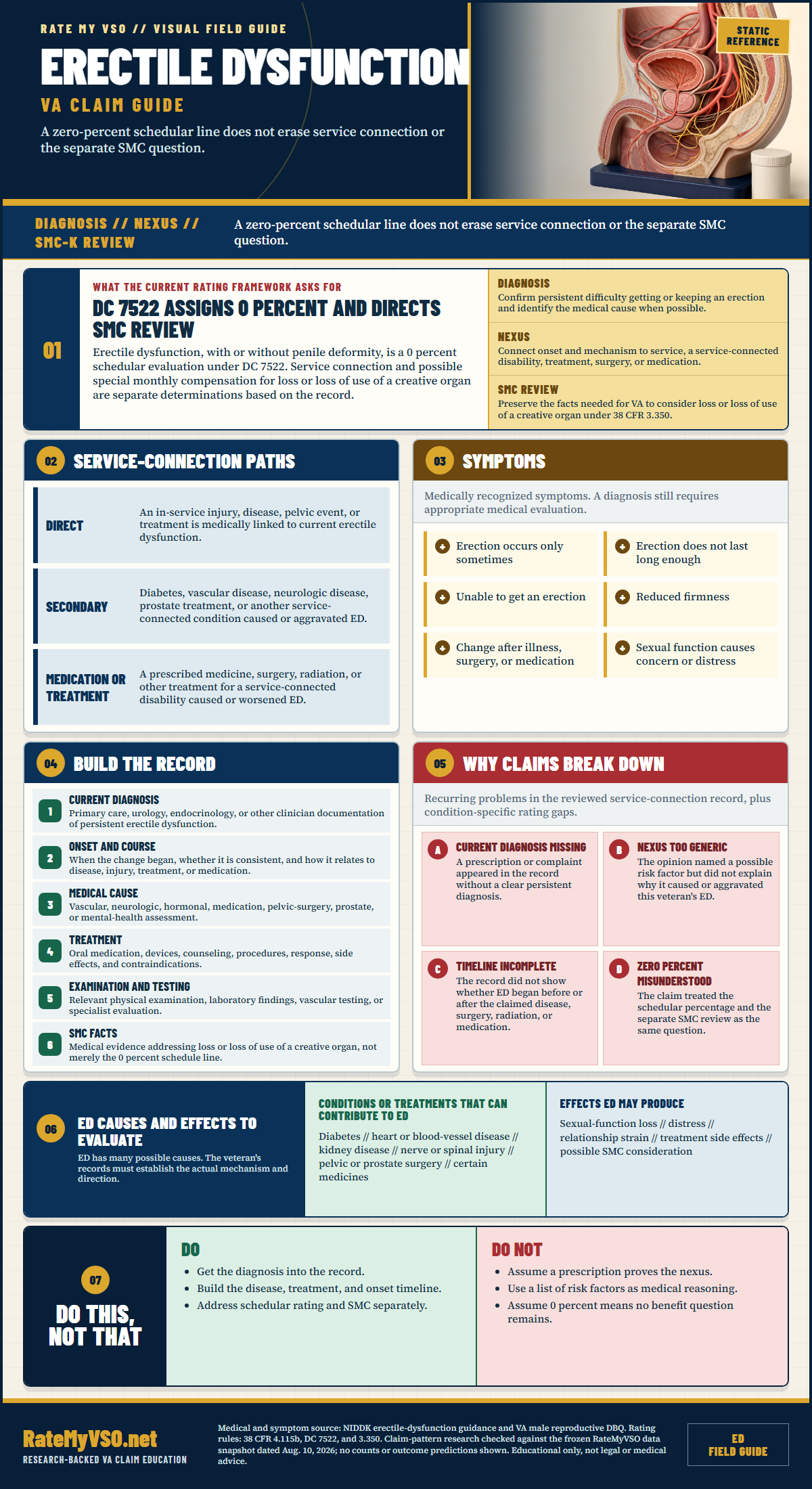 One-page guide: Erectile Dysfunction Claims in One Page
Erectile-dysfunction guide covering DC 7522, the separate SMC review, direct and secondary service paths, symptoms, medical causes, onset and treatment evidence, and common claim gaps. Opens the full-size chart, free to save or print.
One-page guide: Erectile Dysfunction Claims in One Page
Erectile-dysfunction guide covering DC 7522, the separate SMC review, direct and secondary service paths, symptoms, medical causes, onset and treatment evidence, and common claim gaps. Opens the full-size chart, free to save or print.
Start with the essentials
- Record the diagnosis and history privately and precisely
Note the diagnosed condition, onset, treatment, and changes over time. Include only the personal detail needed for your own preparation. Go to this part
- Describe function and treatment effects
Organize symptoms, frequency, devices or materials, medicines, procedures, and practical effects without assigning yourself a rating. Go to this part
- Consider direct and secondary pathways separately
List the service history, other conditions, medicines, or treatment that may be relevant, then take medical-link questions to a clinician. Go to this part
A short take-away plus blank working pages. The full explanations, research, charts and sources are all still on this page, below.
Prepare: your own working pages
Optional. These are your own notes, in your own words. They are not a VA form, they are not sent to the VA, and nothing here is a medical finding or a prediction about your claim.
Sign in or create an account to save your answers and come back to them later. You can fill these in and print them without an account.
Condition and treatment history
Symptoms and functional effects
Connection and examination questions
Records and unanswered questions
Decision-letter reading sheet
Understand the claim
What the VA Counts as Erectile Dysfunction
For VA purposes, erectile dysfunction is the loss of erectile power, meaning the inability to achieve or maintain an erection sufficient for satisfactory function. It is rated under 38 CFR 4.115b, diagnostic code 7522. The current title of the code is "Erectile dysfunction, with or without penile deformity," language set by the 2021 genitourinary rewrite.
Loss of erectile power
The inability to achieve or maintain an erection. This is the core finding. Under the current rules it is rated 0 percent on the schedule, and it points the rater to special monthly compensation for loss of use of a creative organ.
Penile deformity
The Note to DC 7522 states that a disease or traumatic injury of the penis resulting in scarring or deformity shall be rated under diagnostic code 7522. Actual physical deformity is the only path to a percentage above 0, and only when rated by analogy.
ICD-10 Diagnosis Codes
The ICD-10 diagnosis codes most commonly used for DC 7522, Erectile dysfunction, with or without penile deformity (the kind on your medical records, decision letter, or C&P exam report). VA rates the disability and its residuals, not the diagnosis itself, so coding can vary.
How Service Connection Works, At a High Level
Before getting into the SMC mechanics and the specific pathways below, it helps to understand the three things every ED claim ultimately has to show. This is the same basic test that applies to any VA disability claim, just applied to this condition.
- A current diagnosis. A doctor must confirm a current diagnosis of erectile dysfunction. This is the first thing the Board checks, and a missing diagnosis is a common reason ED claims are denied outright.
- A cause connected to service. Either an event or injury during service, or, far more common for ED, a disability the VA has already service connected, such as prostate cancer, PTSD, diabetes, hypertension, or heart disease.
- A medical nexus. A doctor's opinion explaining how service, or the service-connected condition, caused or worsened the ED (38 CFR 3.310). A clear, well-reasoned opinion is consistently what tips these cases toward a grant.
How Erectile Dysfunction Gets Service Connected
ED reaches service connection under more than one legal theory, and we found they do not fare equally:
Direct service connection
Direct service connection for ED requires a current diagnosis, an in-service event, injury, or disease, and a medical nexus linking the two. Direct ED claims are uncommon, and the Board's data shows why: among classified service-connection denials for DC 7522, the dominant dispositive reason is a missing nexus. The missing medical link to service is the single largest reason these claims are denied.
Presumptive pathways
There is no direct toxic-exposure presumptive for erectile dysfunction itself. ED is not on any Agent Orange, burn pit, PACT Act, or Camp Lejeune presumptive list. According to VA.gov's Agent Orange page, the listed conditions include "Diabetes mellitus type 2," not ED.
Where presumptives matter for ED is indirectly. ED routinely reaches service connection by riding on a presumptive primary condition. A veteran can get Type 2 diabetes service connected presumptively (it is an Agent Orange presumptive), then claim ED as secondary to that diabetes. Hypertension (added as an Agent Orange presumptive under the PACT Act) and ischemic or coronary heart disease are additional presumptive primaries that frequently cause ED. See the Agent Orange presumptive page.
Secondary service connection (the main route) (38 CFR 3.310)
Secondary service connection is by far the most common way ED is established. Under 38 CFR 3.310, a secondary claim requires a current diagnosis of ED and a medical nexus opinion stating that a service-connected condition (or a medication taken for it) caused or aggravated the ED. Secondary service connection covers a condition that is caused by a service-connected disability, and also one that is only worsened, or aggravated, by it, the same aggravation prong that applies to any secondary claim. We found the major pathways in the Board's published decisions, ordered by volume. See our Secondary Service Connection Guide.
Established secondary pathways include:
Secondary to diabetes (DC 7913)
The single largest pathway. ED claimed as secondary to diabetes appears 917 times in published Board decisions, granted at approximately 50 percent (n = 917). Vascular and nerve damage from diabetes are the recognized mechanism. See the diabetes claims guide.
Secondary to genitourinary cancer, including prostate cancer (DC 7528)
294 appeals, granted at approximately 65 percent (n = 294). ED is a well-recognized result of prostate cancer treatment, where a doctor explains the connection between the treatment (such as surgery or radiation) and the loss of erectile power.
Secondary to hypertension (DC 7101)
256 appeals, granted at approximately 59 percent (n = 256). Both the vascular effects of hypertension itself and blood-pressure medications are recognized mechanisms.
Secondary to coronary artery disease (DC 7005)
78 appeals, granted at approximately 60 percent (n = 78). See the CAD claims guide.
Secondary to depression (DC 9434 / 9435), often via medication side effects
Major depressive disorder (DC 9434): 59 appeals, granted at approximately 79 percent (n = 59). Unspecified depressive disorder (DC 9435): 52 appeals, granted at approximately 56 percent (n = 52). Many drugs prescribed for depression list ED as a known side effect, and this pathway is frequently argued on the medication-side-effect theory rather than direct causation.
Secondary to PTSD (DC 9411)
The Board has recognized ED as secondary to service-connected PTSD, where a doctor explains how the chronic stress response and hypervigilance associated with PTSD can disrupt sexual function. This pathway is closely related to the depression and medication-side-effect pathways above, since PTSD medications carry some of the same known effects. See our PTSD Claims Guide and the deeper dive at Erectile Dysfunction Secondary to PTSD.
Secondary to chronic pain from service-connected musculoskeletal conditions
Chronic pain from a service-connected joint or musculoskeletal condition is a recognized, if less common, pathway. The Board has granted this theory where a doctor's opinion explained how the chronic pain, or medications used to manage it, affected erectile function. As with any secondary theory, the strength of the medical opinion, not the underlying diagnosis alone, is what tends to decide these claims.
The winning pattern across all of these pathways is consistent: a service-connected primary condition, plus a competent medical opinion tying the ED to that primary or to a medication taken for it. See secondary conditions and secondary vs aggravation.
What VA Looks For: Tests, Records, and Diagnostic Codes
Whether you are filing directly or secondary to another condition, the record VA actually reviews centers on a small set of documents and data points. Diagnostic tests do not change the 0 percent schedular percentage for ED itself, but they are essential to establishing the diagnosis, the nexus, and SMC-K eligibility. The detailed walkthrough of the exam and the DBQ is later in this guide.
- A written diagnosis: a doctor confirming a current diagnosis of erectile dysfunction, ideally with the onset and treatment history.
- The prescription or treatment record: PDE5 inhibitors, a vacuum device, injections, or an implant, which document the loss of erectile power and support the SMC-K referral.
- The diagnostic codes involved: DC 7522 for the ED itself, plus whatever code applies to the condition you're connecting it to, for example DC 7913 (diabetes), DC 7101 (hypertension), DC 7005 (coronary artery disease), DC 9434 (major depressive disorder), DC 9411 (PTSD), or DC 7528 (genitourinary cancer, including prostate cancer).
- The actual form the examiner fills out: the Male Reproductive Organ Conditions DBQ, discussed in more detail later in this guide.
Symptoms and rating
DC 7522 Rating Levels
The genitourinary schedule lists a single rating line for erectile dysfunction. There is no percentage ladder for severity of ED itself, the schedular value is fixed.
Go deeper: open the full erectile dysfunction breakdown- The 0% schedular line and the SMC-K cross-reference
- Evidence that has won at the Board
- Inside the rater's playbook: grant, denial, and remand rates
- Secondary condition map
Because the schedular rating is 0 percent, the value of an ED claim is the SMC-K add-on described above, not a percentage that raises your combined rating. The only way a percentage above 0 attaches to the genitals themselves is through actual penile deformity rated by analogy, described below.
When a separate percentage can apply (penile deformity by analogy)
The Note immediately following DC 7522 states that a disease or traumatic injury of the penis resulting in scarring or deformity shall be rated under diagnostic code 7522. Where there is documented physical deformity of the penis, raters have at times assigned a separate compensable evaluation (commonly cited at 20 to 30 percent) by analogy to an anatomically similar code, in addition to considering SMC-K. This requires objective deformity in the record. Loss of erectile power without deformity remains 0 percent schedular plus SMC-K. A 20 percent rating tied specifically to the pre-2021 "penis, deformity, with loss of erectile power" criterion is possible only under the older version of the rule, and only where there is a documented penile deformity such as Peyronie's disease, when the Board finds the older, more favorable rule applies to the facts of the claim.
| Rating | What it reflects |
|---|---|
| 0% | Erectile dysfunction, with or without penile deformity (the schedular line for ED). Footnote directs review for SMC-K under 38 CFR 3.350. |
| SMC-K | Flat statutory monthly add-on for loss of use of a creative organ under 38 U.S.C. 1114(k) / 38 CFR 3.350(a). Paid on top of the combined rating. |
| 20-30% | Possible only by analogy when there is documented physical penile deformity. Not available for loss of erectile power alone. |
Pyramiding and Rating Separately
The VA's pyramiding rules prevent paying twice for the same disability. For erectile dysfunction, pyramiding rarely becomes an issue, because the schedular rating is 0 percent and contributes nothing to the combined evaluation. The compensation, SMC-K, is a separate special monthly compensation amount layered on top of the combined rating rather than a percentage folded into it.
Two points follow from how the regulation is structured:
- The primary condition and the ED are rated separately: the underlying condition that caused the ED (diabetes, heart disease, depression, PTSD, and similar) is rated under its own diagnostic code. The ED is rated 0 percent under DC 7522, and SMC-K is considered on top. These are distinct lines, not double-counting.
- Penile deformity, if present, is the only ED-side percentage: where a separate compensable evaluation is assigned by analogy for documented physical deformity, it reflects the deformity, not the loss of erectile power, which is already captured by the 0 percent line and SMC-K.
The 0% Rating and SMC-K: Where the Compensation Actually Comes From
Under DC 7522, the schedular rating for erectile dysfunction is a fixed 0 percent. The reason a 0 percent diagnosis still matters is the cross-reference written into the regulation itself. Footnote 1 to the code states: "Review for entitlement to special monthly compensation under 3.350 of this chapter." The section-top note for the whole genitourinary table repeats the point: when a claim involves loss or loss of use of one or more creative organs, the rater must refer to 38 CFR 3.350 to determine whether the veteran may be entitled to special monthly compensation.
Erectile dysfunction is the classic loss-of-use-of-a-creative-organ scenario. Under 38 U.S.C. 1114(k) and 38 CFR 3.350(a), a veteran who, as a result of a service-connected disability, has loss or loss of use of a creative organ is entitled to special monthly compensation at level K, commonly called SMC-K.
What SMC-K is
A flat, statutory monthly dollar amount (approximately $139.87 per month in 2026). It is tax-free and is added on top of the combined schedular rating, even if the veteran is already at 100 percent. It does not change the underlying combined percentage. It is a separate amount layered above it.
How it is triggered
SMC-K is not automatic. The loss of erectile power must be tied to a service-connected disability. Adjudicators refer the file to 38 CFR 3.350 only when the record establishes that link. It can also stack: SMC-K is awarded per qualifying loss.
We analyzed the Board's published decisions and found how central SMC-K is to this condition. Erectile dysfunction appears as the underlying condition in 2,653 special monthly compensation claims, of which 785 were granted, 1,030 denied, and 330 remanded, an approximate grant rate of 43 percent (published BVA decisions, SMC dataset 2018 to 2026). Of those ED-driven SMC claims, the overwhelming majority, 1,930, were at level K. Across all SMC-K decisions, the most-cited evidence was the VA examination (about 4,103 citations), followed by a private medical opinion (about 1,199) and a lay statement (about 1,042).
Evidence and Board research
Evidence That Wins These Claims
The Board's published decisions for DC 7522 show a clear ordering of which evidence types are associated with the highest grant rates. The strongest single lever is a private nexus opinion.
- A current, written diagnosis: a doctor must confirm a current diagnosis of erectile dysfunction. This is the cornerstone of the claim (38 CFR 3.303), and grants consistently rest on a confirmed diagnosis in the file.
- A private nexus opinion: erectile dysfunction appeals are granted at a far higher rate when a private nexus opinion is in the file than without one. The private doctor opinions that won cases cited medical studies and fully explained how the service-connected condition led to ED, not just a bare conclusion. A nexus letter is a private opinion that goes further and explicitly states the service link, which is the largest single factor in the data. A well-reasoned private opinion has outweighed a VA opinion that addressed only part of the claim.
- Medical literature: literature describing the mechanism (for example, diabetes-related vascular damage causing ED) supports a secondary theory.
- The prescription record: documentation of treatment for ED, such as PDE5 inhibitors (for example, sildenafil or tadalafil), vacuum devices, or injections, is core evidence of loss of erectile power and supports the SMC-K determination.
- The primary condition workup: when ED is claimed as secondary, the file for the service-connected primary (for example, diabetes labs, a cardiovascular evaluation, or a medication list showing a drug with ED as a known side effect) helps establish the causal link.
- Naming the primary condition clearly: if your ED is linked to another service-connected condition, say so clearly in your claim and name that condition. A claim that simply lists "erectile dysfunction" with no stated theory of connection gives VA nothing to develop.
Evidence Cited in Published Erectile dysfunction Decisions
We analyzed 25,319 published Board decisions involving erectile dysfunction for condition-specific evidence, counting only case-specific mentions (boilerplate recitations excluded). "Favorable" is the share of decisions citing that evidence where every issue was granted or the outcome was mixed; the baseline across all these decisions is 62.4%. Evidence appearing in a decision does not mean it decided the case. Descriptive of the published record, not a prediction.
Bar length shows decisions citing the evidence.
Detected by phrase-reading the decision text with condition-specific vocabularies. Source: Board of Veterans' Appeals decisions, RateMyVSO analysis.
Why These Claims Get Denied
Beyond the general "no nexus" reason covered above, a few specific denial patterns show up often enough in the Board's published decisions to call out on their own.
- No current diagnosis of ED in the record. This is the most common reason ED claims are denied outright. Having a suspicion, or a history of the condition, is not the same as a doctor confirming a current diagnosis.
- The condition ED is tied to was never itself service connected. A secondary claim requires the primary condition to already be service connected. A claim that ties ED to a condition VA has not accepted, for example an unrelated neurological condition, fails at that first step regardless of how well the connection to that condition is otherwise documented.
- Toxic or burn-pit exposure argued alone. ED is generally not linked to toxic exposure as a standalone theory, so a toxic-exposure examination is not required for it by itself. A claim resting only on general toxic-exposure argument, with no qualifying exposure established and no medical opinion explaining a specific mechanism, is a weak claim.
- A bare form with no explanation. Simply listing erectile dysfunction on a claim form, with no statement and no supporting evidence, is not enough. Listing the condition is not itself evidence, and denials repeatedly note that the veteran offered no theory of connection and no lay statement.
- Declining to cooperate with the C&P exam. VA's duty to assist is not a one-way street. Where a veteran asks the examiner not to conduct the exam, the resulting finding of no diagnosis can sink the claim on its own.
Common Mistakes
Patterns the Board's decisions and the regulation make visible:
- Expecting a monetary percentage from 7522 itself: the schedular rating is a fixed 0 percent, so the diagnosis alone adds nothing to the combined rating. The compensation is SMC-K, which many veterans do not realize applies.
- Relying on an outdated "7522 = 20 percent" guide: that 20 percent "penis deformity with loss of erectile power" criterion was replaced effective November 14, 2021 (86 FR 54086). Current ED is 0 percent schedular plus SMC-K.
- Filing ED as a standalone direct claim with no in-service event and no nexus: the realistic path is usually secondary to a service-connected primary such as diabetes, hypertension, CAD, PTSD, or a mental-health condition. No-nexus is the number one dispositive denial reason for this code.
- Leaving out a private nexus opinion: grant rates in the data are far higher with a nexus opinion in the file than without it.
- Overlooking medication side effects: many prescribed drugs (for depression, PTSD, hypertension, and others) list ED as a side effect, a recognized secondary theory that is missed when a claim argues only direct causation.
- Assuming SMC-K is automatic: it requires the loss of erectile power to be tied to a service-connected disability. Adjudicators refer the file to 38 CFR 3.350 only when the record establishes that link.
- Missing the one-year appeal deadline. A veteran generally has one year to appeal a decision (38 CFR 20.203). Appeals filed well beyond that window, even where the veteran did not understand the process, are ordinarily dismissed as untimely.
Do's and Don'ts
A condensed version of everything above, in the order it actually matters when you sit down to build your file.
- Get a current, written diagnosis of erectile dysfunction from a doctor before you file.
- Identify every service-connected condition that could plausibly have caused or worsened your ED (diabetes, hypertension, heart disease, PTSD, depression, a medication, prostate or GU cancer treatment).
- Say clearly, in your claim, which service-connected condition you believe is connected, and name it.
- Get a private nexus opinion that explains its reasoning, cites your specific medical history, and addresses both causation and aggravation.
- Attend and fully cooperate with any VA examination, including the physical exam.
- Ask VA to consider special monthly compensation (SMC-K) for loss of use of a creative organ, do not assume the rater will catch it automatically.
- Note any penile deformity, such as Peyronie's disease, which can support a separate compensable rating.
- File your appeal within one year of the decision you disagree with.
- Don't assume DC 7522 pays a percentage on its own, it is fixed at 0 percent; the value is SMC-K.
- Don't rely on an outdated guide claiming "7522 = 20 percent," that rule ended November 14, 2021.
- Don't file ED as a standalone direct claim with no in-service event and no nexus opinion.
- Don't try to connect ED to a condition that is not itself service connected, the secondary theory fails at that first link.
- Don't expect toxic or burn-pit exposure by itself to connect the claim, ED isn't on any presumptive list.
- Don't leave your claim as a bare form with no theory of connection and no supporting statement.
- Don't decline to cooperate with the C&P exam, VA's duty to assist depends on your participation too.
- Don't wait past the one-year deadline to appeal a decision you disagree with.
Secondary relationships
Common Secondary Conditions
Secondary service connection runs in two directions. For erectile dysfunction, the high-value direction is what causes ED, because ED is almost always the downstream condition. The reverse direction (what ED itself causes) exists in the data but on much smaller numbers.
Conditions that cause ED (ED claimed as secondary to them)
This is the dominant direction and carries the larger samples. We found each bar is the published BVA grant rate for ED claimed secondary to that condition, with the number of decisions below it:
Prepare and take the next step
Quick Checklist Before You File
Bring these together before you submit anything.
- A current, written diagnosis of erectile dysfunction from a doctor.
- If your ED is linked to another service-connected condition, say so clearly and name that condition (diabetes, hypertension, CAD, PTSD, depression, a medication, prostate or GU cancer).
- A nexus opinion that explains, with reasoning, how service or your service-connected condition caused or worsened your ED.
- Attend and fully cooperate with any VA examination, including the physical exam.
- A request that VA consider special monthly compensation (SMC-K) for loss of use of a creative organ.
- Documentation of any penile deformity, such as Peyronie's disease, which can support a 20 to 30 percent rating by analogy.
- Your treatment and prescription history (PDE5 inhibitors, vacuum device, injections, or an implant).
For the mechanics of actually submitting the claim, see the Standard Claim Guide and the Fully Developed Claim Guide (filing with all your evidence up front can speed up the decision).
The Claims Process, Step by Step
Once you file, your claim moves through a series of hand-offs. Understanding who does what helps you know who to contact, and what to expect, at each stage.
- You file the claim. Directly with VA, through VA.gov, or with the help of an accredited representative.
- VA acknowledges the claim and assigns it for development. A Veteran Service Representative (VSR) is assigned to gather your service treatment records, VA and private medical records, and any other evidence needed.
- The VSR orders a Compensation & Pension (C&P) exam if one is needed. Not every claim requires one, but most ED claims do, especially secondary claims where a nexus opinion is required.
- The C&P exam is conducted. By a VA clinician or a contracted examiner, who completes the Male Reproductive Organ Conditions DBQ documenting the diagnosis and, where relevant, a nexus opinion.
- The file goes to a Rating Veteran Service Representative (RVSR), the "rater." The rater reviews the complete file, including the exam results, and decides whether service connection is warranted, and whether the file supports SMC-K.
- A senior reviewer may review the decision before it's finalized, depending on the complexity of the claim.
- VA issues the decision letter. This states whether the claim is granted or denied, the schedular rating, whether SMC-K was awarded, and the reasons behind the decision.
- If you disagree, you choose an appeal lane. Higher-Level Review, Supplemental Claim, or a Board appeal, covered later in this guide.
Who's who: VSO vs. VSR vs. Rater vs. C&P Examiner
Your VSO
An accredited representative from a veterans service organization, or an accredited attorney or claims agent. Not a VA employee. Helps you prepare, gather evidence, and file, and can represent you through an appeal. Has no authority to decide your claim.
VSR (Veteran Service Representative)
VA staff who "develops" your claim: requests records, schedules the C&P exam, and assembles the file. Does not decide the rating.
Rater (RVSR)
VA staff who reviews the completed file and makes the actual decision, service connection or denial, and whether SMC-K applies. This is the person whose judgment the decision letter reflects.
C&P Examiner
A VA clinician or a contracted medical examiner who conducts the exam and completes the DBQ. Documents findings and, where asked, a nexus opinion. Does not decide the claim.
For the full walkthrough of every stage with more detail, see Inside Your Claim and Claim Stages.
Diagnostic Tests and the DBQ
No laboratory test changes the schedular percentage for ED, which is fixed at 0 percent. Testing serves a different purpose: to confirm the diagnosis, establish the etiology and nexus, and support SMC-K eligibility for loss of use of a creative organ. The following appear in the VA's evaluation process:
- The C&P examination using the Male Reproductive Organ Conditions DBQ: the VA Disability Benefits Questionnaire that captures ED is VA Form 21-0960J-2, available from VA.gov. See the DBQ guide for how these forms work, including whether a private DBQ completed by your own doctor can be submitted instead of relying solely on a VA exam.
- Physical examination of the penis, testes, and prostate: the DBQ physical-exam section documents any deformity, atrophy, or abnormality.
- Medical history of onset, progression, etiology, and treatment response: response to oral PDE5 inhibitors (such as sildenafil or tadalafil), injections, a vacuum device, or an implant is used to establish loss of erectile power.
- Review of the primary condition workup: when ED is claimed as secondary, this includes items such as diabetes labs (fasting glucose or HbA1c), a cardiovascular evaluation, or a medication list documenting drugs with ED as a known side effect.
- The International Index of Erectile Function (IIEF): a validated 15-item symptom questionnaire sometimes used clinically to characterize severity. It is not required for the 0 percent schedular rating but can support documentation.
Before your C&P exam, bring a clear, specific account of your symptoms and be ready to fully cooperate with the physical exam, an exam the veteran declines to complete can result in a finding of no diagnosis. For a full walkthrough of what to expect and how to prepare, see the C&P Exam Prep Guide.
Reading Your Decision Letter, and What to Do If Denied
Your decision letter has two parts: a narrative section explaining the reasoning (often called "reasons and bases"), and a codesheet showing the schedular rating, whether SMC-K was awarded, the effective date, and the diagnostic code used. See the Reading Your Decision Letter Guide for how to find and interpret each part, or use the Letter Interpreter tool to upload your own letter and get a plain-English breakdown.
If your claim is denied, or the decision does not address SMC-K, you have three main lanes:
- Supplemental Claim: refile with new and relevant evidence, such as a new nexus opinion or a diagnosis that was missing before. See Supplemental Claim Guide.
- Higher-Level Review (HLR): a senior reviewer looks at the same evidence again for a difference of opinion, no new evidence is added. See HLR Guide.
- Board Appeal: your case goes to a Veterans Law Judge at the Board of Veterans' Appeals, with options for a direct review, an evidence docket, or a hearing. See Board Appeal Guide.
Not sure which lane fits your situation? See the Appeals decision guide for a side-by-side comparison of all three. Remember the one-year appeal deadline: appeals filed well past a year from the decision, without an extension, are ordinarily dismissed as untimely regardless of the reason for the delay.
After You Win: Rating, Effective Date, and Maintaining Your Grant
A grant is not always the end of the story. A number of published decisions involve veterans who already had ED service connected and were fighting over the rating or the effective date, not the underlying grant. A few lessons follow from those cases:
- The effective date is normally the date VA received your claim, or the date entitlement arose, whichever is later (38 CFR 3.400). An intent-to-file form (38 CFR 3.155) can move the date earlier if you file the full claim within one year of it.
- When ED is granted as secondary to another condition, its effective date is decided on its own and does not automatically match the date of the primary condition.
- Continuous pursuit of the same claim, without a break, can push the effective date back to the original claim, even years earlier.
- Maintaining your rating: keep your treatment consistent, and continue documenting your prescription or treatment history. This protects you if VA schedules a future reexamination, and supports an increased rating if your condition changes. See Protect Your Rating and Future Reexaminations for the specifics.
If a penile deformity develops or is newly documented after your initial grant, you can raise the deformity-by-analogy theory in a new or increased-rating claim. See the Rating Increase Guide.
References and related resources
Quick Reference Tables
Secondary Connection Pathways
| Primary Condition | Mechanism | Evidence Needed |
|---|---|---|
| Diabetes (DC 7913) | Vascular and nerve damage | Diagnosis + nexus opinion linking diabetes to ED |
| Genitourinary / prostate cancer (DC 7528) | Treatment effects (surgery, radiation) | Diagnosis + nexus opinion tying treatment to ED |
| Hypertension (DC 7101) | Vascular effects, or blood-pressure medication | Diagnosis + nexus opinion naming mechanism or medication |
| Coronary artery disease (DC 7005) | Vascular effects of heart disease | Diagnosis + cardiovascular workup + nexus opinion |
| Depression (DC 9434 / 9435) | Medication side effects or the condition itself | Diagnosis + medication list + nexus opinion |
| PTSD (DC 9411) | Chronic stress response, hypervigilance, or medication | Diagnosis + nexus opinion linking PTSD or its treatment to ED |
| Chronic pain / musculoskeletal condition | Medication effects or the physiological stress response to chronic pain | Diagnosis + nexus opinion naming the mechanism |
From Filing to Decision: Who Does What
| Role | Does | Decides your rating? |
|---|---|---|
| VSO / accredited representative | Helps prepare, gather evidence, and file; represents you on appeal | No |
| VSR | Develops the claim: orders records and the C&P exam | No |
| C&P Examiner | Conducts the exam, completes the DBQ, may give a nexus opinion | No / but has a strong impact |
| Rater (RVSR) | Reviews the full file and decides service connection and SMC-K | Yes |
Frequently Asked Questions
Does DC 7522 really pay 0 percent? I read that it is 20 percent.
What is SMC-K and how much is it?
Why is erectile dysfunction almost always a secondary claim?
Is erectile dysfunction an Agent Orange or PACT Act presumptive?
What evidence is associated with the best outcomes for an ED claim?
Can a medication for another condition cause a service-connected ED claim?
What happens if I don't cooperate with the C&P exam?
Sources
- 38 CFR 4.115b, DC 7522, erectile dysfunction
- 38 CFR 3.303, basic rules for service connection (a current disability, an in-service event, and a link between them)
- 38 CFR 3.310, secondary service connection (a condition caused or aggravated by a service-connected disability)
- 38 CFR 3.102 and 38 U.S.C. 5107(b), benefit of the doubt
- 38 U.S.C. 1110 and 38 U.S.C. 1131, basic service connection
- 38 CFR 3.350, special monthly compensation (SMC-K, loss of use of a creative organ), and 38 U.S.C. 1114(k)
- 38 CFR 3.400 and 38 U.S.C. 5110, effective dates
- 38 CFR 3.155, intent to file a claim
- 38 CFR 3.301 and 38 U.S.C. 105(a), line of duty and willful misconduct
- 38 CFR 20.203 and 38 CFR 3.109(b), deadline and extensions to appeal
- VA.gov, Agent Orange exposure and presumptive conditions
- Shedden v. Principi, 381 F.3d 1163 (Fed. Cir. 2004), the three-element test for service connection: a current disability, an in-service event or injury, and a nexus between them
- Williams v. Wilkie, Vet. App., addressing what counts as a "deformity" for rating erectile dysfunction by analogy under DC 7522
This guide draws on patterns observed across a set of published Board of Veterans' Appeals decisions on erectile dysfunction. Board decisions bind only the case they decide and do not set VA-wide policy, so these are patterns, not guarantees; individual outcomes depend on the facts of each claim. This guide is educational, not legal or medical advice, and not a prediction of any individual claim outcome. Rating criteria can change. Confirm current details in 38 CFR 4.115b and 38 CFR 3.350. For help with your own claim, talk to a VA-accredited representative.